



Summarize this blog post with:


In this article, you’ll learn why Ahrefs no longer has an affiliate program, what happened behind the scenes when they shut it down, and why that creates an opportunity for you. You’ll also find a step-by-step walkthrough of an alternative affiliate program that pays 30% recurring commissions — with no cap — and practical strategies to start earning from it right away.
Table of Contents
Does Ahrefs Have an Affiliate Program?
No. Ahrefs discontinued its affiliate program back in 2020 and has no plans to bring it back.
If you landed here after Googling “ahrefs affiliate program,” you’re not alone. Hundreds of marketers search for it every month, only to find outdated blog posts with dead referral links or sketchy third-party sites pretending the program still exists.
Here’s the short version: Ahrefs ran an affiliate program for several years. Affiliates earned recurring commissions for every paying customer they referred. It was one of the most popular programs in the SEO space — and then Ahrefs pulled the plug.
Their own blog post about it is brief. They cite two reasons:
-
Technical debt on the billing side. As their product evolved (new pricing tiers, add-ons, different payment processors), maintaining the affiliate tracking infrastructure became a headache.
-
Concentration of results. Only 3% of their affiliates generated 90% of the leads. The rest sent little to no traffic. Ahrefs decided it made more sense to negotiate individual sponsorship deals with top-performing partners instead of running a program open to everyone.
So the program was killed. If you stumble across old articles with Ahrefs referral links, those links are dead.
What This Means for You (and Why It’s Actually an Opportunity)
Here’s the thing most people miss: the demand for SEO tool affiliate programs didn’t disappear when Ahrefs ended theirs. It grew.
The SEO and digital marketing tools landscape has expanded dramatically since 2020. More businesses need analytics and optimization tools than ever. And with AI search engines like ChatGPT, Perplexity, Claude, and Gemini now driving measurable traffic to websites, a brand new category has opened up: AI search analytics.
This means affiliate marketers who pivoted away from SEO tool programs too early left money on the table. The products changed, and so did the earning potential.
What Makes a Great SaaS Affiliate Program?
Before jumping into alternatives, it helps to know what separates a great affiliate program from a mediocre one. Not all affiliate programs deserve your time. Here’s what to look for:
Recurring commissions over one-time payouts. A program that pays you once per referral forces you to constantly chase new leads. A program that pays you every month — for as long as your referral stays subscribed — lets your income compound. If you refer 10 customers this month at $30 each, you’re earning $300/month. Refer 10 more next month, and you’re at $600/month. That’s the power of recurring commissions.
No earnings cap. Some programs limit how much you can earn per month or per referral. Avoid these. The best programs let your earnings scale with your effort.
A product that solves a real problem. Affiliate marketing is much easier when you’re promoting something people already need. If the product solves a painful, specific problem — and the audience you’re targeting actively searches for solutions — your conversion rates will be higher and your content will feel less like a sales pitch.
Monthly payouts with a low threshold. Programs that hold your money for 60–90 days or set high minimum payout thresholds add unnecessary friction. Look for monthly payouts with a reasonable minimum (ideally $50 or less).
A growing market. Promoting a product in a shrinking category means you’re fighting for a smaller pie each year. Promoting something in a category that’s growing — like AI search optimization — means the audience is expanding even before you do anything.
Try This Instead: The Analyze AI Affiliate Program
Analyze AI is an AI search analytics platform that helps marketing teams track how their brand appears across AI answer engines like ChatGPT, Perplexity, Claude, Gemini, and Copilot — and ties that visibility to actual traffic, conversions, and revenue.
And unlike Ahrefs, Analyze AI has an active affiliate program designed to reward partners fairly over the long term.
Here’s how it works:
|
Feature |
Details |
|---|---|
|
Commission Rate |
30% recurring, every month |
|
Cookie Duration |
Standard tracking window |
|
Payout Frequency |
Monthly |
|
Minimum Payout |
$50 |
|
Earnings Cap |
None — unlimited |
|
Commission Lifetime |
As long as the customer stays subscribed |
|
Signup Process |
Free, takes under 2 minutes |
To put that in perspective: if you refer 20 customers who each stay subscribed for a year, that’s $7,200 in annual recurring affiliate income — from a single campaign. And because AI search analytics is a fast-growing category (Analyze AI reports 20% month-over-month growth), your referrals are joining a platform with strong retention.
How to Sign Up for the Analyze AI Affiliate Program
The process takes less than two minutes:
-
Go to the Analyze AI Affiliate Program page.
-
Click “Join Program” to open the partner registration form.
-
Fill in your name, email, and how you plan to promote the product (blog, YouTube, newsletter, etc.).
-
Once approved, you’ll get a unique referral link and access to a dashboard where you can track clicks, signups, and earnings in real time.
![[Screenshot: The Analyze AI affiliate signup page showing “Earn 30% Recurring Commission Forever” headline with the Join Program CTA button]](https://www.datocms-assets.com/164164/1774861841-blobid0.png?auto=format,compress&w=1248&fit=max)
That’s it. There’s no complex application review. No minimum traffic requirement. No exclusivity clause.
Why Promote Analyze AI Specifically?
There are plenty of SaaS affiliate programs out there. Here’s why this one is worth your attention:
The category is exploding. AI search traffic is becoming a meaningful revenue channel for companies. Our own data shows that AI citations across ChatGPT, Perplexity, and other platforms are growing month over month. Marketing teams that ignored this channel in 2024 are now scrambling to measure and optimize for it. Analyze AI is the platform they’re turning to.
The product sells itself once you show it. Analyze AI connects to Google Analytics 4, so prospects can instantly see how much AI-referred traffic they’re already getting — often without realizing it. That “aha moment” makes selling the tool much easier than pitching an abstract concept.
There’s very little competition among affiliates. Because AI search analytics is still a relatively new category, there aren’t hundreds of affiliates already flooding the SERPs with review content. If you start creating content now, you’ll have a first-mover advantage.
5 Ways to Promote Analyze AI and Earn Recurring Commissions
Signing up for an affiliate program is the easy part. Making money from it requires a strategy. Here are five proven content approaches that work specifically for promoting AI search analytics tools.
1. Write an Honest Product Review
Product reviews remain one of the highest-converting content formats for affiliate marketing. People who search for “[tool name] review” are already in buying mode — they just need confirmation that the product works.
Here’s what a strong Analyze AI review should cover:
Start with what the product does in one sentence. Analyze AI tracks where your brand appears in AI-generated answers and connects that visibility to real traffic and revenue data from GA4.
Show the dashboard. Screenshots are non-negotiable in review content. Walk readers through what they’d see when they log in for the first time.
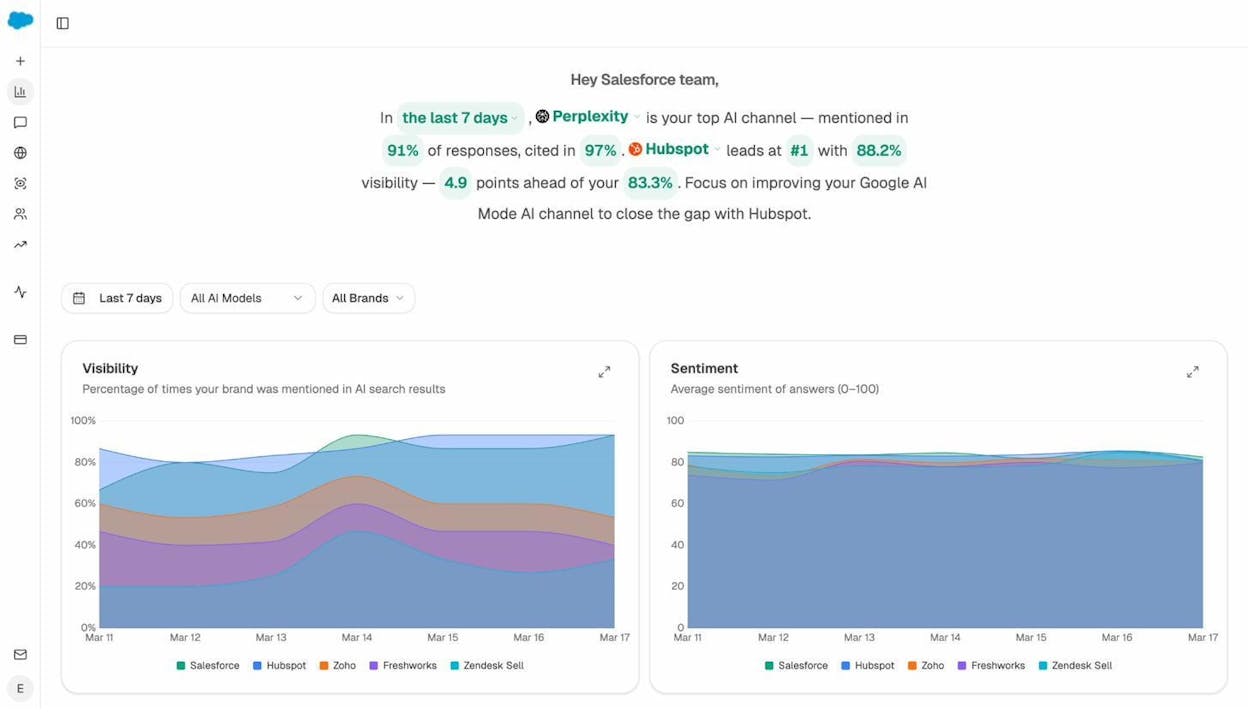
The overview dashboard gives you an instant snapshot: your visibility percentage across AI engines, how your sentiment compares to competitors, and which AI model is your strongest channel. Point out specific data points so readers understand the value before they sign up.
Cover the features that matter most. Don’t list every feature. Focus on the three or four things that would make someone switch from their current setup. For Analyze AI, these are:
-
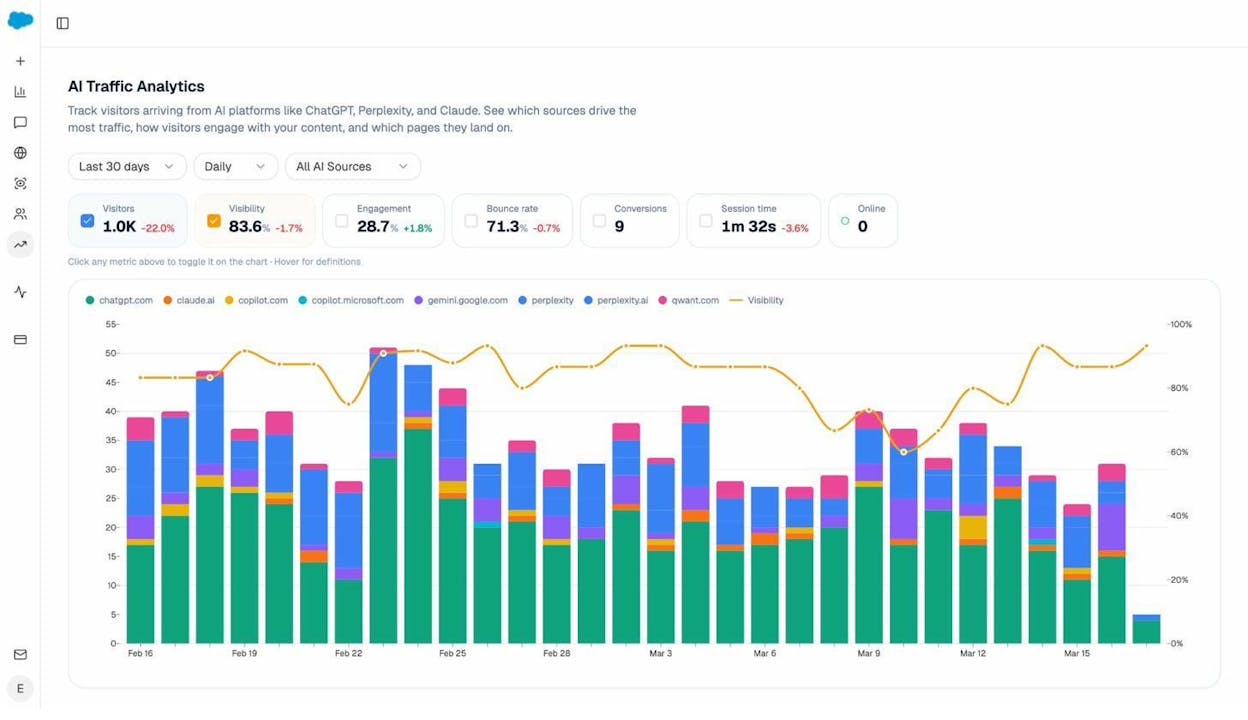
AI Traffic Analytics: See exactly how many visitors come from ChatGPT, Perplexity, Claude, Gemini, and other AI sources — broken down by engine, landing page, engagement rate, and conversions.
-
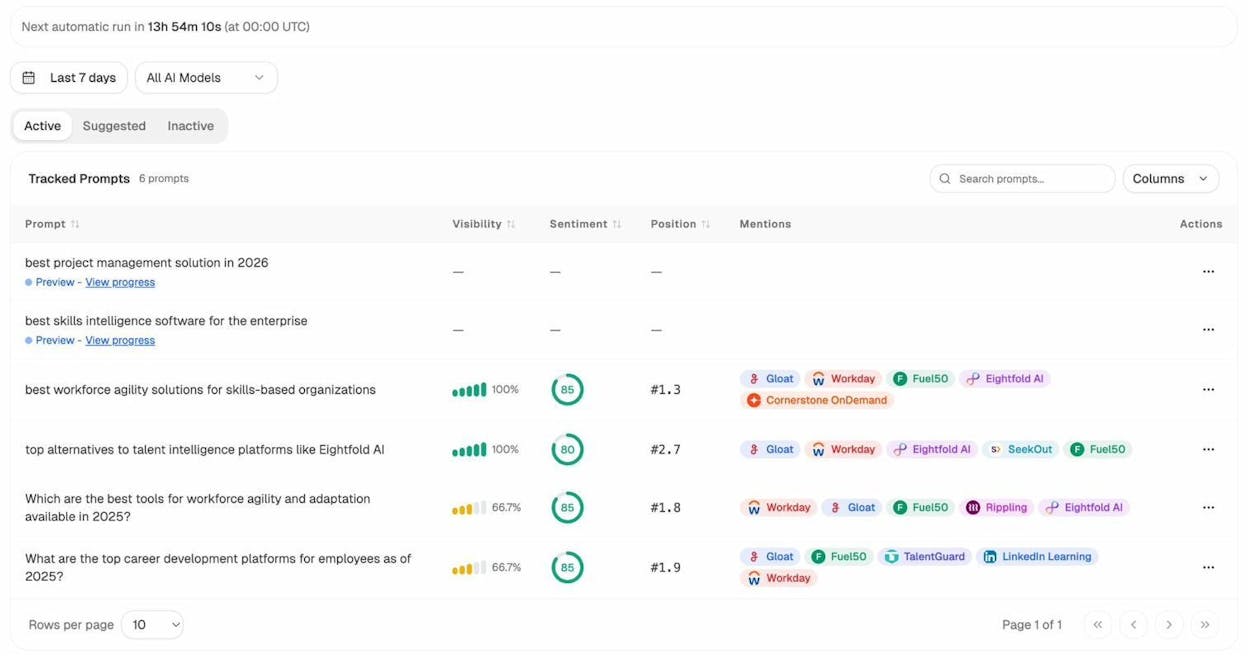
Prompt Tracking: Track specific prompts (like “best CRM for small businesses”) to see whether your brand appears in the AI-generated answer, what position it holds, and how sentiment trends over time.
-
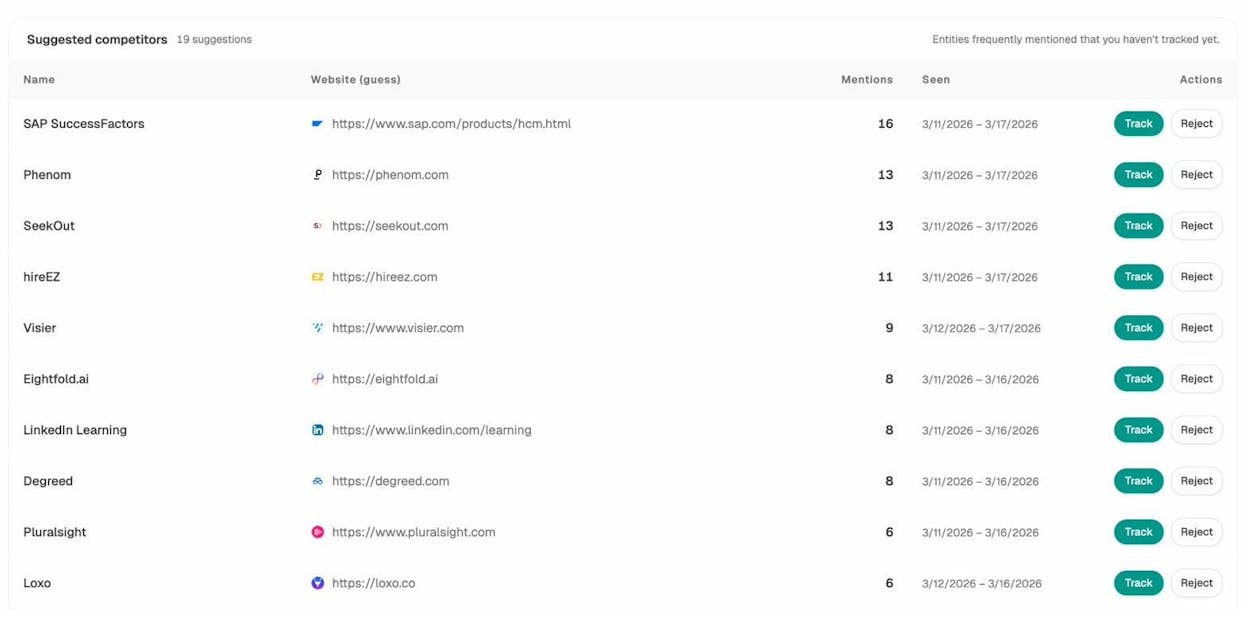
Competitor Intelligence: See which competitors appear alongside your brand in AI answers, how often they’re mentioned, and where they win prompts you don’t.
-
Citation Analytics: Identify which of your pages AI models actually cite — and which external sources they pull from instead.
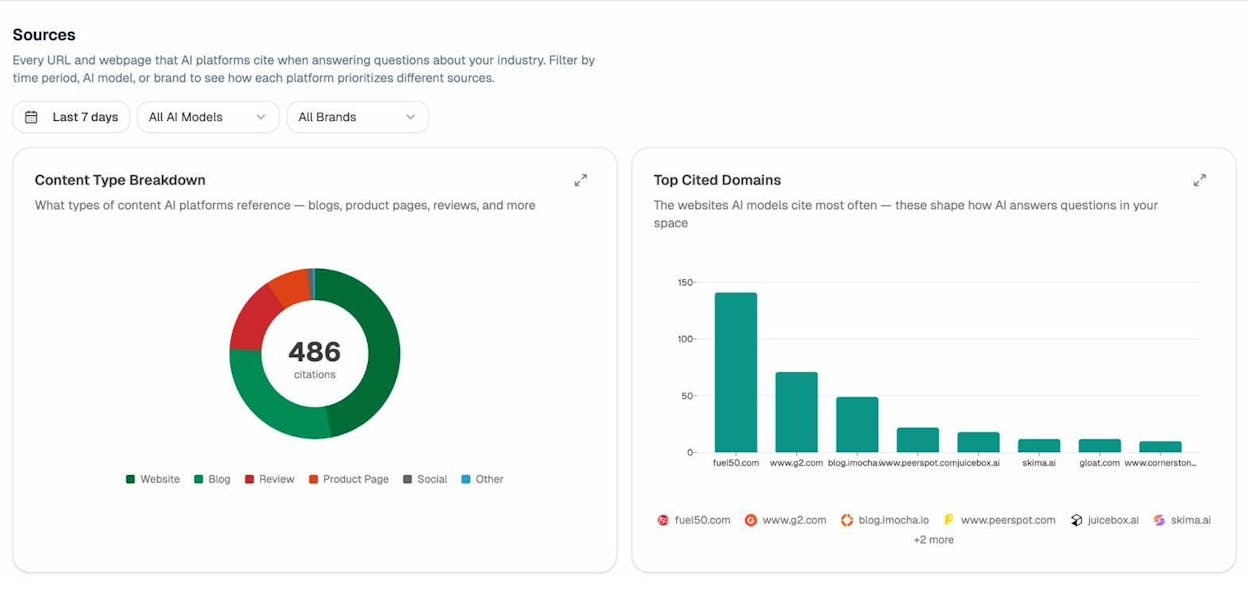
Be honest about limitations. Credibility is what separates a review that converts from one that gets ignored. If there’s a learning curve, say so. If pricing is higher than a basic tool, explain what you get for it. Readers trust reviewers who don’t sugarcoat everything.
End with a verdict and your affiliate link. A clear recommendation (“If you’re already running content marketing and want to measure whether AI search is driving results, Analyze AI is the fastest way to find out”) works better than a generic “click here to try it.”
2. Create Comparison Content
Comparison posts target people who are further along in their buying decision. They’ve narrowed their options to two or three tools and want to know which one is right for them.
Effective comparison angles for Analyze AI include:
-
“Analyze AI vs. [GEO competitor]: Which One Actually Measures AI Traffic?”
-
“5 Alternatives to [Tool Name] for AI Search Analytics”
-
“Best AI Visibility Tools for Marketing Teams in 2026”
Analyze AI already has comparison pages on their site that you can reference for positioning:
When writing comparison content, use a consistent evaluation framework. Compare products on the same criteria (pricing, features, ease of use, data accuracy) so readers can make a clear decision. And always include screenshots of both products side by side — not just descriptions.
![[Screenshot: Side-by-side view of Analyze AI’s Competitor Overview screen showing your brand vs. rivals with visibility share data]](https://www.datocms-assets.com/164164/1774861860-blobid6.png?auto=format,compress&w=1248&fit=max)
3. Build Tutorials Around AI Search Analytics
Tutorial content attracts people who are trying to solve a specific problem. Instead of selling the tool directly, you teach them how to do something — and the tool becomes a natural part of the solution.
Tutorial topics that work well:
“How to Track AI-Referred Traffic to Your Website” Walk readers through connecting GA4 to Analyze AI, then show them how to see which AI engines are sending traffic, which pages receive it, and which content converts.
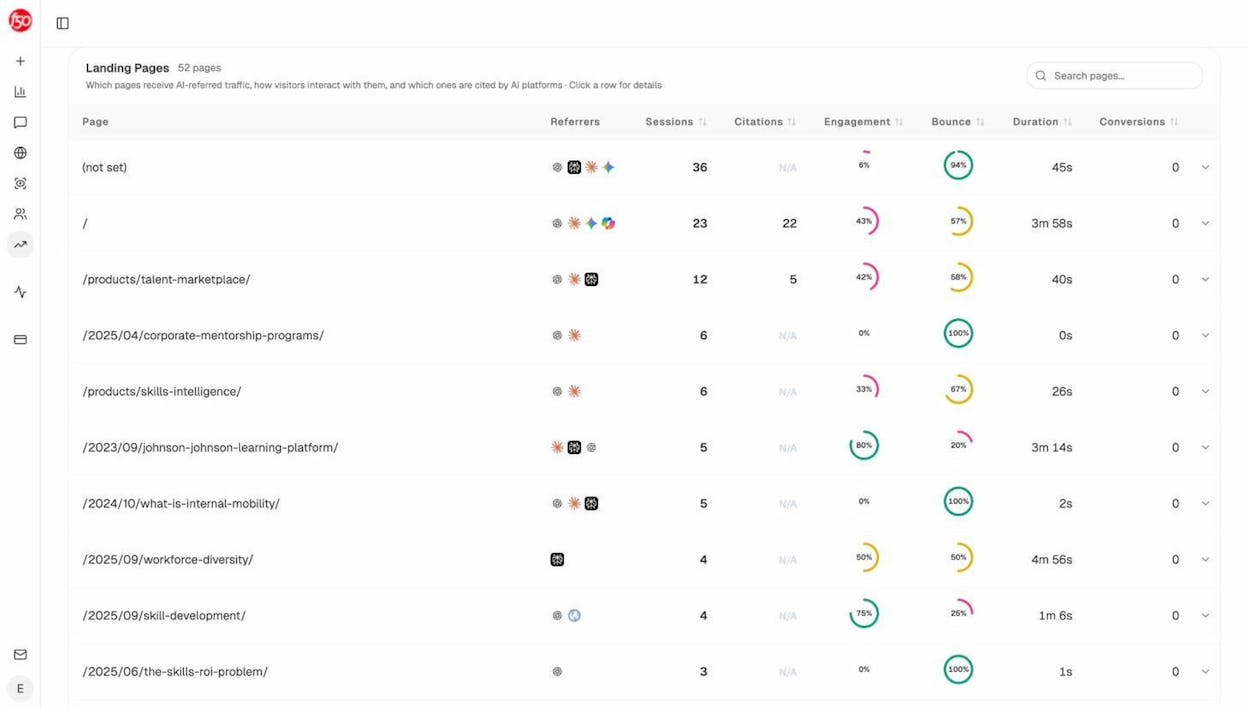
This screenshot shows the Landing Pages report inside Analyze AI. Readers can see exactly which URLs receive AI traffic, how many sessions each page gets, which AI engines referred that traffic, and whether visitors actually engage (engagement rate, session duration, conversions). This is the kind of data most marketers don’t even know exists.
“How to Find Out if ChatGPT Recommends Your Brand” Show readers how to set up prompt tracking in Analyze AI. Walk them through adding industry-relevant prompts, scheduling daily runs, and interpreting the visibility and sentiment scores.
“How to See Which Competitors AI Models Recommend Instead of You” Use Analyze AI’s competitor features to show readers where rivals are winning prompts they aren’t. This is a particularly powerful tutorial because it reveals blind spots most marketers didn’t know they had.
Each tutorial should be detailed enough that someone could follow along step by step, with screenshots marking every key action. The more specific you are, the more the reader trusts your content — and the more likely they are to sign up through your link.
4. Target AI Search–Related Keywords
Here’s where traditional SEO knowledge and AI search awareness intersect.
People are actively searching for information about how AI search works, how to optimize for it, and which tools help with it. These keywords represent a growing search category with relatively low competition compared to established SEO terms.
Some keyword clusters worth targeting:
-
“how to track AI traffic to my website”
-
“does ChatGPT drive traffic”
-
“AI search optimization tools”
-
“generative engine optimization”
-
“how to appear in ChatGPT answers”
-
“Perplexity AI SEO”
You can find these keywords using free tools like Analyze AI’s Keyword Generator or the YouTube Keyword Tool if you’re creating video content.
The strategy here is straightforward: write the most helpful, most detailed article on the topic. If you’re writing about how to appear in ChatGPT answers, make it a genuine tutorial — not a 500-word overview. Include real examples, explain the mechanics (how LLMs pull citations, what content formats they prefer), and then show how Analyze AI lets you measure whether your efforts are working.
This is standard SEO content strategy, applied to a new category. The fundamentals haven’t changed: find what people search for, create the best answer, and let the content work for you over time.
5. Leverage AI Search as a Distribution Channel (Not Just a Topic)
This is the strategy most affiliate marketers haven’t caught onto yet.
Traditional affiliate marketing relies heavily on Google organic traffic: you write a review, rank it on Google, and earn commissions from the visitors who click through. That playbook still works, but there’s now a second lane.
AI answer engines like ChatGPT, Perplexity, and Gemini are generating answers to questions your target audience is asking — and they cite sources. If your blog post, review, or tutorial gets cited by an AI model, you receive traffic from a completely new channel.
How do you know if it’s working? You use the product you’re promoting.
With Analyze AI, you can:
-
Track which of your affiliate content pages receive AI-referred traffic. Open the AI Traffic Analytics landing pages report and filter by your review or tutorial URLs.
-
See which AI engines send the most visitors. Maybe ChatGPT sends the most traffic but Perplexity visitors convert at a higher rate. That tells you where to focus your optimization efforts.
-
Monitor the prompts where your content appears. Set up prompt tracking for queries related to the products you’re promoting. If you’re writing an “Analyze AI review,” track the prompt “best AI search analytics tool” and see whether your page gets cited.
This creates a positive feedback loop: you promote the product, use it to measure your own performance, and share those results as proof that the tool works — which makes your promotional content even more convincing.
Why AI Search Analytics Is a Growing Affiliate Niche
If you’ve been in affiliate marketing for a while, you know that timing matters. Getting into a niche early — before it’s saturated — is one of the biggest advantages you can have.
AI search analytics is at that inflection point right now. Here’s why:
More AI-referred traffic exists than most companies realize. Many marketing teams still don’t track AI referrals separately from organic search. When they finally install proper tracking (which Analyze AI does via GA4 integration), they discover they’ve been receiving AI traffic for months without knowing it. That discovery moment is what drives signups.
Enterprise and mid-market budgets are shifting. Companies that spent their entire search budget on traditional SEO tools are now allocating a portion to AI search measurement. According to our analysis of 83,670 AI citations, the volume of sources AI models reference is growing — and so is the number of companies trying to influence those citations.
SEO is evolving, not dying. This is a critical point. You might see headlines claiming “SEO is dead” or “GEO replaces SEO.” Neither is true. What’s happening is that search is expanding from ten blue links to multi-modal, prompt-shaped answers. The fundamentals of good content — depth, originality, structure, and usefulness — still determine visibility. What’s changed is where that visibility needs to be legible: not just to crawlers, but to AI models and the people asking them questions.
This means the audience for AI search analytics tools is growing in two directions: companies that are new to AI search optimization, and companies that already do SEO and want to add AI search as a complementary channel. Both are strong prospects for an Analyze AI referral.
How to Track Whether AI Models Recommend the Products You Promote
This section is specifically for affiliate marketers who want to go beyond traditional SEO tactics.
Here’s a scenario: you’ve written a detailed review of a software product. It ranks on page one of Google. But you want to know — does ChatGPT recommend this product when someone asks?
You can answer that question with Analyze AI’s prompt tracking.
Step 1: Set up prompts that match buyer intent. Think about the questions a potential buyer would ask an AI. For example: “What’s the best AI search analytics tool?” or “How do I track ChatGPT traffic to my website?” Add these as tracked prompts in your Analyze AI dashboard.
![[Screenshot: Adding a new prompt to track in Analyze AI’s Prompts interface, showing the Active tab with prompt input]](https://www.datocms-assets.com/164164/1774861867-blobid8.png?auto=format,compress&w=1248&fit=max)
Step 2: Schedule daily runs and monitor results. Analyze AI automatically runs your prompts across ChatGPT, Perplexity, Claude, Gemini, and other models on a daily schedule. Each run tells you whether the product (or your review article) was mentioned, cited, or recommended.
Step 3: Check which sources get cited. The Sources tab shows you which domains and URLs AI models reference most frequently when answering questions in your niche. If your competitor’s blog is getting cited and yours isn’t, you know exactly where to focus your content improvements.
Step 4: Double down on what works. If your tutorial on “how to track ChatGPT traffic” is getting cited by Perplexity but not by ChatGPT, investigate why. Look at which sources ChatGPT prefers, what format those sources use, and adapt your content accordingly. Analyze AI’s citation analytics make this kind of iterative improvement possible.
This approach — using the product you promote to improve your own affiliate content — is what sets apart affiliate marketers who earn consistently from those who publish one review and hope for the best.
7 Tips to Maximize Your Affiliate Earnings with Analyze AI
Once you’ve started promoting, these tactics will help you increase conversions and grow your recurring revenue:
1. Lead with the GA4 integration angle. The number one thing that grabs a prospect’s attention is seeing their own AI traffic data. Encourage readers to connect GA4 and see what they’ve been missing. Once they see the numbers, they’re much more likely to subscribe.
2. Use real screenshots, not generic mockups. Every screenshot in your content should show real data (anonymized if needed). Generic product shots don’t build trust. Detailed screenshots of actual dashboards do.
3. Write for people who already run SEO. The ideal Analyze AI customer isn’t starting from zero. They’re already doing content marketing and SEO — and they want to add AI search as another organic channel. Speak to that audience. Frame Analyze AI as the next layer in their existing stack, not a replacement.
4. Embed your affiliate link in tutorials, not just reviews. A link at the bottom of a “how to track AI traffic” tutorial often converts better than a link in a generic review. The reader is in implementation mode. They want the tool now.
5. Create content for YouTube too. Video walkthroughs of the Analyze AI dashboard perform well because the product is visual. Showing a live dashboard on screen — visitors from ChatGPT, prompt tracking results, competitor data — is more compelling than writing about it. Use the YouTube Keyword Tool to find video topics worth targeting.
6. Update your content quarterly. AI search evolves fast. New AI models launch, tracking capabilities improve, and the volume of AI-referred traffic changes. Refreshing your articles with updated screenshots and data keeps them ranking and converting.
7. Build an email list around AI search topics. Email lets you promote new Analyze AI features, share updated tutorials, and keep your affiliate link in front of the same audience over time. Even a small, targeted list of 500 marketers interested in AI search analytics can generate meaningful affiliate revenue.
Frequently Asked Questions
Can I still find working Ahrefs affiliate links?
No. All Ahrefs affiliate links are inactive. Any site claiming to offer an active Ahrefs affiliate link is either outdated or misleading.
Does Ahrefs have a referral or partner program instead?
Ahrefs does selective, private sponsorship deals with high-profile creators and influencers. There’s no open program you can apply to. If you’re interested, you’d need to reach out to their partnerships team directly — but they’ve stated publicly that they have no plans to relaunch a general affiliate program.
How much can I earn with the Analyze AI affiliate program?
There’s no cap. You earn 30% recurring commission on every referred customer for as long as they remain subscribed. If you refer 20 customers at $100/month plans, that’s $600/month in passive recurring income ($7,200/year). Refer 50 customers and you’re at $1,500/month ($18,000/year).
What’s the best type of content for promoting Analyze AI?
Product reviews, comparison posts, and step-by-step tutorials have the highest conversion rates. Focus on showing the product in action — screenshots of the dashboard, specific use cases, real data insights — rather than listing features abstractly.
Do I need to be an Analyze AI customer to promote it?
While you don’t technically need a paid account to become an affiliate, it helps significantly. Using the product yourself lets you create more authentic, detailed content — and readers can tell the difference between someone who’s used a tool and someone who’s writing from a press release.
What if I already promote other SEO tools?
That’s actually ideal. Many affiliate marketers promote a stack of complementary tools. Analyze AI isn’t a replacement for SEO tools — it’s an addition. Your audience that’s already using traditional SEO platforms is exactly the audience that would benefit from adding AI search analytics.
Start Earning from a Program That Actually Exists
Ahrefs had a good affiliate program. But it’s gone, and it’s not coming back.
The demand for SEO and AI search tool recommendations hasn’t gone anywhere. If anything, it’s grown. Marketers are actively searching for tools to help them navigate a landscape where AI answer engines sit alongside traditional search results — and they need guidance on what to use.
The Analyze AI affiliate program pays 30% recurring commission with no cap, supports a product in one of the fastest-growing martech categories, and is open to anyone willing to create useful content.

Ernest

Ibrahim


