



Summarize this blog post with:


The car business is unusual. People search locally before they ever type a brand name. Inventory turns over weekly. A single dealership runs four businesses under one roof (sales, service, parts, financing). And buyers spend weeks comparing models before they ever visit a lot. SEO for an automotive site has to account for all of it, and now it has to account for ChatGPT, Perplexity, and Google’s AI Overviews too, where shoppers ask “what’s the most reliable used SUV under $25k near me” and skip the blue links entirely.
In this article, you’ll learn how to build organic visibility for an automotive business across Google and AI search engines. You’ll see how to lock down your local presence, target the right keywords for car shoppers and service customers, build the page types that actually convert, fix the technical issues that hold most dealership and repair shop sites back, and track the work in a way that ties back to leads and revenue.
Table of Contents
What makes automotive SEO different
Automotive SEO gets your dealership, repair shop, parts store, or auto brand to show up when people search for cars or auto services. The basics are the same as any SEO. Five things make it harder.
-
Local intent dominates. Most automotive searches have a local angle even when shoppers don’t type “near me.” Google reads “used Forester” as a near-me search and serves a map pack. Your site has to compete inside that map pack, not just below it.
-
Inventory is a moving target. Cars sell, new ones come in, prices shift weekly. The catalogue you ranked yesterday isn’t the one you have today. Setups that work for a clothing store fall apart on a car lot.
-
You’re running multiple businesses. Sales, service, parts, and financing each attract different searchers with different intents. Treating them as one site is the fastest way to rank for nothing.
-
Trust is the bottleneck. Buyers read reviews, ask Reddit, watch YouTube walk-arounds, and check competitor lots before they call. Your visibility has to compound across those surfaces.
-
Franchise rules cut both ways. OEMs hand franchise dealers a pre-built site with limited edit access. That cuts your optimisation surface but lets you legally use the manufacturer’s brand in URLs and titles, a real advantage for queries like “used Toyota Tacoma”.
![[Screenshot of a Google Map Pack for “used Forester” showing local dealerships ranking with location, hours, and review counts]](https://www.datocms-assets.com/164164/1778178081-blobid1.jpg?auto=format,compress&w=1248&fit=max)
The payoff is worth it. A page that ranks for “BMW service Austin” earns you customers every month for years at no incremental cost. A paid ad costs you the same on day 365 as day 1. In a business with ongoing service revenue, that compounding matters.
Lock down your local presence
For most automotive businesses, local SEO matters more than anything else. If you don’t show up in Google’s map pack and local results for shoppers in your area, the rest barely matters. It’s also where most dealerships and repair shops can move the needle in 30 days, not six months.### Give every location its own page and Google Business Profile
Google treats each physical location as a separate business. Each one needs its own optimised landing page and claimed Google Business Profile. The page should have unique content (not a copy-pasted template with the city name swapped), a local phone number, a Google Map embed, photos of that specific lot and team, and reviews from that location.
![[Screenshot of two location pages from a multi-location dealership chain showing the same template filled with location-specific NAP, photos, and reviews]](https://www.datocms-assets.com/164164/1778178092-blobid2.png?auto=format,compress&w=1248&fit=max)
Christian Brothers Automotive is a clean reference. Dozens of locations, each with its own landing page and Google Business Profile. Identical layout, unique content.
Get your inventory into Google Vehicle Listings
If you sell cars, this is the highest-leverage move on the list. Google’s free Vehicle Listings program feeds your live inventory into Google Search, Maps, and the Cars for Sale tab. It’s one of the few industry-specific surfaces Google gives away, and most independent dealers don’t use it. Set it up.
![[Screenshot of Google Vehicle Listings appearing inline in a “cars for sale” Google search]](https://www.datocms-assets.com/164164/1778178092-blobid3.png?auto=format,compress&w=1248&fit=max)
Build NAP consistency across directories
Get listed on Cars.com, Edmunds, AutoTrader, CarGurus, and the local directories that matter in your city (Yelp, BBB, your Chamber of Commerce). These directories rank for shopper queries, send referral traffic, and strengthen your local ranking signals when your name, address, and phone (NAP) stay consistent across them. The fastest audit is a once-a-year sweep with Whitespark or BrightLocal.
Treat reviews as a ranking factor, because they are
Google’s local algorithm has three pillars. Relevance, distance, and prominence. Review count and rating sit inside prominence. Reviews do two jobs at once. They move you up the map pack, and they close the customer who already found you.
Four things actually move review counts:
-
Send a review request by SMS the same day a customer picks up their car or finishes service. Same-day requests convert several times better than next-week ones.
-
Respond to every review, positive or negative, within 48 hours.
-
Track review velocity per location, not total count. A location with 200 reviews and none new in six months reads as stale.
-
Surface your best reviews on your own location pages with Review schema markup so they can show up as rich results.
Target the right automotive keywords
Keyword targeting connects your pages to actual demand. For automotive, that demand splits into four buckets, each one serving a different stage of the buyer journey.
Before you build a list, do this. Open Analyze AI’s free keyword generator, enter a seed term (“used Toyota Camry”, “brake repair”, “Honda lease”), and pull the suggestions. Then filter by intent, search volume, and difficulty using our free keyword difficulty checker.
![[Screenshot of a keyword generator tool showing suggestions and difficulty scores for “used Toyota Camry”]](https://www.datocms-assets.com/164164/1778178098-blobid4.png?auto=format,compress&w=1248&fit=max)
The four keyword types you’ll work with, in roughly the order they show up in a buyer’s journey:
|
Keyword type |
What the searcher wants |
Examples |
Best page type |
|---|---|---|---|
|
Informational |
Education |
“is a CVT transmission reliable”, “how often to replace brake pads” |
Blog post, guide |
|
Commercial |
Comparing options |
“best used SUV under 25k”, “Honda CR-V vs RAV4” |
Comparison page, hub |
|
Transactional |
Ready to act |
“schedule oil change Austin”, “buy used Mazda CX-5 near me” |
Service page, inventory page |
|
Local |
Near-me intent |
“Toyota dealer Houston”, “BMW service near me” |
Location page, GBP listing |
Two patterns matter more than the rest.
The “specials” problem. Independent dealerships almost always lose lease and specials keywords to aggregators like Cars.com and CarGurus, which have higher domain authority. Use a hub-and-spoke setup instead. One main “specials” page covering all current offers, then a dedicated page per model (Toyota Camry Specials, Toyota RAV4 Specials, etc.), all interlinking. You won’t beat Cars.com for “Toyota specials.” You can beat them for “2025 Toyota Tacoma specials Houston.”
The local prompt extension. AI search engines now answer the same intent that powers local searches, just in conversational form. “Best Toyota dealer in Austin with no markup pricing” is the AI equivalent of “Toyota dealer Austin.” The brands cited by ChatGPT or Perplexity for those prompts are the ones building durable visibility.
Use Analyze AI’s Prompt Discovery to find the prompts shoppers in your area run on AI engines, then track whether your business shows up.
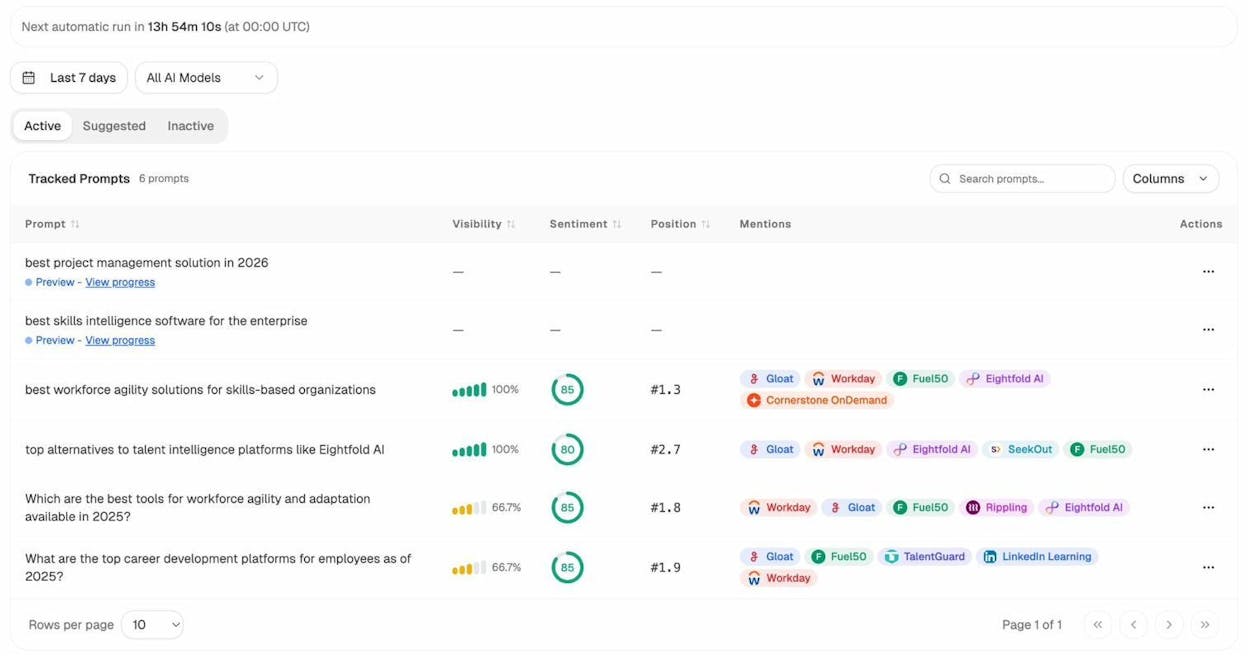
For deeper coverage, see our guides on SEO keywords and keyword types for SEO and AI search.
The three page types that drive automotive SEO
Successful automotive sites have three workhorse page types. Almost everything else (homepage, about, blog) is supporting cast. Spending 80% of your effort here is rarely the wrong call.
Inventory pages
These are your digital car lot. They power transactional searches like “used Mazda CX-5 under $20k” and they’re how you compete for every model and trim in your listings. What to focus on:
-
Clean URL structure like /inventory/used/suvs/mazda-cx5-2022/. Readable for users, scannable for Google.
-
Treat each vehicle page like a product page. Make, model, year, mileage, VIN, price, photos, condition report, and a single primary CTA.
-
Control your filters. URLs like ?color=red&price=20000-25000 create thousands of near-duplicate pages. Canonicalise the useful ones, noindex the rest.
-
Image SEO. Descriptive filenames (2022-mazda-cx5-front-3-4.jpg instead of IMG_4421.jpg) and accurate alt text. Vehicle images show up in Google Images and increasingly in AI search answers.
-
Categorical landing pages that double as evergreen content. “Family-friendly SUVs”, “First cars under $10k”, “Off-road trucks”. These survive even when specific inventory turns over.
![[Screenshot of a dealership inventory page showing make/model filters, vehicle cards with VIN, price, and CTA]](https://www.datocms-assets.com/164164/1778178104-blobid6.png?auto=format,compress&w=1248&fit=max)
Treat brand and model pages as permanent landing pages, even when you’re between stock. Add CTAs like “Call us to check availability” or “These sell fast, get in touch.” The page keeps ranking. The lead form keeps converting. For ecommerce-style guidance applied to AI search, see our ecommerce SEO guide.
Service pages
These bring high-margin, recurring traffic from people ready to book. Brake repair. Tire rotation. State inspection. Oil change. The intent is clear and the conversion window is short.
What to focus on:
-
One dedicated page per service. /services/brake-repair/ not /services/ with everything dumped on it.
-
Optimise for “service + city” combinations like “oil change Austin” or “transmission repair Dallas”.
-
Trust signals on the page. ASE certifications, technician bios, real photos of your bay (not stock), warranty terms, and a clear price range.
-
An online booking widget above the fold. Most service pages bury this two scrolls down and lose the customer.
Location pages
A good location page wins you “Toyota dealer Phoenix” and converts the cold visitor into a walk-in.
What to focus on:
-
Localised URL and H1. /locations/phoenix/ and “Used Cars in Phoenix | Open 7 Days”.
-
Real photos of your dealership, staff, and signage. Stock photos read as fake.
-
Map embed, driving directions, parking notes, hours.
-
Reviews specific to that location, not aggregated chain reviews.
-
Internal links to inventory and services available at that location.
For the deeper format, see our breakdown on internal linking for SEO.
Get your technical foundation right
Technical SEO is the boring part everything else depends on. If your inventory pages take 8 seconds to load on mobile, no amount of keyword targeting will save them.
You don’t need a developer for the basics. Run a site audit, then fix what shows up red. The recurring offenders for automotive sites:
-
Inventory bloat from filters. Hundreds of ?sort=price-low&color=blue URLs returning near-duplicate content. Canonicalise or noindex.
-
Slow mobile load. Most car shoppers are on phones. Anything over 4 seconds and you’re losing them. Compress photos, lazy-load below-the-fold images, put your inventory feed behind a CDN.
-
Broken links. Sold cars get unlinked, but old internal links still point at them. Run a quarterly check with our free broken link checker.
-
Missing schema. AutoDealer, Vehicle, Product, and LocalBusiness schema all matter. Vehicle schema in particular feeds Google’s Vehicle Listings program.
-
Thin or missing meta titles on inventory pages, where templates often default to “VIN | Dealer Name” and waste valuable search real estate.
Run the audit monthly. Fix the top three issues. That’s the whole job.
Use video to capture YouTube and AI search demand
YouTube is the second-biggest search engine in the world, and it’s where car buyers go to see vehicles in motion before they ever visit a lot. A 90-second walkaround of a Tacoma you have on the lot can earn views for years.
Three reasons video deserves focused effort. First, Google embeds YouTube videos directly into the SERP, often above text results, for queries like “Honda CR-V hybrid review” or “how to check transmission fluid”. Second, AI engines like ChatGPT and Perplexity now embed videos in their answers when the query has a “show me” intent. A walkaround that ranks on YouTube can show up inside an AI answer about a model you sell. Third, video builds trust faster than text. A mechanic explaining a common problem in 60 seconds does what 1,500 words of blog copy can’t.
![[Screenshot of a Google SERP for a car model query showing the YouTube video carousel above the text results]](https://www.datocms-assets.com/164164/1778178108-blobid7.png?auto=format,compress&w=1248&fit=max)
The video types that earn the most traffic in automotive:
-
Vehicle walkarounds. One per vehicle that’s been on the lot more than 30 days.
-
Service explanations. “What is a CV joint and when do you replace it.” Real shopper question, real authority.
-
Customer testimonials. Two-minute clips, real customer, real story.
-
Comparison videos. “2024 Tacoma vs 2025 Tacoma, what changed.” Captures shoppers mid-decision.
You don’t need a production team. Phone-shot, well-lit, clearly captioned video performs as well as polished work for most automotive niches.
Show up in AI search alongside Google
Most automotive SEO guides treat AI search as a distant concern or skip it entirely. That’s a mistake. Industry research now shows more than half of US car buyers using generative AI somewhere in their research, and the share is climbing every quarter.
Here’s what that looks like. A shopper asks ChatGPT “what’s the most reliable used hybrid SUV under $30k” and gets back three model recommendations, often with brand and dealer mentions baked in. If your dealership is the cited source, you’ve earned a top-of-funnel placement that didn’t exist on Google. If you’re invisible, your competitor is the default.
Three things to do here, in order.
1. Find the prompts that matter for your business
Start with the prompts your customers actually run. For automotive, those usually fall into a few categories.
-
Comparison. “RAV4 vs CR-V for a family of four”, “best used trucks for towing under $30k”
-
Local discovery. “Most trusted Toyota dealer in Austin”, “best place to service a BMW in Phoenix”
-
Buying advice. “Should I lease or buy in 2026”, “best time of year to buy a used SUV”
-
Service advice. “What does it cost to replace brake pads on a Tacoma”, “how often to service a Mercedes E-class”
Rather than guessing, use Analyze AI’s Prompt Discovery to surface the prompts your industry and competitors actually appear in. Track them, see who’s getting cited, and identify where competitors win and you don’t.
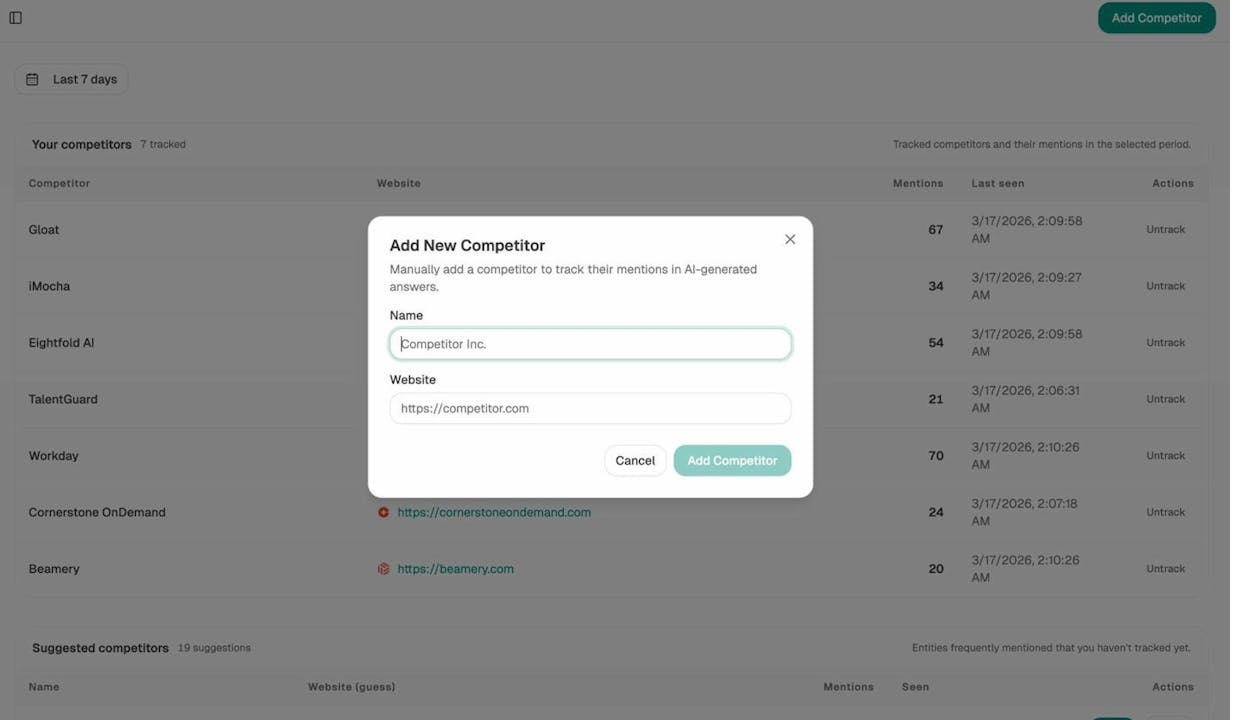
That last view is the one that compounds. Every prompt where competitors win and you don’t is a content brief waiting to be written.
2. See which sources AI engines actually cite for automotive
AI engines don’t cite the same sources Google ranks. Reddit, YouTube, Cars.com, Edmunds, CarGurus, and major review sites get cited disproportionately often. Your blog, even if it ranks well on Google, often doesn’t.
Use the Sources dashboard to see which domains AI engines pull from when answering automotive questions.
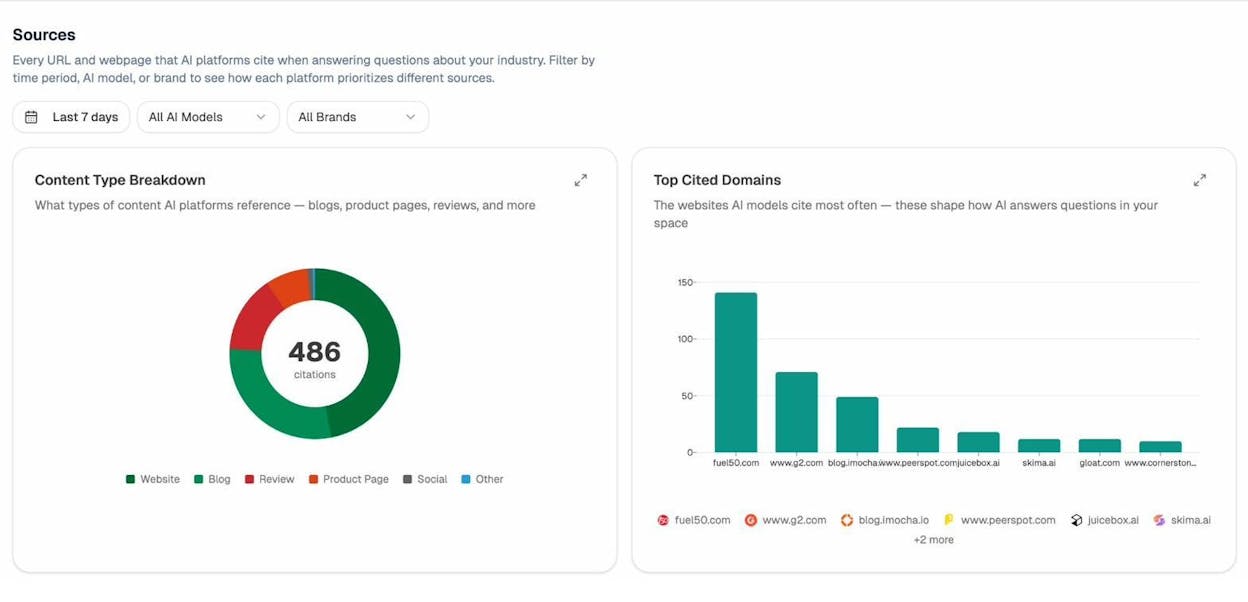
That tells you two things. Which third-party sites you should be earning placements on (a Reddit AMA, a Cars.com listing, an Edmunds dealer profile, a YouTube partnership). And which content gaps exist on your own domain to start getting cited directly.
3. Track which of your pages already earn AI search traffic
If you have any volume at all, you’re already getting some AI referral traffic. Most analytics setups don’t surface it cleanly because referrers from ChatGPT and Perplexity look different from Google traffic.
Analyze AI’s AI Traffic Analytics shows which pages bring visitors in from AI engines, what those visitors do, and which pages convert best.
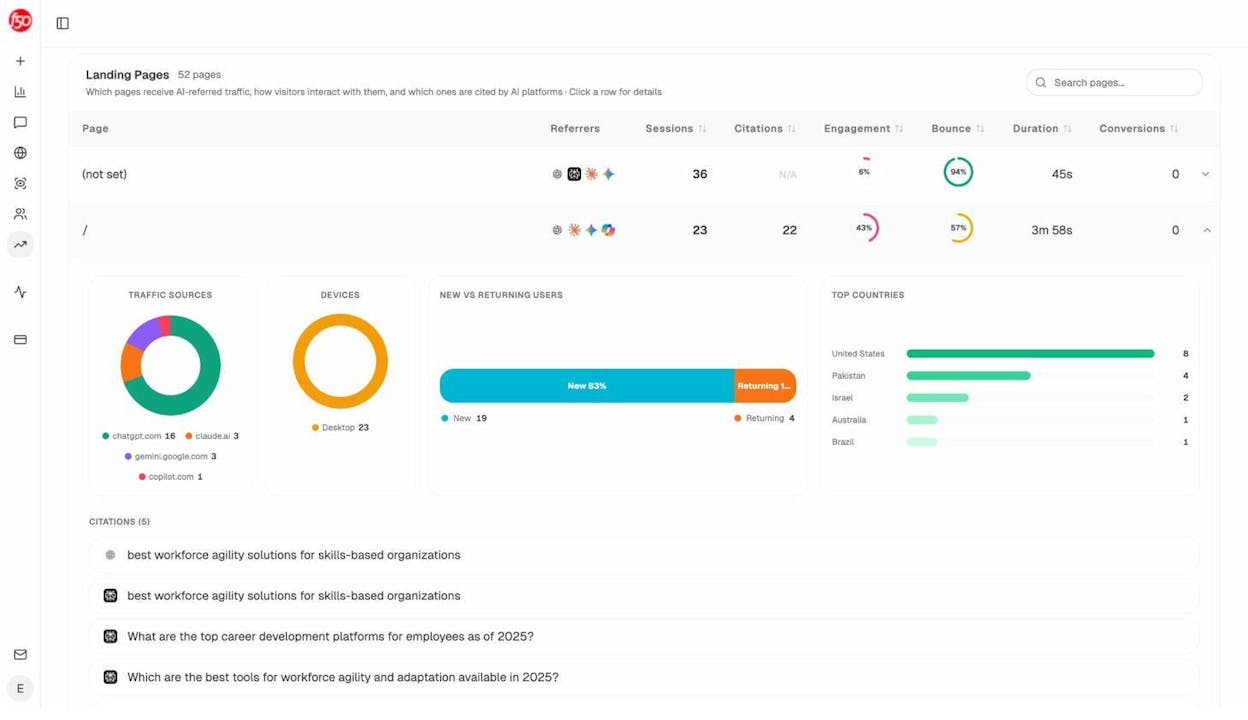
Use that as your prioritisation list. The pages already earning AI traffic are templates for what works. The pages that should but don’t tell you what content to write next.
For more, see our guides on how to rank on ChatGPT and how to outrank competitors in AI search.
Make SEO and paid search work together
Most dealerships run SEO and Google Ads as separate budgets and never share insights. That’s a wasted opportunity.
Three uses for paid that your SEO team should care about:
-
Keyword validation. SEO content takes 6-12 months to mature. A paid campaign tells you in two weeks whether a keyword converts. Use that signal to prioritise SEO content.
-
Coverage on competitive terms where you can’t yet rank organically. A bid on “Toyota dealer Austin” buys you placement while your location page climbs.
-
Seasonal pushes. Year-end clearance, summer service specials. Paid covers the spike. SEO is the always-on background.
Paid for short-term coverage and validation. SEO for compounding long-term gains.
Track what’s actually working
Most automotive SEO reports focus on rankings and traffic, which are inputs, not outcomes. The metrics that matter:
-
Organic leads by source page. Which pages produce form fills, calls, or test-drive bookings? That’s your real ranking.
-
Local map pack visibility for your priority queries, tracked weekly per location.
-
Share of voice versus your three biggest local competitors for the keywords that drive revenue.
-
AI search visibility. What percentage of your tracked prompts mention your brand on ChatGPT, Perplexity, Gemini, and Google AI Overviews. Track this with our AI Visibility Tracking feature.
-
Review velocity per location, not aggregate count.
-
Site health (broken links, crawl errors, Core Web Vitals) tracked monthly.
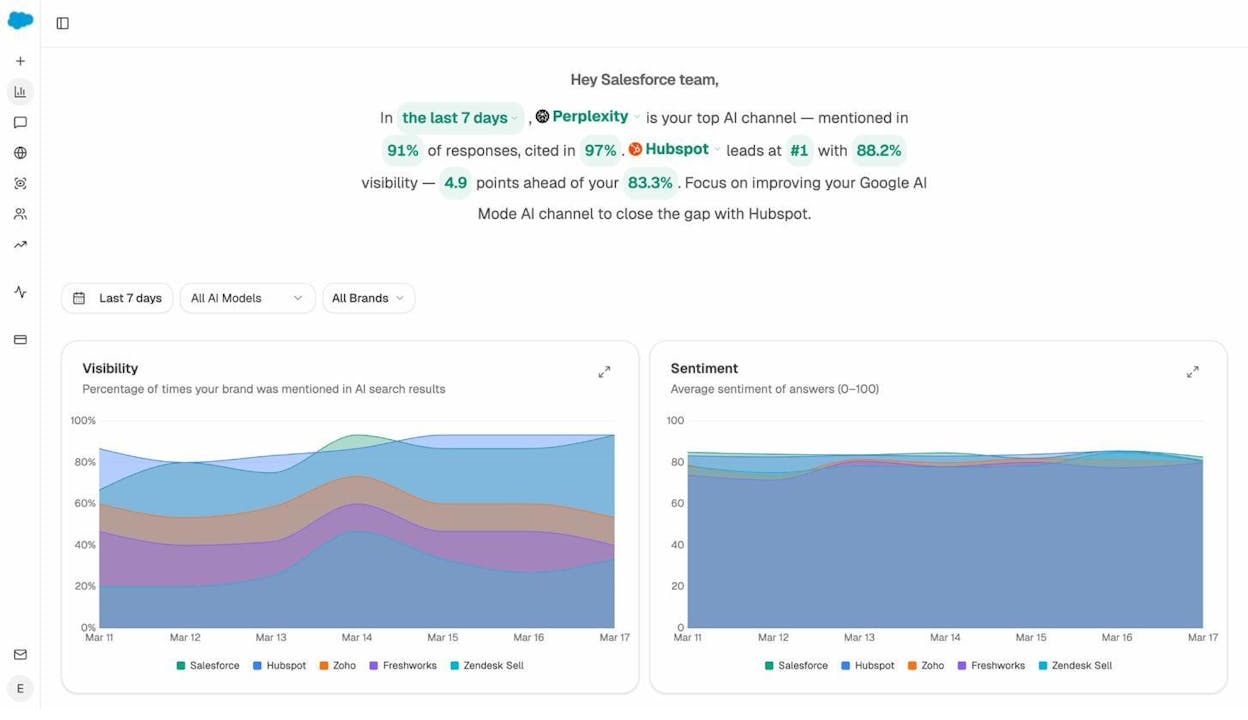
Reports should land in the inboxes of people who can act on them, not buried in a dashboard nobody opens. Set up weekly email digests that go to the GM and marketing lead with the three numbers that moved that week and the one thing to focus on next.
Avoid vanity metrics. “Impressions up 40%” doesn’t move a dealership. “Two extra test drives booked from organic this week” does. Tie everything back to qualified demand.
For multi-location operators, our SEO competitor analysis guide walks through comparative tracking. Gut-check any competitor’s domain with our free website authority checker and website traffic checker.
Final thoughts
Automotive SEO has always been a long game. Cars don’t sell on impulse, and rankings don’t materialise overnight. The work that compounds is the same work that’s compounded for a decade. A clean local presence. The right page types. Fast technical foundations. Video where it matters. Consistent reviews from real customers.
What’s new is the layer on top. ChatGPT, Perplexity, and Google AI Overviews are now part of how shoppers research cars and service. Treating that as additive instead of a replacement is how durable brands will win the next decade.
Start with one location, one set of priority keywords, one cycle of fixes. Then do it again next month.

Ernest

Ibrahim


