

Summarize this blog post with:


Bluefish AI calls itself the AI marketing platform for the Fortune 500. The company raised $43 million in Series B funding in April 2026, bringing total funding to $68 million, and counts Adidas, American Express, Hearst, Ulta Beauty, and Tishman Speyer as customers.
CEO Alex Sherman positions Bluefish as an “agentic marketing platform for enterprises” focused on how brands appear inside ChatGPT, Perplexity, Claude, Gemini, Copilot, and Amazon’s Rufus. As of May 2026, the platform spans five pillars. AI Monitoring, GEO Optimization, GEO Measurement, AI Commerce, and AI Accuracy (their newest module, launched May 5).
I spent 30 days inside the product and compared it head to head with Analyze AI. The verdict is mixed. Bluefish has a clear point of view on enterprise AI visibility and a few features worth paying attention to. But the closed pricing, the Fortune 500 fit, and the missing attribution layer make it a hard recommend for most marketing teams.
Table of Contents
Bluefish AI at a glance
Skim this if you only have 30 seconds.
|
Bluefish AI |
|
|---|---|
|
What it is |
Enterprise AI marketing platform for the Fortune 500. Five pillars: AI Monitoring, GEO Optimization, GEO Measurement, AI Commerce, AI Accuracy. |
|
Best for |
Fortune 500 brands with 50+ marketing headcount, dedicated brand and PR teams, and six-figure annual budgets for AI search tooling. |
|
Top features |
Impact Score and Influence Rank for source weighting, AI Brand Vault for centralized brand data, Collections for campaign-level AI attribution, AI Accuracy for hallucination flagging. |
|
Pricing |
Quote-only. No public plans. Reported entry tiers $99 to $799 per month. Enterprise contracts run into 5 to 6 figures annually. |
|
Main limitations |
Opaque pricing, restricted API on lower tiers, sized for org structures most companies don’t have, no GA4 or conversion attribution. |
|
Better fit if you’re not Fortune 500 |
Analyze AI (public pricing, GA4 attribution, programmable agents). |
Three things I actually liked about Bluefish AI
![[Description of Bluefish AI homepage hero with “AI marketing platform for the Fortune 500” headline]](https://www.datocms-assets.com/164164/1778584399-blobid1.png?auto=format,compress&w=1248&fit=max)
Three Bluefish choices stood out among AI search monitoring tools during my test.
1. Impact Score and Influence Rank go beyond vanity visibility
Most LLM monitoring tools give you a single visibility percentage and call it a day. Bluefish goes further. Its Impact Score measures how closely a piece of cited content aligns with the AI’s answer text. Its Influence Rank aggregates that signal across platforms to estimate which sources actually move the needle.
![[Description of Bluefish AI dashboard showing Impact Score and Influence Rank widgets per source]](https://www.datocms-assets.com/164164/1778584406-blobid2.jpg?auto=format,compress&w=1248&fit=max)
If you run PR or earned media, you already know that ChatGPT citing three different domains in a single response does not mean those citations are equal. One source might shape 70% of the answer wording, another 5%. That source weighting tells you which earned-media bets compound and where to spend your next pitch, sponsorship, or co-marketing dollar.
2. The AI Brand Vault gives you a controlled input channel
If you’ve ever watched ChatGPT misquote your pricing, your founding date, or a feature you killed two years ago, the Brand Vault will appeal to you. It’s an enterprise-controlled repository of brand facts, product specs, positioning lines, and messaging guardrails, structured for AI ingestion.
![[Description of Bluefish AI Brand Vault interface showing brand asset library]](https://www.datocms-assets.com/164164/1778584413-blobid3.png?auto=format,compress&w=1248&fit=max)
In testing, the Vault made the most sense as a single source of truth for cross-team alignment. Marketing, legal, PR, and product pull from the same library, reducing the risk of the marketing site, press kit, and help center contradicting each other in AI answers.
If you run brand at a large enterprise, this central source of truth is genuinely valuable. If you run growth at a 50-person SaaS, it is overkill.
3. Collections and AI Accuracy bring real campaign measurement
In February 2026, Bluefish launched Collections, which groups owned content, earned coverage, and AI visibility data into a single campaign view. You pick a campaign theme, attach assets, and Bluefish tracks how visibility, sentiment, and citations shift for the prompts tied to that theme.
![[Description of Bluefish AI Collections campaign view showing owned, earned, and AI visibility metrics]](https://www.datocms-assets.com/164164/1778584415-blobid4.jpg?auto=format,compress&w=1248&fit=max)
In May 2026, they followed it up with AI Accuracy, which monitors AI hallucinations and inaccurate brand mentions in real time. Together these two are the closest thing in the market to “campaign attribution and brand safety for AI search.”
The catch. Collections only counts what Bluefish ingests. It does not connect to your GA4, your CRM, or your conversion data. You see citation lift week over week, but you cannot tie it to traffic, leads, or pipeline.
Three things that didn’t work for me about Bluefish AI
If you are evaluating Bluefish for an actual purchase, these are the friction points to think hard about.
1. Quote-only pricing makes evaluation slow and political
Bluefish does not publish prices. Every plan goes through sales, every quote depends on volume, and the most useful capabilities sit inside enterprise contracts.
![[Description of Bluefish AI pricing page showing only a “Request a demo” CTA, no public plans]](https://www.datocms-assets.com/164164/1778584421-blobid5.png?auto=format,compress&w=1248&fit=max)
If you’re a CMO at a Fortune 500 with procurement and legal already aligned, this is normal. If you’re a head of marketing or an SEO lead trying to pick tooling this quarter, it adds three to six weeks of friction before you can even test the product. By the time you’ve sat through two demos and a security review, your competitor has shipped a new content cluster.
2. The platform is sized for teams that don’t exist at most companies
Bluefish dashboards assume a marketing org with separate brand, content, PR, and product-marketing functions. Their platform pages explicitly call out four buyer roles. Search teams, content teams, brand teams, and PR teams. Each role is expected to maintain prompt groups, manage the Brand Vault, run Collections campaigns, and triage alerts.
![[Description of Bluefish AI solutions page with four separate team-based modules]](https://www.datocms-assets.com/164164/1778584427-blobid6.png?auto=format,compress&w=1248&fit=max)
If you have those four teams, great. If you’re an agency owner running AI search work for ten clients, a four-person in-house marketing team, or a one-person SEO and AI search owner, the structure works against you. You pay for capability you cannot operationalize, and the dashboards start to feel like a second job.
3. API access and data portability are restricted on most plans
The data Bluefish collects is rich. Getting it out and into your stack is harder than it should be. API access, raw data exports, and integrations are gated behind higher tiers, which means smaller teams either work entirely inside Bluefish or build manual export workflows on the side.
![[Description of Bluefish AI integrations page showing limited connectors on lower tiers]](https://www.datocms-assets.com/164164/1778584430-blobid7.png?auto=format,compress&w=1248&fit=max)
If you’ve already stitched GA4, GSC, a CDP, and a CRM together, the result is a tool that runs in parallel to your other systems instead of inside them. That parallel data lake creates more reporting work for your ops team, not less.
Bluefish AI pricing in 2026: what teams actually pay
Bluefish uses quote-based pricing, so exact numbers require a sales call. Based on third-party reviews and conversations with current users, here are the ranges teams report paying.
|
Tier |
Reported price range |
What you get |
Common limitations |
|---|---|---|---|
|
Starter |
~$99 to $299 per month |
Basic visibility monitoring across major AI engines |
Restricted API access, narrow channel coverage |
|
Growth / Professional |
~$299 to $799 per month |
Expanded tracking, more seats, additional integrations |
Stops short of full enterprise flexibility |
|
Enterprise |
Custom (5 to 6 figure annual contracts reported) |
Full Collections, Brand Vault, Custom AI Audiences, AI Accuracy, broad API access, white-glove support |
Long sales cycle, complex implementation |
If you’re spending six figures a year and the cost of being misrepresented in AI answers exceeds the platform fee, the math works. If you’re not, the features that justify the price live in the higher tiers and the cheaper plans give you a thinner version without solving the real problem.
Bluefish AI vs Analyze AI: Better agentic marketing features that do not cost an arm and a leg
Both platforms track how brands appear in AI answers. Bluefish stops at AI-side metrics (citations, sentiment, share of voice). Analyze AI takes the same starting data and ties it to actual sessions, landing pages, conversions, and revenue, then layers a programmable agent platform on top so you can automate the response.
|
Capability |
Bluefish AI |
Analyze AI |
|---|---|---|
|
Tracks brand visibility across major AI engines |
Yes |
Yes (AI Visibility Tracking) |
|
Sentiment monitoring |
Yes |
Yes (AI Sentiment Monitoring) |
|
Source and citation analysis |
Yes (Impact Score, Influence Rank) |
Yes (Citation Analytics) |
|
Brand safety / hallucination flagging |
Yes (AI Accuracy) |
Yes (AI Sentiment Monitoring) |
|
Connects AI visibility to GA4 sessions |
No |
Yes (AI Traffic Analytics) |
|
Page-level conversion attribution from AI engines |
No |
Yes |
|
Auto-suggested prompts based on your category |
Limited |
Yes (Prompt Discovery) |
|
Perception map of you vs competitors |
No |
Yes (Perception Map) |
|
AI battlecards for sales and PMM teams |
No |
Yes (AI Battlecards) |
|
Built-in writer trained on AI gaps |
No |
Yes (AI Content Writer) |
|
Page-level optimizer with citation gaps |
No |
Yes (AI Content Optimizer) |
|
Programmable agent builder with 180+ nodes |
No |
Yes |
|
Pricing transparency |
No (quote only) |
Yes (public plans) |
|
Time to first insight |
Weeks |
Minutes |
|
Best fit |
Fortune 500 enterprise |
Mid-market and growth-stage teams |
Why Analyze AI is the better fit if you’re not Fortune 500
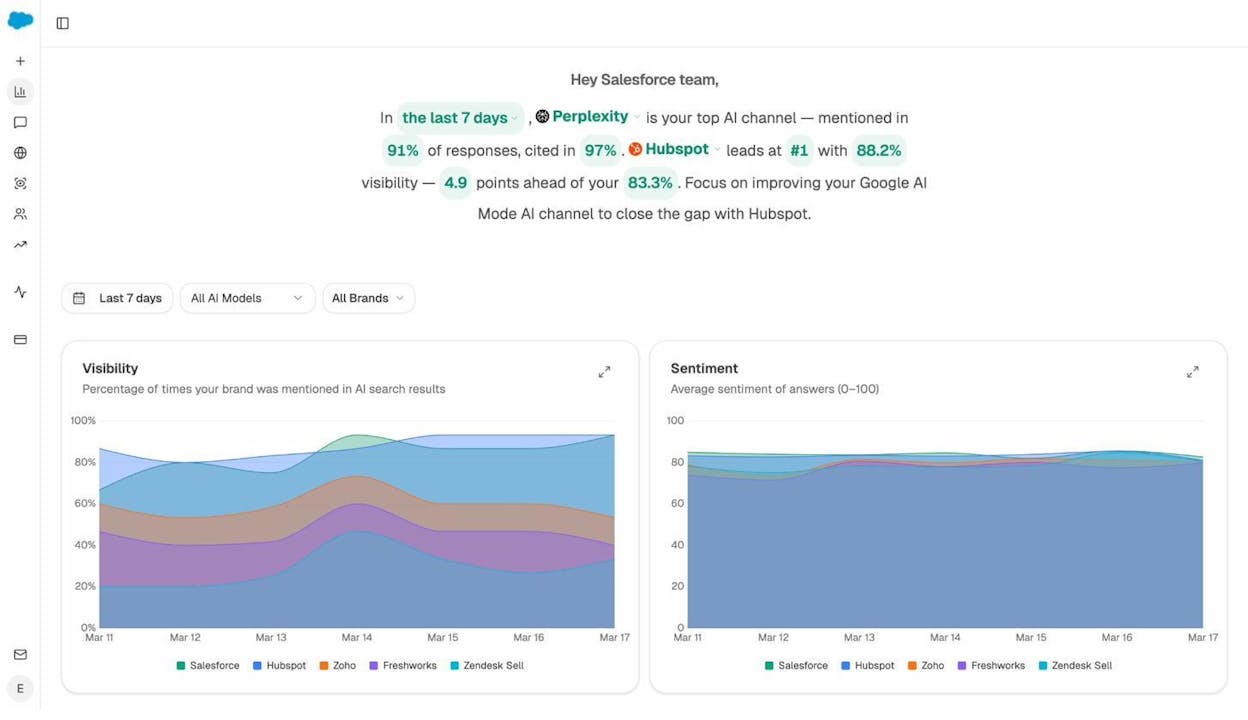
Before the features, our position. SEO is not dead. AI search is an additional organic channel sitting alongside Google, and the brands that win in 2026 treat it that way. We covered the data behind the shift in the great decoupling, and it is the foundation of our manifesto.
Analyze AI does the AI visibility work Bluefish does, then connects every signal back to the metrics your CMO already cares about. Traffic, conversions, and pipeline. Here are the five capabilities that make the difference.
1. Real AI referral traffic, not just mentions
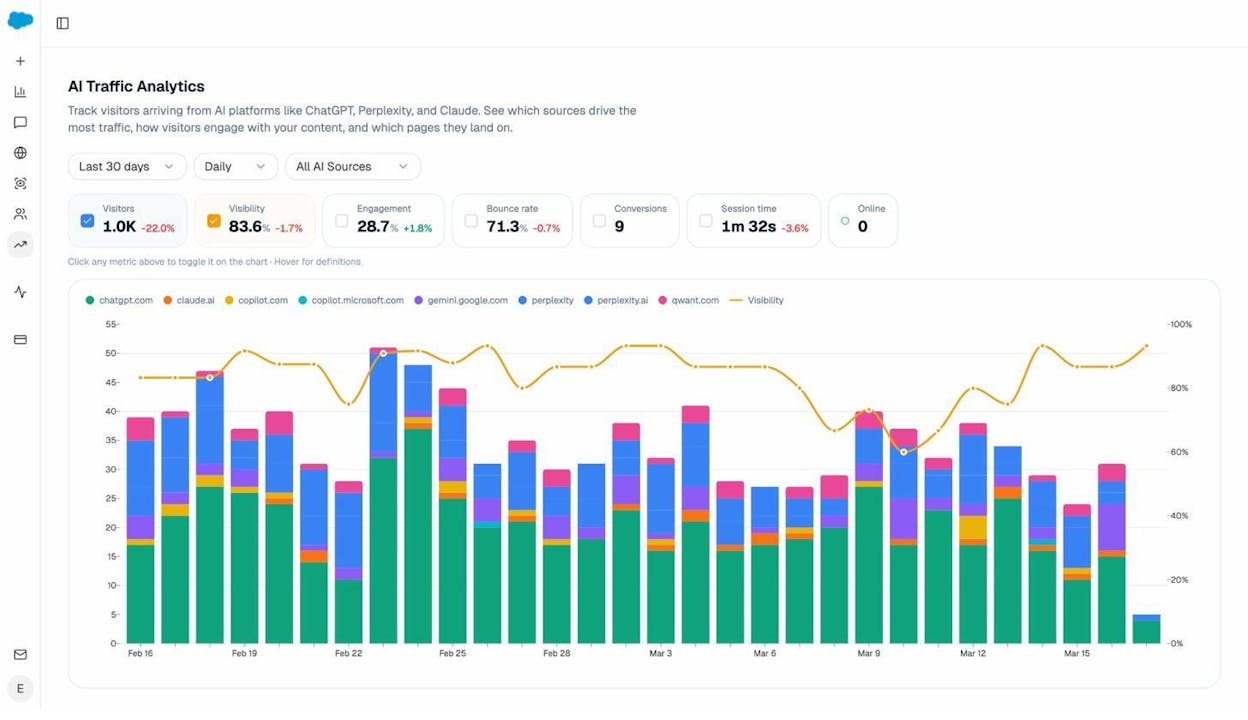
Most AI search visibility tools tell you whether ChatGPT mentioned your brand. Analyze AI tells you which AI engines actually sent visitors to your site, how many sessions each drove, and how that traffic is trending over the past 30, 60, or 180 days.
When ChatGPT sends 248 sessions and Perplexity sends 142, you know where to focus. When Claude starts driving more conversions than Copilot, you can shift content priorities without guessing. Without that data layer, you optimize for visibility you cannot value.
2. Page-level attribution from AI answer to conversion
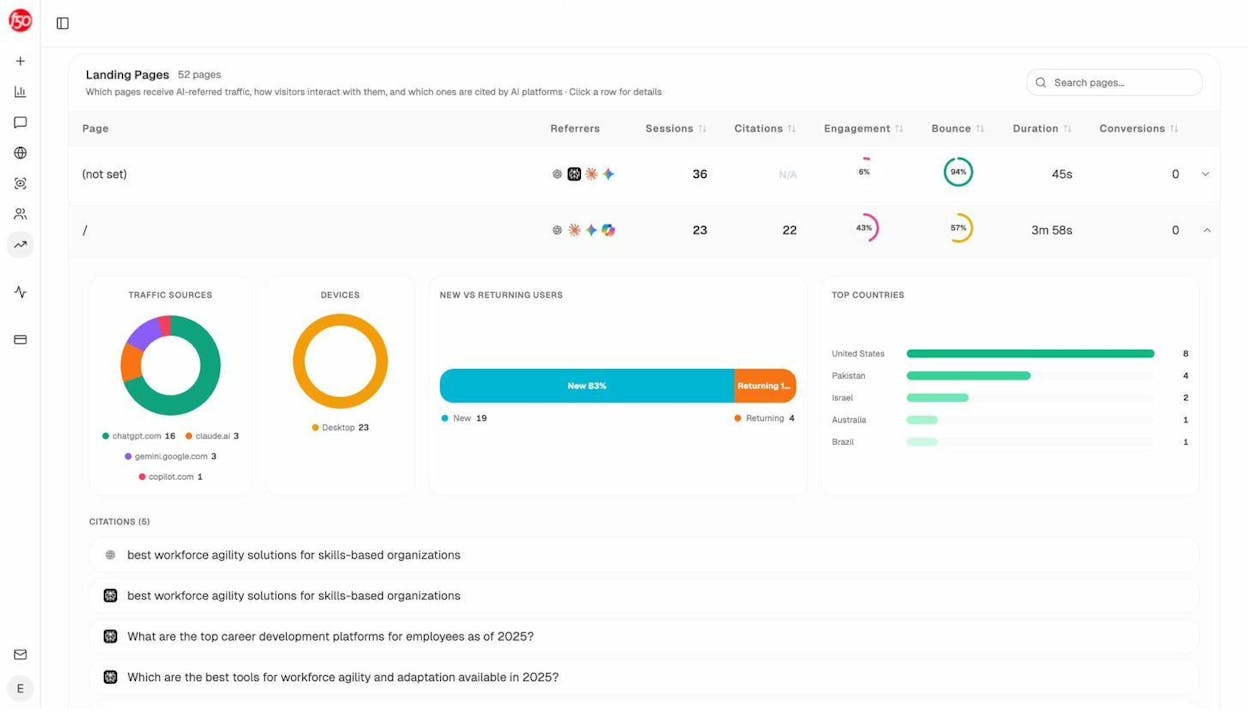
Analyze AI shows the full path from AI answer to landing page to conversion. You see which pages receive AI referrals, which engine sent each visit, and what conversion events those visits trigger.
Showing a brand mention in Perplexity is easy. Showing that the mention drove 50 sessions to your product comparison page, that 12% converted to trials, and that two of those trials closed last quarter is what earns budget in your next planning cycle. Our free AI website audit tool gives you a baseline read in under a minute.
3. Prompt-level visibility with built-in suggestions
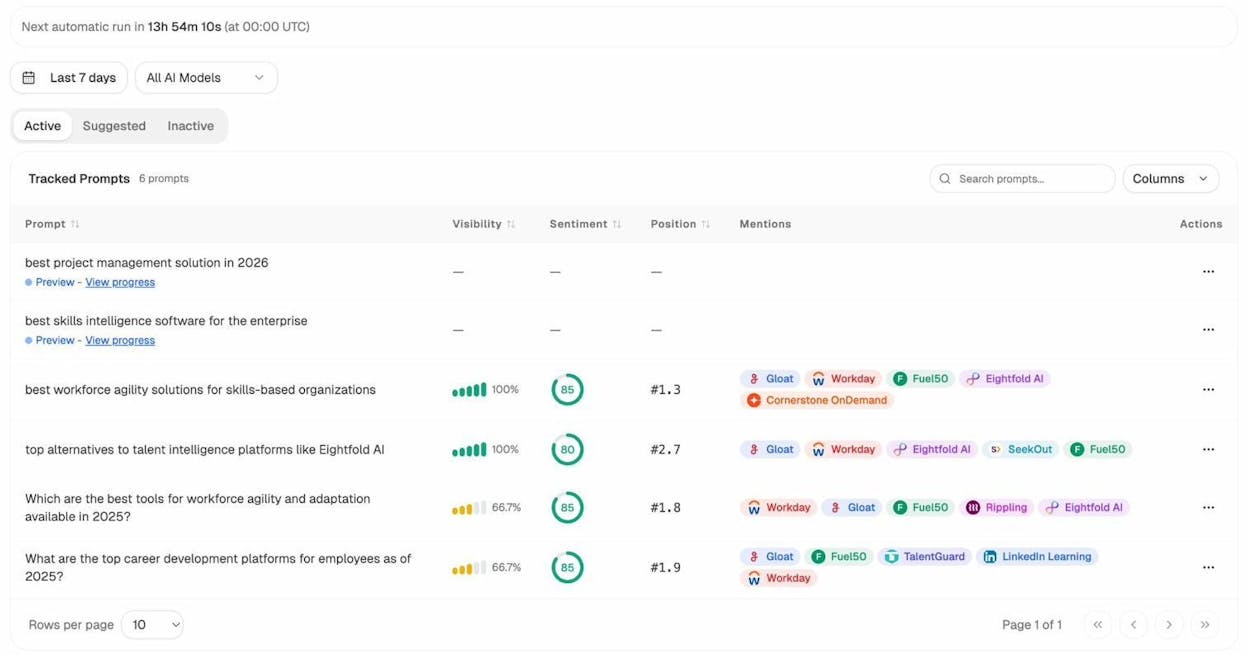
Analyze AI tracks specific prompts across all major LLMs. For each prompt, you see your visibility percentage, your position relative to competitors, and your sentiment score across ChatGPT, Gemini, Perplexity, Claude, and Copilot.
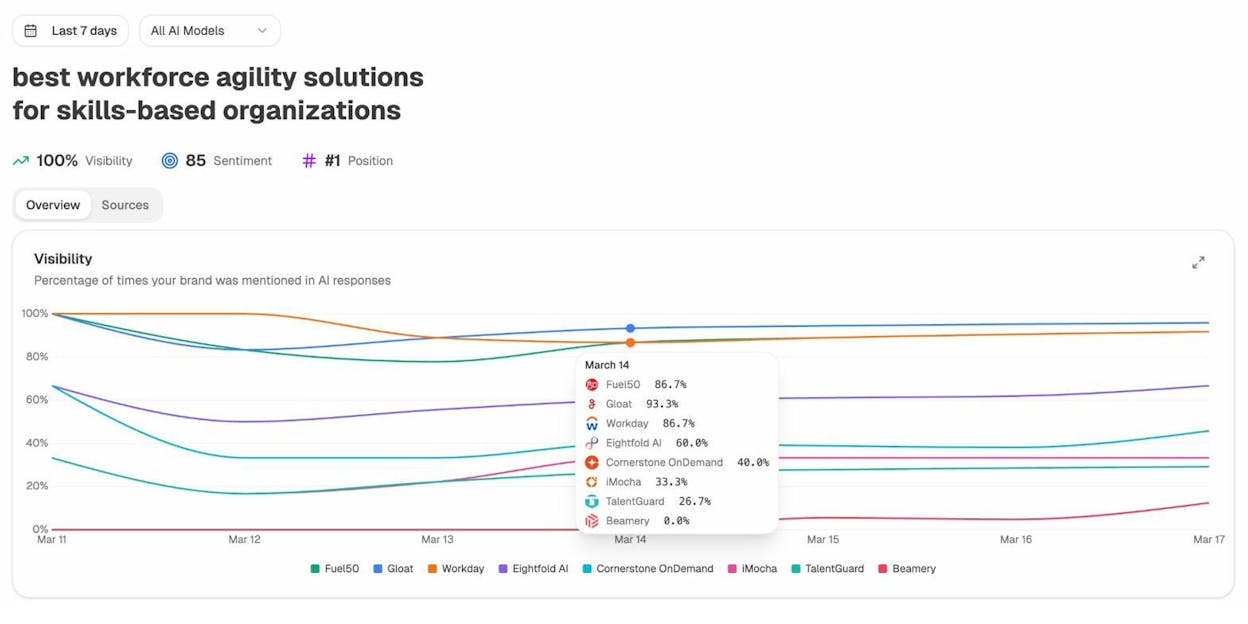
If you don’t know which prompts to track, the platform suggests bottom-of-funnel prompts based on your category, your competitors, and the AI engines your buyers actually use. You don’t need a list of 200 prompts before you start. Add three to five seed prompts, and Analyze AI expands them into the full landscape of buying-intent queries you should be tracking. Our breakdown on how to outrank competitors in AI search covers which prompts move pipeline.
4. Citation analysis that points to specific actions
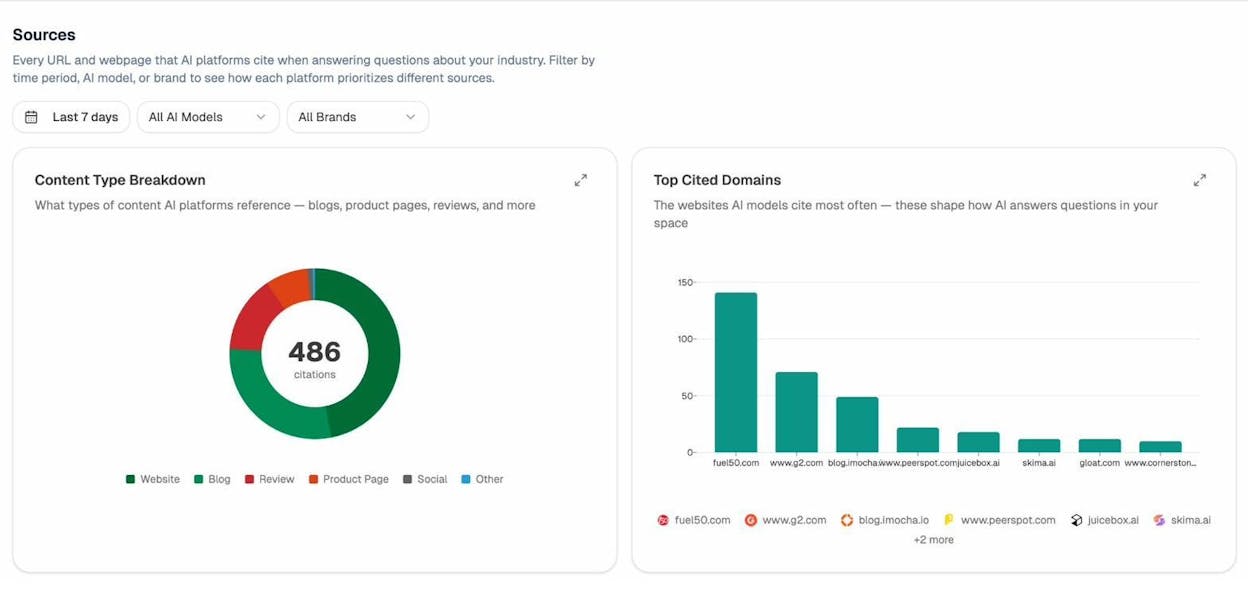
Analyze AI shows you exactly which domains and URLs models cite when they answer questions in your category, with usage count per source, which models reference each domain, and when those citations first appeared.
That changes what link building and earned media look like. Instead of chasing generic backlinks, you target the sources AI engines already trust in your niche, and reverse-engineer what makes competitor pages citation-worthy. Our analysis of how LLMs cite sources across 83,670 AI citations walks through the patterns we found.
5. The Perception Map and AI Battlecards
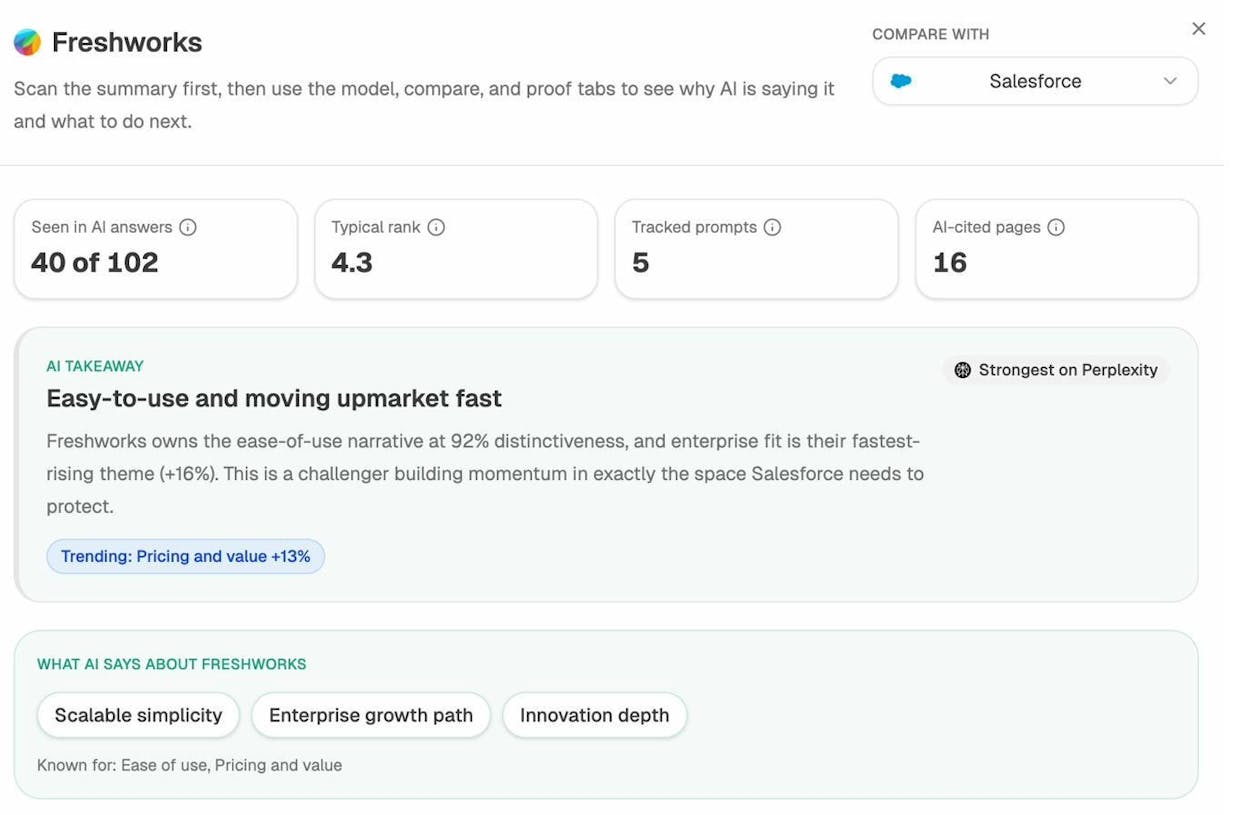
The Perception Map plots you against competitors on two axes. How visible you are in AI answers, and how strong your narrative is. The result is a quadrant view that tells you whether you’re leading, hidden, generic, or losing share of voice.
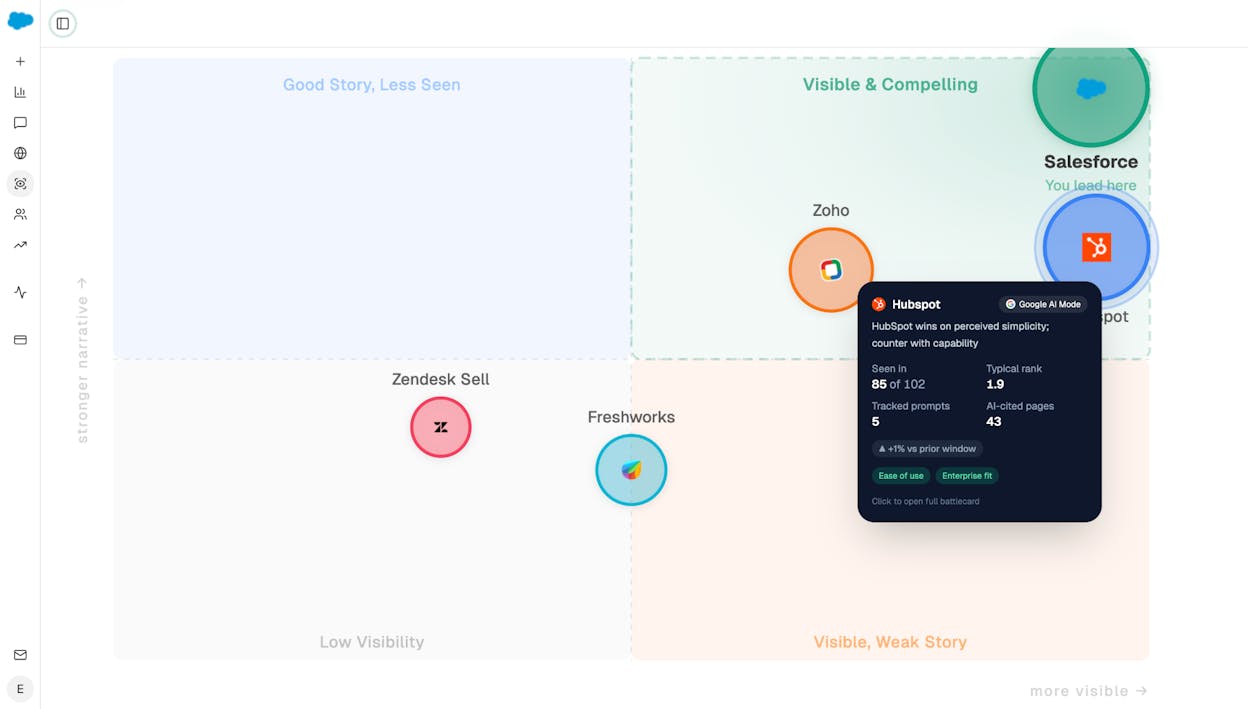
That is strategic intelligence Bluefish does not offer in this format. It feeds directly into our AI Battlecards, which give your sales team a one-page brief on each competitor’s positioning and the counter-positioning that works. Our piece on brand gap analysis covers the full workflow.
The Agent Builder: the unfair advantage Bluefish does not have
Underneath everything Analyze AI does is a programmable agent platform. 180+ nodes, 34 pre-built data recipes, and three trigger modes (manual, scheduled, webhook). Same surface area as Zapier, Retool, Make, and n8n stitched together, except every node is already wired to your AI visibility data, your GA4, your GSC, your brand vault, and your competitors.
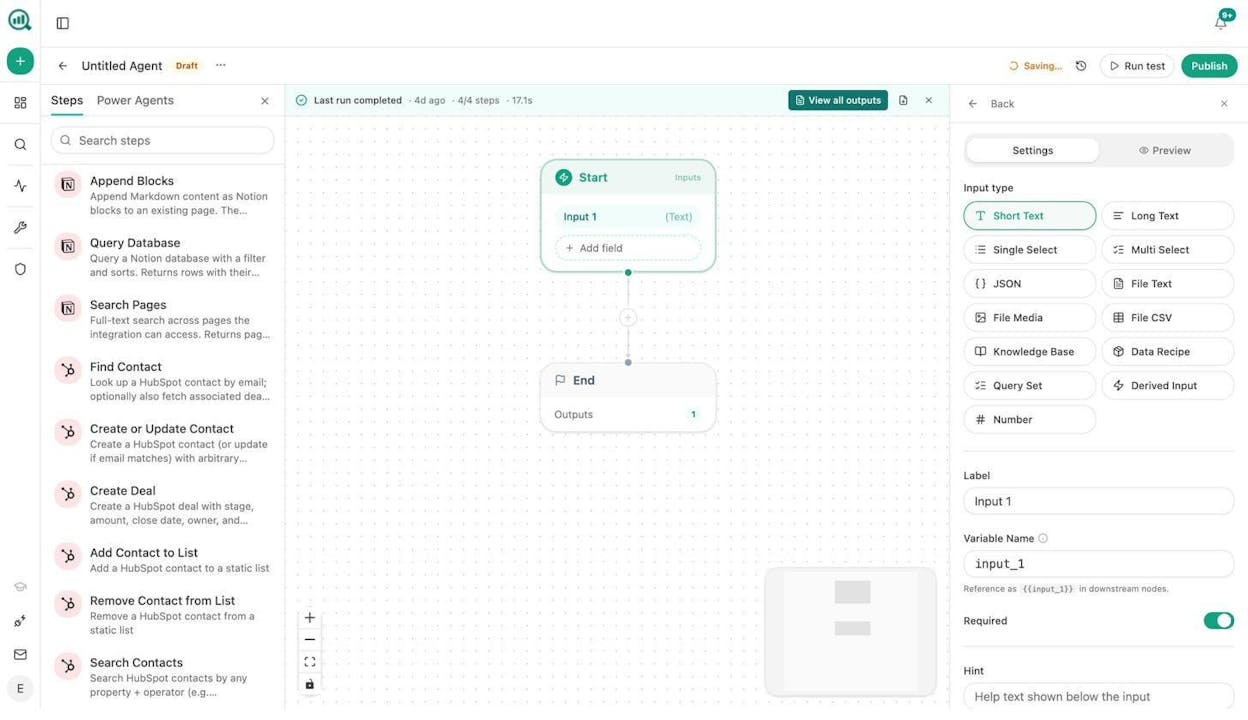
The AI Content Writer and AI Content Optimizer are themselves built on this substrate. So is every workflow your team can ship next week without an engineer.
Here is what teams already run in production.
If you run an agency:
-
A Monday client briefing pack agent that drops a fresh DOCX with last week’s AI visibility delta, citation changes, and competitor SERP movement into each client folder at 7am. Reporting day stops existing.
-
A pitch-deck generator that takes a prospect domain, runs a full AI visibility audit, and produces a Gamma deck in 30 minutes.
-
A crisis playbook that fires when media monitoring flags negative coverage, drafts three response options, and Slacks them to the PR team before the client sees the article.
If you run a content team:
-
An editorial calendar autopilot that pulls last week’s uncovered prompts every Sunday night and assembles next week’s calendar in Notion, one card per piece, brief attached.
-
A brief-to-publish pipeline triggered by a Notion status flip. Research, outline, draft, AI gap scoring, and only publishes if the score clears 80. Anything lower goes back to the writer with the gaps highlighted.
-
A content refresh fleet that runs weekly across declining pages, rewrites them for freshness and AI visibility, and updates them in WordPress.
If you run AI search visibility:
-
A daily visibility regression alert at 7am if any tracked prompt dropped meaningfully in the last 24 hours, with a counter-content brief attached.
-
An AEO opportunity finder that crosses competitor citation sources with your keyword opportunities every week and tells you which pages to write next.
-
A perception-quadrant snapshot that emails the strategy team a screenshot every Monday so leadership conversations start grounded in data.
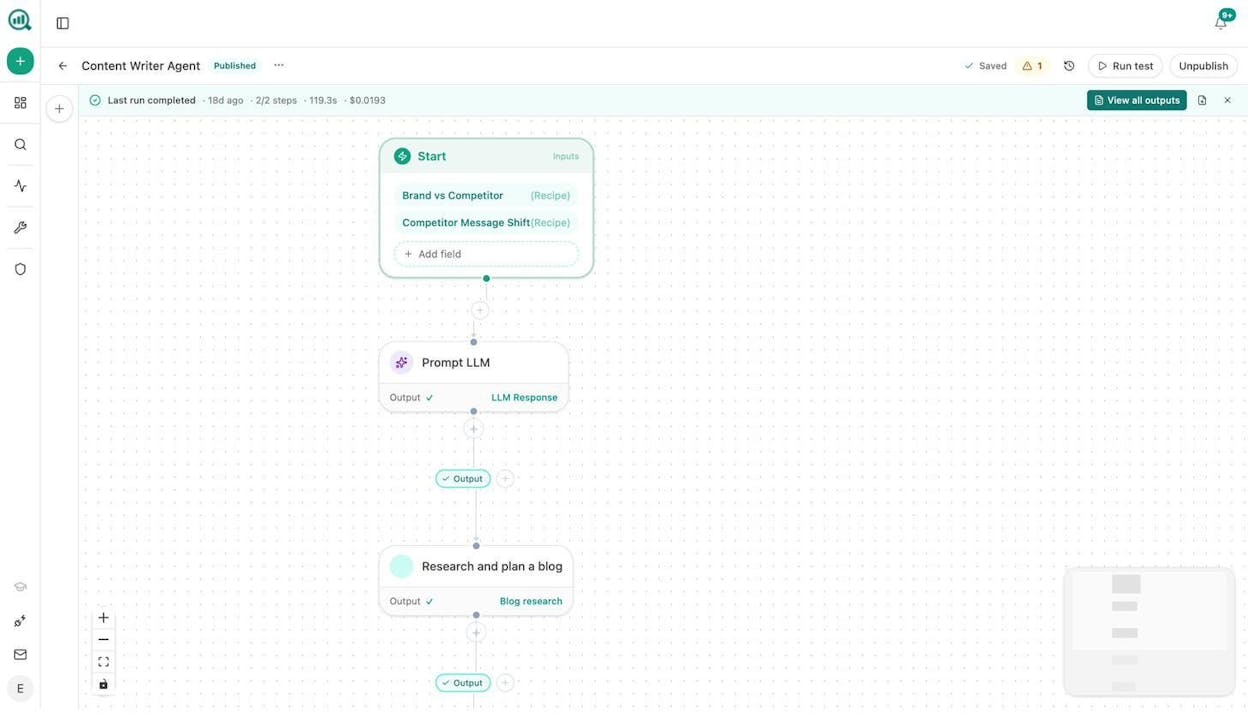
Bluefish does not have an equivalent. Most AI search visibility tools do not. This is the layer that turns a monitoring platform into an operations layer for your marketing org, and it’s why teams switching from Bluefish to Analyze AI tend to delete two or three other tools at the same time.
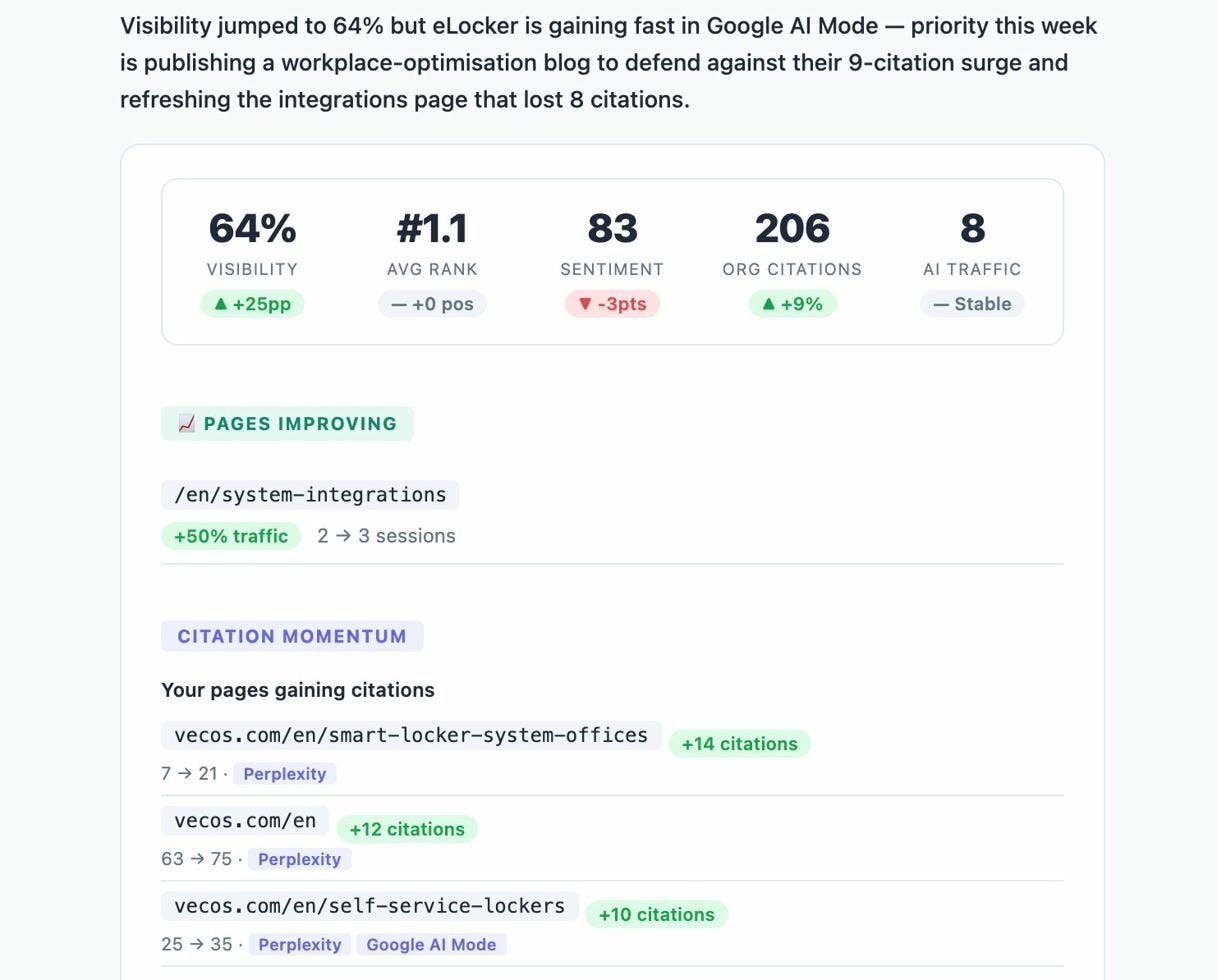
If logging in is not how you want to consume insight, our Weekly Email Digests deliver prioritized actions, citation changes, and competitor shifts to your inbox every Monday. That feature is itself a prebuilt agent.
Who should choose what
The honest answer depends on your stage, your team, and your goals.
Choose Bluefish AI if you are a Fortune 500 brand with a marketing org of 50+, dedicated brand-safety and PR teams, a six-figure annual budget, and a need for centralized brand-data control across multiple product lines and regions. You’re also comfortable with quote-based pricing and a longer sales cycle.
Choose Analyze AI if you are a growth-stage SaaS, a mid-market B2B brand, an agency managing multiple clients, or an enterprise team that wants to prove AI search is driving pipeline. You want public pricing, fast onboarding, real GA4 attribution, a single platform that covers monitoring, optimization, and automation, and the option to wire programmable agents into your existing stack.
You can start a trial of Analyze AI or book a demo to see the platform mapped against your category. To baseline your visibility first, the free AI website audit tool gives you a starting read in under a minute. Our free SERP checker and keyword rank checker cover the SEO side of the same picture.

Ernest

Ibrahim