



Summarize this blog post with:


Multiple studies show AI Overviews are reducing click-through rates on traditional search results by 15% to 35% on average. The traffic is not vanishing. It is shifting into ChatGPT, Perplexity, Google AI Mode, and Copilot, where ranking #1 in Google does not guarantee you appear at all. We dug into this in our analysis of 83,670 AI citations across ChatGPT, Claude, and Perplexity. Spying on competitors with only an SEO tool now leaves half the picture out.
In this article, you’ll learn seven ways to spy on your competitors and turn what you find into a backlog of work you can ship next week. Each tactic has two parts. One for Google search, one for AI search. We separate them because your competitors now compete for both channels, and most spying guides only cover the first one.
Table of Contents
TL;DR
To save you time, here is the playbook in one table. Pick a tactic, learn it once, then repeat it every quarter for each priority competitor.
|
What you spy on |
What it reveals |
What to do with it |
|---|---|---|
|
Organic keywords and AI prompts |
Demand they capture and you do not |
Build content for the gaps |
|
Traffic, rankings, and AI visibility |
Where they are gaining or declining |
Copy momentum, exploit declines |
|
Top pages and AI-cited pages |
Which assets do their heavy lifting |
Reverse-engineer format and angle |
|
Backlinks and AI citation sources |
Who vouches for them |
Pitch the same publications |
|
Google Ads |
Paid keywords and ad copy |
Borrow proven value props |
|
Brand narrative and AI perception |
What AI says about them |
Reposition to counter |
|
Content engine velocity |
Which writers and pages are moving |
Hire, partner, or out-publish |
Now the tactics, in order.
1. Spy on your competitor’s organic keywords and AI prompts
The first job is to find the demand they are capturing.
On Google
Plug the competitor’s domain into your SEO tool of choice and open the Organic keywords report. You want two columns visible. Keyword Difficulty (KD) tells you how hard the term is to rank for. Traffic tells you what the prize is.
![[Screenshot of Ahrefs Site Explorer Organic keywords report with KD and Traffic columns highlighted, sorted by traffic descending]](https://www.datocms-assets.com/164164/1778178799-blobid1.png?auto=format,compress&w=1248&fit=max)
Sort by traffic, then filter for KD under 30 to start. These are the keywords your competitor is ranking for, with reasonable difficulty, that you could realistically take. Export the list. You now have a backlog of post topics, ranked by likely return.
If you want to widen the net, run their domain through a free keyword rank checker and a keyword difficulty checker. For deeper keyword work, the keyword research tools we use most are listed here.
![[Screenshot of Google Autocomplete suggestions for the competitor’s brand name plus seed terms]](https://www.datocms-assets.com/164164/1778178811-blobid2.png?auto=format,compress&w=1248&fit=max)
A second pass. Type the competitor’s brand name into Google and screenshot the autocomplete suggestions. Those are queries real users are asking about them. “[Competitor] alternatives,” “[competitor] vs,” and “[competitor] pricing” are usually three of the high-converting keywords you can target.
On AI search
Now run the same job for AI prompts. The unit of demand in AI search is not the keyword. It is the prompt. “Best CRM for small business” is a keyword. “What is the best CRM for a 15-person services firm with HubSpot integration needs?” is a prompt. They are related but not the same, and your competitors are getting cited for prompts you have never thought to track.
In Analyze AI, the Opportunities report lists prompts where one or more of your tracked competitors gets cited and your brand does not.
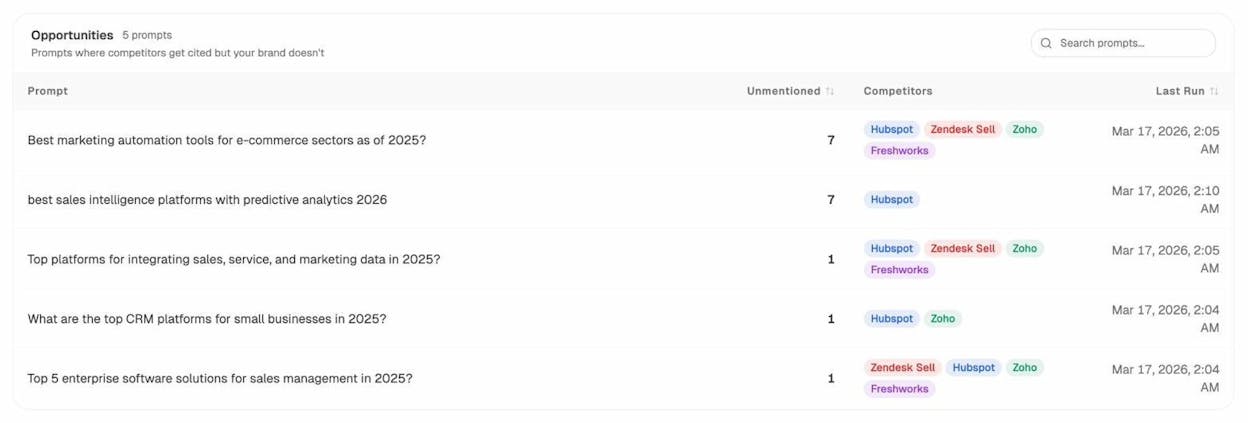
Each row is a content brief in disguise. The competitor names are the gap. The prompt is the keyword equivalent. The “Unmentioned” count is the urgency.
If you are not sure which prompts to track in the first place, the Suggested Prompts tab pulls candidates from real AI conversations in your category, so you do not have to guess what buyers are typing.
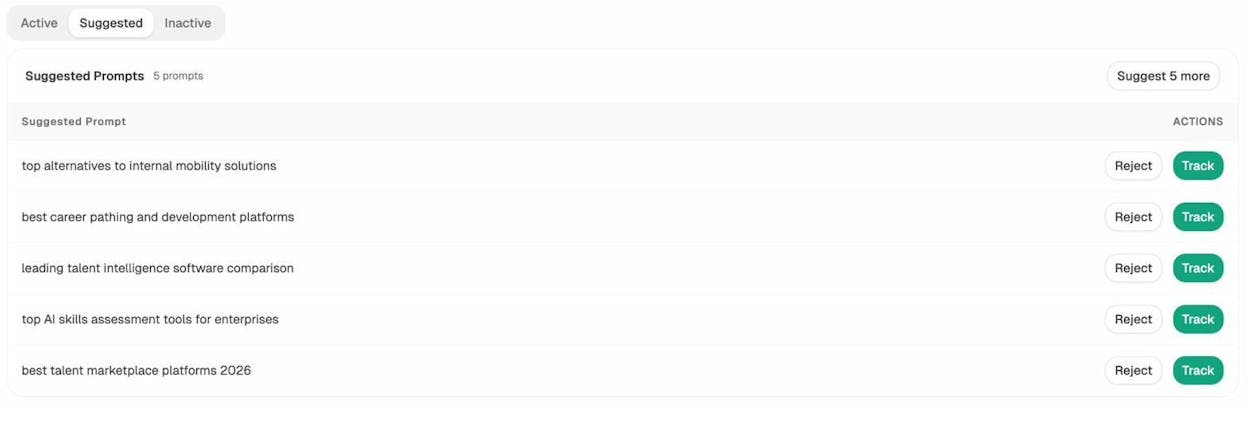
Track the ones that match your buyer intent, reject the rest. The system runs them across ChatGPT, Perplexity, and Google AI Mode every day.
For one-off research without committing a tracked prompt, the Ad Hoc Searches view lets you fire any prompt at any model in any country and see who gets cited.
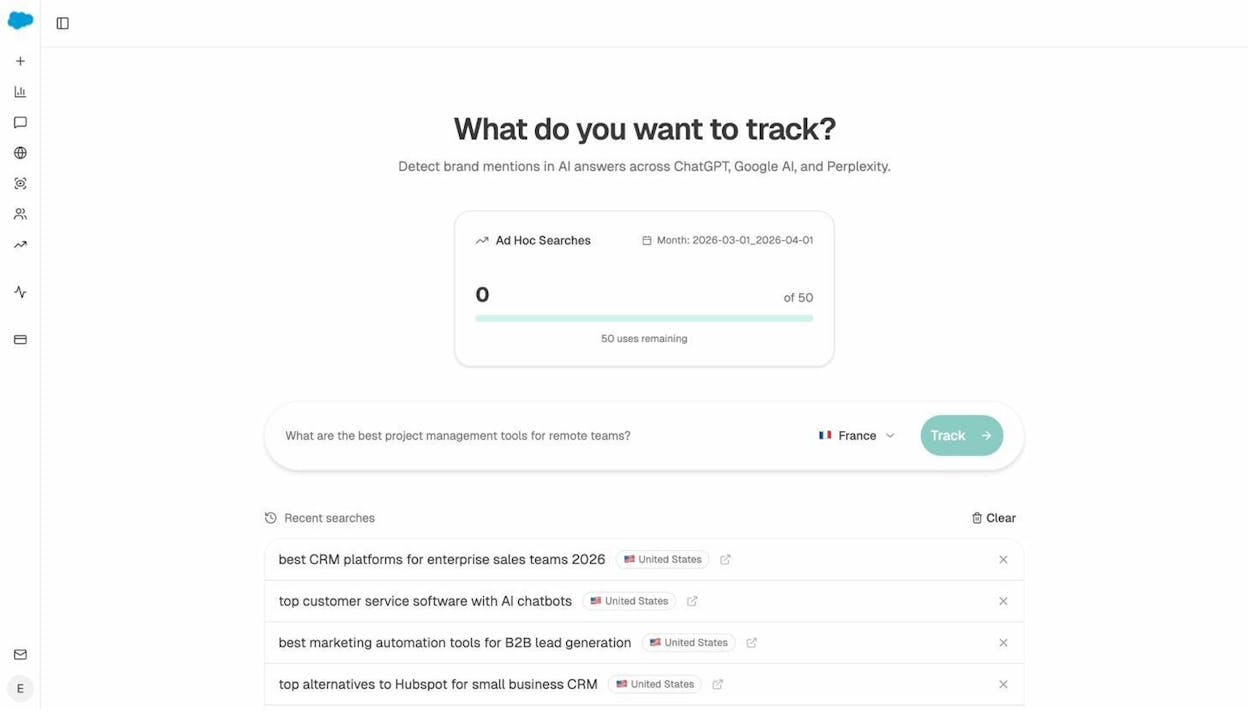
This is the AI-search version of typing a query into Google to see the top 10. Use it when you want to know, fast, who AI thinks is the answer to a specific buyer question. For a deeper walkthrough on this exact workflow, see our guide to AI keyword research.
The output of this section is a single spreadsheet with two tabs. SEO keywords your competitor ranks for, and AI prompts your competitor gets cited in. That is your content roadmap for the next quarter.
2. Spy on your competitor’s traffic, rankings, and AI visibility
Keywords and prompts tell you what they target. Traffic and visibility tell you what is working.
On Google
Plug the domain into your SEO tool and open the Overview report. Note three numbers. Organic traffic, organic traffic value, and the traffic trend over the last 12 months.
![[Screenshot of Ahrefs Site Explorer Overview report showing organic traffic, traffic value, and the 12-month chart]](https://www.datocms-assets.com/164164/1778178825-blobid6.jpg?auto=format,compress&w=1248&fit=max)
A flat line means stable. A rising line means a winning content motion you should study. A falling line means an opening you can exploit.
To see what changed and when, go to the rankings calendar inside the Top pages or rank tracking view. Filter for “Improved” to see keyword wins, then for “Lost” to see keyword losses.
![[Screenshot of the Ahrefs rankings calendar with Improved checkbox selected, showing keyword position changes by date]](https://www.datocms-assets.com/164164/1778178828-blobid7.png?auto=format,compress&w=1248&fit=max)
Wins on a specific date usually mean a new piece of content shipped or an algorithm update favored them. Losses are an invitation. If a competitor dropped 200 keyword positions in March, their March content audit is your April publishing schedule. Free rank tracking tools cover this for a small set of keywords if you do not have an SEO suite.
On AI search
Visibility in AI search is a different metric. It is the percentage of times your brand was mentioned across the AI prompts you track. The Analyze AI overview shows your visibility next to your competitors’ over time, on one chart.
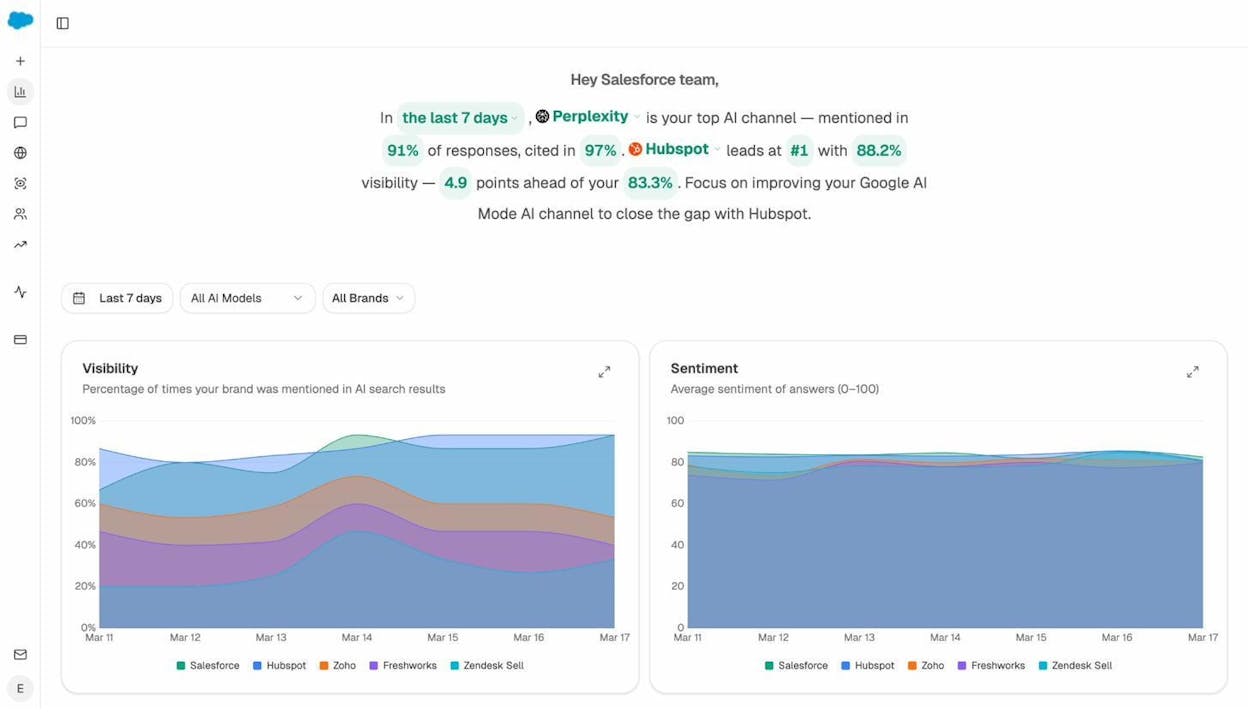
Read this chart the same way you read the Google traffic line. A flat competitor line means stability. A rising line means they are winning more AI conversations. A falling line means a window has opened.
The Position Trend chart goes one level deeper. It shows where each brand ranks among competitors when AI does include both of you in the same answer.
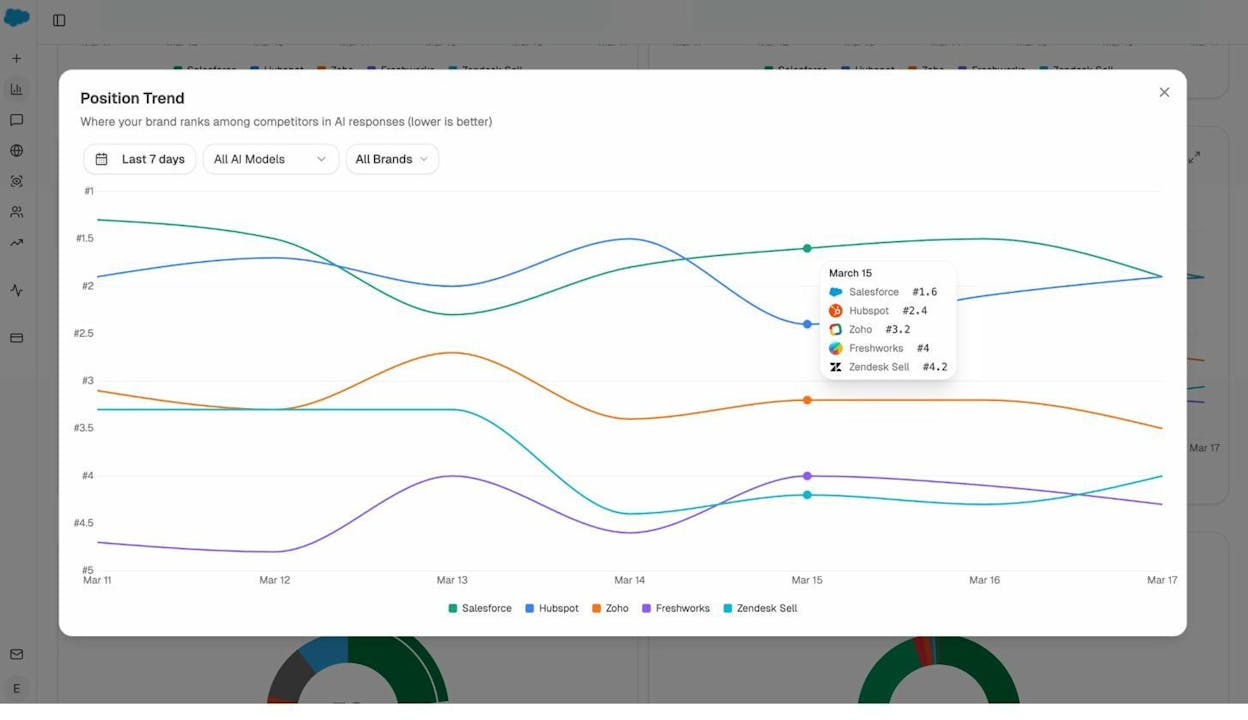
Lower is better. If your top competitor sits at #1.6 and you sit at #2.4, the gap is 0.8 ranks. That is the number you are trying to close. Closing it is mostly a matter of being cited by more of the sources AI engines trust in your space, which we cover in section 4.
For a single tracked prompt, the per-prompt view shows visibility curves for every competitor on that one prompt, segmented by AI model.
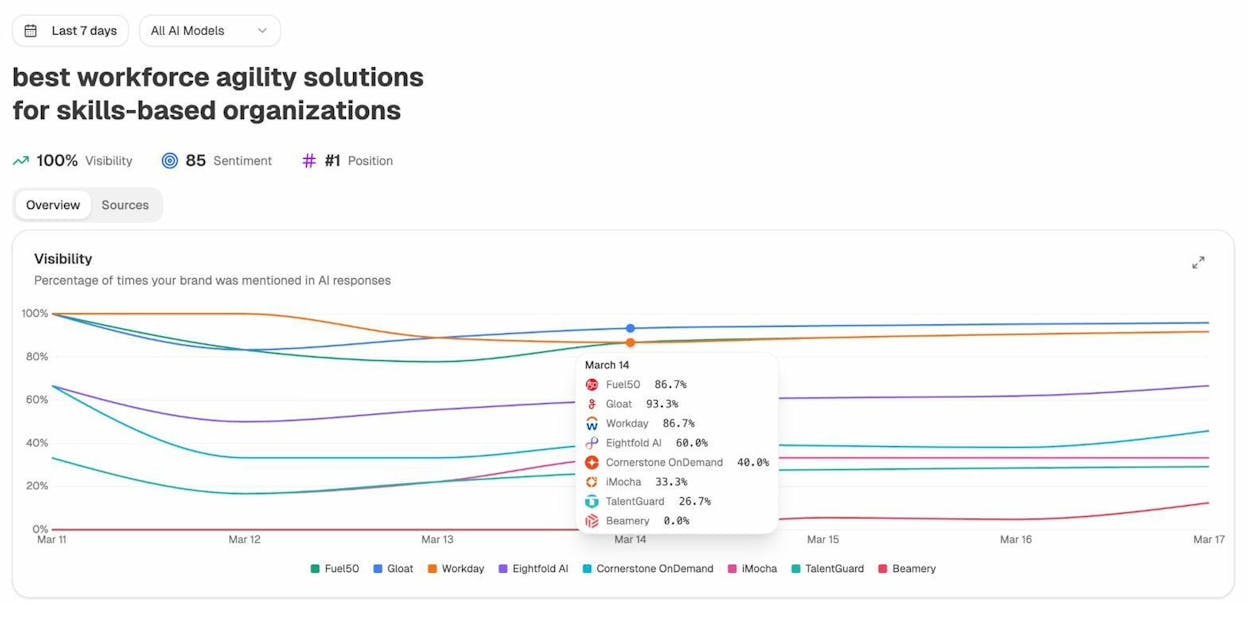
Use this to find the specific prompts where you are losing badly. Those are your high-leverage content briefs. For more on this measurement layer, see our AI visibility tracking feature page.
3. Spy on the pages doing their heavy lifting
Knowing the keywords is not enough. You need to know which specific pages are bringing the traffic and citations home.
On Google
In your SEO tool, open Top pages and filter the URLs by /blog/. This surfaces the blog posts driving the most organic traffic.
![[Screenshot of Ahrefs Top pages report with /blog/ URL filter applied, sorted by traffic]](https://www.datocms-assets.com/164164/1778178843-blobid11.png?auto=format,compress&w=1248&fit=max)
Open the top five tabs and read each post end to end. Take notes on three things. The angle, the structure, and the depth of detail. You are not copying. You are diagnosing why these specific pages outperform their direct alternatives. Then you write a better one. Our SEO content strategy playbook covers the briefing process in full.
For value-of-page analysis, sort the same report by traffic value rather than traffic. A page worth $50,000 in monthly traffic is the page you write before you write the page worth $5,000.
On AI search
The equivalent question is which competitor pages AI engines cite most often. Open the Sources report in Analyze AI. The URL list shows every page AI has cited in your tracked prompts, with the brands mentioned in the response, the content type, and how often it was used.
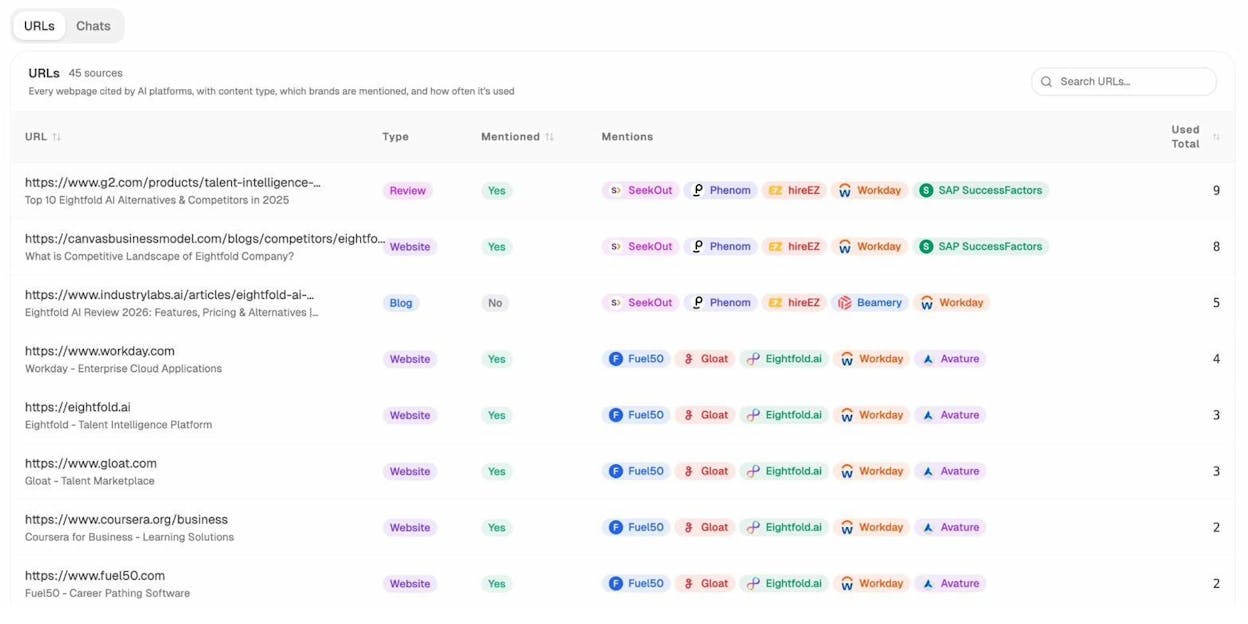
Sort by Used Total to find the most-cited pages in your category. If a competitor’s blog post has 9 citations, that post is doing the AI-search equivalent of ranking #1. Read it. Note its structure, its claim density, its citations and statistics. The pattern that gets cited in your space is now visible to you.
For a single prompt, you can see exactly which sources AI used to construct each answer.
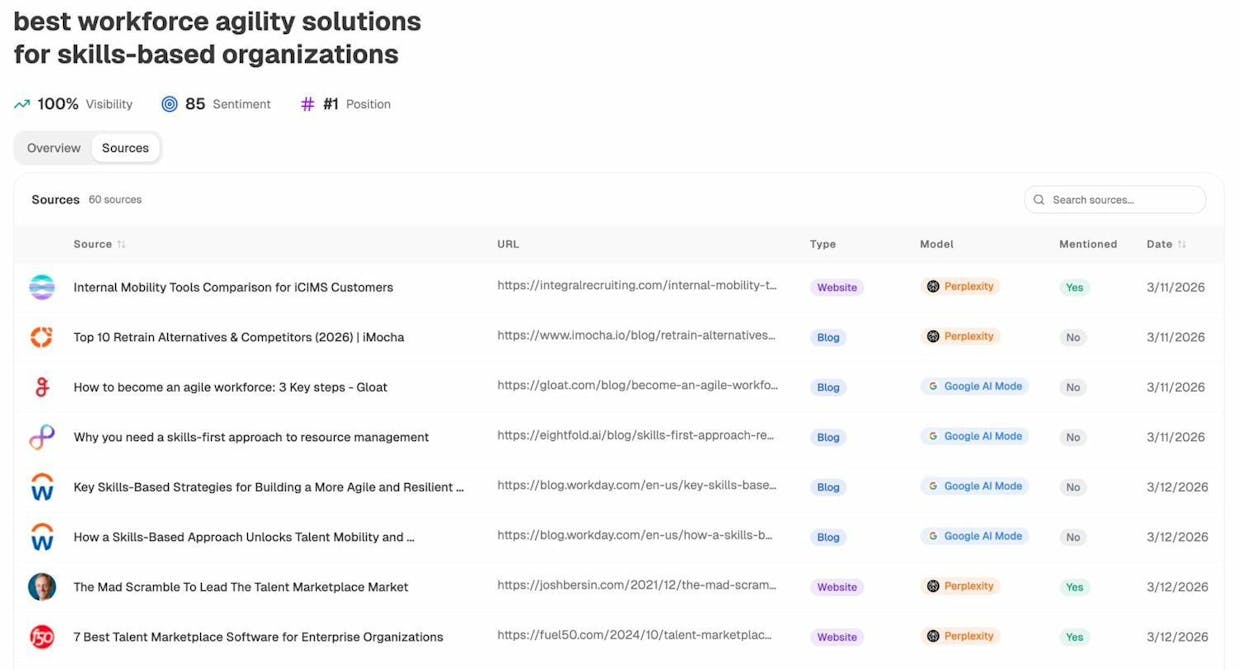
This view is useful when you want to figure out, for one specific buyer question, what AI is reading to answer it. If five of the top eight sources are review sites, your investment for that prompt is review-site placement, not a blog post.
To find patterns across your own AI traffic so you can double down on what already works, the Landing Pages report lists every page on your site that has received AI-referred sessions, with bounce rate, duration, and the prompts that drove the visit.
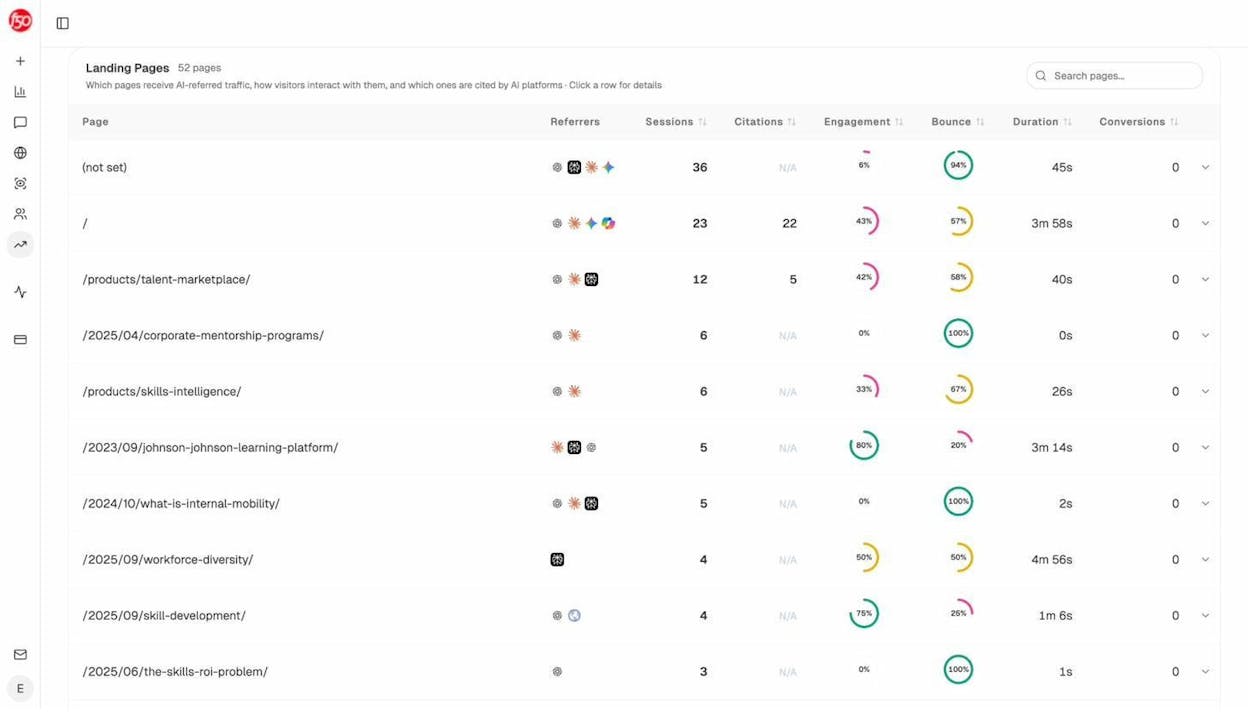
Pages with strong duration and low bounce are formats AI is sending qualified traffic to. Whatever pattern those pages share, lean into it.
4. Spy on their backlinks and AI citation sources
Authority follows the same logic in both channels. You are looking for the third-party sites that vouch for your competitor, then you are pitching the same sites yourself.
On Google
Open the Referring domains report in your SEO tool. Sort by domain rating descending. The top of the list is your initial outreach target list.
![[Screenshot of Ahrefs Referring domains report sorted by DR descending]](https://www.datocms-assets.com/164164/1778178857-blobid15.png?auto=format,compress&w=1248&fit=max)
Click into a referring domain to see exactly which page on the competitor’s site they linked to and why. That gives you the angle for your pitch. If The Guardian linked to your competitor’s Oxford comma article, your pitch is a more authoritative or more specific version of that piece.
To find link prospects in bulk, use a link intersect feature. Plug your competitor on top, your own domain on the bottom, and you get the list of domains linking to them but not you.
![[Screenshot of Ahrefs Link Intersect tool with three competitor domains in the top rows and your domain in the bottom]](https://www.datocms-assets.com/164164/1778178860-blobid16.png?auto=format,compress&w=1248&fit=max)
For free starting points, a website authority checker gives you a quick read on any domain, and our roundup of backlink building tools covers the workflow.
On AI search
The AI-search analog of a backlink is a citation. AI engines repeatedly draw from a small set of trusted domains in every category. If you are not on that list, you are not in the answer.
The Top Cited Domains view in Analyze AI shows the sites AI engines cite most often when answering questions in your space.
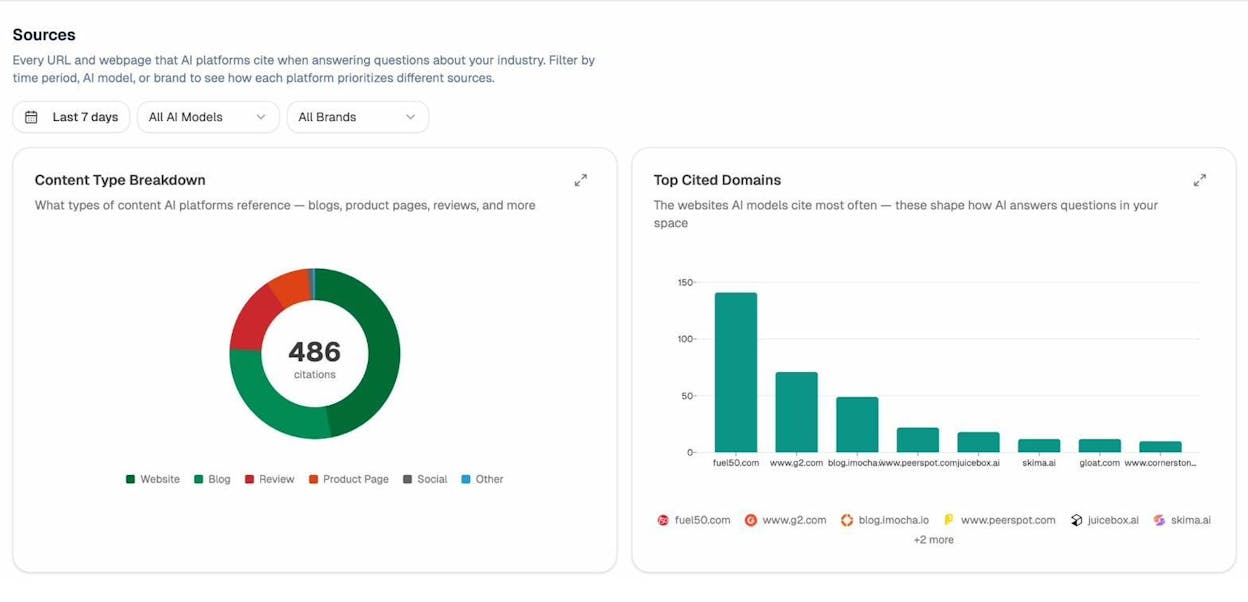
You can filter by AI engine because each one has different preferences. ChatGPT relies more on Wikipedia and LinkedIn. Claude leans into company blogs. Perplexity favors product pages and review sites. The same chart, filtered by ChatGPT only, looks materially different.
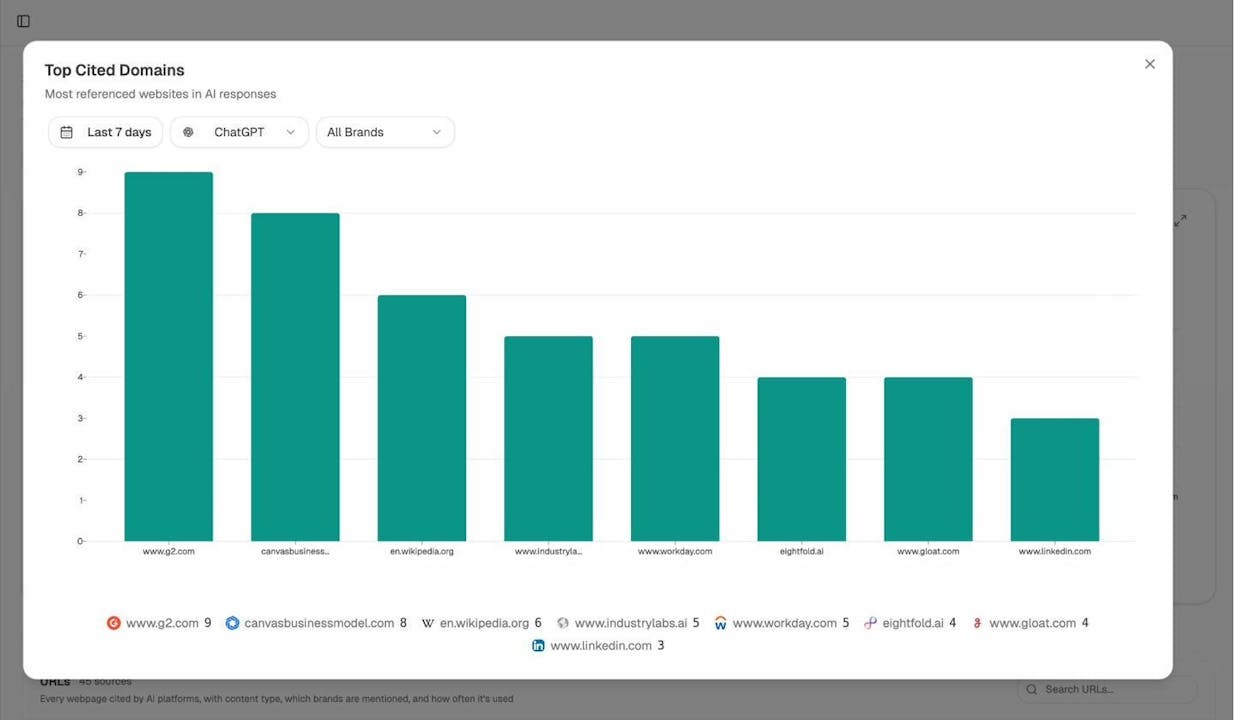
The output of this section is your citation outreach list. If G2 and Capterra are cited 100+ times in your space, you need a strong G2 profile. If Wikipedia comes up often on ChatGPT, you need a Wikipedia entry. If a specific industry blog dominates Perplexity, you need a guest post or product mention there. For a structured workflow on this, see how to get mentioned in AI search, which we built from 65,000 citations of data.
5. Spy on your competitor’s Google Ads
Paid is the channel with the most public data, because anyone running the same search sees the ads.
Plug the domain into your SEO tool, open Paid search, and you see the keywords they bid on, the estimated paid traffic, and a 24-month spend trend.
![[Screenshot of Ahrefs Site Explorer Paid search overview with keyword count, paid traffic, and the spend trend chart]](https://www.datocms-assets.com/164164/1778178871-blobid19.png?auto=format,compress&w=1248&fit=max)
Two questions to answer with this data. What keywords are they buying that you are not, and what does their ad copy say. The first tells you if there is bottom-funnel demand you are missing. The second tells you which value props convert well enough to fund an ad budget.
To read the copy, open the Ads subview and filter the descriptions for any keyword you care about, like “pricing” or “free trial.”
![[Screenshot of Ahrefs Ads report with a description filter applied for the keyword “pricing”]](https://www.datocms-assets.com/164164/1778178874-blobid20.png?auto=format,compress&w=1248&fit=max)
Their ad copy is the A/B test their team paid to run, and you get to read the winners for free. Borrow the framing for your landing pages and your own paid tests.
6. Spy on their brand narrative and AI perception
This is the section that does not exist in any traditional SEO spying guide, because before AI search there was no way to measure it.
Brand perception used to be a survey. You hired a research firm, asked 500 buyers what they thought of you and your competitors, and got a deck three months later. AI engines now do this in real time, except instead of buyers it is the model summarizing thousands of public sources for every prompt.
Analyze AI’s Perception Map plots every tracked brand on a quadrant defined by visibility (how often AI mentions them) and narrative strength (how distinctive AI’s story about them is).
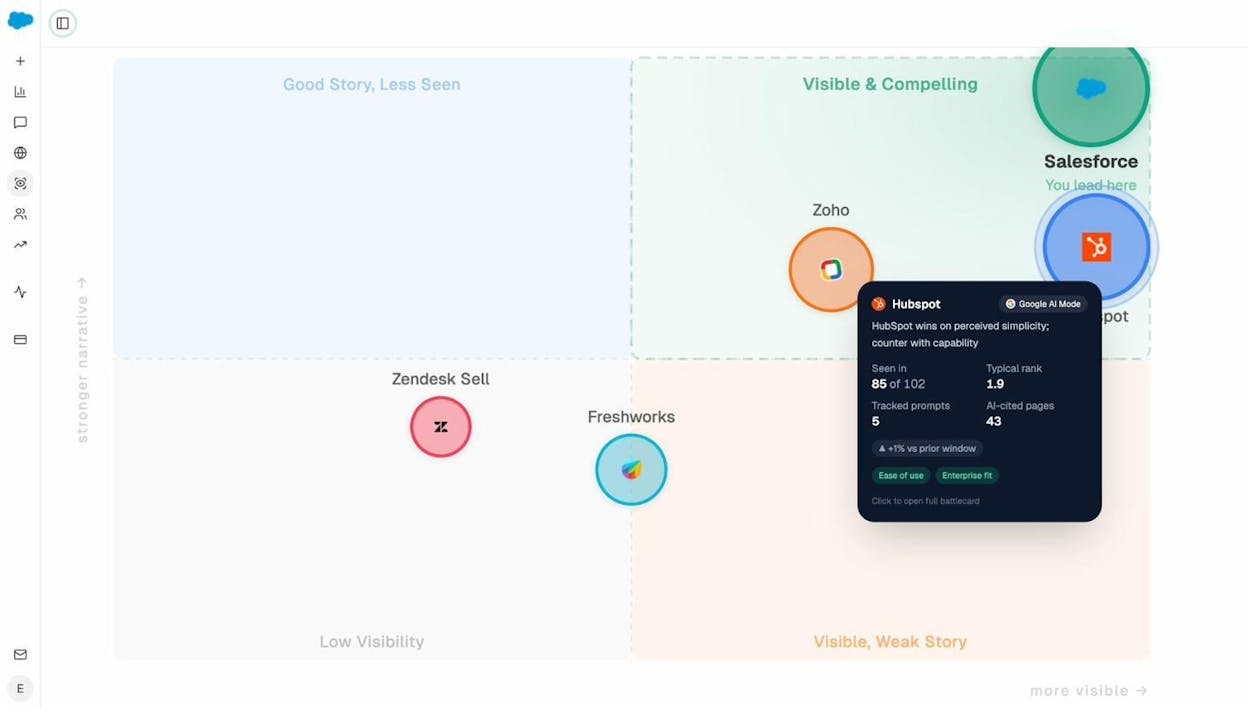
A competitor in Visible & Compelling is the one to study, not the one ranked #1 on Google. They have a story AI repeats. A competitor in Visible, Weak Story is exposed. AI mentions them, but the story is generic. That is the brand you can outflank with sharper messaging.
Click into any competitor and you get a head-to-head battlecard with the angle to use against them, the ship-to-close-the-gap content recommendation, and the proof you would need.
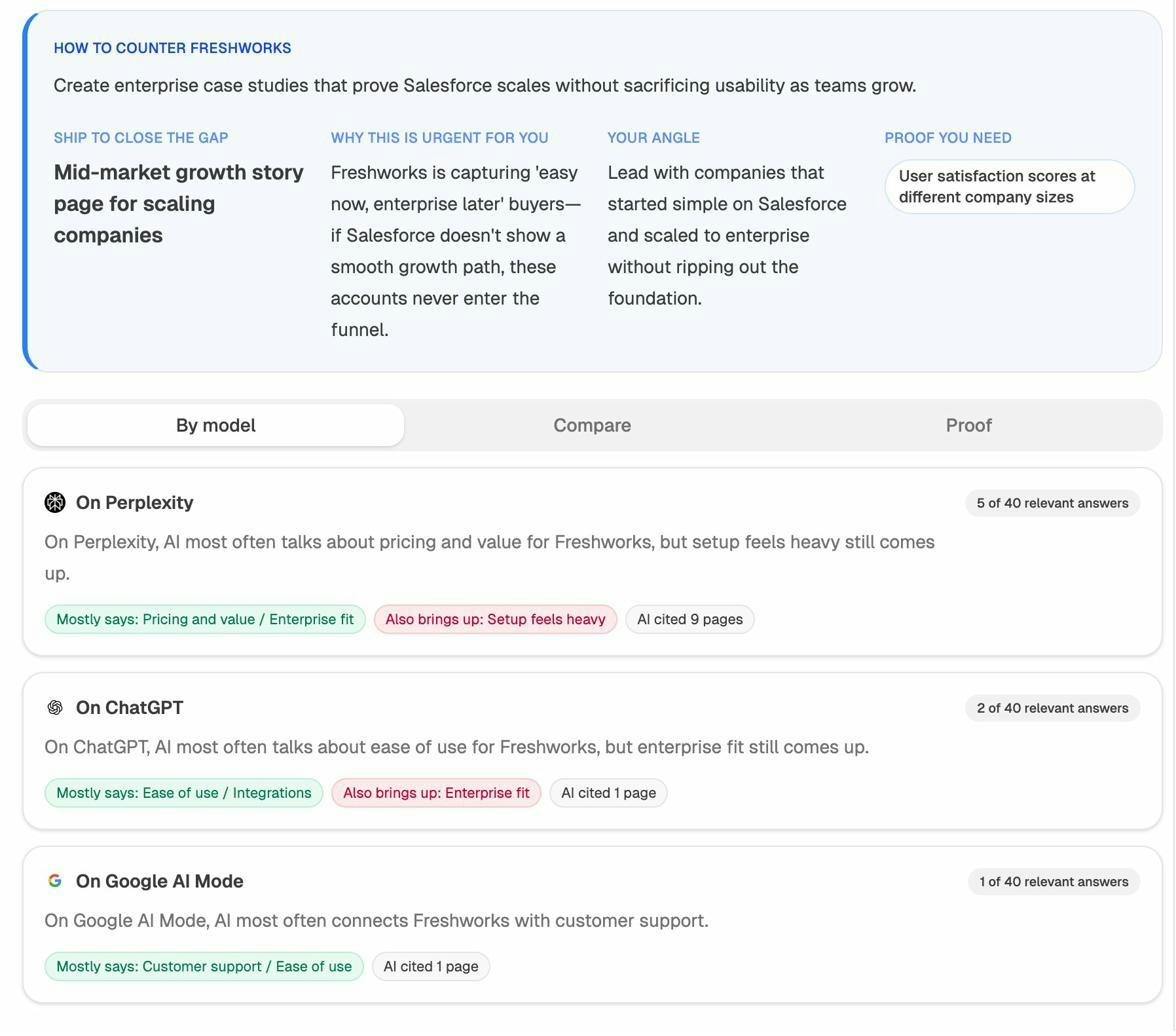
This is the part of the workflow that turns spying into a brief in minutes. It tells you, in one screen, what to ship next.
The third tab on the same screen shows the actual phrases AI repeats when describing each brand, weighted by frequency and sentiment.
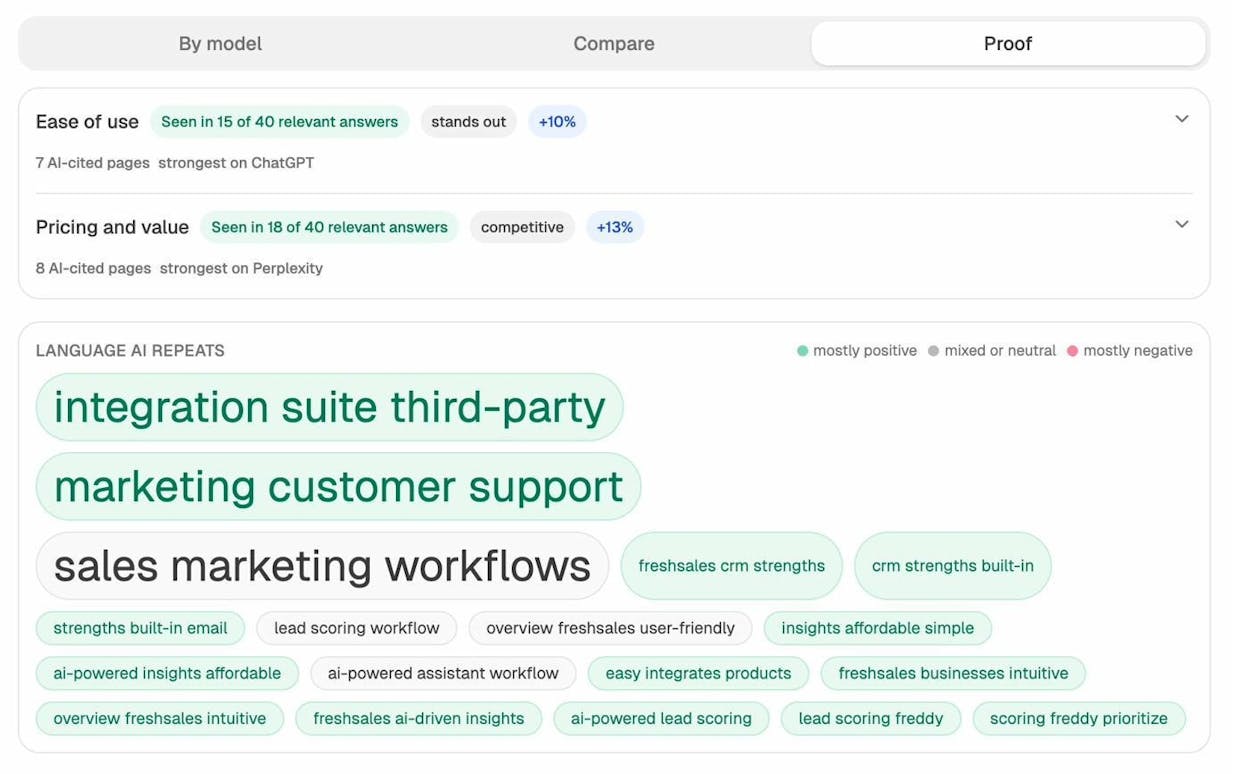
If “setup feels heavy” appears in their cloud and “easy to deploy” appears in yours, you have a positioning lever. If their cloud is full of vague phrases like “integration suite” and yours has specific outcomes like “30-day onboarding,” you are winning the language war on AI. The Perception Map and AI battlecards features are built for exactly this.
7. Spy on their content engine
A competitor outranking you is not always a content problem. It is often an output problem. They are publishing more, and the right kind of more.
On Google
Open Content Explorer in your SEO tool, type site:competitor.com, and click the Authors tab. You see every author writing for them, ranked by total traffic, traffic value, and posts.
![[Screenshot of Ahrefs Content Explorer Authors tab for competitor.com showing the top authors ranked by traffic value]](https://www.datocms-assets.com/164164/1778178894-blobid24.jpg?auto=format,compress&w=1248&fit=max)
The top author on a competitor’s blog is usually a hire signal. They wrote 40 posts that drive $300,000 in traffic value. You either recruit them, find their freelance equivalent, or study what made their posts work and brief that pattern to your team.
For a tour of competitor monitoring tools that make this kind of recurring research easier, that roundup is current.
On AI search
The AI-search version of “content engine velocity” is which competitor pages are gaining citations week over week. The Analyze AI weekly digest surfaces this automatically.
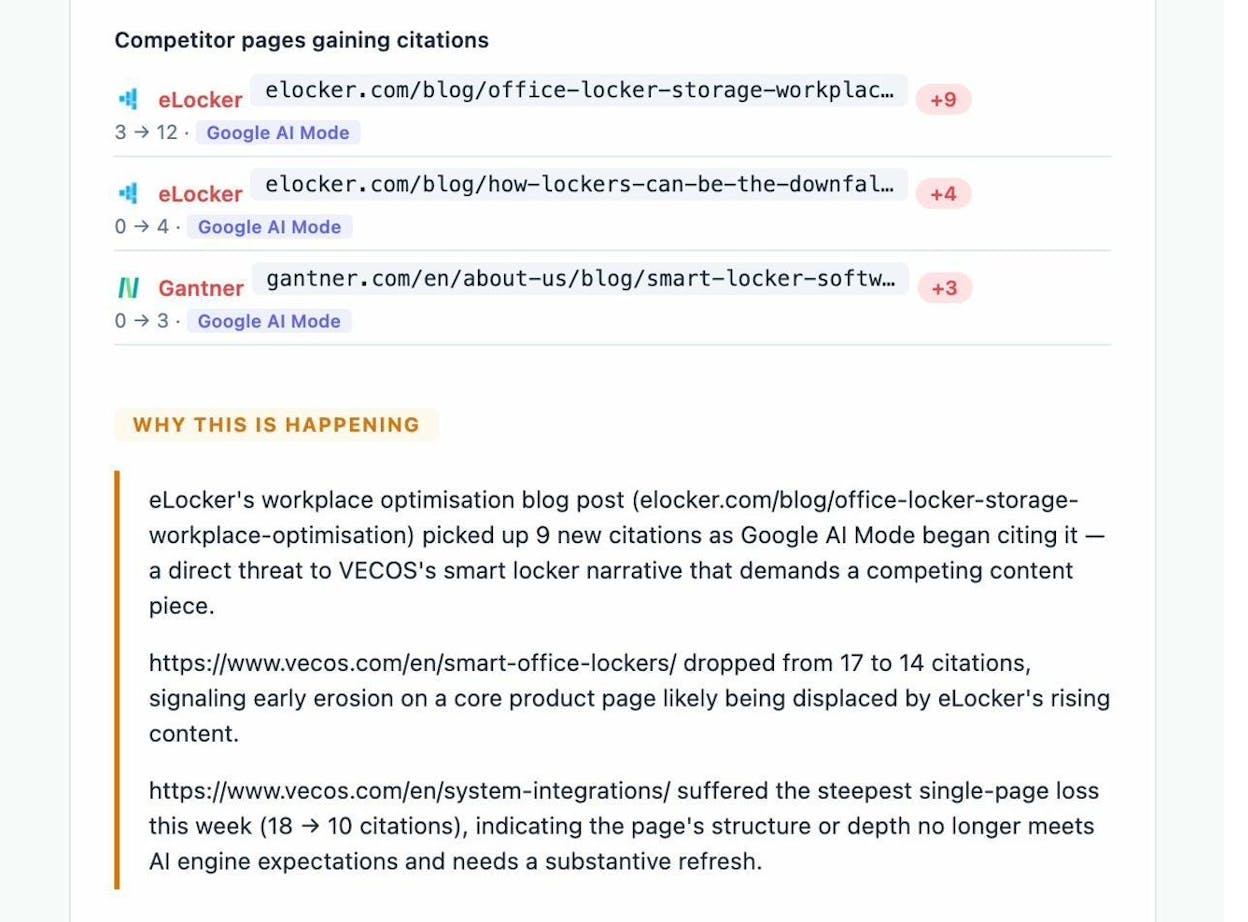
A competitor page that picked up 9 citations in a week did something. Maybe they updated it. Maybe an authoritative source linked to it. Maybe AI engines began trusting the domain more. Either way, that is the page to study before it compounds.
If you are not sure which competitors to even watch, the Suggested Competitors view lists brands that show up frequently in AI answers in your category but you have not started tracking yet.
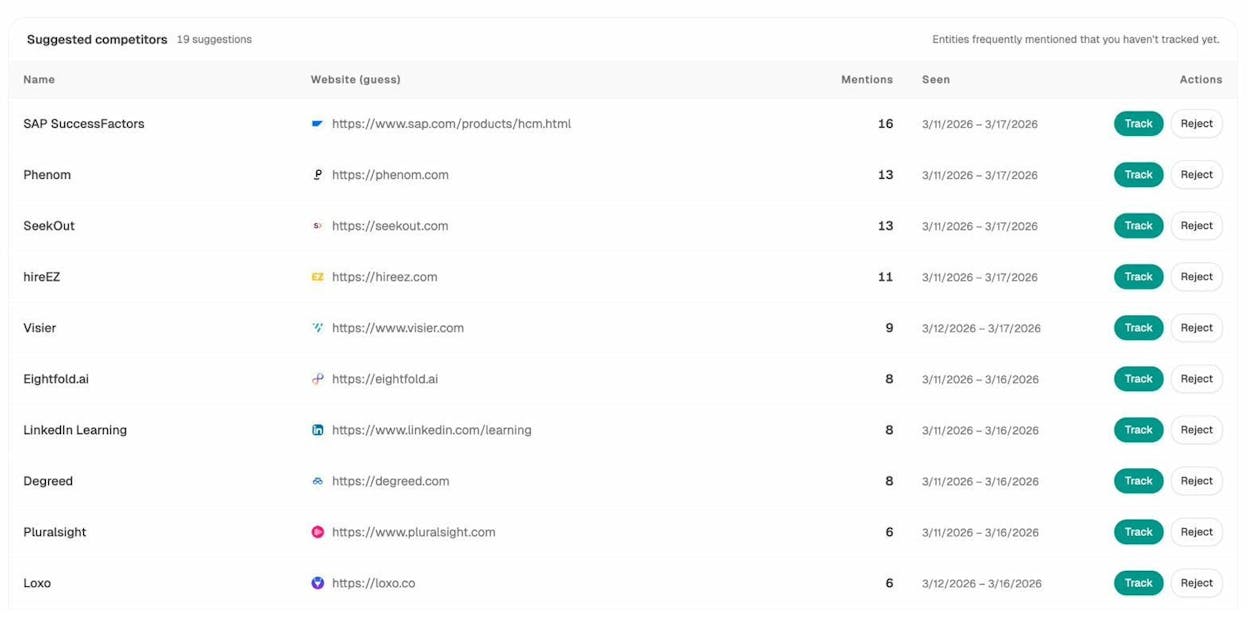
Track the ones that match your buyer’s consideration set. Reject the rest. The system updates this list as AI conversations evolve, so the watch list is never stale. For the strategic frame around this kind of recurring competitive review, see our SEO competitor analysis guide and our brand tracking roundup.
Final thoughts
Spying on your competitors used to mean reading their blog and clicking through their backlinks. That worked when Google was the only channel that mattered. It does not work anymore, because half of buyer demand now lives inside AI answers your SEO tool cannot see.
The fix is not to abandon the SEO playbook. It is to run a parallel one. Same questions, two surfaces. Who is winning the demand, where are they winning it, who is vouching for them, and what is the language that wins.
Three things to do this week.
-
Pick one priority competitor. Run the seven tactics above on them once. Block four hours.
-
Set up competitor intelligence and prompt tracking so the AI-search half of the analysis runs on autopilot.
-
Pull the gaps you found into a single content brief and ship one piece against the priority gap by end of the month.
Compound this every quarter and the position you spy on next year will be your own.

Ernest

Ibrahim


