

![Link Building Outreach: A Step-by-Step Guide [With Templates]](/_next/image?url=https%3A%2F%2Fwww.datocms-assets.com%2F164164%2F1774864954-blobid0.png&w=3840&q=75)

Summarize this blog post with:


Link outreach is the process of contacting other websites to ask for a backlink. It sounds simple, but most people do it badly — sending hundreds of generic emails and wondering why nobody replies.
In this article, you’ll learn how link outreach actually works, from finding the right prospects to writing emails that get responses. You’ll also learn why traditional outreach is only half the picture now that AI search engines like ChatGPT, Perplexity, and Gemini are reshaping how people discover and reference content.
Table of Contents
What Is Link Outreach?
Link outreach is when you email (or DM) another website owner to request a backlink to your content. The backlink could be a brand new link, a replacement for a broken one, or a swap from a competitor’s resource to yours.
Here is an example of a link outreach email requesting a broken link replacement:
![[Screenshot: Example outreach email showing a polite broken link replacement request, with subject line, personalized opener referencing the recipient’s specific article, a note about the broken link, and a suggestion for your replacement resource]](https://www.datocms-assets.com/164164/1774864954-blobid1.png?auto=format,compress&w=1248&fit=max)
At its core, link outreach is a value exchange. You are asking someone to take time out of their day — log into their CMS, find the right page, edit the HTML — so you need to make the “why” crystal clear.
Before we get into the mechanics, here is the key mindset shift: link outreach is not about sending emails. It is about finding the right people, with the right reason to link, and making the ask as easy as possible.
Why Link Outreach Still Matters (Even in the Age of AI Search)
You might be wondering: does link building still matter when ChatGPT and Perplexity are changing how people search?
Short answer: yes. Here is why.
Backlinks remain one of Google’s top ranking signals. Pages with strong backlink profiles consistently outrank pages without them. That has not changed.
But here is what has changed: AI search engines like ChatGPT, Perplexity, Claude, and Gemini now pull answers from the web and cite their sources. If your content ranks well on Google — partly because of your backlinks — it is more likely to be cited in AI-generated answers too.
In other words, link building creates a compounding effect. Better backlinks lead to higher Google rankings, which lead to more AI citations, which lead to more brand visibility across both channels.
This is why we believe SEO is not dead — it is evolving. AI search is a complementary organic channel, not a replacement. The fundamentals of building authority through great content and strong links still apply. What has expanded is where that authority gets recognized.
You can track this compounding effect directly. With Analyze AI, you can see exactly which of your pages receive AI referral traffic, which AI engines drive sessions, and how your visibility changes over time.
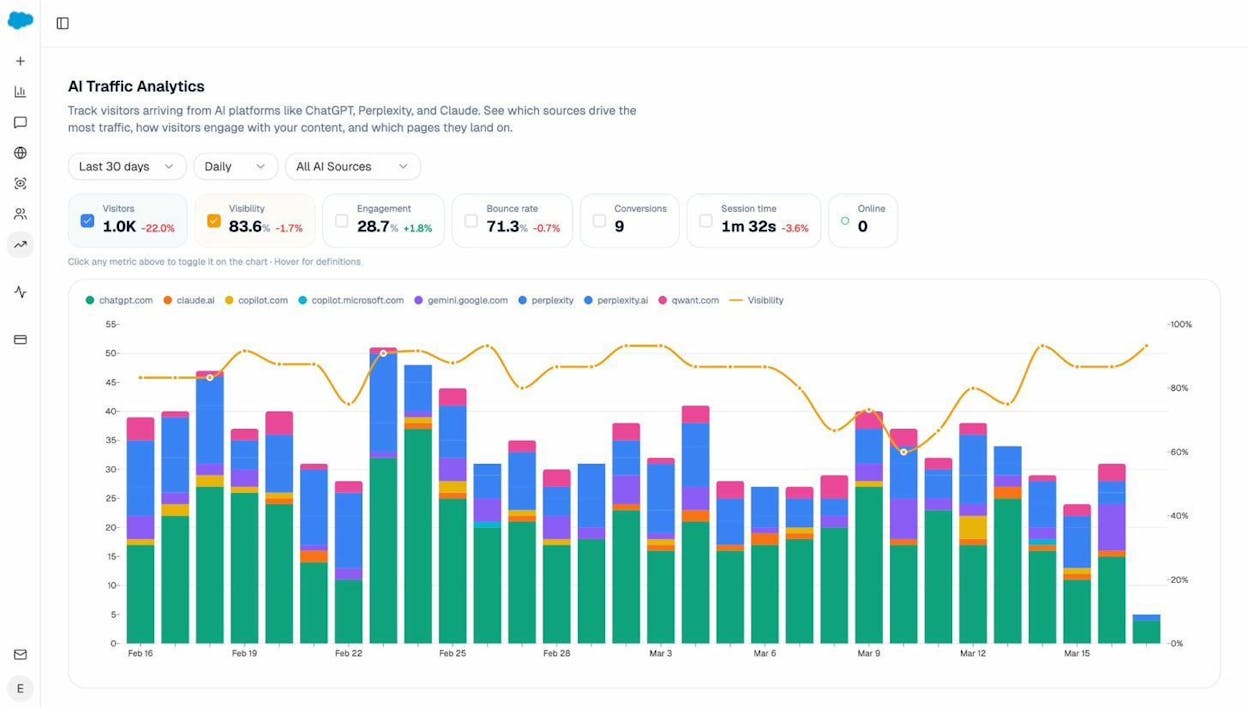
When you build high-quality links to a page and that page climbs in Google’s rankings, you can use this dashboard to see whether AI engines start citing that same page more frequently. That feedback loop — backlinks → rankings → AI citations → more traffic — is what makes link outreach so valuable today.
How to Do Link Outreach (Step by Step)
Link outreach breaks down into five steps: choose a tactic, find prospects, find their contact info, send a personalized pitch, and follow up.
Each step matters. Skip one and the entire campaign falls apart.
Step 1: Choose Your Link Building Tactic
Before you reach out to anyone, decide what type of campaign you are running. Your tactic determines who you reach out to and what you say.
Here are the most common link building tactics and the type of prospect each one requires:
|
Link Building Tactic |
Who to Reach Out To |
What You Offer |
|---|---|---|
|
Broken link building |
People linking to a dead page about your topic |
A working replacement resource |
|
Guest blogging |
Sites that publish content from outside contributors |
A free, high-quality article for their blog |
|
Skyscraper technique |
People linking to a less comprehensive page on your topic |
A more thorough, updated resource |
|
Unlinked brand mentions |
People who mentioned your brand but did not link |
A simple request to add the link |
|
Resource page link building |
People who curate industry resource lists |
Your resource as a suggested addition |
|
Podcast link building |
People who host niche podcasts |
Your expertise as a guest |
|
Statistics page outreach |
People who cite statistics in their content |
Your original data or research |
Pick one tactic to start with. Trying to run five campaigns simultaneously splits your attention and dilutes your results.
If you are new to link outreach, broken link building is the easiest starting point. You are doing the other person a favor (alerting them to a dead link) while also providing a solution (your working resource). That makes the ask feel helpful instead of transactional.
For a deeper look at each of these tactics and more, check out our guide to off-page SEO strategies.
Step 2: Find the Right Prospects
The most common link outreach mistake is spending hours perfecting your email while sending it to the wrong people. Finding the right prospects matters more than writing the perfect pitch.
Here is how to find prospects for three of the most popular tactics:
Finding Prospects for Broken Link Building
Broken link building works because you lead with value: “Hey, you have a dead link on your site. Here’s a working replacement.”
To find broken link opportunities:
-
Identify popular pages in your niche that no longer exist. Use a tool like Wayback Machine or check competitors’ sites for 404 pages on topics you cover.
-
Find who links to those dead pages. Plug the dead URL into a backlink analysis tool. You will see every website that still links to the now-broken page.
-
Filter for quality. Not every linking site is worth contacting. Focus on sites with actual organic traffic, a decent domain authority, and content that is relevant to yours. You can check domain authority quickly using our Website Authority Checker.
-
Verify the link is still broken. Pages sometimes get redirected or fixed. Open the linking page and confirm the broken link still returns a 404. You can speed this up with our Broken Link Checker, which scans any page and flags dead links in seconds.
![[Screenshot: Analyze AI Broken Link Checker tool scanning a URL and returning a list of broken links found on the page]](https://www.datocms-assets.com/164164/1774864972-blobid3.png?auto=format,compress&w=1248&fit=max)
-
Make sure you have (or can create) a suitable replacement page. Your replacement content should cover the same topic as the dead page, ideally better.
![[Screenshot: Using a backlink analysis tool to find sites linking to a dead URL — showing the list of referring domains, their domain ratings, and the number of referring pages]](https://www.datocms-assets.com/164164/1774864976-blobid4.png?auto=format,compress&w=1248&fit=max)
Finding Prospects for Guest Blogging
Guest blogging is one of the oldest link building tactics, and it still works — if you target the right sites.
Here is how to find sites likely to accept guest posts:
-
Search Google for your topic + “write for us” or “guest post.” This surfaces sites that actively solicit guest contributions. For example: content marketing "write for us".
![[Screenshot: Google search results for ‘content marketing “write for us”’ showing multiple sites with guest post submission pages]](https://www.datocms-assets.com/164164/1774864985-blobid5.png?auto=format,compress&w=1248&fit=max)
-
Look for sites with multiple authors. If a blog has only one author, they probably do not accept guest posts. If it lists five or more authors, it is far more likely.
-
Check organic traffic. There is no point guest posting on a site that gets zero visitors. Use our Website Traffic Checker to estimate how much organic traffic the site receives.
-
Prioritize relevance over metrics. A guest post on a small but highly relevant industry blog will send more qualified traffic (and carry more topical authority) than a post on a massive but unrelated site.
Finding Prospects for Unlinked Brand Mentions
Unlinked mentions are the lowest-hanging fruit in link building. Someone already wrote about you — they just forgot to link.
To find unlinked mentions:
-
Search Google for your brand name (in quotes) and exclude your own site. For example: "Analyze AI" -site:tryanalyze.ai.
-
Review the results. Open each page and check whether they mentioned your brand with or without a link.
-
Use a brand monitoring tool. Tools like Google Alerts or dedicated mention trackers can email you every time your brand is mentioned online. This way you catch new unlinked mentions in real time.
AI search adds a new dimension to this. ChatGPT, Perplexity, and Gemini frequently mention brands in their answers without linking. With Analyze AI, you can see exactly which prompts mention your brand, whether the AI linked to your site, and how competitors compare.
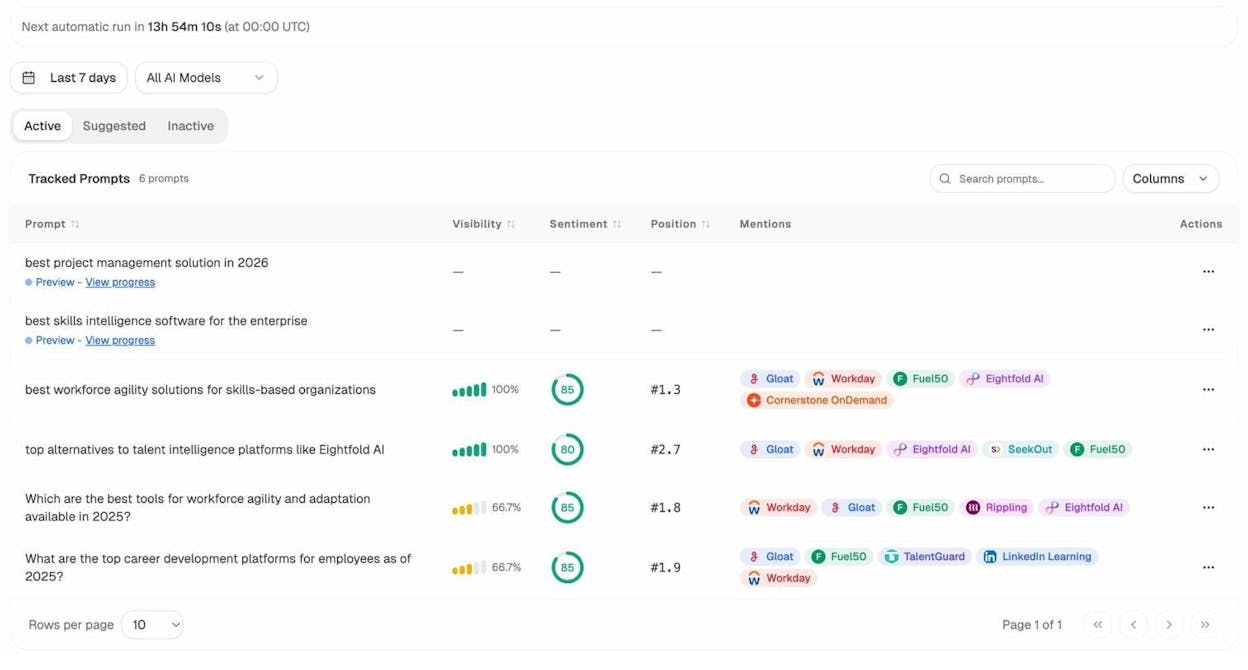
This gives you an entirely new category of “unlinked mentions” to act on — not from blog posts, but from AI-generated answers. When you know which AI prompts mention you without citing your pages, you can optimize that content to earn the citation next time.
For a complete guide to tracking these AI mentions, see our post on answer engine optimization.
Step 3: Find Their Contact Details
You have a list of prospects. Now you need their email addresses.
Here is the process:
Find the Right Person
Do not email [email protected]. Generic inboxes get ignored. You want the actual person responsible for the content you are referencing.
For most blog-based outreach, that person is one of:
-
The author of the article you are referencing
-
The editor or head of content
-
The site owner (for smaller sites)
Check the article’s byline first. Then look for that person on the company’s About or Team page.
Use an Email Lookup Tool
Once you know the person’s name and domain, use an email lookup tool to find their email. Here are the most reliable options:
|
Tool |
What It Does |
Pricing |
|---|---|---|
|
Finds emails by name + domain; has a Google Sheets add-on for bulk lookups |
Free up to 25 searches/month, then from $49/month |
|
|
Email finder + verifier + drip campaign tool in one |
Free up to 50 credits/month, then from $39/month |
|
|
Simple name + domain search with high accuracy |
From $49/month for 1,000 leads |
|
|
Finds professional emails + phone numbers |
Free trial, then from $53/month |
![[Screenshot: Hunter.io interface showing an email search — enter first name, last name, and company domain, and the tool returns the verified email address with a confidence score]](https://www.datocms-assets.com/164164/1774864994-blobid7.jpg?auto=format,compress&w=1248&fit=max)
Tip: If you cannot find a personal email, look for the person on LinkedIn. Many content marketers have their email in their LinkedIn profile, or they accept InMail messages.
Verify Before Sending
Always verify email addresses before sending outreach. A high bounce rate damages your sender reputation and can get your domain flagged as spam.
Use a verification tool like NeverBounce or ZeroBounce to validate your entire list. Upload a CSV of emails and the tool will flag invalid, risky, or catch-all addresses.
This step takes five minutes and saves you from sending 200 emails into the void.
Build a Tracking Spreadsheet
Keep all your prospect data in one place. A simple Google Sheet with these columns works:
-
Prospect Name — Who you are contacting
-
Website/Domain — The site you want a link from
-
Page URL — The specific page where the link should go
-
Contact Email — Their verified email
-
Tactic — Broken link, guest post, skyscraper, etc.
-
Status — Not Contacted, Emailed, Replied, Link Won, Declined
-
Date Sent — When you sent the initial email
-
Follow-Up Date — When to send a follow-up
-
Notes — Anything relevant (their preferred contact method, related topics, etc.)
This spreadsheet becomes your command center for the entire campaign. Without it, things get messy fast.
Step 4: Write and Send Your Outreach Email
This is where most guides spend 90% of their time. But here is the truth: the email matters far less than the prospect and the value proposition.
If you are reaching out to the right person with a genuine reason to link, even an average email will get results. If you are reaching out to the wrong person with no clear value, the world’s best email will not save you.
That said, your email should do three things well:
-
Get opened. Your subject line needs to be short, specific, and not look like a template.
-
Get read. Your email body needs to be brief and hook the reader immediately.
-
Get a response. Your pitch needs to make the action clear and low-friction.
Subject Line Rules
Keep your subject line under 50 characters. Make it specific to the recipient. Avoid anything that sounds like a mass email.
Good subject lines:
-
Quick question about your [Topic] post
-
Found a broken link on [Page Title]
-
[Name], resource suggestion for [Page Title]
-
Loved your piece on [Topic] — quick thought
Bad subject lines:
-
Link Exchange Opportunity!! — screams spam
-
I have a great resource for your readers — too vague
-
Collaboration Request — every spammer uses this
-
Hello [First Name], I hope this email finds you well — instant delete
Email Body Templates
Here are three templates for the three most common outreach tactics. These are starting points — customize them for each prospect.
Template 1: Broken Link Building
Subject: Broken link on [Page Title]
Hi [First Name],
I was reading your article on [Topic] and noticed that the link to
[Dead Page Title] in the section about [Context] seems to be broken
(returns a 404).
I recently published a guide on [Your Topic] that covers similar
ground: [Your URL]
Might be a good replacement if you're updating the post. Either way,
wanted to give you a heads up about the dead link.
Cheers,
[Your Name]
Why this works: You lead with something useful (the broken link notification), provide a solution (your replacement), and keep it short. The tone is casual and helpful, not desperate.
Template 2: Skyscraper / Resource Suggestion
Subject: Resource for your [Topic] article
Hi [First Name],
Your guide on [Topic] is one of the best I've found — especially
the section on [Specific Detail].
I just published an updated guide that covers [Unique Angle or
New Data]: [Your URL]
Could be a useful addition for your readers, especially the
section on [Specific Part of Your Content].
No worries if not — just thought I'd share.
[Your Name]
Why this works: You open with a genuine compliment about a specific section (proving you actually read their content), offer something with a concrete differentiator, and end with zero pressure.
Template 3: Unlinked Brand Mention
Subject: Thanks for mentioning [Your Brand]
Hi [First Name],
Appreciate you mentioning [Your Brand] in your article on [Topic].
Would you mind adding a link to [Your URL] so your readers can
find us easily? Here's where you mentioned us: [Quote or section
reference].
Happy to share the article with our audience once the link is
live.
Thanks,
[Your Name]
Why this works: The request is tiny (add a link to a mention that already exists) and you offer something in return (social sharing).
What Makes a Bad Outreach Email
Before you hit send, check your email for these red flags:
-
It starts with “I hope this email finds you well.” This is the universal signal of a mass email. Delete it.
-
It spends three paragraphs talking about you. Nobody cares about your company’s mission. Get to the point.
-
It does not explain why they should link. “Please check out my article” is not a reason. What is in it for them?
-
It uses fake personalization. Referencing an article the person wrote six years ago (or worse, a guest post they wrote for another site) proves you did not do your homework.
-
It asks for too much. Requesting a link, a social share, a newsletter mention, AND a reply in one email is overwhelming. Pick one ask.
![[Screenshot: Example of a bad outreach email — a wall of text with no personalization, a generic subject line like “Collaboration Opportunity!”, and a request to link to an unrelated page]](https://www.datocms-assets.com/164164/1774864998-blobid8.png?auto=format,compress&w=1248&fit=max)
Step 5: Follow Up (Once)
People are busy. Inboxes are crowded. Your email may have been buried under 50 others.
Send one follow-up email 5–7 days after your initial outreach. Keep it short:
Subject: Re: [Original Subject Line]
Hi [First Name],
Just bumping this to the top of your inbox. Totally understand
if you're busy — just wanted to make sure you saw my note about
[Brief Reason].
[Your Name]
One follow-up is enough. Two or more follow-ups cross the line from persistent to annoying. If they are not interested, they are not interested. Move on to the next prospect.
7 Link Outreach Tips That Actually Move the Needle
The five-step process above is the foundation. These tips are what separate a 1% response rate from a 5–10% response rate.
1. Find More Prospects (Not Better Templates)
Most people obsess over their email template. They rewrite the subject line 15 times, agonize over every word, and A/B test their sign-off.
Meanwhile, they are sending that perfected email to 50 people.
A poll of 800+ SEOs found that the average link outreach conversion rate is 1–5%. Run the math:
-
50 emails × 3% conversion rate = 1–2 links
-
500 emails × 3% conversion rate = 15 links
The biggest lever is not your template. It is the size and quality of your prospect list. Spend more time prospecting, less time wordsmithing.
This does not mean spamming everyone in your niche. It means being thorough in your prospecting: finding every relevant site that links to competing content, every resource page in your industry, every blog that accepts guest posts.
2. Use the Scoped Shotgun Approach
There are two schools of outreach:
-
Sniper approach: Every email is 100% unique. You spend 30 minutes per email researching the person, reading their latest articles, and crafting a deeply personal message.
-
Shotgun approach: You blast the same template to 1,000 people with zero personalization.
Both are wrong.
The sniper approach does not scale. You cannot spend 30 minutes per email when you need to contact 500 people. And the harsh reality is that hyper-personalization rarely changes someone’s mind if they were not inclined to link in the first place.
The shotgun approach gets you flagged as spam and destroys your sender reputation.
The solution is the scoped shotgun approach: use a template with dynamic variables that create natural, relevant personalization.
Your template stays the same, but each email automatically inserts:
-
The recipient’s first name
-
The title of their article
-
A specific section or detail from their article
-
Your unique value proposition for that particular prospect
You can set this up in outreach tools like Pitchbox, Buzzstream, or even simple mail merge tools like GMass for Gmail.
![[Screenshot: An outreach email template in a mail merge tool showing dynamic variables like {{first_name}}, {{article_title}}, and {{broken_link_url}} that get replaced with unique values for each prospect]](https://www.datocms-assets.com/164164/1774865000-blobid9.jpg?auto=format,compress&w=1248&fit=max)
This gives you personalization at scale — each email feels tailored without requiring 30 minutes of research.
3. Lead with Value, Not with Your Ask
The best outreach emails give before they ask.
Here are ways to lead with value depending on your tactic:
|
Tactic |
Value You Provide First |
|---|---|
|
Broken link building |
Alerting them to a dead link on their site |
|
Guest post |
Offering a free, high-quality article their audience will love |
|
Skyscraper |
Sharing a more comprehensive, more current resource |
|
Unlinked mention |
Reminding them of content they already liked enough to reference |
|
Statistics page |
Providing free, citable data they can use in future content |
Notice a pattern: in every case, you are solving a problem or providing something useful. You are not just asking for a favor from a stranger.
4. Verify Your Prospects Before Reaching Out
Nothing kills a campaign faster than emailing the wrong people. Here is a quick checklist before adding someone to your prospect list:
-
Does the site have organic traffic? A site with zero traffic means zero link value. Check with our Website Traffic Checker.
-
Is the site relevant to your niche? A link from a random, unrelated site does not help (and might hurt).
-
Does the person control the page? If they wrote a guest post for another site, they cannot edit it. You need to contact the site owner, not the author.
-
Is the site’s authority reasonable? Use our Website Authority Checker to gauge the site’s domain strength.
-
Is the link opportunity real? For broken link building, verify the link is actually broken. For skyscraper, verify your content is genuinely better.
Spending 60 seconds on this checklist per prospect saves hours of wasted outreach.
5. Build a Brand Before You Build Links
Here is an uncomfortable truth about link outreach: your brand matters more than your email.
When someone receives an outreach email from a brand they recognize, they are far more likely to respond. The “stranger” problem disappears. They already know you produce quality content, so they trust the ask.
How do you build a brand? The same way every successful brand does it: by consistently publishing great content over a long period.
Write helpful blog posts. Publish original research. Record podcast episodes. Share insights on LinkedIn and X. Show up consistently with quality work and your name will start to precede your outreach emails.
This takes time. There are no shortcuts. But once your brand is recognized in your niche, your outreach conversion rates will jump noticeably.
6. Build Relationships Before You Need Links
The best link builders do not send cold emails. They contact people they already know.
Here is how to build relationships in your industry before you ever ask for a link:
-
Comment on their content. Leave thoughtful, substantive comments on their blog posts, LinkedIn articles, and tweets. Not “Great post!” — actual engagement with specific points they made.
-
Share their work. If someone publishes something genuinely good, share it with your audience and tag them. This is one of the simplest ways to get on someone’s radar.
-
Invite them to contribute. Ask them for a quote for your next blog post, or invite them as a guest on your podcast. Giving them exposure first makes them far more receptive when you ask for something later.
-
Meet them in person. Industry conferences, local meetups, and online communities (Slack groups, Discord servers, subreddits) are all places where you can build genuine relationships. A 10-minute conversation at a conference creates more goodwill than 50 email exchanges.
Think of relationship building as a long-term investment. The dividends — in links, collaborations, referrals — compound over years.
7. Track Your Results and Iterate
You cannot improve what you do not measure. Track these metrics for every campaign:
-
Emails sent — Total outreach emails in the campaign
-
Open rate — What percentage opened your email (use a tool that tracks opens)
-
Reply rate — What percentage replied (positive or negative)
-
Conversion rate — What percentage resulted in a link won
-
Links won — Total new backlinks secured
-
Domain authority of links won — Are the links from high-quality or low-quality sites?
After each campaign, review what worked and what did not. Did certain subject lines get higher open rates? Did one tactic convert better than another? Did prospects from certain industries respond more?
Use these insights to refine your next campaign.
How to Track Whether Your Links Improve AI Visibility
Here is where link outreach gets interesting in 2026.
You can now measure whether your link building efforts improve your visibility in AI search — not just Google.
Traditional SEO metrics (rankings, organic traffic, domain authority) only tell half the story. The other half is whether AI engines like ChatGPT, Perplexity, Claude, and Gemini are citing your content in their answers.
With Analyze AI, you can track this directly:
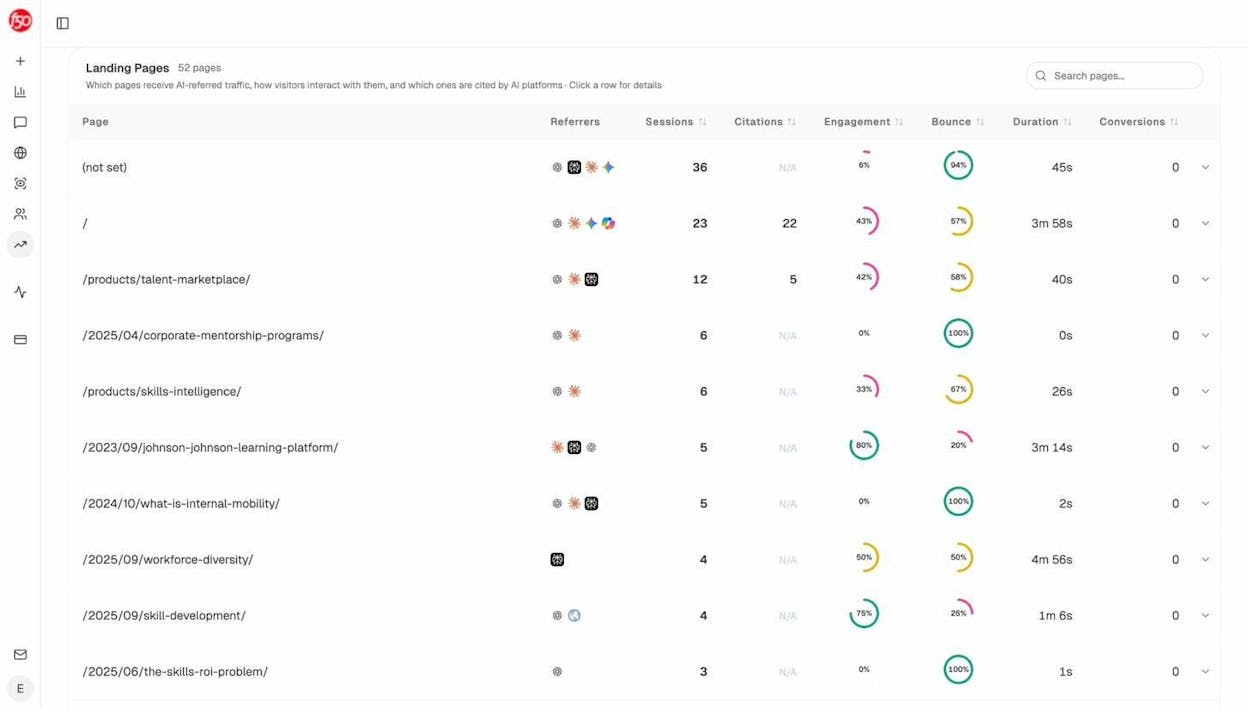
See which of your pages get AI referral traffic. After building links to a specific page, check whether that page starts appearing more frequently in AI-generated answers.
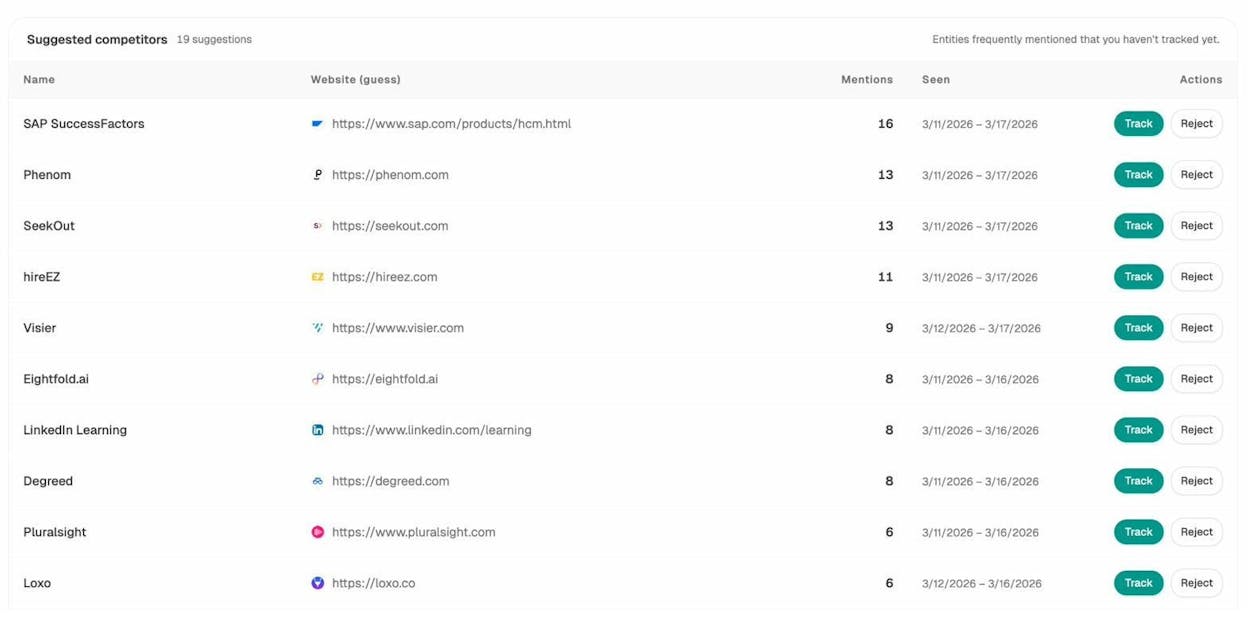
Monitor your competitor overlap. Analyze AI shows which brands appear alongside yours in AI answers. If a competitor consistently shows up in prompts where you do not, that is a gap you can close — partly through better link building to your competing content.
Track citation sources. Analyze AI reveals which URLs AI models cite when answering questions about your industry. If a competitor’s guide on “link building strategies” gets cited by ChatGPT but yours does not, building more high-quality links to your guide could help it earn that citation.
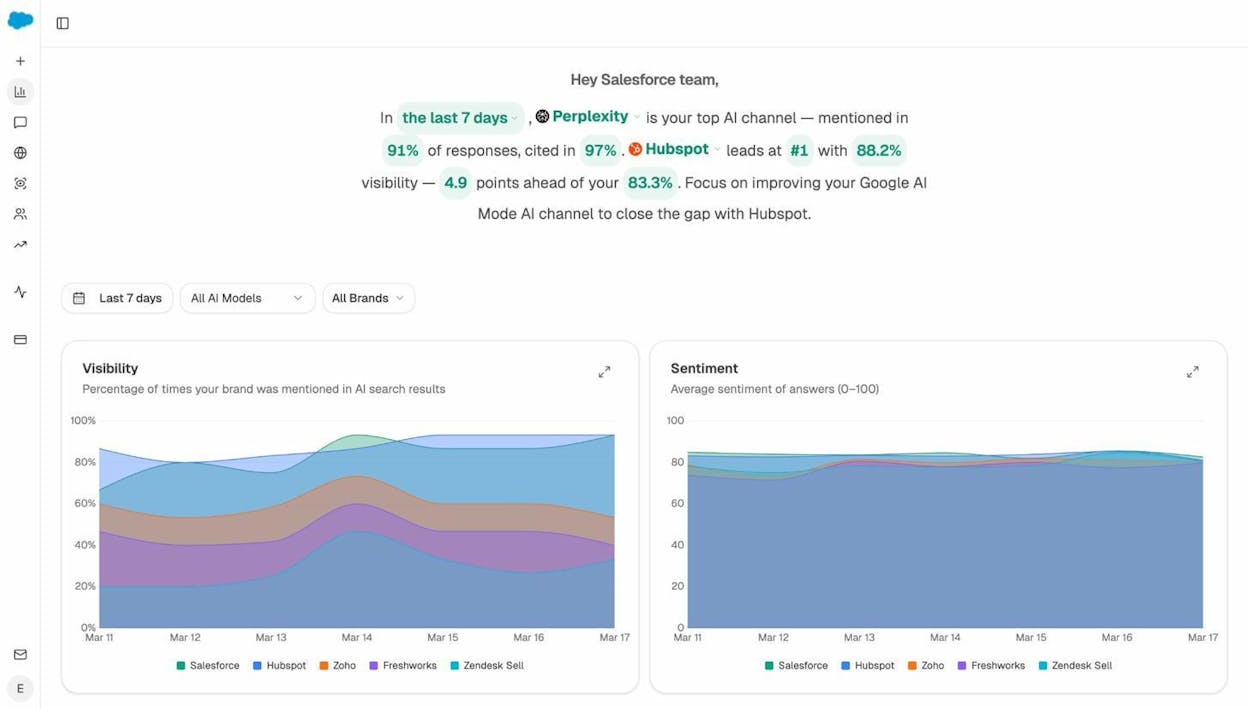
Watch your visibility trend over time. The Overview dashboard shows your brand’s visibility percentage across AI models and how it changes week over week. You can correlate this with your link building campaigns to see which efforts moved the needle.
This creates a new kind of link building feedback loop:
-
Build high-quality links to your content
-
Watch your Google rankings improve
-
Track whether AI engines start citing that content more
-
Double down on the content types and link sources that drive both Google and AI results
Nobody else is doing this. Most link builders still measure success only by links won and rankings gained. By also tracking AI visibility, you get a fuller picture of how your authority compounds across all search channels.
How AI Search Creates New Link Building Opportunities
Beyond tracking, AI search actually creates entirely new opportunities for outreach campaigns. Here is how to use those opportunities.
Find Content That AI Engines Cite (And Build Links to It)
If ChatGPT or Perplexity is already citing one of your pages, that page is primed for a link building push. More backlinks → higher Google rankings → more AI citations. It is a virtuous cycle.
To find these pages, open Analyze AI’s AI Traffic Analytics and look at the Landing Pages tab. Sort by sessions to see which of your pages receive the most traffic from AI search engines.
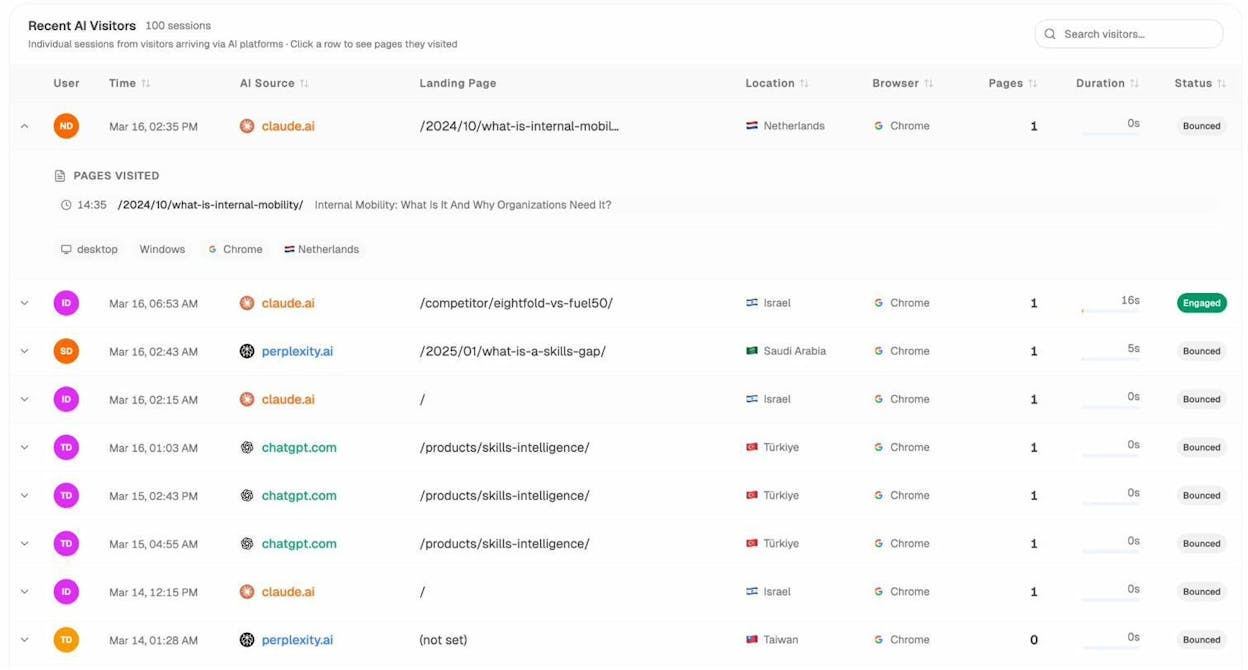
These pages are already “working” in AI search. Building more links to them accelerates the compounding effect.
Use AI Citation Data to Find New Outreach Angles
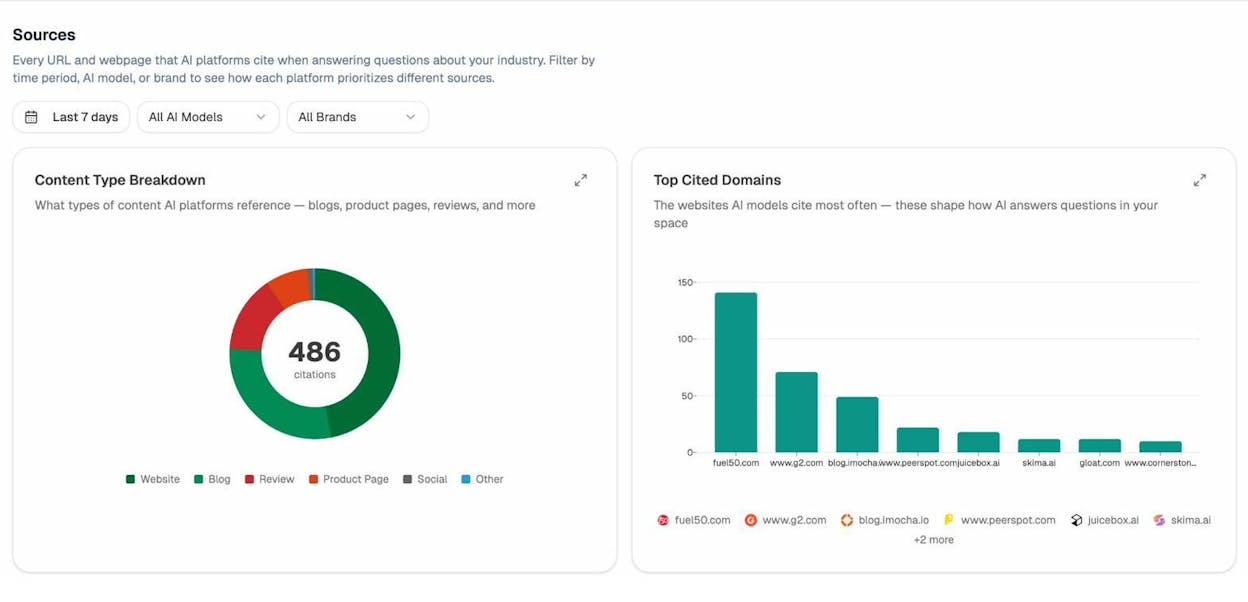
Analyze AI’s Sources dashboard shows you which domains AI models cite most frequently for questions in your industry. These are the authoritative sources that AI engines trust.
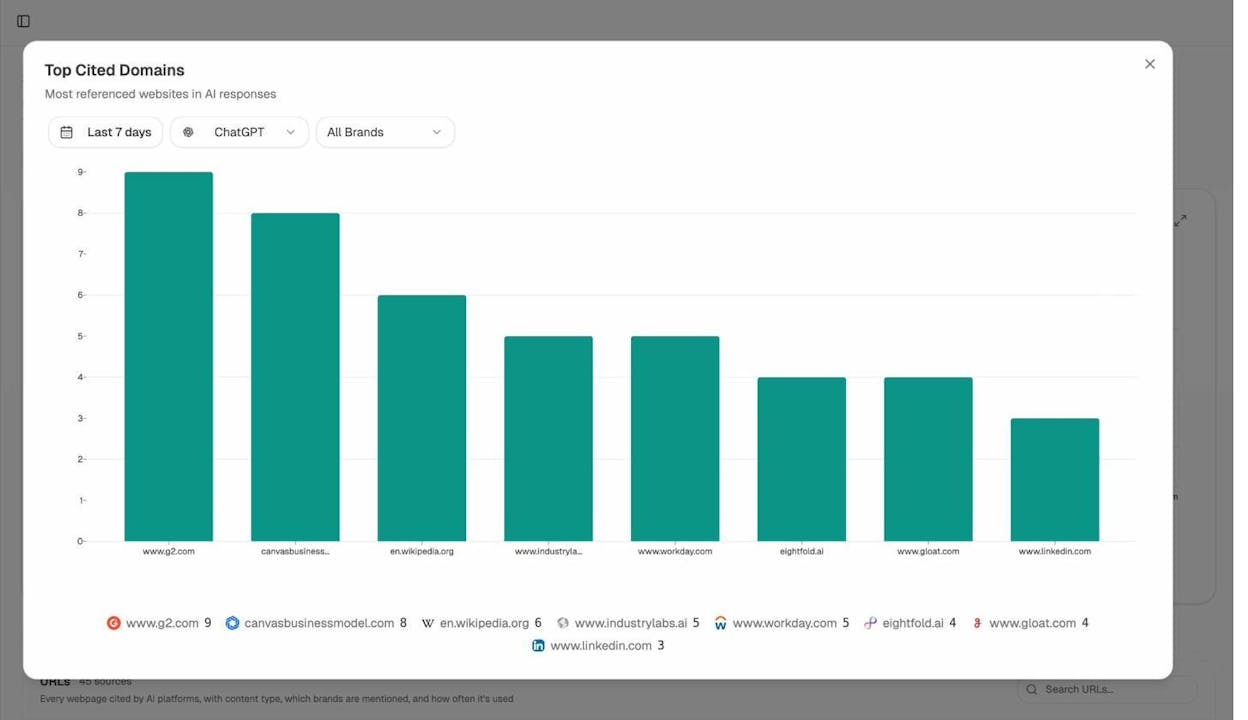
This data is gold for outreach in two ways:
-
Target sites AI already trusts. If a domain frequently gets cited by AI engines, a link from that domain carries extra weight — not just for Google, but for AI visibility too. Prioritize outreach to these sites.
-
Create content that fills AI citation gaps. If AI engines cite competitors for a topic you also cover, your content may need more depth, better structure, or stronger external signals (links) to compete. Build links to close that gap.
Use Prompt-Level Data to Discover Content Gaps Worth Building Links To
Analyze AI lets you track specific prompts — the questions people ask AI engines. For each prompt, you can see whether your brand appears, your position, and which competitors show up instead.
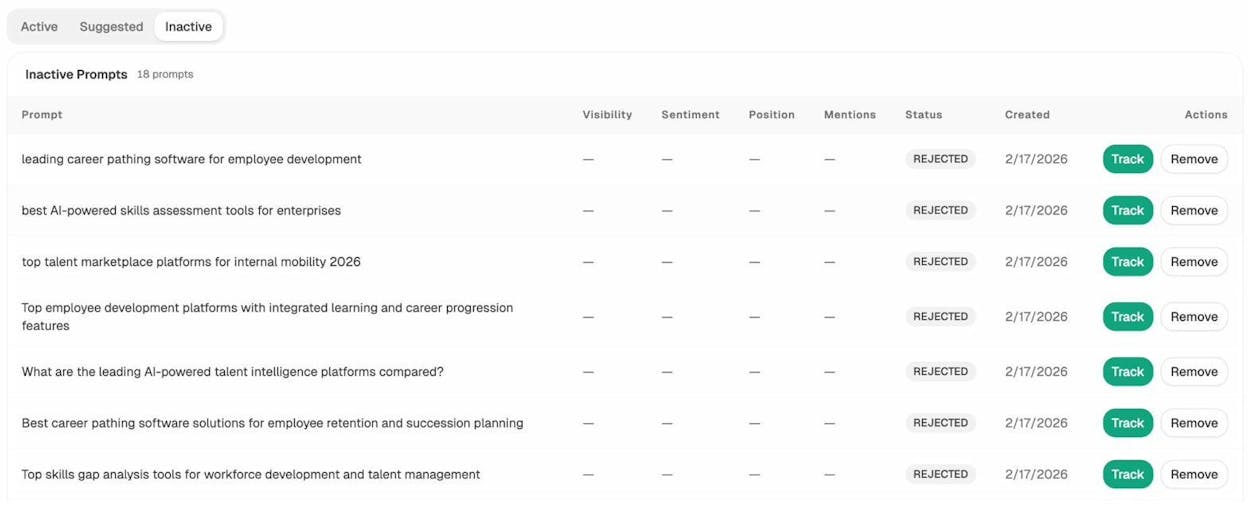
If a competitor appears for a high-value prompt and you do not, look at what content they have on that topic. Then create something better and build links to it.
This is the AI search equivalent of keyword gap analysis in traditional SEO — except you are finding gaps in AI-generated answers rather than Google search results.
For more on how to use this approach, read our guide on SEO competitor analysis with AI search tracking.
Common Link Outreach Mistakes to Avoid
After thousands of outreach campaigns, these are the mistakes that kill results most often.
Emailing People Who Cannot Help You
If someone wrote a guest post for a site, they do not control that site’s content. You need to contact the site owner or editor, not the guest author. Similarly, do not email a company’s general inbox (info@, hello@, support@) — those emails get buried or ignored.
Using Templates That Look Like Templates
If your email starts with “I recently came across your excellent article on [Topic]” followed by “I’ve written a similar piece that I think your readers would love” — congratulations, you have written the same email that everyone else sends.
The problem is not using templates. The problem is using the same templates that every other link builder uses. Write your own templates. Make them sound like a human wrote them, not a link building course.
Pitching Content That Is Not Link-Worthy
Before asking for a link, ask yourself: if you received this email, would you link to this content?
If your content is a 500-word generic article that says nothing new, no amount of outreach will earn links. Fix the content first.
Link-worthy content has at least one of these qualities:
-
Original data (surveys, studies, analysis)
-
Comprehensive depth (the definitive guide on a topic)
-
Unique perspective (a framework or approach nobody else has shared)
-
Practical tools (calculators, templates, checklists)
Not Tracking Your Results
If you do not track your open rates, reply rates, and conversion rates, you are flying blind. Every failed campaign is wasted if you do not learn from it.
Use an outreach tool that tracks opens and replies, and review your data after every campaign. Patterns will emerge — certain subject lines, certain angles, certain prospect types will outperform others.
Ignoring AI Search Entirely
In 2026, ignoring AI search when building links is like ignoring mobile search in 2015. The channel is growing and it rewards the same signals (authority, depth, relevance) that link building strengthens.
Track your AI visibility alongside your traditional SEO metrics. Use tools like Analyze AI to measure whether your link building campaigns improve your presence across ChatGPT, Perplexity, Claude, and Gemini.
Link Outreach Tools Worth Using
You do not need 20 tools to run outreach campaigns. Here are the categories that matter and one or two strong options in each:
|
Category |
Tools |
What They Do |
|---|---|---|
|
Backlink Analysis |
SEO tools with backlink databases |
Find who links to competitors, identify broken link opportunities, assess domain authority |
|
Email Finding |
Find email addresses by name + domain |
|
|
Email Verification |
Validate email addresses before sending to reduce bounces |
|
|
Outreach Automation |
Manage campaigns, send templated emails with dynamic variables, track opens and replies |
|
|
Link Prospecting |
Google search operators, SEO tools |
Discover guest post opportunities, resource pages, and niche directories |
|
AI Visibility Tracking |
Track which pages get cited in AI search, monitor AI referral traffic, find competitor gaps in AI answers |
|
|
Domain Analysis |
Quickly assess a prospect site’s authority before reaching out |
For a comprehensive breakdown of link building tools, see our guide to the best backlink building tools.
Putting It All Together: Your Link Outreach Workflow
Here is a simple workflow you can follow for any link outreach campaign, from start to finish:
Week 1: Setup and Prospecting
-
Choose one link building tactic (e.g., broken link building)
-
Use backlink analysis tools to find 200–500 prospects
-
Filter your list using the quality checklist (traffic, relevance, authority)
-
Find contact details using Hunter.io or Snov.io
-
Verify emails with NeverBounce
-
Set up your tracking spreadsheet
Week 2: Outreach
-
Write your email template with dynamic variables
-
Send 20–30 emails per day (do not blast 500 at once — this triggers spam filters)
-
Log each email in your spreadsheet
Week 3: Follow-Up and Measurement
-
Send one follow-up to anyone who did not reply after 5–7 days
-
Track opens, replies, and links won
-
Check Analyze AI to see if outreach is moving your AI visibility
Week 4: Review and Iterate
-
Analyze your conversion rate
-
Identify what worked (which angles, which prospect types, which subject lines)
-
Apply learnings to the next campaign
Repeat this cycle monthly. Over time, your prospect lists get better, your templates get sharper, and your conversion rate climbs.
Final Thoughts
Link outreach is not glamorous. It is methodical, repetitive work that requires patience and consistency.
But it works — and it compounds. Every link you earn today strengthens your rankings tomorrow. And in a world where AI search engines increasingly cite authoritative content, those rankings create visibility in places that did not exist two years ago.
The people who win at link outreach are the ones who find the right prospects, lead with value, and measure their results. They also recognize that link building is no longer just about Google rankings — it is about building authority that compounds across Google, ChatGPT, Perplexity, Claude, and every search surface that matters.
Start with one tactic. Send 100 emails. Track your results. Iterate. That is the entire playbook.

Ernest

Ibrahim


