



Summarize this blog post with:


In this article, you’ll learn what a marketing funnel is, how it works at each stage, and exactly how to build one that attracts prospects, nurtures their interest, and converts them into customers. You’ll also learn how to extend your funnel into AI search—a growing channel where prospects are already asking ChatGPT, Perplexity, and Google AI Mode questions that your brand should be answering.
Table of Contents
What Is a Marketing Funnel?
A marketing funnel is a model that maps the stages a person moves through from first hearing about your brand to becoming a paying customer. It helps you see where prospects enter, where they drop off, and where your marketing needs work.
Most marketers use the AIDA model, developed in 1898 by E. St. Elmo Lewis. AIDA stands for Awareness, Interest, Desire, and Action. Each stage represents a shift in how a prospect relates to your brand.
![[Screenshot: A clean funnel diagram showing four layers—Awareness at top, Interest, Desire, and Action at the bottom—with the funnel narrowing at each stage]](https://www.datocms-assets.com/164164/1774865667-blobid1.png?auto=format,compress&w=1248&fit=max)
The funnel shape matters. More people will become aware of your brand than will buy from you. That natural drop-off at each stage is what creates the narrowing funnel shape.
Here’s a simple example. Imagine 10,000 people see your brand mentioned in an article. Of those, maybe 2,000 visit your site. 500 sign up for your email list. And 50 eventually buy. Each transition is a stage in the funnel—and each transition is a place where your marketing can improve.
The Stages of the Marketing Funnel
Let’s break down each stage so you know exactly what happens—and what your job as a marketer is at each one.
1. Awareness
Awareness is when someone first learns you exist. They don’t know your product. They may not even know they have a problem you solve.
This happens in many ways. Someone might stumble on your blog post in Google. They might see a colleague share your infographic on LinkedIn. They might hear your founder on a podcast.
The key: at this stage, the prospect isn’t looking for you. They’re looking for information, entertainment, or answers. Your job is to be where they’re looking.
For example, a SaaS company selling project management software might create content around “how to run a remote team standup.” The reader isn’t searching for software—they’re searching for a process. But by providing a helpful answer, the company introduces itself.
2. Interest
Interest is when a prospect starts engaging with your brand deliberately. They’ve moved past “oh, that exists” to “let me learn more.”
At this stage, someone might subscribe to your newsletter, follow you on social media, watch several of your YouTube videos, or browse your product pages. They’re exploring whether your product or service could be relevant to them.
The shift from Awareness to Interest is subtle but critical. In Awareness, the prospect finds you. In Interest, the prospect chooses you—they opt in for more.
3. Desire (Consideration)
Desire is the evaluation stage. The prospect knows who you are and what you sell. Now they’re deciding whether to buy from you or someone else.
This is where they compare. They read reviews on G2 or Trustpilot. They ask colleagues. They search for “[your product] vs [competitor].” They look at pricing pages. They check case studies.
Search volume data shows that comparison and review queries make up a significant portion of commercial search. People don’t just buy—they investigate first.
4. Action (Conversion)
Action is when the prospect becomes a customer. They click “Buy,” sign the contract, or start the trial.
Your job here is simple: don’t get in the way. Make the checkout smooth, the sign-up fast, and the onboarding clear. Every unnecessary form field, confusing pricing page, or broken link at this stage costs you revenue.
How These Stages Work in Reality
In textbooks, the funnel is neat and linear. In reality, people bounce around. Someone in the Desire stage might loop back to Awareness-level content. A prospect might sit in Interest for months before jumping straight to Action.
That’s normal. The funnel isn’t a conveyor belt—it’s a mental model. It helps you make sure you have marketing tactics for each stage, so no part of the buyer’s journey is neglected.
Without this focus, you end up with a “leaky” funnel. You might drive tons of traffic (Awareness) but have no email capture (Interest). Or you might have great product content (Desire) but no way for prospects to discover you in the first place.
Why Does the Marketing Funnel Matter?
The marketing funnel matters because it forces you to think about your marketing as a system, not a collection of isolated tactics.
Here’s what it actually helps you do:
Diagnose problems. If your website gets 50,000 visitors per month but only 10 sign up for your email list, you know the leak is between Awareness and Interest. If you get 5,000 email subscribers but almost no one converts, the problem is between Desire and Action. The funnel gives you language to locate the issue.
Allocate resources. Without a funnel framework, teams tend to over-invest in one stage. Content teams might churn out top-of-funnel blog posts but produce nothing for people who are evaluating. Sales teams might obsess over bottom-of-funnel leads but starve the pipeline of new prospects. The funnel helps you balance.
Align teams. Marketing and sales teams often clash because they think about the customer journey differently. The funnel creates shared vocabulary. Marketing owns the top. Sales owns the bottom. Everyone knows where their work starts and stops—or where they need to overlap.
Measure what matters. Each stage has its own metrics. You can track traffic, engagement, conversion rate, and revenue separately. When something breaks, you know which stage to fix. We’ll cover specific metrics later in this article.
How to Create a Marketing Funnel
Every business already has a customer journey. Your prospects go from not knowing you to (hopefully) buying from you. So you can’t really “create” a funnel from scratch. What you can do is build a strategy for each stage.
To simplify, marketers often group the AIDA stages into three buckets:
-
Top of the funnel (TOFU) — Awareness
-
Middle of the funnel (MOFU) — Interest
-
Bottom of the funnel (BOFU) — Desire and Action
![[Screenshot: A three-tier funnel labeled TOFU, MOFU, and BOFU with corresponding stages]](https://www.datocms-assets.com/164164/1774865674-blobid2.png?auto=format,compress&w=1248&fit=max)
This simplification is useful because it maps cleanly to content types, keyword strategies, and campaign goals. Let’s walk through each.
1. Top of Funnel (TOFU): Build Awareness
Your goal at TOFU is to put your brand in front of people who don’t know you yet. You want to reach as many relevant prospects as possible.
Here are the tactics that work:
Target TOFU Keywords in Organic Search
Your prospects are searching for information on Google right now—questions related to their problems, not your product. TOFU content targets those broader queries.
For example, if you sell email marketing software, your target customer might be searching for “how to grow an email list” or “best ways to increase newsletter open rates.” They’re not searching for “email marketing software” yet. That comes later.
Here’s how to find TOFU keywords:
-
Open a keyword research tool like Analyze AI’s free keyword generator or Google Keyword Planner
-
Enter broad terms related to your prospect’s problems (not your product)
-
Browse the results for high-volume, informational keywords
![[Screenshot: Using Analyze AI’s keyword generator tool to find TOFU keywords — show the tool interface with a broad term entered and results displayed]](https://www.datocms-assets.com/164164/1774865679-blobid3.png?auto=format,compress&w=1248&fit=max)
For instance, a CRM company might start with terms like “sales pipeline,” “customer retention,” or “lead management.” The resulting keyword list will include dozens of TOFU topics.
From there, go through the list and find keywords that are relevant to your audience. Look for terms where you can create genuinely useful content that naturally leads toward your product category.
You can also check what keywords your competitors rank for to find gaps you’re missing. Use a tool like Analyze AI’s keyword rank checker or the SERP checker to see who’s currently ranking and where the opportunities are.
![[Screenshot: Using Analyze AI’s SERP checker to analyze the top results for a TOFU keyword]](https://www.datocms-assets.com/164164/1774865680-blobid4.png?auto=format,compress&w=1248&fit=max)
Discover What Prospects Ask AI Search Engines
Here’s what most TOFU guides miss: prospects aren’t only searching Google anymore. They’re asking ChatGPT, Perplexity, Claude, and Google AI Mode questions like “what’s the best way to manage a remote sales team?” or “how do I improve customer retention?”
If your brand shows up in those AI-generated answers, you’ve just earned awareness in a channel your competitors are probably ignoring.
The challenge is that you can’t optimize for AI search the same way you optimize for Google. AI engines pull from different sources, weight citations differently, and surface brands based on how often (and how positively) they appear across the web.
To find out what prompts matter in your space, use Analyze AI’s prompt tracking feature. It suggests prompts your target audience is likely asking AI engines, and lets you track whether your brand appears in the responses.
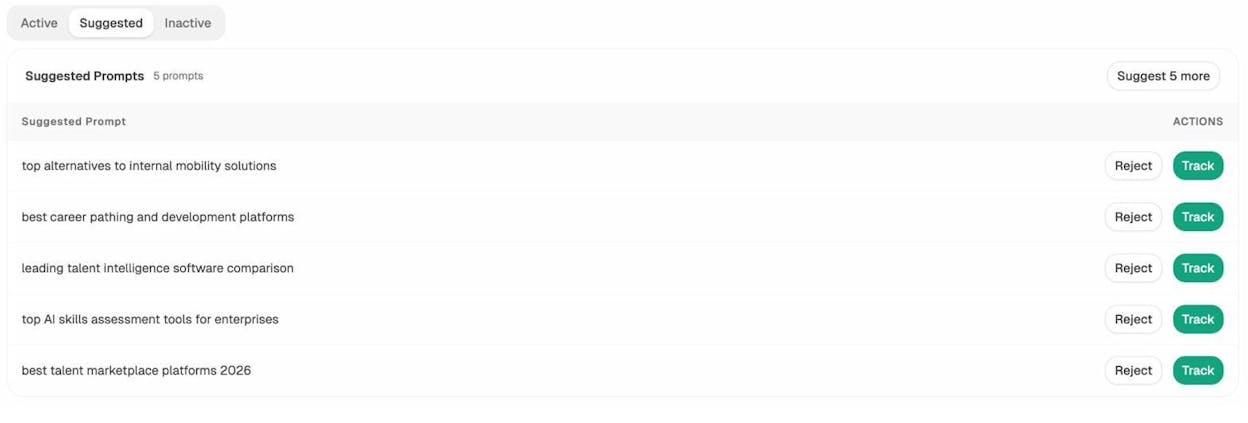
For example, you might discover that ChatGPT consistently recommends three of your competitors for “best project management tools for startups” but never mentions you. That’s a TOFU gap—and now you know exactly which content and citations to build to close it.
Tap Into Other People’s Audiences
Not all awareness comes from search. Some of the most effective TOFU tactics involve borrowing someone else’s audience.
Podcast appearances are one of the best ways to do this. Find podcasts in your industry and pitch to be a guest. Here’s a quick way to find opportunities:
-
Identify someone in your industry who appears on podcasts frequently
-
Search their name plus “podcast” or “episode” on Google
-
Make a list of the shows they’ve been on
-
Pitch yourself to those same shows
![[Screenshot: Google search for “[industry leader name] podcast episode” showing results]](https://www.datocms-assets.com/164164/1774865693-blobid6.png?auto=format,compress&w=1248&fit=max)
Beyond podcasts, consider webinars, conference talks, guest articles, and co-marketing campaigns. The idea is simple: go where your audience already is.
Run Paid Ads
If you have budget, paid ads remain one of the fastest paths to awareness. YouTube pre-rolls, LinkedIn sponsored posts, Google Ads, and social media ads can all put your brand in front of thousands of new people quickly.
The tradeoff is that paid awareness stops the moment you stop paying. Organic content keeps working after you publish it. The best TOFU strategies combine both.
2. Middle of Funnel (MOFU): Capture and Nurture Interest
MOFU is where you turn a casual visitor into an engaged prospect. They know you exist. Now you need to earn their attention and keep it.
Target MOFU Keywords
At this stage, your prospects know their problem and are starting to explore solutions. They’re searching for more specific, product-aware terms.
For example, if you sell accounting software, MOFU keywords might include “accounting software for freelancers,” “invoicing tool comparison,” or “free bookkeeping template.” These searchers know they need a solution—they’re just figuring out which one.
Here’s how to find MOFU keywords:
-
Open a keyword research tool
-
Enter terms related to your product category (not your brand)
-
Filter for terms that include words like “tool,” “software,” “template,” “checklist,” “how to,” or “guide”
![[Screenshot: Keyword research results showing MOFU-level keywords with product-aware intent]](https://www.datocms-assets.com/164164/1774865693-blobid7.png?auto=format,compress&w=1248&fit=max)
You can also look at your competitors’ top-ranking pages. What terms are they capturing at the MOFU level that you’re not? Use Analyze AI’s keyword difficulty checker to evaluate which ones are worth pursuing based on competition level.
Build Your Email List
An email subscriber is worth more than a social media follower. Why? Because email is explicit permission to enter someone’s inbox. It’s the highest-value interest signal a prospect can give you (short of requesting a demo).
To grow your list, add sign-up opportunities at natural points on your website:
-
A floating sign-up box on blog posts
-
Exit-intent popups on high-traffic pages
-
A dedicated newsletter landing page
-
Content upgrades (e.g., a downloadable checklist or template in exchange for an email)
![[Screenshot: Example of an email sign-up box on a blog post sidebar]](https://www.datocms-assets.com/164164/1774865699-blobid8.png?auto=format,compress&w=1248&fit=max)
Once someone subscribes, don’t leave them hanging. Set up a welcome email sequence that introduces your best content, your product, and the value you provide. First impressions matter—a weak welcome sequence wastes the goodwill the subscriber just gave you.
Earn Reviews
Reviews are MOFU fuel. According to PowerReviews’ research, 93% of shoppers say reviews influence their purchase decisions, and 91% read reviews regularly.
Make it easy for your customers to leave reviews on platforms like Google Reviews, G2, Trustpilot, or Capterra. The best time to ask for a review is right after a positive customer experience—a successful onboarding, a problem solved by support, or a milestone reached.
Don’t just collect reviews. Respond to them—good and bad. Research from the Harvard Business Review shows that replying to reviews results in better overall ratings over time. It signals that you care, which matters to prospects who are watching.
Teach Prospects How to Use Your Product
This is one of the most underrated MOFU tactics: show people how your product works before they sign up.
The logic is counterintuitive but sound. Most marketers assume people sign up first and learn later. In reality, many people learn how to use a product first—through blog posts, tutorials, and YouTube videos—and then sign up because they already know how it works.
Create content that walks people through real use cases with your product. Show your interface. Explain your features in the context of solving actual problems. The more a prospect can visualize themselves using your product, the more likely they are to convert.
![[Screenshot: A tutorial-style blog post showing step-by-step product usage with screenshots]](https://www.datocms-assets.com/164164/1774865703-blobid9.png?auto=format,compress&w=1248&fit=max)
Track Your AI Search Presence at the MOFU Level
MOFU is also where AI search starts to matter for competitive positioning. When prospects ask ChatGPT or Perplexity “what are the best [product category] tools?” or “how does [product type] work?”, your brand either shows up or it doesn’t.
With Analyze AI, you can track exactly which prompts mention your competitors but not you. The Competitor Overview dashboard shows visibility share across all tracked prompts, so you can see who dominates the AI conversation in your space—and where the gaps are.
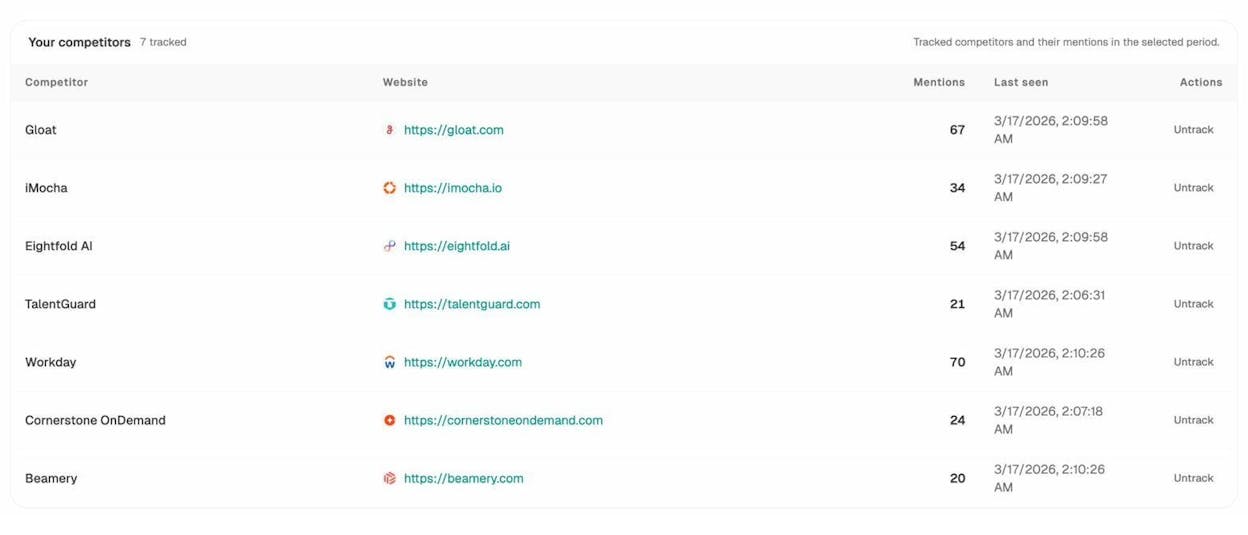
This is especially useful for MOFU because comparison prompts (“best X vs Y,” “top tools for Z”) are where AI engines most frequently surface brand recommendations. If you’re absent from these responses, you’re losing consideration-stage prospects to competitors who are present.
Offer Free Tools or Trials
Let prospects experience your product without commitment. Free trials, freemium tiers, and free tools all work.
At Analyze AI, for example, we offer a suite of free marketing tools—including a broken link checker, website traffic checker, website authority checker, and keyword generator. When prospects use these tools to solve a real problem, they see our platform in action. That makes upgrading to the full product a natural next step, not a leap of faith.
3. Bottom of Funnel (BOFU): Convert Prospects Into Customers
BOFU covers both the Desire and Action stages. Your prospect is evaluating options and deciding whether to buy. Your job is to win the comparison and make buying easy.
Target BOFU Keywords
BOFU keywords signal purchase intent. These are the comparison, review, and pricing searches that happen right before a buying decision.
Examples include:
-
“[your brand] vs [competitor]”
-
“[product category] pricing”
-
“[competitor] alternatives”
-
“[your product] review”
-
“is [your product] worth it”
To find these keywords:
-
Enter your brand name and your competitors’ names in a keyword research tool
-
Filter for terms containing “vs,” “versus,” “review,” “pricing,” “alternative,” or “comparison”
-
Prioritize by search volume and relevance
![[Screenshot: Keyword research results showing BOFU comparison keywords]](https://www.datocms-assets.com/164164/1774865711-blobid11.png?auto=format,compress&w=1248&fit=max)
These keywords might have lower volume than TOFU terms, but they have dramatically higher conversion intent. A blog post ranking for “[competitor] alternatives” can drive more revenue than a TOFU post with 10× the traffic.
Create a Comparison Page
Your prospects will compare you to competitors whether you like it or not. The question is: do you want to control that narrative, or leave it to third-party review sites?
A dedicated comparison page (e.g., “Us vs. Competitor A vs. Competitor B”) lets you frame the conversation on your terms. But don’t just create a biased feature table where you “conveniently” win every category. Savvy buyers see through that immediately.
Instead, consider including third-party reviews, industry poll results, and an honest breakdown of what makes your product different. Focus on unique capabilities rather than checkbox comparisons. Prospects respect honesty, and it builds the trust you need to close the deal.
![[Screenshot: An example comparison page that features third-party poll data and unique features]](https://www.datocms-assets.com/164164/1774865713-blobid12.jpg?auto=format,compress&w=1248&fit=max)
Address Final Objections
Talk to your sales team and customer support. Ask them: what stops people from buying?
Common objections include concerns about pricing, implementation difficulty, data migration, contract length, and missing features. Create content that addresses each of these directly—whether it’s a FAQ page, a case study showing smooth implementation, or a pricing calculator.
Don’t bury this content. Link to it from your pricing page, your comparison pages, and your email sequences. The closer a prospect is to buying, the more they need reassurance.
Give People a Reason to Act Now
Urgency works—but only when it’s real. If your cohort-based course is closing enrollment, say so. If your product has limited seats, mention it. If there’s a seasonal discount, put a deadline on it.
What doesn’t work is fake urgency. A countdown timer that resets every time you visit the page destroys trust. People notice. Don’t fake scarcity.
Monitor How AI Engines Recommend You at the Decision Stage
At the BOFU level, AI search becomes a direct competitive battleground. When a prospect asks Perplexity “should I use [your product] or [competitor]?”, the AI’s response can shape their decision.
Analyze AI lets you track these exact prompts and see how each AI engine positions your brand versus competitors. The Perception map shows where you sit on a matrix of visibility and narrative strength—are you visible with a compelling story, or visible with a weak one?
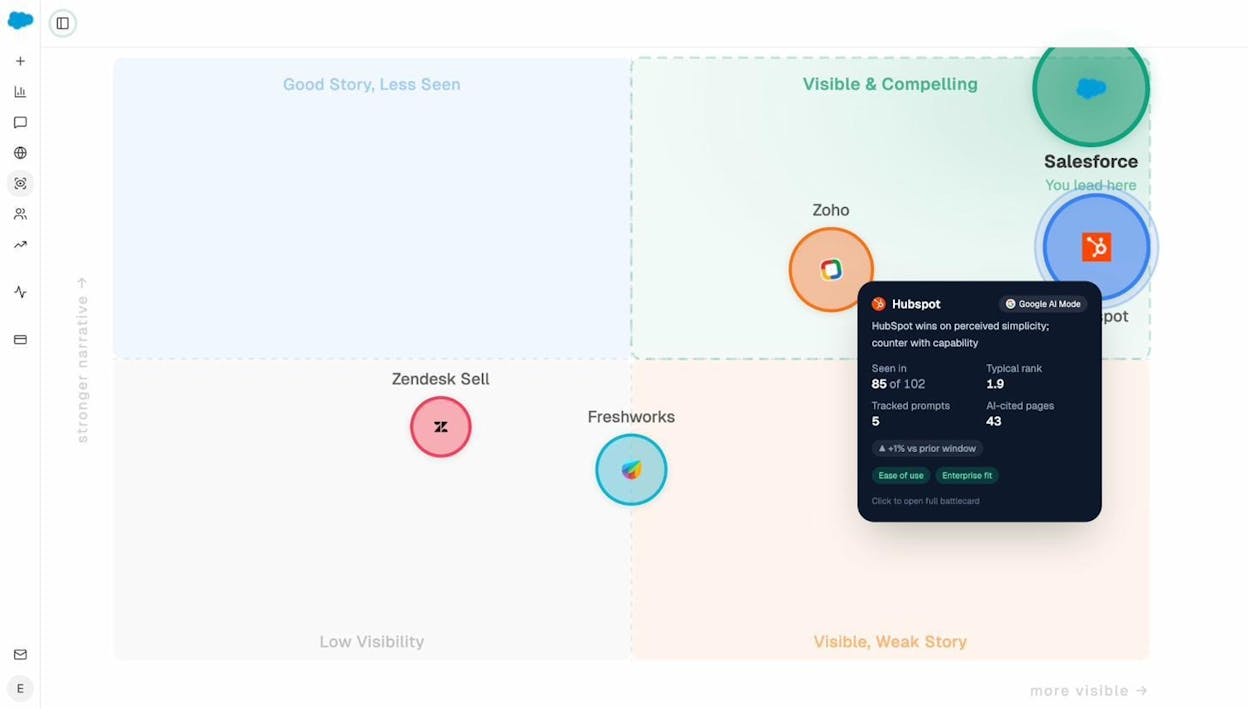
If you’re in the “Visible, Weak Story” quadrant, the fix isn’t more content—it’s better content. You need to strengthen the citations and sources that AI models pull from so that your brand narrative improves.
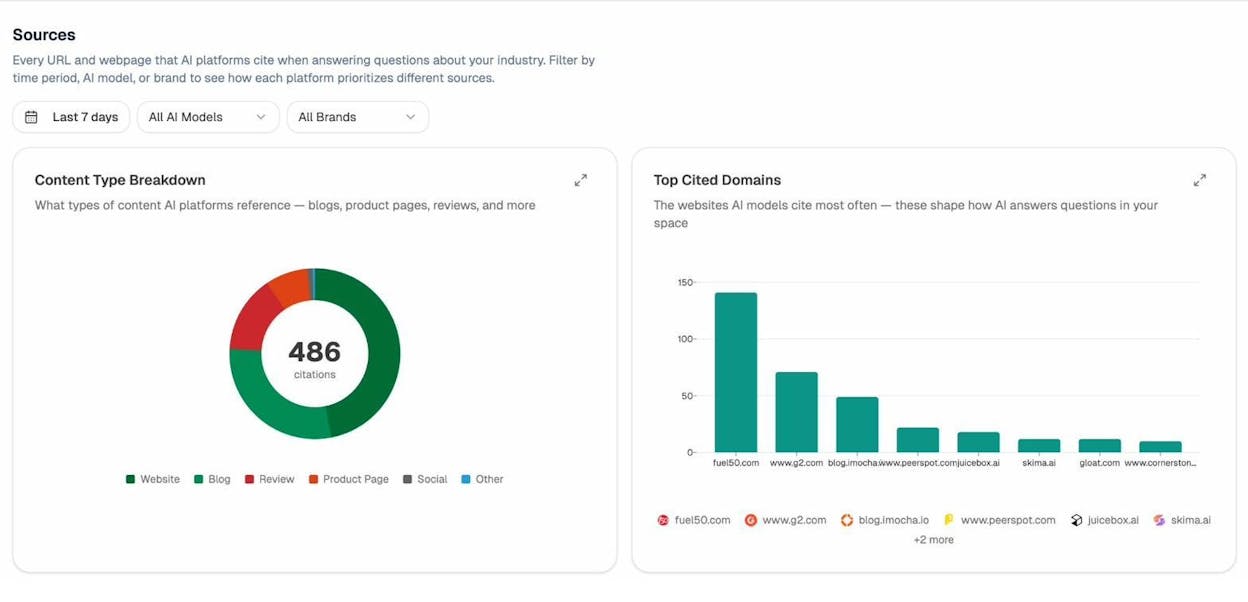
The Sources dashboard in Analyze AI shows you exactly which websites and content types AI models cite when answering questions about your industry. If your competitor’s blog gets cited 150 times and yours gets cited 10, you know where to focus.
Marketing Funnel Metrics: How to Measure Each Stage
Building a funnel is only half the work. You also need to track it. Here are the metrics that matter at each stage:
|
Funnel Stage |
Metric |
What It Tells You |
|---|---|---|
|
TOFU |
Website visitors (unique users) |
How many people are discovering your brand |
|
TOFU |
Organic traffic from search |
How well your SEO content attracts new prospects |
|
TOFU |
TOFU keyword rankings |
Whether your awareness-stage content is visible |
|
MOFU |
Email subscriber growth rate |
How effectively you’re capturing interest |
|
MOFU |
Star ratings and review count |
How your reputation looks to evaluating prospects |
|
MOFU |
MOFU keyword rankings |
Whether your product-aware content is visible |
|
BOFU |
Conversion rate |
What percentage of prospects become customers |
|
BOFU |
ROI by channel |
Which marketing channels actually drive revenue |
|
BOFU |
BOFU keyword rankings |
Whether your comparison and review content is visible |
You can track most of these through Google Analytics, Google Search Console, and keyword tracking tools like Analyze AI’s keyword rank checker.
Add AI Search Metrics to Your Funnel
Traditional funnel metrics miss an increasingly important channel: AI search.
More prospects are getting answers from ChatGPT, Perplexity, Google AI Mode, Claude, and Copilot. If those AI engines mention your competitors but not you, you’re losing funnel opportunities you can’t even see in Google Analytics.
Here are the AI search metrics worth tracking:
|
Metric |
What It Tells You |
|---|---|
|
AI visibility rate |
How often your brand appears in AI-generated answers |
|
AI sentiment score |
Whether AI engines describe your brand positively or negatively |
|
AI position / rank |
Where your brand ranks in AI responses relative to competitors |
|
AI referral sessions |
How many website visits come from AI search engines |
|
AI-cited landing pages |
Which of your pages AI engines reference and send traffic to |
|
AI citation sources |
Which external websites AI models cite about your industry |
Analyze AI tracks all of these. The AI Traffic Analytics dashboard connects to your GA4 account and shows exactly how many sessions come from each AI engine, which pages receive that traffic, and whether those visitors engage or bounce.
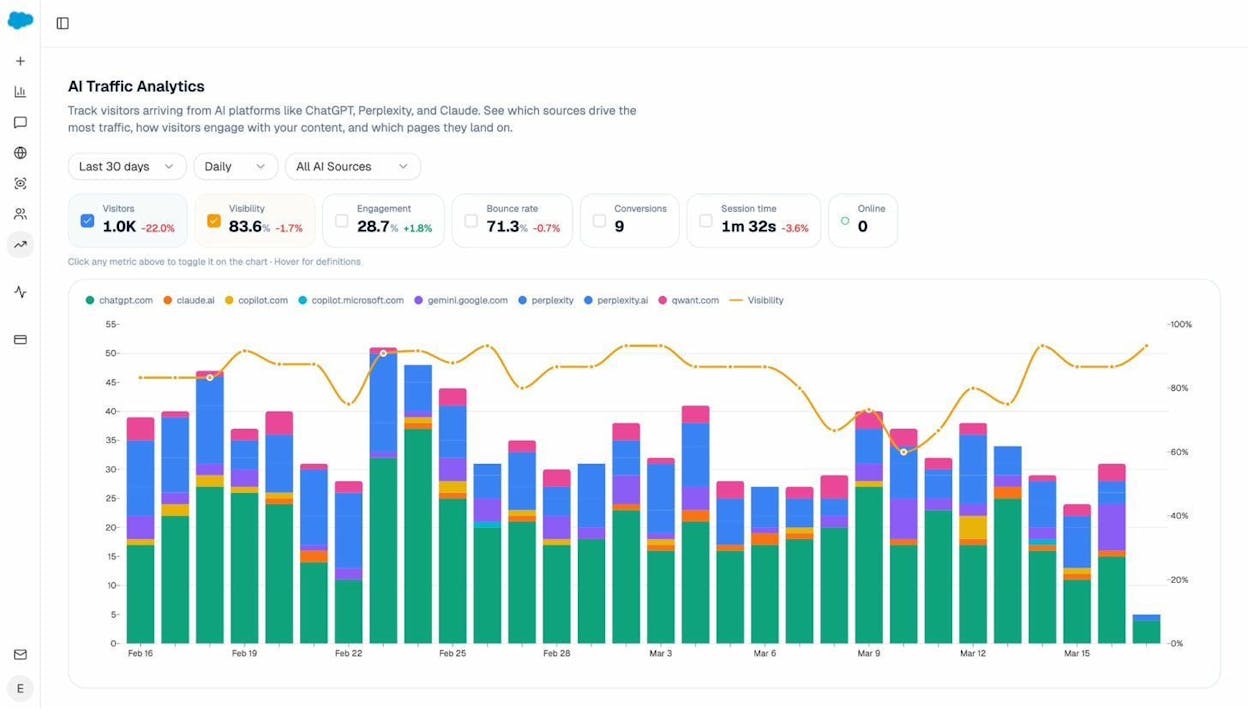
This is the missing piece in most marketing funnels. Traditional analytics tools can’t tell you that ChatGPT sent 36 sessions to your homepage last month, or that your blog post on “best CRM tools” gets cited by Perplexity but not by Claude. Analyze AI can.
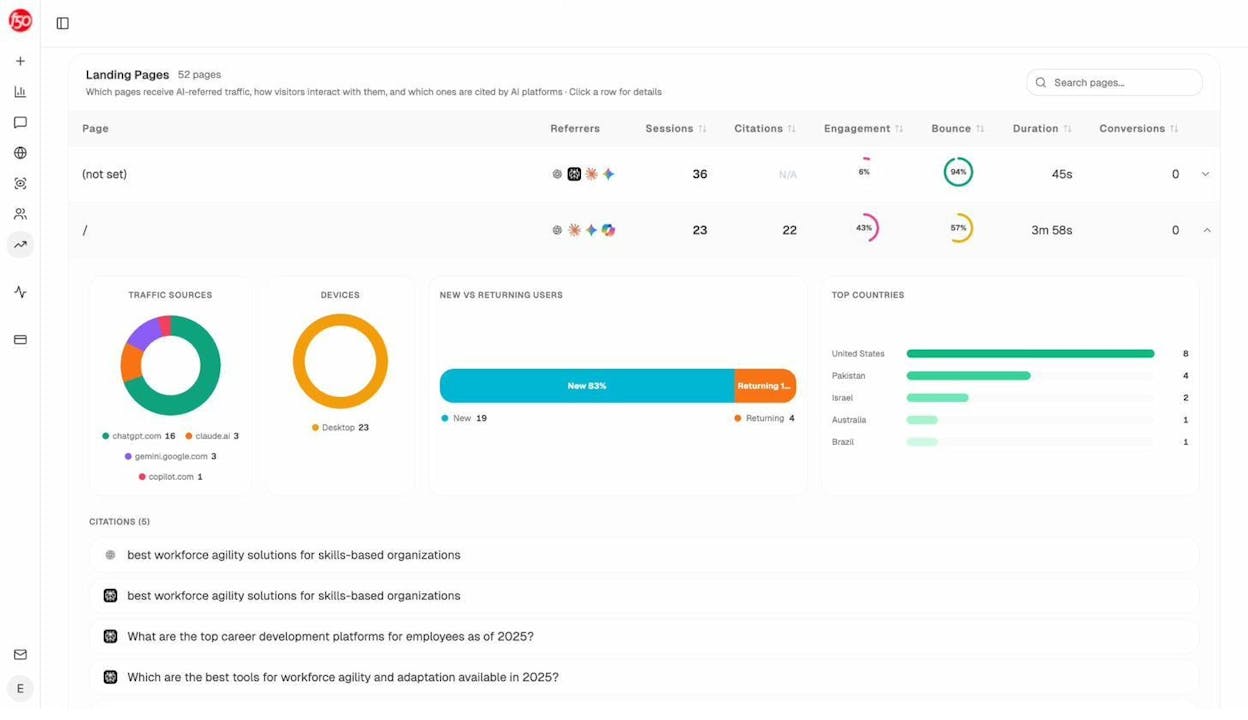
The landing page report is especially useful. It shows you which specific pages AI engines send traffic to, broken down by referrer, sessions, engagement, bounce rate, and conversions. You can use this to double down on page formats that AI engines prefer and fix pages that attract AI traffic but don’t convert.
How AI Search Changes the Marketing Funnel
The traditional marketing funnel assumes that prospects find you through Google, ads, social media, or word of mouth. That’s still true—but it’s no longer complete.
Today, a growing number of prospects start their journey by asking an AI engine a question. Instead of typing “best CRM software” into Google and clicking through 10 blue links, they ask ChatGPT: “What CRM should a 20-person startup use?”
The AI responds with a list of recommendations. If your brand is on that list, you’ve just entered the prospect’s funnel. If it’s not, you’ve been filtered out before you had a chance.
This is not a replacement for SEO. As the Analyze AI manifesto puts it: GEO isn’t a replacement for SEO—it’s the next transformation of it. Search is expanding from ten blue links to multi-modal, prompt-shaped answers. The fundamentals haven’t changed. Quality content, authority, depth, and usefulness still govern visibility. What’s changed is where that quality needs to show up.
Here’s what that means for each funnel stage:
TOFU: Prospects discover brands through AI answers to broad questions. If you’re not cited in those answers, you miss the awareness window entirely. Traditional SEO builds the foundation. AI visibility extends the reach.
MOFU: Prospects evaluate options by asking AI follow-up questions. “How does [product] compare to [competitor]?” or “What do users say about [product]?” AI engines pull from review sites, blog posts, and product pages to form responses. Your content strategy needs to feed both Google and AI engines.
BOFU: Prospects ask AI for final recommendations before purchasing. “Should I buy [product A] or [product B] for my use case?” If the AI’s answer favors your competitor because their citations are stronger, you lose the deal without ever knowing why.
The takeaway: your marketing funnel needs both a search engine strategy and an AI search strategy. They work together. Strong SEO content becomes the source material that AI engines cite. Analyze AI helps you see whether that citation is actually happening—and where it’s not.
How to Build AI Search Into Your Funnel: A Step-by-Step Approach
Here’s a practical workflow for adding AI search to each funnel stage:
Step 1: Identify the prompts that matter. Start with the questions your target audience is likely asking AI engines. Analyze AI’s prompt suggestion feature recommends prompts based on your industry and competitors, so you don’t have to guess.
Click “Track” on any suggested prompt and Analyze AI will run it daily across ChatGPT, Perplexity, Claude, Gemini, and Copilot—logging your visibility, position, sentiment, and competing brands for each.
Step 2: Track your visibility across AI engines. Once you’re tracking prompts, the Tracked Prompts dashboard shows your visibility score, sentiment, average position, and which competitors appear alongside you for each prompt.
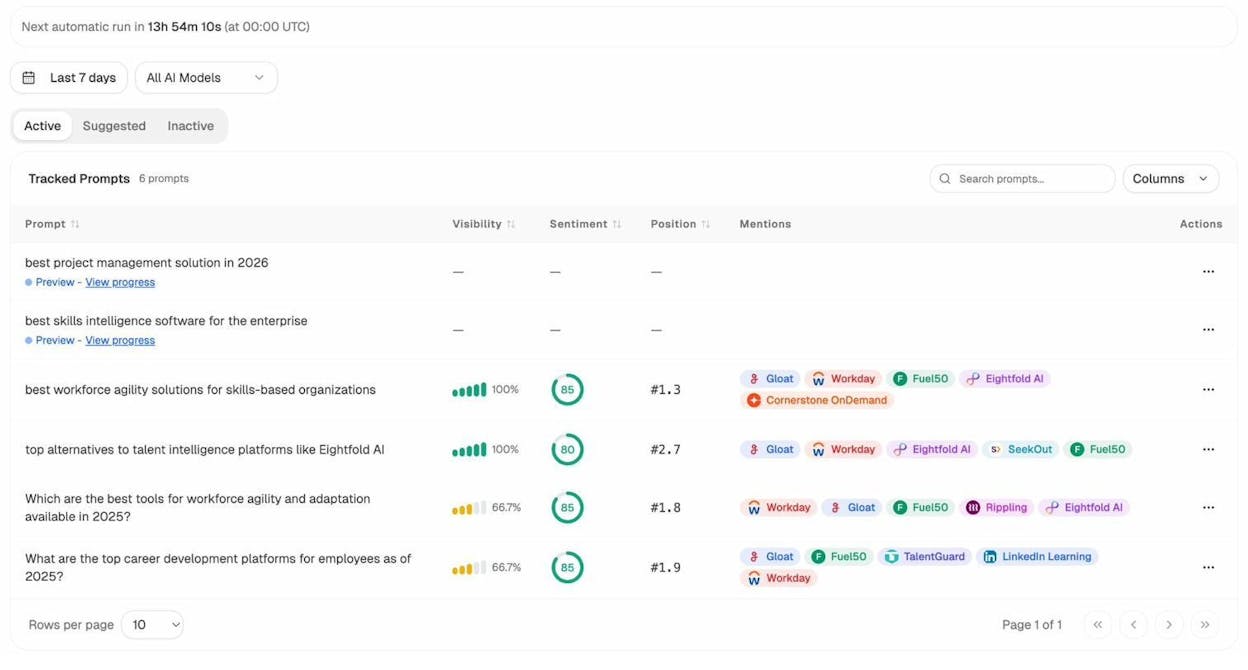
If a prompt shows 0% visibility, it means AI engines aren’t mentioning you at all when users ask that question. That’s a content gap you can close.
Step 3: Analyze what AI engines cite. AI models don’t invent recommendations—they pull from sources. The Sources dashboard in Analyze AI shows which domains and content types (blogs, product pages, review sites) get cited most in your space.
If review sites dominate the citations, you know that earning more reviews matters. If competitor blog posts get cited heavily, you need to create deeper, more authoritative content on those same topics.
Step 4: Measure AI-referred traffic. Connect your GA4 account to Analyze AI and track how many sessions come from each AI engine. This turns “AI visibility” from a vanity metric into a real traffic number you can tie to conversions.
Step 5: Double down on what works. Use the Landing Pages report to see which of your pages AI engines send the most traffic to. Look for patterns—what content format, length, structure, and topic type performs best? Then create more content that matches those patterns.
This is how you build a compounding AI search strategy: track, analyze, optimize, and repeat.
Common Marketing Funnel Mistakes (and How to Avoid Them)
Here are the mistakes that sabotage most funnels:
Over-investing in TOFU and neglecting BOFU. It’s satisfying to watch traffic numbers climb. But traffic without conversion is a cost center, not a growth engine. Make sure you have comparison pages, case studies, and clear pricing alongside your awareness content.
Ignoring the middle of the funnel. MOFU often gets the least attention. Companies create blog posts (TOFU) and pricing pages (BOFU) but forget the nurturing in between—email sequences, product tutorials, and review management. That gap costs you prospects who were interested but never got a reason to evaluate.
Not tracking per-stage metrics. If you only measure “conversions,” you can’t diagnose where the funnel is leaking. Break your metrics down by stage so you know whether the problem is awareness, engagement, or conversion.
Treating the funnel as linear. Real buyers don’t follow a straight path. They revisit stages, skip steps, and take detours. Design your content and campaigns to support non-linear journeys—make it easy for someone to jump from a TOFU blog post directly to a pricing page if they’re ready.
Ignoring AI search entirely. If you’re only optimizing for Google, you’re optimizing for a shrinking share of how prospects discover and evaluate products. AI search isn’t replacing SEO, but it’s adding a new layer that rewards brands with strong, citation-worthy content across the web. Use a tool like Analyze AI to track your presence and close the gaps.
FAQ
What is the difference between a B2B and B2C marketing funnel?
The structure is the same—Awareness, Interest, Desire, Action—but the dynamics differ. In B2C, one person usually navigates the funnel alone. In B2B, multiple decision-makers are involved (buyers, end-users, finance, legal), which means the funnel takes longer and requires more touchpoints.
B2B funnels also tend to rely more heavily on sales teams at the Desire and Action stages, while B2C funnels rely more on self-serve content, reviews, and frictionless checkout.
Is there a difference between a marketing funnel and a sales funnel?
They describe the same process. The difference is who owns it. Marketing teams typically manage the top and middle of the funnel (attracting and nurturing), while sales teams manage the bottom (closing). In practice, the lines overlap—especially in companies where content marketing drives conversions directly.
What about loyalty and advocacy?
The classic AIDA funnel ends at Action. But keeping a customer is cheaper than acquiring a new one, so many marketers add two more stages:
-
Loyalty — The customer buys from you again. You nurture this with great product experience, customer-only communities, and ongoing support.
-
Advocacy — The customer recommends you to others. Referral programs, case study collaborations, and review requests all fuel this stage.
![[Screenshot: An extended funnel showing Loyalty and Advocacy stages below Action]](https://www.datocms-assets.com/164164/1774865733-blobid18.png?auto=format,compress&w=1248&fit=max)
These stages matter because they feed back into the top of the funnel. Every advocate creates awareness for someone new.
How does the marketing funnel work for AI search?
AI search adds a parallel discovery path at every funnel stage. Prospects use ChatGPT, Perplexity, and Google AI Mode to ask questions at all stages—from “what is [topic]?” (TOFU) to “best [product] for [use case]” (MOFU) to “[product A] vs [product B]” (BOFU). If your brand appears in those AI-generated answers, you enter the prospect’s consideration set. If it doesn’t, you’re invisible in a channel that’s growing fast.
Tools like Analyze AI help you monitor this by tracking prompts, measuring visibility, analyzing citations, and attributing AI-referred traffic to specific landing pages. This lets you build AI search into your funnel strategy alongside traditional SEO—not instead of it.
What is the best way to track my marketing funnel?
Use Google Analytics for website traffic and conversion tracking, Google Search Console for organic search performance, and a keyword tracking tool for ranking visibility. For AI search, use Analyze AI to track prompt-level visibility, AI-referred traffic, and citation analytics. The combination gives you a complete picture of how prospects discover, evaluate, and choose your brand across both traditional search and AI search.
Build Your Funnel, Then Extend It
The marketing funnel is a model—not a mandate. Use it to identify gaps, allocate effort, and measure progress. Build content and campaigns for each stage. Track the metrics that tell you where the leaks are.
And as AI search grows, extend your funnel to cover this new channel. The same principles apply—awareness, interest, desire, action—but the discovery surface is wider. Prospects are asking AI engines the same questions they used to type into Google. Make sure your brand shows up in both places.
If you want to see where your brand currently stands in AI search, try Analyze AI and track your first prompts for free.

Ernest

Ibrahim
![Link Building Outreach: A Step-by-Step Guide [With Templates]](/_next/image?url=https%3A%2F%2Fwww.datocms-assets.com%2F164164%2F1774864954-blobid0.png&w=3840&q=75)


