



Summarize this blog post with:


In this article, you’ll learn what long-tail keywords actually are (and what they aren’t), why they matter more than ever for both SEO and AI search visibility, the two distinct types you need to know about, and how to find them using free and paid methods. You’ll also learn how to turn them into content that ranks in Google and gets cited by AI engines like ChatGPT, Claude, and Perplexity.
Table of Contents
What Are Long-Tail Keywords?
Long-tail keywords are search queries that individually attract a small number of searches per month. They tend to be longer, more specific, and more intent-rich than broad “head” terms. Because they describe a narrower need, they often convert at a higher rate.
Here’s a quick example. The keyword “meditation” pulls roughly 211,000 searches per month. It’s a head term—broad, competitive, and expensive to rank for. The keyword “can meditation help with ADHD focus” might get 40 searches per month. That’s a long-tail keyword—specific, low competition, and aimed at someone with a clear problem to solve.
![[Screenshot: Ahrefs Keywords Explorer showing “meditation” at 211K volume vs. “can meditation help with ADHD focus” at ~40 volume—side-by-side comparison ]](https://www.datocms-assets.com/164164/1774857928-blobid0.png?auto=format,compress&w=1248&fit=max)
The difference between the two isn’t just volume. It’s intent clarity. Someone searching “meditation” could want anything: a definition, an app recommendation, a scientific study, or a YouTube video. Someone searching “can meditation help with ADHD focus” wants a direct answer to a specific question. That clarity makes long-tail keywords easier to target and more likely to drive meaningful action from readers.
Head Terms vs. Long-Tail Keywords at a Glance
|
Characteristic |
Head Terms |
Long-Tail Keywords |
|---|---|---|
|
Search volume |
High (10K–1M+) |
Low (typically under 1K) |
|
Word count |
Usually 1–2 words |
Often 3–7+ words |
|
Specificity |
Broad, ambiguous intent |
Narrow, clear intent |
|
Competition |
Very high |
Generally low |
|
Conversion rate |
Lower (mixed intent) |
Higher (specific need) |
|
Content effort |
Requires comprehensive, long-form pages |
Often addressable in shorter, focused pieces |
|
AI search behavior |
Rarely triggers full AI answers |
Often triggers detailed, cited AI responses |
That last row is worth pausing on. When someone types a specific, question-style query into ChatGPT or Perplexity, those engines pull information from web sources, synthesize an answer, and cite the pages they drew from. Long-tail queries are the natural language of AI search. More on this later in the article.
Why Are They Called “Long-Tail” Keywords?
The name comes from their position on the search demand curve—a power-law distribution that describes how search volume is spread across all queries.
If you plotted every search query performed on Google in a given month and sorted them by volume (highest to lowest), you’d see a chart shaped like this:
![[Screenshot: Search demand curve diagram—a sharp peak on the left (“head” terms) followed by a long, flat tail stretching to the right (“long-tail” keywords)]](https://www.datocms-assets.com/164164/1774857928-blobid1.png?auto=format,compress&w=1248&fit=max)
On the far left, a tiny number of keywords have massive search volumes. These are head terms like “shoes,” “weather,” and “news.” The curve drops quickly, and then it stretches out into an enormously long tail of billions of queries that each get only a handful of searches.
To put real numbers behind this: in one major U.S. keyword database of roughly 4 billion keywords, only about 31,000 have search volumes above 100,000 per month. Meanwhile, approximately 3.8 billion keywords—about 95% of the entire database—get fewer than 10 searches per month.
![[Screenshot: Pie chart showing search volume distribution—~95% of keywords get fewer than 10 monthly searches]](https://www.datocms-assets.com/164164/1774857939-blobid2.png?auto=format,compress&w=1248&fit=max)
Google itself has confirmed that around 15% of daily searches are entirely new queries that have never been searched before. The tail isn’t just long—it’s growing.
A Common Misconception: Long-Tail Does Not Mean “Long”
One of the most persistent myths in SEO is that long-tail keywords are defined by their word count. They’re not.
There are single-word keywords with fewer than 50 monthly searches (obscure product names, niche scientific terms). There are also five-word phrases with hundreds of thousands of searches (“how to lose weight fast” or “how to make money online”).
What makes a keyword long-tail is its search volume, not its character count. A one-word query that gets 30 searches a month sits firmly in the tail. A seven-word phrase that gets 200,000 searches a month is a head term.
This distinction matters because it changes how you evaluate keyword opportunities. If you’re filtering your keyword research by word count alone (say, only looking at phrases with four or more words), you’ll miss short long-tail gems and accidentally chase long head terms that are far too competitive.
What Makes Long-Tail Keywords Worth Targeting?
There are four concrete reasons to make long-tail keywords a core part of your SEO content strategy.
1. They Are Less Competitive
Suppose you’ve just launched a blog about personal finance. You’d love to rank for keywords like “investing,” “best credit cards,” or “how to build wealth.” These terms pull enormous search volumes.
But check the competition. In most keyword research tools, these queries carry Keyword Difficulty (KD) scores in the 70–90+ range. That means the pages already ranking for them have massive backlink profiles, high domain authority, and years of accumulated trust. For a new or mid-authority site, ranking on page one for these terms is unrealistic in the short or medium term.
![[Screenshot: A keyword research tool showing “investing” and “best credit cards” with KD scores of 80+]](https://www.datocms-assets.com/164164/1774857939-blobid3.png?auto=format,compress&w=1248&fit=max)
Now look at a long-tail variation like “best high-yield savings account for freelancers” or “how to start a Roth IRA at 22.” These keywords might get 100–300 searches per month, but their KD scores often drop to single digits. You can verify this in seconds with Analyze AI’s free Keyword Difficulty Checker—enter the long-tail keyword, get a 0–100 difficulty score alongside search volume and competition data, no signup required.
![[Screenshot: A keyword research tool showing long-tail finance keywords with KD under 10]](https://www.datocms-assets.com/164164/1774857945-blobid4.png?auto=format,compress&w=1248&fit=max)
Lower competition means a newer site can rank on page one, attract targeted visitors, and start building topical authority—which eventually helps you compete for the head terms too.
2. They Are Easier to Create Content For
The broader the keyword, the more ground you need to cover. A page targeting “email marketing” needs to explain what it is, why it matters, how to get started, which tools to use, best practices, advanced strategies, and probably a dozen subtopics underneath each of those.
A page targeting “how to write a welcome email sequence for an e-commerce store” has a much narrower scope. You can write a focused, actionable 1,500-word guide that answers the query thoroughly without trying to be an encyclopedia.
This also opens up a scalable content approach. You can identify groups of structurally similar long-tail keywords and create pages that share 70–80% of the same foundation while tailoring the remaining 20–30% to each specific variation.
Take “best website builder for” queries as an example:
-
best website builder for photographers
-
best website builder for restaurants
-
best website builder for artists
-
best website builder for real estate agents
![[Screenshot: A keyword tool showing “best website builder for” with filter applied—dozens of niche variations visible]](https://www.datocms-assets.com/164164/1774857946-blobid5.png?auto=format,compress&w=1248&fit=max)
The core evaluation criteria (ease of use, pricing, templates, SEO features) stay the same across all of these. What changes is the specific use case, the relevant examples, and the recommended templates. You can produce a batch of these efficiently without sacrificing quality.
3. They Compound Over Time
No single long-tail keyword will flood your site with traffic. But the math works in your favor because there are so many of them.
If you publish content targeting 50 long-tail keywords and each brings in an average of 50 visits per month, that’s 2,500 monthly visitors from long-tail content alone. Publish 200 pieces over time, and you’re looking at 10,000+ visitors per month—all from queries where you had a realistic chance of ranking.
This compounding effect is especially powerful for newer sites. While you wait to accumulate enough authority to compete for head terms, long-tail content keeps the traffic flowing, builds your topical authority in Google’s eyes, and generates the engagement signals (time on page, low bounce rate, conversions) that strengthen your domain overall.
4. They Are the Native Language of AI Search
This is the reason long-tail keywords matter more in 2026 than they did five years ago.
When people interact with AI search engines—ChatGPT, Claude, Perplexity, Google’s AI Mode—they don’t type two-word queries. They ask full questions, describe their situation in detail, and add context that would never fit in a traditional search box. In other words, they naturally use long-tail phrasing.
A prompt like “What’s the best project management tool for a 10-person remote marketing team that already uses Slack and Google Workspace?” is essentially a hyper-specific long-tail keyword. And when an AI engine processes that prompt, it pulls from web sources that address those specific details—then cites them.
Research from Analyze AI’s study of 83,670 AI citations shows that content which answers specific, detailed queries is cited more frequently by LLMs than broad overview content. The pages that get cited tend to be deep, specific, and structured around clear questions—exactly the kind of content you create when you target long-tail keywords.
This means your long-tail SEO strategy doesn’t just serve Google rankings. It simultaneously builds your visibility in AI search results, where citation is the new ranking. At Analyze AI, we believe that SEO isn’t dead—it’s evolving. AI search is not a replacement for organic visibility. It’s the next transformation of it. The same principles that drive rankings in traditional search—depth, originality, structure, and usefulness—are what get your content cited by AI engines. What’s changing is where that quality must be legible: not just to crawlers, but to models and the people asking better questions.
How to Find Long-Tail Keywords
There are several methods for discovering long-tail keywords, ranging from free manual techniques to powerful paid tools. Not all of them are equally effective. Let’s walk through each one.
1. Google Autocomplete (Useful, but Be Careful)
Some guides suggest typing your seed keyword into Google followed by each letter of the alphabet to generate long-tail ideas. The logic sounds reasonable—Google’s Autocomplete shows you real queries people search for.
![[Screenshot: Google search bar showing autocomplete suggestions for “meditation a,” “meditation b,” etc.]](https://www.datocms-assets.com/164164/1774857951-blobid6.png?auto=format,compress&w=1248&fit=max)
The problem is that Google Autocomplete is designed to surface popular queries, not low-volume ones. If you check the search volumes for most Autocomplete suggestions, you’ll find they skew toward moderate-to-high-volume terms that are often just as competitive as the head keyword you started with.
Autocomplete is useful for understanding search intent and spotting related topics. But it’s not a reliable source of true long-tail keywords. The same limitation applies to tools like Answer The Public and Soovle, which scrape Autocomplete data.
When Autocomplete does help: If your seed keyword is already somewhat specific (e.g., “meditation for insomnia” rather than just “meditation”), the suggestions it returns are more likely to be genuine long-tail terms. The more specific your starting point, the deeper into the tail the suggestions will reach.
2. Use a Keyword Research Tool With Volume Filters
The most efficient way to find long-tail keywords is to use a dedicated keyword research tool with search volume filters.
Here’s the step-by-step process:
Step 1. Enter a broad seed keyword that defines your niche. For example, “meditation.”
Step 2. Navigate to the “Matching terms” or “Related terms” report.
Step 3. Set the maximum search volume filter to a low threshold—anywhere from 100 to 500, depending on how deep into the tail you want to go.
Step 4. Optionally, set the Keyword Difficulty filter to a low number (e.g., KD ≤ 20) to surface the least competitive options.
![[Screenshot: A keyword tool’s “Matching Terms” report for “meditation” with volume filtered to max 500 and KD max 20—showing a list of specific long-tail keywords]](https://www.datocms-assets.com/164164/1774857952-blobid7.png?auto=format,compress&w=1248&fit=max)
Step 5. Browse the results and look for keywords with clear, specific intent. Keywords phrased as questions (“how,” “why,” “can,” “does”) often signal high-intent long-tail queries.
This method surfaces thousands of long-tail opportunities in minutes. The key is to start broad and filter narrow—let the tool do the heavy lifting.
If you don’t have a paid keyword tool: Start with Analyze AI’s free Keyword Generator. Enter any seed keyword, select your target country from 15+ options, and the tool returns a list of related keywords with search volume, keyword difficulty, CPC, and competition data—no signup required. It also surfaces semantically related keywords, which are useful for building topical depth in your content. For a quick gut check on whether a specific long-tail keyword is worth pursuing, run it through the free Keyword Difficulty Checker to see its difficulty score alongside search volume.
3. Mine Your Competitors’ Rankings
Your competitors have already done some of the keyword research for you. You just need to look at which long-tail keywords they rank for.
Here’s how to do this step by step:
Step 1. Identify 5–10 competitors in your niche. These should be sites that publish content on similar topics and have comparable or slightly higher domain authority than yours. If you’re not sure how a competitor stacks up, run their domain through Analyze AI’s free Website Authority Checker to see their estimated organic traffic, number of ranked keywords, and keyword ranking distribution. This quickly tells you whether a site is in your competitive range or leagues ahead.
Step 2. Plug each competitor’s domain into a site explorer tool. If you want a quick overview before committing to a paid subscription, Analyze AI’s free Website Traffic Checker shows you estimated organic and paid traffic, total keywords, and traffic value for any domain.
Step 3. Open the “Organic keywords” report.
Step 4. Filter for low search volume (max 500) and sort by traffic to see which long-tail keywords are actually sending visitors to their site.
![[Screenshot: A site explorer “Organic Keywords” report for a competitor domain, filtered by volume ≤ 500, showing long-tail keywords with traffic data]](https://www.datocms-assets.com/164164/1774857957-blobid8.png?auto=format,compress&w=1248&fit=max)
Step 5. Export the list and look for keywords you haven’t targeted yet. Pay special attention to keywords where your competitor ranks on page one but not in positions 1–3—these represent opportunities where better content could overtake them. You can also use Analyze AI’s free Keyword Rank Checker to quickly see what keywords any specific domain ranks for, along with their positions and estimated traffic—without a paid subscription.
Repeat this across multiple competitors, and you’ll build a long-tail keyword list that could fuel months of content production.
Do this for AI search competitors, too. Your competitors in traditional search aren’t always the same brands that dominate AI search results. A brand that rarely shows up on Google might get cited frequently by ChatGPT or Perplexity because their content is structured in a way that LLMs favor.
Use Analyze AI’s Competitor Overview to see which brands are being mentioned alongside yours in AI-generated responses. If a competitor keeps appearing in prompts related to your niche, study the content that’s getting cited—you’ll often find they’re targeting the exact long-tail topics you should be going after.
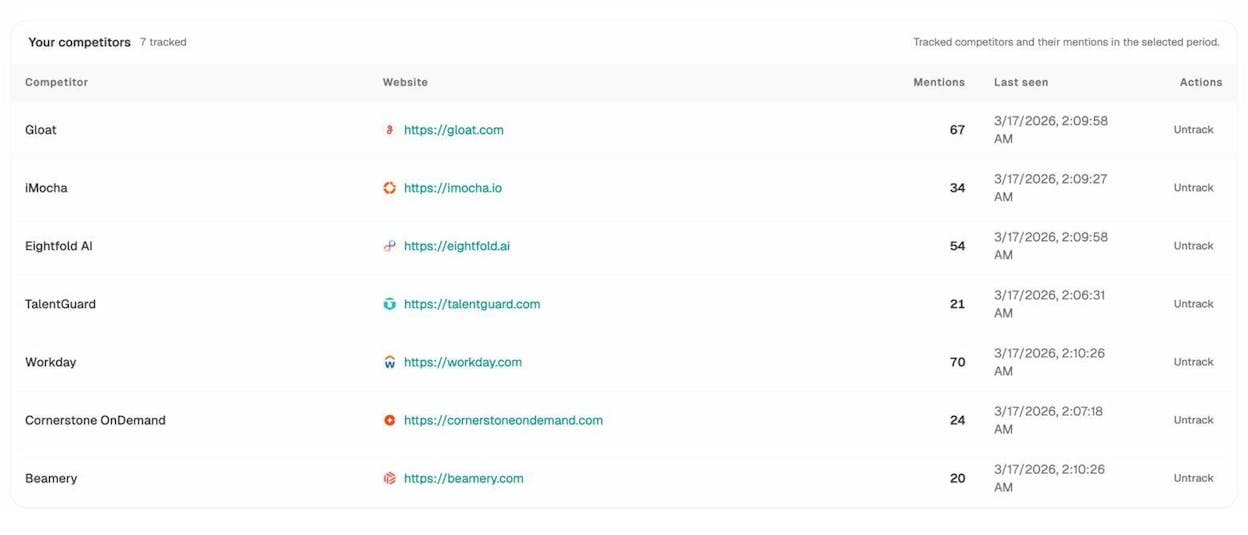
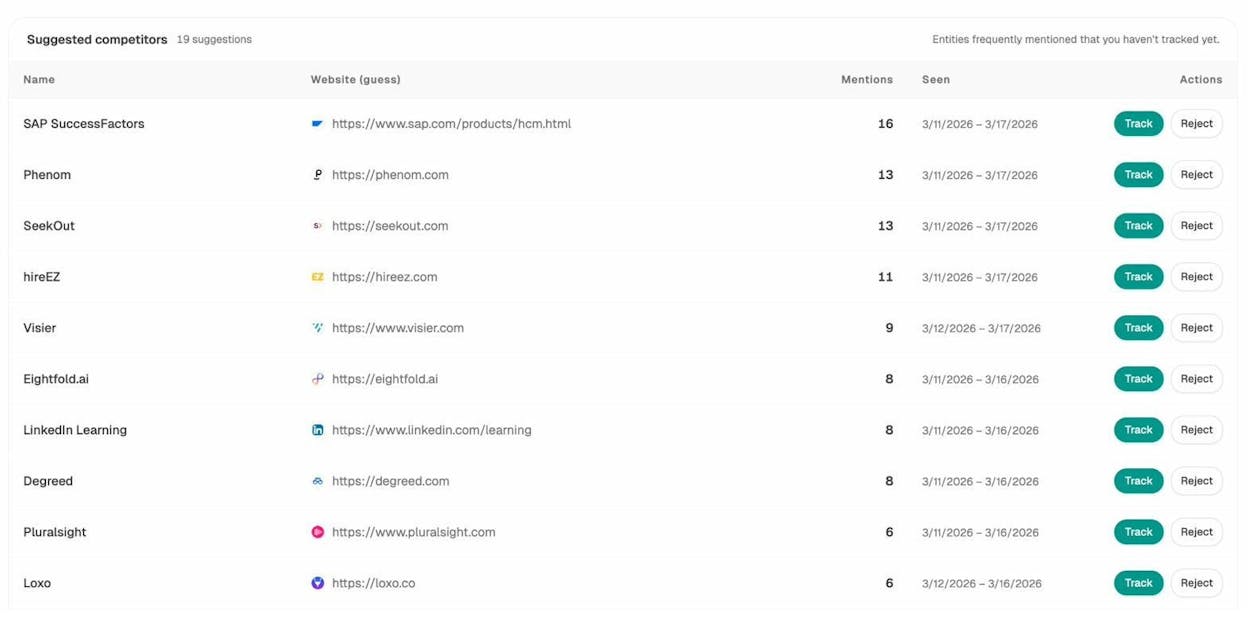
Below your tracked competitors, Analyze AI also surfaces Suggested competitors—entities frequently mentioned in AI responses that you haven’t started tracking yet. This is a fast way to discover new players entering your space through AI search.
4. Browse Reddit, Quora, and Niche Forums
People go to forums when Google doesn’t give them a satisfying answer. That makes forums a useful source for discovering long-tail queries that aren’t yet well-served by existing content.
Here’s how to use this method effectively:
Step 1. Search Reddit for your niche topic. Use Google with a site-specific query like site:reddit.com "meditation for" to find relevant threads.
![[Screenshot: Google search results for site:reddit.com “meditation for” showing threads with specific, long-tail questions]](https://www.datocms-assets.com/164164/1774857964-blobid11.png?auto=format,compress&w=1248&fit=max)
Step 2. Scan the thread titles and top comments. Look for specific questions, complaints, and niche use cases that come up repeatedly.
Step 3. Take the phrasing from those threads and check the search volume and KD in a keyword tool. Analyze AI’s free Keyword Generator works well for this—paste the thread’s core question and see if it (or a close variation) has measurable search volume.
Step 4. If the keyword has even modest search volume (10–200 per month) and low competition, it’s a valid long-tail target.
The bonus of this approach: the forum thread itself gives you raw material for content creation. The questions people ask, the pain points they describe, and the language they use can all inform how you structure and write your article.
The downside: this method is time-consuming. You can discover the same keywords faster using a keyword tool with the right filters. Where forums shine is in uncovering the intent and emotion behind queries—information that no keyword tool provides.
5. Use Google Search Console Data You Already Have
If your site has been live for a while, Google Search Console is a goldmine of long-tail keywords you’re already ranking for—often without realizing it.
Step 1. Open Google Search Console and navigate to the “Performance” report.
Step 2. Filter for queries where your average position is between 8 and 30. These are keywords where you’re ranking on page one or two but not yet at the top.
Step 3. Sort by impressions. Keywords with high impressions but few clicks often represent long-tail queries where your page shows up but doesn’t match the intent well enough to earn the click.
![[Screenshot: Google Search Console Performance report filtered by position 8–30, sorted by impressions, showing long-tail queries with low CTR]](https://www.datocms-assets.com/164164/1774857969-blobid12.jpg?auto=format,compress&w=1248&fit=max)
Step 4. Review these keywords and decide whether you can improve the existing page to better target them, or whether they deserve their own dedicated page.
This is one of the most underused methods because it doesn’t require any external tool—just data you’re already generating. It’s especially powerful for finding new keyword opportunities you wouldn’t have thought to target.
Don’t Stop at Google: Long-Tail Keywords Exist on Every Search Platform
Google isn’t the only place people search—and it isn’t the only platform feeding AI engines.
Bing deserves special attention because ChatGPT uses Bing’s search index for its web browsing and retrieval. Long-tail keywords that perform on Bing directly influence what ChatGPT surfaces in its responses. Use Analyze AI’s free Bing Keyword Tool to research Bing-specific search volume, difficulty, and CPC for any keyword. If a long-tail keyword has meaningful volume on Bing, optimizing for it gives you a pathway into ChatGPT’s citation pool. For deeper guidance on getting cited, see our guide on how to rank on ChatGPT.
YouTube is the world’s second-largest search engine and a major source that AI engines draw from for how-to and tutorial content. If your long-tail keyword lends itself to video (“how to set up a drip irrigation system for raised beds”), research it with the free YouTube Keyword Tool to see whether there’s an untapped video opportunity alongside your written content.
Amazon matters if your long-tail keywords have commercial intent. Product-related long-tail queries like “best wireless earbuds for small ears under $50” behave differently on Amazon than on Google. The free Amazon Keyword Tool shows you how people search on Amazon specifically, which can inform both your product content and your blog content targeting buyers.
The point is this: long-tail keywords are platform-agnostic. The same specificity that makes them valuable on Google makes them valuable everywhere people search—including the AI engines that pull from all of these platforms.
6. Discover Long-Tail Prompts With Analyze AI
Traditional keyword research tells you what people search on Google. But it tells you nothing about what people ask AI engines.
This is where Analyze AI fills a critical gap. Instead of relying solely on Google search volume data, you can see the actual prompts people are using across ChatGPT, Claude, Perplexity, and Google AI Mode—and discover which of those prompts your brand is (or isn’t) appearing in.
Here’s how to use Analyze AI to discover long-tail opportunities in AI search:
Step 1. Set up your brand and competitors in Analyze AI.
Step 2. Navigate to the Prompt Suggestions feature. Analyze AI scans your domain and niche, then recommends prompts you should be tracking—prompts that real users are likely entering into AI engines about your category.
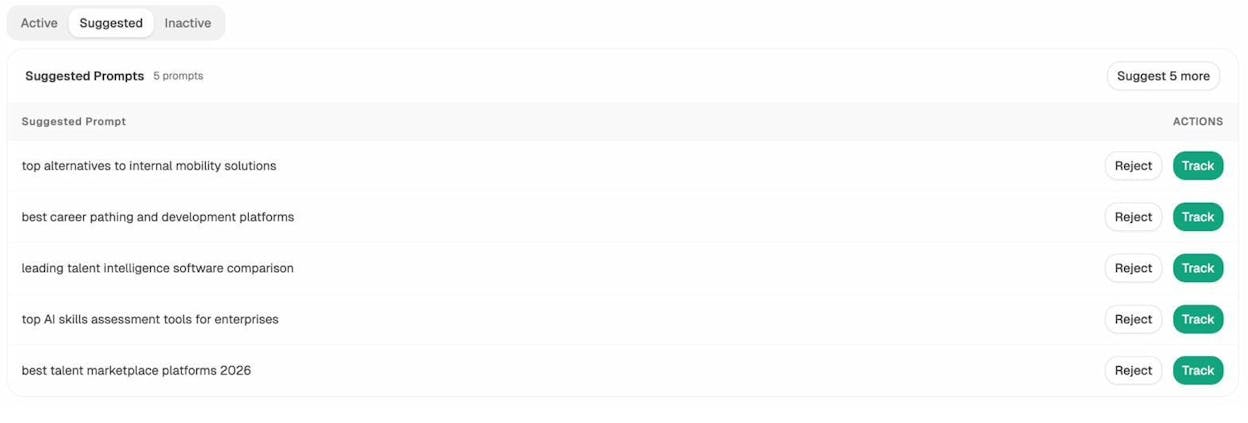
Step 3. Review the suggested prompts. Each one is essentially a long-tail query phrased in natural language—exactly how people interact with AI search. Track the ones relevant to your business and they’ll be monitored daily across all major AI engines.
Step 4. Switch to the Active tab to see your tracked prompts with live data. For each prompt, Analyze AI shows visibility percentage, sentiment score, ranking position, and which competitor brands are being mentioned alongside you.
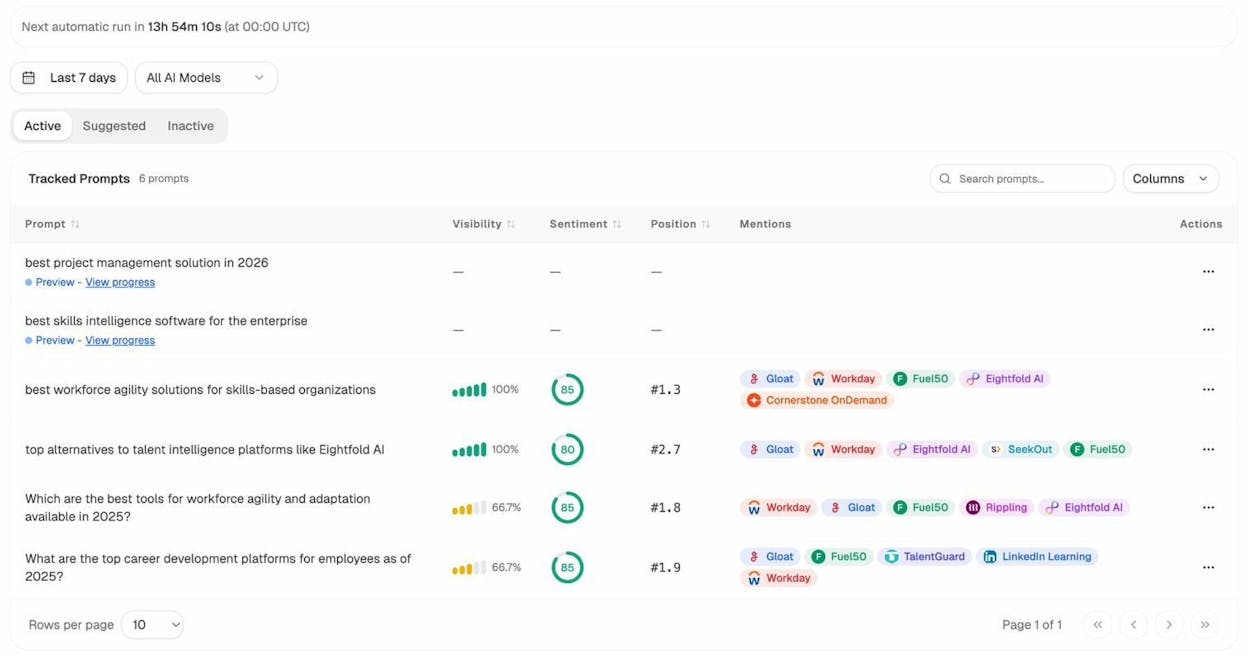
Step 5. Click into any individual prompt to see a detailed visibility trend over time. This shows exactly how your brand’s presence in AI responses changes day by day, compared against every competitor—so you can see whether your content updates are actually moving the needle.
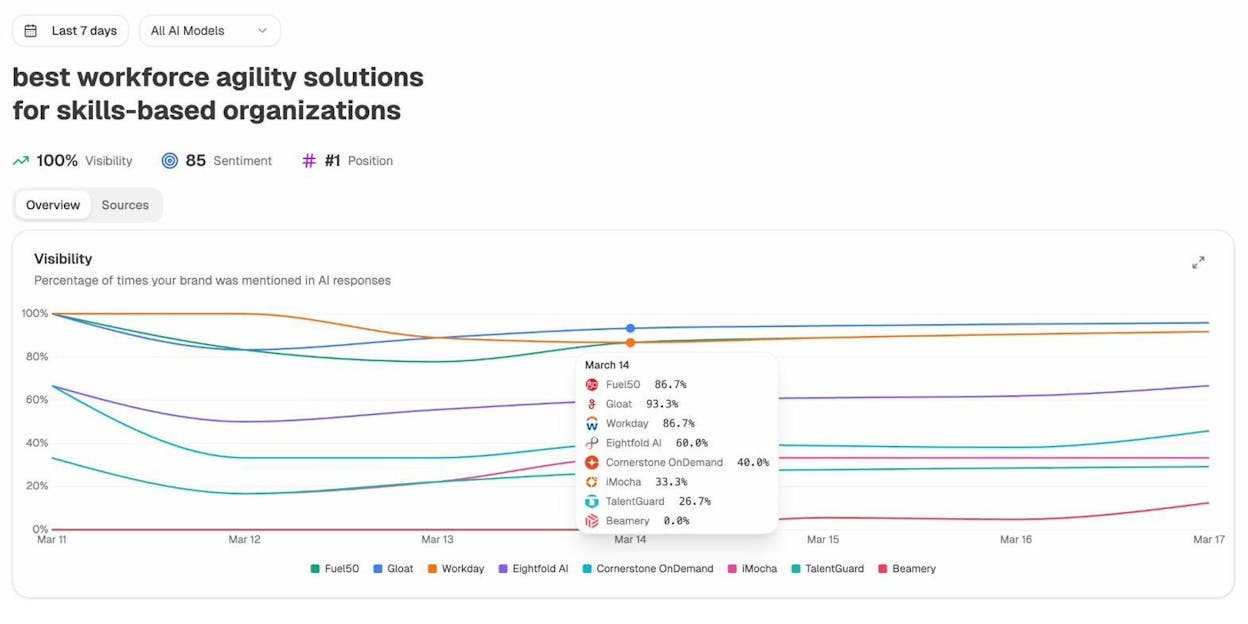
This method is unique because it bridges the gap between traditional keyword research and AI search optimization. The prompts you discover aren’t just theoretical keywords—they represent actual conversations happening in AI engines right now. And since Analyze AI also has a library of ready-made ChatGPT prompts for finding long-tail keyword opportunities, you can combine AI-native discovery with traditional keyword research in a single workflow.
The Two Types of Long-Tail Keywords
Not all long-tail keywords deserve their own page. Understanding the two types will prevent you from creating duplicate content and wasting effort.
Supporting Long-Tail Keywords
A supporting long-tail keyword is a less popular phrasing of a more popular search query. Google recognizes that these variations mean the same thing and ranks the same set of pages for all of them.
Example: “best healthy treats for dogs” gets about 100 searches per month. But there are several variations of this query:
|
Keyword |
Monthly Search Volume |
|---|---|
|
best healthy dog treats |
2,500 |
|
healthiest dog treats |
2,500 |
|
healthy treats for dogs |
600 |
|
best healthy treats for dogs |
100 |
If you Google each of these, you’ll see largely the same pages ranking for all four. Google understands they represent the same intent. You can verify this quickly with Analyze AI’s free SERP Checker—enter each keyword variation and compare the top 10 results. If the same URLs dominate across all variations, they’re supporting long-tails of the same parent topic.
This means you do not need to create separate pages for each variation. Instead, target the highest-volume version (“best healthy dog treats”) with a single, comprehensive page. If that page ranks well, it will automatically rank for all the supporting long-tail variations.
How to identify supporting long-tail keywords: Most keyword research tools have a “Parent Topic” feature or a SERP similarity metric that tells you whether a keyword belongs to a broader topic. If the top-ranking results for your keyword are the same as the top-ranking results for a higher-volume keyword, yours is a supporting long-tail.
Topical Long-Tail Keywords
A topical long-tail keyword represents a distinct search intent that no higher-volume keyword covers. This is the type that deserves its own dedicated page.
Example: “fly bites on dogs ears” gets modest search volume, but when you check its Parent Topic, it points back to itself—there’s no more popular phrasing for this specific query. The top-ranking pages for this keyword are different from the pages that rank for broader terms like “dog skin problems” or “fly control for pets.”
When the Parent Topic matches your keyword, you’ve found a topical long-tail. Create a dedicated page for it. Once that page ranks, it’ll pick up all of its own supporting variations automatically.
When the Lines Get Blurry
Sometimes the distinction isn’t clean. Take “natural sleep aid for dogs” as an example. A keyword tool might group this under the parent topic “sleep aid for dogs.” But the word “natural” signals a meaningfully different intent—people searching for this want alternatives to pharmaceutical options.
If you check the Google results for “sleep aid for dogs,” none of the top-ranking pages focus specifically on natural remedies. That’s a content gap.
In cases like this, creating a dedicated page for the more specific long-tail keyword—even though a tool groups it under a broader parent—can be the right call. Your page would be the only result that directly addresses the searcher’s specific need, which is a strong signal for Google to rank it highly.
The rule of thumb: Don’t blindly trust automated Parent Topic assignments. Always check the actual search results. Use the free SERP Checker to pull the top 10 results for both the long-tail keyword and its supposed parent topic. If the overlapping URLs are fewer than 3–4 out of 10, you’re likely looking at a distinct topical long-tail that deserves its own page.
This principle applies directly to keyword clustering. When you group keywords, use SERP overlap as your guide—not just semantic similarity. Two keywords that look similar on paper may trigger completely different search results, which means they need separate pages.
Long-Tail Keywords and AI Search: Why They Matter More Now
Traditional SEO has always rewarded long-tail targeting. But the rise of AI search engines has made long-tail content even more valuable—for a reason most SEO guides haven’t caught up to.
AI Prompts Are Natural Long-Tail Queries
When a user types into ChatGPT or Perplexity, they don’t use keyword shorthand. They write full sentences, add constraints, and describe their specific situation:
-
“What’s the best accounting software for a freelance graphic designer who invoices in multiple currencies?”
-
“How do I fix a leaking kitchen faucet if the handle is stuck and I don’t want to call a plumber?”
-
“Which meditation app has the best free content for complete beginners over 60?”
Every one of these prompts is a long-tail query. And when the AI engine processes them, it searches the web, evaluates sources, and selects the ones that most directly address the specific question. If your content answers that exact question—with depth, specificity, and structure—you have a higher chance of being cited.
This is what we mean at Analyze AI when we say that GEO isn’t a replacement for SEO—it’s the next transformation of it. Search is expanding from ten blue links to multi-modal, prompt-shaped answers. Quality still governs visibility. Authority still comes from depth, originality, structure, and usefulness. What changes is where that quality must be legible—to crawlers, to models, and to the people asking better questions.
How to Track Your Long-Tail Visibility in AI Search
Traditional keyword tracking tools show you where you rank on Google for a given keyword. But they can’t tell you whether AI engines are citing your content when users ask related questions.
This is the gap that Analyze AI’s prompt tracking was built to close. Here’s how to use it:
Step 1. Take the long-tail keywords you’ve identified through your research and convert them into natural-language prompts. For example, the SEO keyword “best CRM for small consulting firms” becomes the AI prompt “What’s the best CRM for a small consulting firm with 5–10 employees?”
Step 2. Add these prompts to Analyze AI’s tracking dashboard. The platform will run them daily across ChatGPT, Claude, Perplexity, and other engines, recording whether your brand or URLs appear in the responses.
Step 3. Monitor your visibility over time. You’ll see which prompts cite your brand, which cite competitors, and which cite neither—giving you a clear view of where to focus your content efforts.
Step 4. Check the Sources view to see which domains and URLs are being cited most often in your category. The Content Type Breakdown shows whether AI engines are favoring blogs, product pages, reviews, or other formats—so you know what type of long-tail content to create. The Top Cited Domains chart reveals which websites are shaping AI answers in your space.
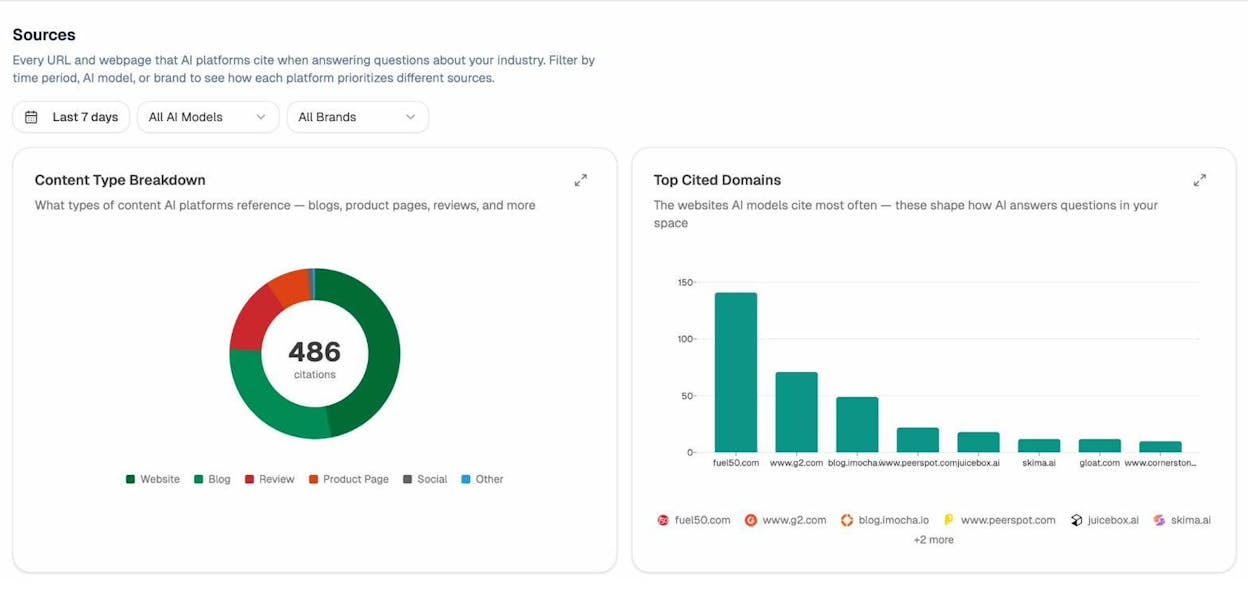
If a third-party review site or industry blog keeps getting cited for prompts related to your product, that’s a signal to either earn coverage on that site or create competing content that LLMs find equally authoritative. This is how you turn AI citation data into an actionable content strategy. For a deeper dive on earning citations, see our data-backed guide on how to outrank competitors in AI search.
Identify Content Patterns That Win in AI Search
Once you’re tracking AI visibility, look for patterns in which of your pages drive the most AI referral traffic. In Analyze AI’s AI Traffic Analytics, you can connect your GA4 account to see exactly which pages receive visits from AI search engines, broken down by source (ChatGPT, Claude, Perplexity, Copilot, Gemini, and more), engagement metrics, and conversions.
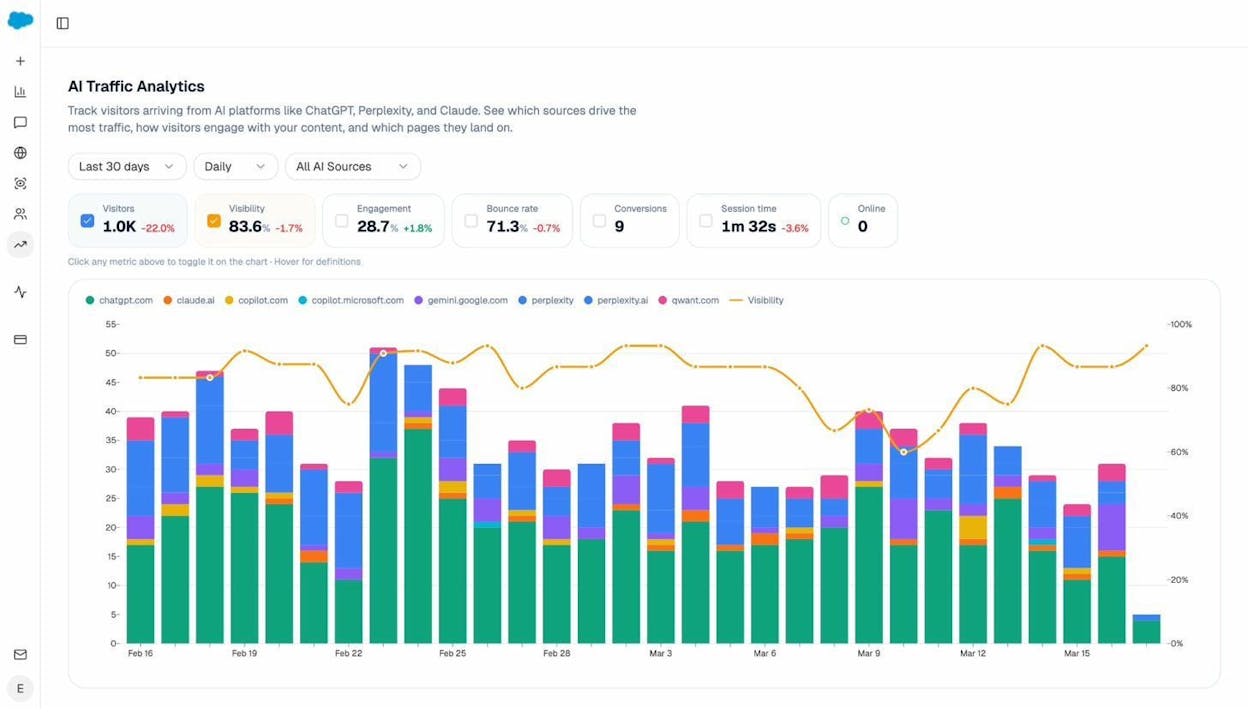
Drill down into the Landing Pages report to see which specific URLs AI engines are sending traffic to, which AI platform referred each visit, and the sessions, citations, engagement, bounce rate, duration, and conversions for each page. Click any row to expand and see a full breakdown of traffic sources, devices, new vs. returning users, top countries, and the exact AI prompts that cited that page.
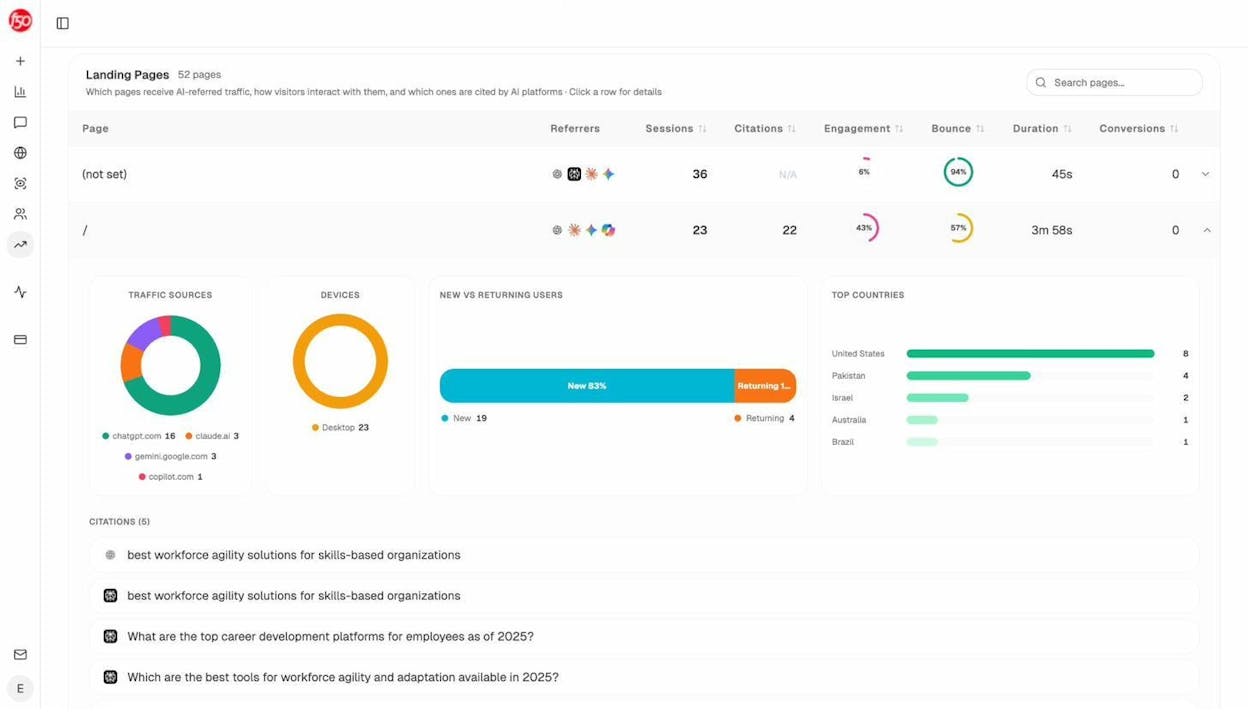
If you notice that your long-form, question-and-answer-style articles consistently outperform your shorter overview pieces in AI referral traffic, that’s a content pattern worth doubling down on. Similarly, if certain page structures (e.g., comparison tables, step-by-step guides, or FAQ sections) appear more frequently in AI citations, use that structure in future long-tail content.
This data-driven approach turns long-tail keyword targeting from a one-channel SEO tactic into a multi-channel visibility strategy that covers Google, AI Overviews, ChatGPT, Perplexity, Claude, and every other surface where your audience searches.
How to Create Content That Ranks for Long-Tail Keywords
Finding long-tail keywords is half the job. The other half is creating content that actually ranks for them—in both traditional search and AI engines. Here’s how to approach it.
Match the Search Intent Precisely
Before writing a single word, search your target long-tail keyword on Google and study the top 3–5 results. Ask yourself:
-
What format do they use? (Listicle, how-to, comparison, definition, etc.)
-
How deep do they go? (You don’t need to match their length—you need to match their depth.)
-
What subtopics do they cover? (These are the minimum expectations. You need to meet them, then go further.)
-
What’s missing? (This is your information gain—the unique value that earns you a ranking advantage.)
For long-tail keywords, the top results are often thin. That’s your advantage. A well-structured, 1,200-word piece that directly answers the query with specific examples will outrank a 500-word generic post that only tangentially touches the topic.
Bonus tactic: Run the top-ranking pages for your target long-tail keyword through Analyze AI’s free Broken Link Checker. If a competitor’s page has broken outbound links, outdated resources, or technical SEO issues, those are weaknesses you can exploit. Your page—with working links, fresh data, and clean technical health—sends stronger quality signals to both Google and AI engines.
Structure Your Content for Machines and Humans
Both Google and AI engines reward content that’s easy to parse. Here are the structural elements that matter:
Use clear H2 and H3 headings that mirror the way people phrase their questions. If your target keyword is “how to start a Roth IRA at 22,” your H2 shouldn’t be “Getting Started”—it should be “How to Open a Roth IRA When You’re in Your Early 20s.”
Answer the core question early. Don’t bury the answer under five paragraphs of background. Put a concise, direct answer within the first 100–200 words, then expand with details, examples, and nuance. AI engines frequently excerpt the first direct answer they find.
Use tables and structured data where appropriate. If your long-tail keyword involves a comparison, include a table. AI engines parse tables more reliably than paragraphs when assembling comparison responses.
Include FAQ sections for closely related long-tail variations. If your target keyword has 3–5 supporting long-tail variations that are phrased as questions, answer them as individual H3 subheadings or in a dedicated FAQ section. This increases your chances of ranking for multiple queries with one page. For more on identifying the right questions, check our guide on People Also Ask optimization.
For a deeper walkthrough on structuring content for both SEO and AI search, see our guide on answer engine optimization.
Add Information Gain
The content already ranking for your long-tail keyword represents the baseline. Matching it will earn you a place in the SERPs. Exceeding it—by adding information the existing results don’t contain—is what earns you a top position.
Information gain can come from:
-
Original data or research (e.g., “We analyzed 500 Roth IRA portfolios and found that…”)
-
First-hand experience (e.g., “I opened my Roth IRA at 22 through Fidelity. Here’s exactly what the process looked like.”)
-
Expert quotes or interviews (e.g., “I asked a certified financial planner whether…”)
-
Specific, detailed examples that the existing results only cover generically
-
A unique angle that reframes the topic in a way no other result does
This principle applies in AI search just as strongly. Analyze AI’s research on AI citations shows that LLMs disproportionately cite pages that contain unique data, structured comparisons, or specific expertise that isn’t replicated across multiple sources. Generic content that restates what five other pages already say is less likely to be selected as a citation source.
Use Keywords Naturally Across the Page
Once you have your target long-tail keyword and its supporting variations, weave them into the content naturally. Use your primary keyword in the title tag, H1, URL slug, meta description, and within the first 100 words. Use variations and secondary keywords throughout the body. Consider incorporating LSI keywords to signal topical depth.
Don’t force exact-match phrasing where it reads awkwardly. Google’s natural language processing is advanced enough to understand synonyms and rephrased variations. AI engines are even more flexible—they parse meaning, not keyword strings.
For a deeper walkthrough on placing keywords effectively, see our guide on how to use keywords in SEO.
Putting It All Together: A Long-Tail Keyword Workflow
Here’s the full process, from research to published content, consolidated into a repeatable workflow:
1. Start with your niche seed keywords. Pick 3–5 broad terms that define your category. Enter them into a keyword research tool or Analyze AI’s free Keyword Generator.
2. Filter for long-tail opportunities. Set maximum search volume to 500 (or lower for very competitive niches). Set maximum KD to 20–30. Export the results.
3. Mine your competitors. Run 5–10 competitor domains through a site explorer tool or the free Keyword Rank Checker. Export their long-tail rankings and merge with your list.
4. Check your Google Search Console. Pull queries where you rank positions 8–30 with moderate impressions. Add these to your list.
5. Expand beyond Google. Run your top long-tail keyword candidates through the free Bing Keyword Tool, YouTube Keyword Tool, and Amazon Keyword Tool to spot cross-platform opportunities.
6. Discover AI prompt gaps. Use Analyze AI to find prompts where competitors are cited but you’re not. Add these to your list.
7. Classify each keyword. Determine whether it’s a topical long-tail (deserves its own page) or a supporting long-tail (should be folded into an existing page targeting a broader term). Use the free SERP Checker to compare SERPs when you’re unsure.
8. Prioritize. Rank your keywords by a combination of: traffic potential, business relevance, competition level, and AI search opportunity.
9. Create content. For each topical long-tail, produce a focused, intent-matched piece with clear structure, direct answers, and information gain over existing results.
10. Track and iterate. Monitor Google rankings via Search Console and AI visibility via Analyze AI’s prompt tracking. Double down on formats, structures, and topics that perform in both channels.
Long-tail keywords aren’t a fallback strategy for sites that can’t compete on head terms. They’re the foundation of a sustainable search visibility strategy that works across Google, AI Overviews, ChatGPT, Perplexity, and every other surface where your audience looks for answers. The brands that invest in long-tail content today are building visibility that compounds across every channel—traditional and AI—tomorrow.
Analyze AI’s Free SEO Tools
Throughout this guide, we’ve referenced several free tools. Here’s the full list so you can bookmark them:
|
Tool |
What It Does |
|---|---|
|
Generate keyword ideas with volume, KD, and CPC from any seed term |
|
|
Check how hard it is to rank for any keyword (0–100 score) |
|
|
See what keywords any website ranks for in Google |
|
|
Check Google’s top 10 results for any keyword |
|
|
Check any site’s organic authority, traffic, and keyword count |
|
|
Estimate any site’s organic and paid traffic |
|
|
Audit any page for broken links and SEO issues |
|
|
Research Bing-specific keyword volume and difficulty |
|
|
Find keyword data for YouTube video optimization |
|
|
Research Amazon-specific search terms for product content |
All tools are free and require no signup. Use them alongside your existing SEO stack—or as a starting point if you don’t have one yet.

Ernest

Ibrahim


