



Summarize this blog post with:


In this article, you’ll learn why ranking for the same keyword with multiple pages is not always a problem, how to tell the difference between harmful cannibalization and beneficial diversification, which keywords are best suited for a multi-page strategy, and how to audit your own site for both effects across Google and AI search engines.
Table of Contents
Good vs. Bad Multiple Rankings
Multiple rankings happen when a site ranks for the same keyword with more than one page. This can appear in two forms, and each one requires a completely different response.
![[Screenshot description: Google Search Console showing a keyword with multiple pages ranking in the Performance report, filtered by query]](https://www.datocms-assets.com/164164/1777503783-blobid1.png?auto=format,compress&w=1248&fit=max)
Keyword Cannibalization: Bad Multiple Rankings
Keyword cannibalization occurs when Google constantly swaps which page it ranks for a keyword, or when multiple pages rank simultaneously but cover similar enough content that they could be merged into one stronger piece.
You can recognize cannibalization by two patterns.
Pattern 1: Ranking volatility. Your position history shows two or more URLs trading places in the SERPs. One week, your guide ranks at position 4. The next week, your how-to article replaces it at position 8. Neither page holds a stable ranking because Google cannot decide which one to serve.
![[Screenshot description: Google Search Console position history chart showing two URLs swapping rankings for the same keyword over a 6-month period]](https://www.datocms-assets.com/164164/1777503792-blobid2.png?auto=format,compress&w=1248&fit=max)
Pattern 2: Redundant simultaneous rankings. Two pages rank at the same time, but they serve the same intent with overlapping content. The combined traffic of both pages is lower than what one consolidated page could earn. You are splitting your own authority.
Both patterns share the same root cause. The pages are too similar in topic, angle, or format for Google to clearly differentiate between them.
How to Spot Cannibalization in Practice
Open Google Search Console. Navigate to the Performance report. Click on a keyword you want to investigate. Then click the “Pages” tab to see which URLs rank for that query.
If you see two or more URLs showing impressions for the same keyword, ask yourself three questions.
First, are the pages serving the same intent? If both pages are guides covering the same topic from the same angle, they are likely cannibalizing each other. A guide to “link building” and a “complete link building tutorial” are essentially the same page in Google’s eyes.
Second, is the position stable? Export the data over 6 months or longer. If both URLs maintain consistent positions without swapping, this is likely diversification, not cannibalization. If positions oscillate, that is a strong signal of cannibalization.
Third, would a reader benefit from having both pages exist? If someone could reasonably land on either page and get the same answer, you have redundant content. If each page serves a distinct need (like a guide vs. a free tool), they are complementary.
![[Screenshot description: Spreadsheet showing a cannibalization audit with columns for keyword, URL 1, URL 2, intent match, position stability, and recommended action]](https://www.datocms-assets.com/164164/1777503799-blobid3.png?auto=format,compress&w=1248&fit=max)
Example: How Consolidation Fixes Cannibalization
Suppose your site has three separate blog posts about “content marketing metrics.” Each covers slightly different metrics, but there is significant overlap. Google rotates between them, and none consistently rank in the top 5.
The fix is to create one comprehensive guide that pulls the best sections from all three, set the strongest URL as the canonical, and 301 redirect the other two. The consolidated page inherits the combined authority and gives Google a single, clear answer to serve.
After consolidation, sites commonly see a jump into the top 5 within weeks. The reason is simple. Instead of dividing signals across three weak pages, all backlinks, internal links, and user engagement flow to one strong page.
Keyword Diversification: Good Multiple Rankings
Keyword diversification is the opposite scenario. Two or more pages rank for the same keyword simultaneously, each serving a distinct intent or format, and there is no benefit to merging them.
This is what healthy keyword clustering looks like in practice. Google has decided that searchers for this query want different types of content, and your site delivers on multiple fronts.
You can recognize diversification by three signals.
Signal 1: Stable parallel rankings. Both pages maintain their positions over time without swapping. One might sit at position 2 and the other at position 7 for months.
Signal 2: Different content types. The pages serve different formats. A blog article at position 3 and a tool landing page at position 6 is a classic diversification pattern. So is a glossary entry in the featured snippet and a detailed guide at position 4.
Signal 3: Complementary intent coverage. Each page addresses a different facet of the search query. For the keyword “keyword research,” one page might explain what it is (informational intent) while another offers a free keyword research tool (transactional intent).
Example: Blog Post + Free Tool
Consider a site that ranks for “keyword difficulty” with two pages. A blog post explaining what keyword difficulty means sits at position 5. A free keyword difficulty checker tool ranks at position 1.
These pages do not compete with each other. The blog post attracts searchers who want to understand the concept. The tool attracts searchers who want to check a specific keyword’s difficulty score. Merging them would mean choosing between educational content and a functional tool. That is a net loss for both the site and its audience.
Example: Guide + Comparison Post
A SaaS company ranks for “project management software” with a detailed buyer’s guide at position 4 and a “best project management tools” comparison post at position 8. One helps the reader understand what to look for. The other gives them a shortlist. Both are valuable and serve different stages of the buyer journey.
This is the kind of diversification that smart content strategies produce deliberately. You create content for different stages of the funnel, each targeting the same core keyword from a different angle. Google rewards this with multiple spots in the SERPs because each page genuinely serves the searcher.
How to Audit Your Multiple Rankings
Before you fix anything, you need to know what you are dealing with. Here is a step-by-step process to audit every keyword where your site has multiple rankings.
Step 1: Pull Your Multiple-Ranking Keywords
In Google Search Console, go to Performance > Search results. Set the date range to the last 6 months. Click “Pages” and export the data.
![[Screenshot description: Google Search Console Performance report with Pages tab selected, date range set to 6 months, and the Export button highlighted]](https://www.datocms-assets.com/164164/1777503801-blobid4.png?auto=format,compress&w=1248&fit=max)
In a spreadsheet, filter for keywords where more than one URL appears. You can do this by creating a pivot table with the query as the row and counting distinct URLs. Any keyword with 2 or more URLs is a candidate for review.
If you use an SEO audit tool, many will flag this automatically. Tools like Ahrefs Site Explorer show multiple rankings in the Organic Keywords report. Use the “Multiple URLs only” filter to isolate these cases instantly.
![[Screenshot description: Ahrefs Site Explorer Organic Keywords report filtered to show only keywords with multiple URLs, displaying position and traffic data for each URL]](https://www.datocms-assets.com/164164/1777503816-blobid5.png?auto=format,compress&w=1248&fit=max)
Step 2: Classify Each Case
For each keyword with multiple rankings, assign one of three labels.
Cannibalization. The URLs serve the same intent with overlapping content, and positions are volatile. Action required.
Diversification. The URLs serve different intents or formats, and positions are stable. No action needed.
Unclear. You cannot tell from the data alone. Requires manual review of the content and SERP landscape.
Create a simple spreadsheet with columns for the keyword, URLs, average positions, content type of each URL, intent served, position stability (stable vs. volatile), and your classification.
Step 3: Prioritize by Impact
Not every cannibalization issue deserves your attention. Prioritize based on two factors.
Search volume. A cannibalized keyword with 10,000 monthly searches is a bigger problem than one with 50 searches. Fix the high-volume issues first.
Position gap. If both URLs are stuck at positions 8 and 12, consolidation could push the merged page into the top 5. That is a meaningful traffic gain. If one URL is at position 2 and the other is at position 45, the second URL is not really competing. It is just an incidental ranking that does not affect your primary page.
Step 4: Fix Cannibalization Cases
For each case you labeled as cannibalization, choose one of these actions.
Consolidate. Merge the content from both pages into the stronger URL. This works when both pages cover the same topic and the combined content would create a better resource. Redirect the weaker URL to the stronger one with a 301.
Differentiate. Rewrite one of the pages to serve a distinctly different intent. If you have two “what is” articles, turn one into a “how to” guide. This converts cannibalization into diversification.
Deindex. If one page has no traffic, no backlinks, and no strategic value, consider removing it from Google’s index with a noindex tag. This is a last resort for truly redundant content.
Canonicalize. If both pages need to exist for UX or site structure reasons (for example, product variants), use a canonical tag to tell Google which one to prioritize for search.
![[Screenshot description: Decision flowchart showing the four cannibalization fix options based on content overlap, traffic, and backlinks]](https://www.datocms-assets.com/164164/1777503821-blobid6.png?auto=format,compress&w=1248&fit=max)
Step 5: Monitor the Results
After making changes, track position and traffic weekly for at least 8 weeks. Consolidation effects are not always immediate. Google needs to recrawl and reevaluate the updated content.
Use a rank tracking tool to monitor position changes for the consolidated URL. Look for the merged page climbing in rankings as the redirect passes authority.
Can Diversification Squeeze More Traffic from a Keyword?
The appeal of diversification is obvious. Rank twice in the top 10, get clicks from both positions. But the reality is more nuanced than that.
When two pages from the same site rank in the top 10, the traffic distribution between them varies wildly. Here is what the data shows across different scenarios.
|
Keyword |
Traffic Uplift from 2nd Page |
Traffic Share (Original Page) |
Traffic Share (New Page) |
|---|---|---|---|
|
keyword search |
1.94% |
98.10% |
1.90% |
|
seo audit |
37.74% |
72.60% |
27.40% |
|
free seo tools |
296.13% |
25.24% |
74.76% |
|
affiliate marketing for beginners |
6.63% |
93.78% |
6.22% |
|
free keyword research tool |
677.69% |
12.86% |
87.14% |
|
keyword rankings |
60.71% |
62.22% |
37.78% |
|
how to become an affiliate marketer |
2.39% |
97.67% |
2.33% |
|
keyword difficulty |
9,233.33% |
1.07% |
98.93% |
Three distinct patterns emerge from this data.
Pattern 1: The new page dominates. In cases like “free keyword research tool” and “keyword difficulty,” the newer page captured the vast majority of traffic. This happens when the new page is a free tool or interactive resource that serves the intent better than the original article. The uplift can be massive because the new content format is fundamentally more useful to the searcher.
Pattern 2: The original page holds. For keywords like “keyword search” and “how to become an affiliate marketer,” the second page barely moved the needle. The original page kept 97%+ of the traffic. The second page ranked but barely attracted clicks. This is the most common scenario. You rank twice, but the incremental traffic is negligible.
Pattern 3: Meaningful split. Keywords like “seo audit” and “keyword rankings” show a genuine split where both pages contribute meaningful traffic. The original page still leads, but the second page captures 27-38% of clicks. This is the sweet spot for diversification.
What Determines Which Pattern You Get?
The critical factor is not the keyword itself. It is the content type differential between your two pages.
When both pages are articles, the second page typically captures very little additional traffic. Searchers click the first result from your site and skip the second. But when one page is an article and the other is a tool, calculator, or template, the split becomes meaningful. These formats serve different micro-intents within the same query.
Another factor is position. If your second page ranks at position 9, it gets far fewer clicks than if it ranks at position 3. The CTR curve drops steeply after position 3, so a second-page ranking below position 5 often contributes minimal traffic.
The Hidden Benefit: Keyword Diversification Beyond the Primary Keyword
The traffic table above only shows the primary keyword. But every page you create ranks for dozens or hundreds of additional keywords. A tool page that ranks alongside your blog post for “keyword research” might also rank independently for “free keyword tool,” “check keyword volume,” and “keyword suggestions.”
When you evaluate diversification, do not just look at the overlapping keyword. Look at the total organic traffic each page generates across all keywords. A page that adds only 2% more traffic to the primary keyword might bring in 5,000 additional visits from its own unique keyword footprint.
Should You Target Keywords with More Than One Page?
Yes, but with clear criteria. Intentional diversification works when the following conditions are met.
Condition 1: The SERP already shows mixed intent. Check the top 10 results for your target keyword. If you see a mix of articles, tools, videos, and forums all ranking, Google is telling you that this query has multiple valid intents. That is your green light to create content for more than one of those intents.
![[Screenshot description: SERP overview for a keyword showing mixed intent with articles, tools, and videos ranking in the top 10]](https://www.datocms-assets.com/164164/1777503829-blobid7.png?auto=format,compress&w=1248&fit=max)
Use the SERP Checker to analyze the current ranking landscape before deciding on your content format.
Condition 2: You can create a genuinely different content type. A second blog post on the same topic is not diversification. It is duplication. Your second page needs to serve the keyword in a fundamentally different way. The most effective combinations are an article paired with a free tool, a guide paired with a comparison post, or an in-depth tutorial paired with a glossary definition.
Condition 3: You can maintain both pages over time. Diversification requires ongoing maintenance. Both pages need to stay updated, earn links, and satisfy their respective intents. If you cannot commit to maintaining a second page, the short-term ranking boost will fade.
Strategies That Work for Intentional Diversification
Create a free tool for a keyword you already rank for with content. If your blog post ranks in the top 5 for “website authority checker,” build a free tool that lets people check their authority score instantly. The tool serves the transactional intent while your article serves the informational intent.
Build a glossary or definition hub. Sites that maintain a glossary of industry terms often capture featured snippets for definitional queries while their in-depth guides rank in the regular results. The glossary entry gives Google a concise answer for the snippet, and the guide ranks for users who want to go deeper.
Leverage video content. If a keyword shows video carousel results in the SERPs, create a video targeting that keyword. The video can rank in the video carousel while your article ranks in the standard organic results. This is one of the easiest diversification plays because Google treats video and web results as separate ranking systems.
What Not to Do
Do not create thin content just to rank twice. A second page needs to be genuinely useful. If you create a shallow landing page just to grab an extra SERP slot, Google will either ignore it or penalize your site’s overall quality signals.
Do not target the same format twice. Two listicles on the same keyword is cannibalization waiting to happen. If you already have a “10 best” post, do not publish a “15 best” post. Instead, build a free tool or a detailed guide that approaches the topic from a different angle.
Do not ignore Google’s site diversity update. Since 2019, Google limits most domains to two results per SERP. Attempting to rank three or more pages for the same keyword is unlikely to succeed and may trigger quality reevaluation of your existing rankings.
Are Some Keywords Better Choices for Diversification?
Not all keywords are equally suited for a multi-page strategy. Here is what the data tells us about which keyword characteristics correlate with successful diversification.
Search Volume Does Not Determine Diversification Potential
You might expect high-volume keywords to show more diversification because there is more traffic to distribute. But the data shows no meaningful correlation.
The median search volume for keywords with multiple rankings is virtually identical to single rankings (50 vs. 40). This means diversification is possible across the entire volume spectrum, from head terms to long-tail queries.
Low-volume keywords can support diversification just as well as high-volume ones, as long as the SERP shows mixed intent.
Intent Alignment Is the Single Most Important Factor
Every successful diversification case follows the same pattern. Both pages align with intents that already exist in the top 10 results.
|
Keyword |
Content Types in Top 10 |
Diversified Rankings |
|---|---|---|
|
keyword search |
Landing pages (tools) |
Two free tools |
|
seo audit |
7 articles, 2 landing pages |
Guide + tool landing page |
|
free seo tools |
7 articles, 2 landing pages |
Listicle + free tools page |
|
keyword rankings |
7 articles, 2 landing pages |
Article + free tool |
|
keyword difficulty |
5 articles, 2 tools, 2 forums |
Free tool + guide |
In every case, the diversified content matches formats already present in the top 10. No diversified page broke through by introducing a content type that did not already exist in the SERPs.
This has a practical implication. Before you create a second page for a keyword, check what is already ranking. If the top 10 is all articles, your best bet is diversifying with a tool or video, not another article. If the top 10 already has tools and articles, you have proof that Google accepts both formats for this query.
Long-Tail Keywords Work Just as Well
Conventional thinking suggests that long-tail keywords have clearer intent, making diversification harder. The data says otherwise.
The word count distribution in keywords with multiple rankings is nearly identical to single rankings. Most diversified keywords fall in the 3-4 word range, which represents fairly specific queries.
This means you do not need broad, ambiguous keywords to diversify. Even specific queries like “best free keyword research tool” can support a listicle article at one position and a tool landing page at another.
Higher Difficulty Keywords Show More Diversification
This one is surprising. Keywords with higher difficulty scores show significantly more diversification than easy keywords (median KD of 64 vs. 37 for single rankings).
There are two possible explanations. First, high-difficulty keywords tend to have more search volume and more diverse intent, creating more opportunities for multiple content types. Second, sites that can rank for competitive keywords tend to have strong domain authority, which makes it easier for multiple pages to break into the top 10.
The practical takeaway is encouraging. You should not avoid diversification on competitive keywords. If anything, competitive keywords may be better candidates because their SERPs tend to be more diverse.
How Multiple Rankings Work in AI Search
Everything we have covered so far applies to traditional Google search. But search is evolving, and the concept of multiple rankings now extends to AI search engines like ChatGPT, Perplexity, Gemini, and Copilot.
In traditional search, you rank with URLs on a results page. In AI search, your brand appears as a mention or citation within an AI-generated answer. And just like Google, AI engines can recommend your brand in multiple ways within the same response.
AI Search Has Its Own Version of Diversification
When someone asks ChatGPT “what are the best CRM tools for small businesses,” the response might mention your product in the recommendation list, cite your comparison blog post as a source, and link to your pricing page for more details. That is three touchpoints from a single prompt. It is the AI equivalent of ranking three times in the top 10.
The brands that achieve this kind of multi-citation coverage are the ones with diverse content types across their site. A product page alone will not get you mentioned, cited, and linked. You need educational content, comparison content, and product content working together.
This is why content strategy for SEO and AI search are not separate disciplines. The same content diversification that wins in Google also wins in AI-generated answers.
How to Track Multi-Mention Coverage in AI Search
Unlike Google Search Console, AI engines do not give you a performance report. You need a dedicated tool to see how AI search engines are treating your brand.
Analyze AI tracks your brand’s visibility, sentiment, and position across ChatGPT, Perplexity, Gemini, Copilot, and other AI engines. You can see exactly which prompts mention your brand, which competitors appear alongside you, and which content types AI engines prefer to cite.
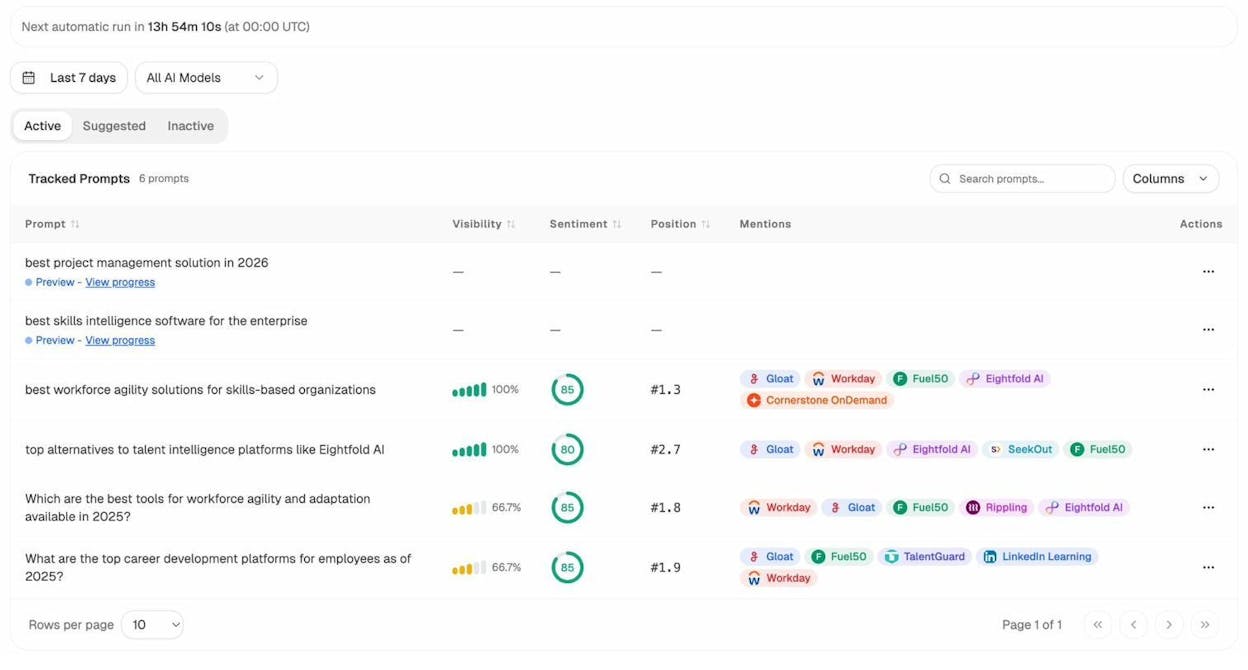
Analyze AI Prompt Tracking dashboard showing visibility, sentiment, and competitor mentions per prompt
In the Prompt Tracking view above, you can see each tracked prompt with its visibility percentage, sentiment score, position, and the competitors mentioned alongside your brand. This is the AI equivalent of checking your SERP positions and seeing who else ranks for the same keyword.
Finding Diversification Opportunities in AI Search
The Competitor Intelligence feature in Analyze AI shows which brands appear most frequently in AI answers for your tracked prompts. If a competitor shows up consistently and you do not, that is a content gap.
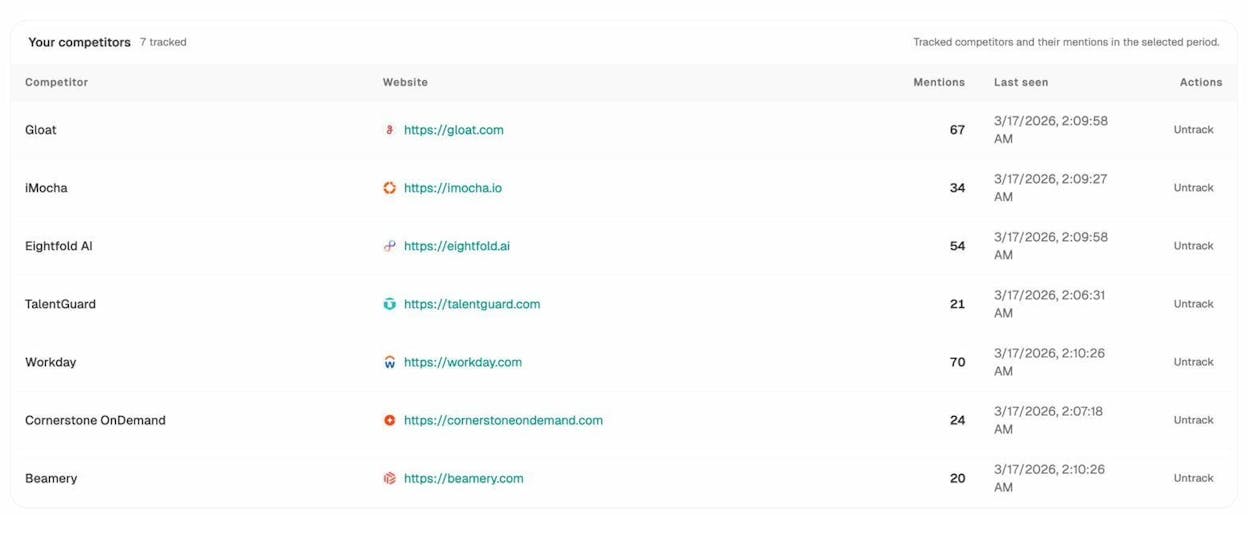
Analyze AI Competitor Intelligence showing tracked competitors with mention counts
But the real insight comes from the Sources view. This shows which content types AI engines prefer to cite: blogs, product pages, reviews, documentation, or social content.
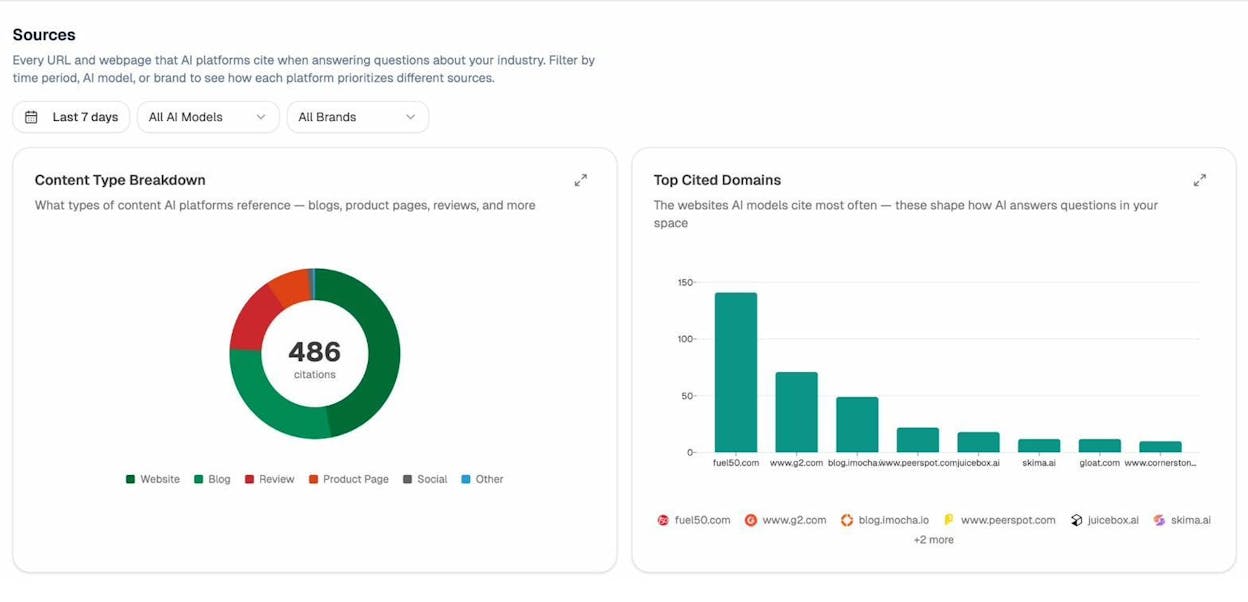
Analyze AI Sources dashboard showing content type breakdown and top cited domains
If AI engines in your space primarily cite blog posts and review sites, that tells you where to focus your diversification efforts. Creating content in the formats that AI engines already trust is the AI search version of aligning with existing SERP intent.
Connecting AI Visibility to Actual Traffic
Tracking mentions is useful, but tracking traffic is what matters. The AI Traffic Analytics feature in Analyze AI shows exactly how many visitors arrive from each AI engine, which pages they land on, and how they engage.
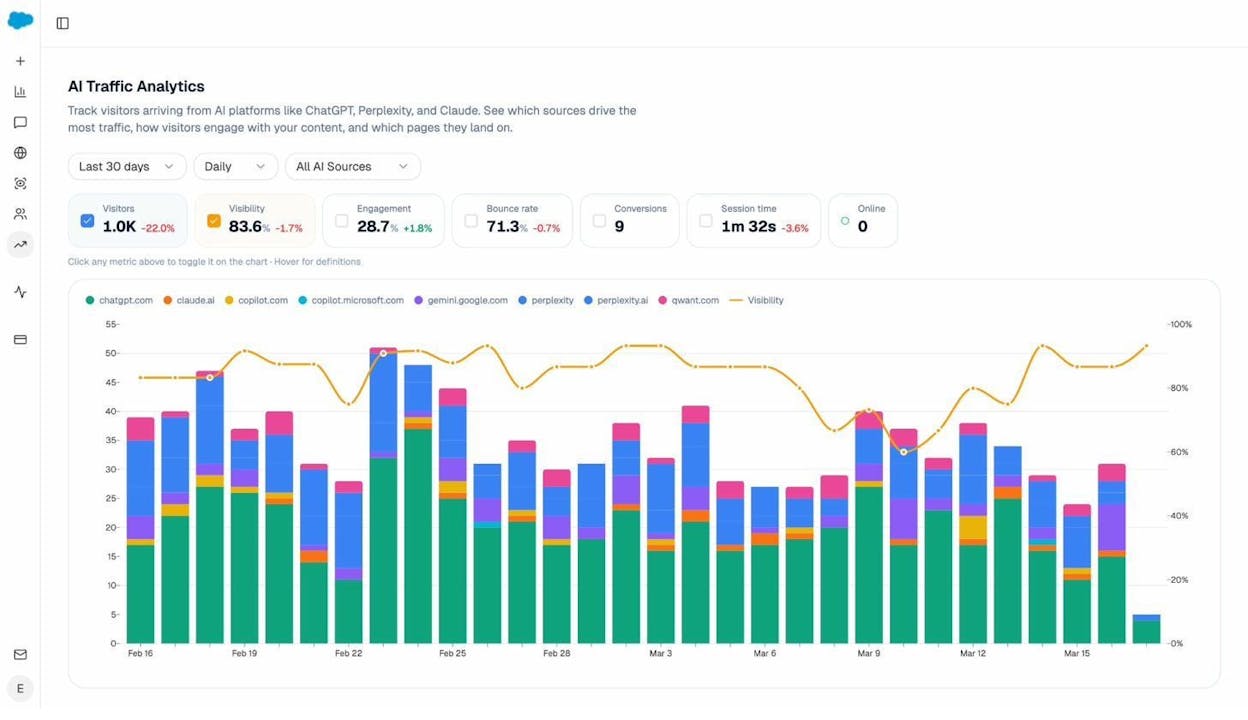
Analyze AI Traffic Analytics dashboard showing visitors by AI source, engagement, and conversions
This data reveals which of your pages receive AI-referred traffic. If your product page gets visits from ChatGPT but your blog does not, you know where the diversification gap is. And the landing page report shows granular detail for each page, including which prompts generated citations.
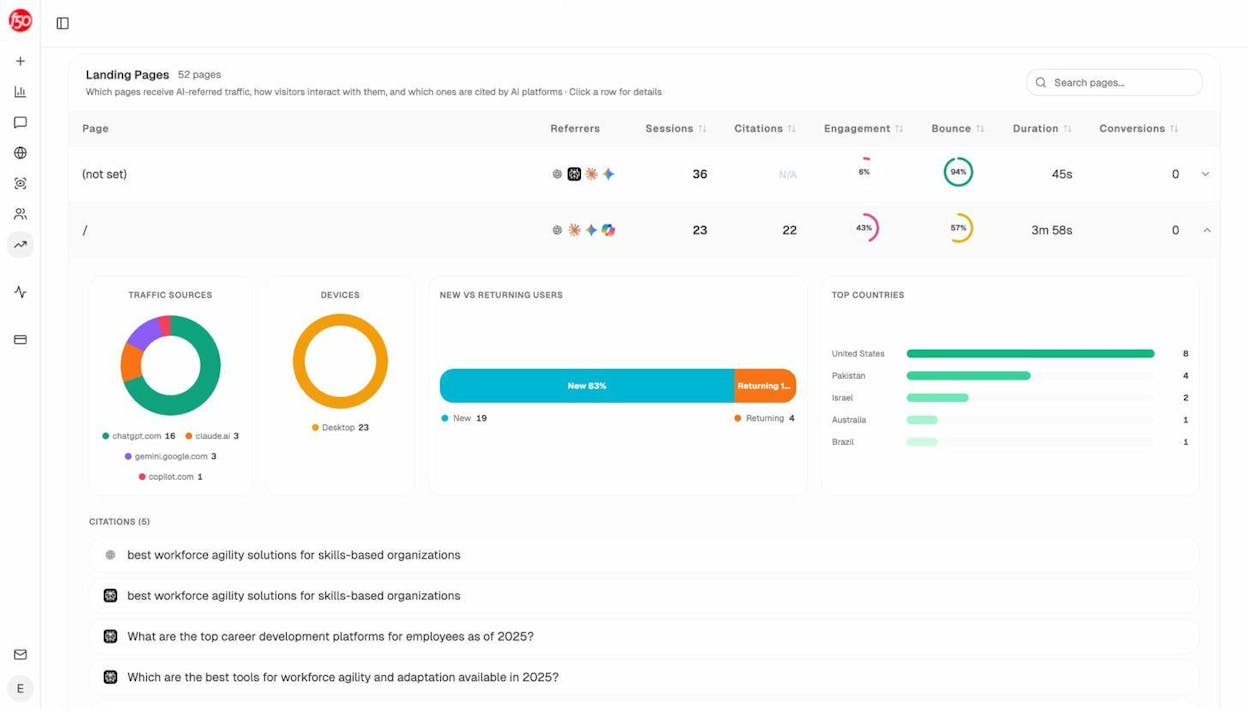
Analyze AI Landing Pages report showing sessions, citations, engagement, bounce rate per page
The landing page data is the AI search equivalent of the “traffic share by page” report you would use in a traditional keyword rank checker. It tells you which pages earn AI traffic and which ones are invisible.
Testing Prompts Before You Commit
Before building a full content campaign around a keyword for AI search, you can validate your hypothesis with a one-off search. The AI Search Explorer in Analyze AI lets you run any prompt across ChatGPT, Gemini, and Perplexity to see who shows up.
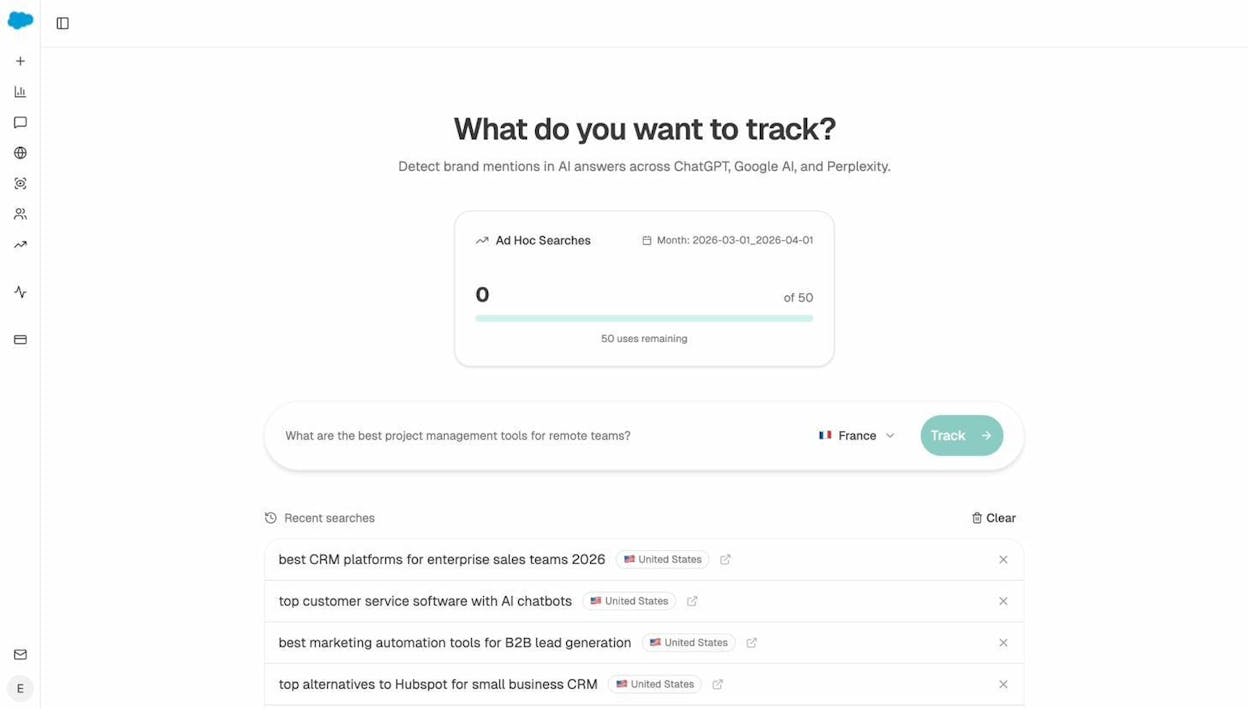
Analyze AI Ad Hoc Prompt Searches showing a prompt input field with recent searches
Type in the prompt you are considering targeting. If your brand does not appear in the results from any engine, that prompt is a diversification opportunity. If a competitor dominates across all engines, you know the gap you need to close.
How to Fix Cannibalization (Step by Step)
If your audit revealed genuine cannibalization, here is the exact process to fix it.
Fixing Cannibalization in Google
Step 1: Choose the winner. Pick the URL with the strongest combination of backlinks, traffic, and content quality. This is the page that will survive.
Step 2: Merge content. Copy any unique, valuable sections from the losing pages into the winning URL. Do not just delete the weaker pages. Extract their best content first.
Step 3: Update internal links. Find every internal link pointing to the losing URLs and update them to point to the winner. Internal link equity should flow to the consolidated page.
Step 4: 301 redirect. Set up permanent redirects from the losing URLs to the winning URL. This passes any external link equity from the old pages to the new one.
Step 5: Resubmit for indexing. In Google Search Console, submit the winning URL for inspection and request indexing. Also submit the redirected URLs so Google processes the redirects faster.
Step 6: Monitor. Track the consolidated URL’s position and traffic weekly for 8-12 weeks. You should see position improvements within 2-4 weeks as Google recrawls and reevaluates.
![[Screenshot description: Checklist showing the 6 steps for fixing keyword cannibalization with status checkboxes]](https://www.datocms-assets.com/164164/1777503866-blobid14.png?auto=format,compress&w=1248&fit=max)
Fixing Cannibalization in AI Search
AI search engines do not use PageRank or backlink profiles the way Google does. They decide which brands to mention based on the quality, clarity, and authority of your content plus the sources they trust.
If two of your pages are competing for the same AI prompt (meaning AI engines alternate between citing one or the other), you fix it the same way: consolidate into one definitive resource.
But there is an additional step for AI search. After consolidation, check whether AI engines are actually picking up the changes. Use the Prompt Tracking feature in Analyze AI to monitor whether your consolidated page starts receiving more citations and higher visibility scores.
The Content Optimizer in Analyze AI can also help. It analyzes your existing pages and identifies specific gaps in entity coverage, argument structure, and citation signals that make content more likely to be referenced by AI engines.
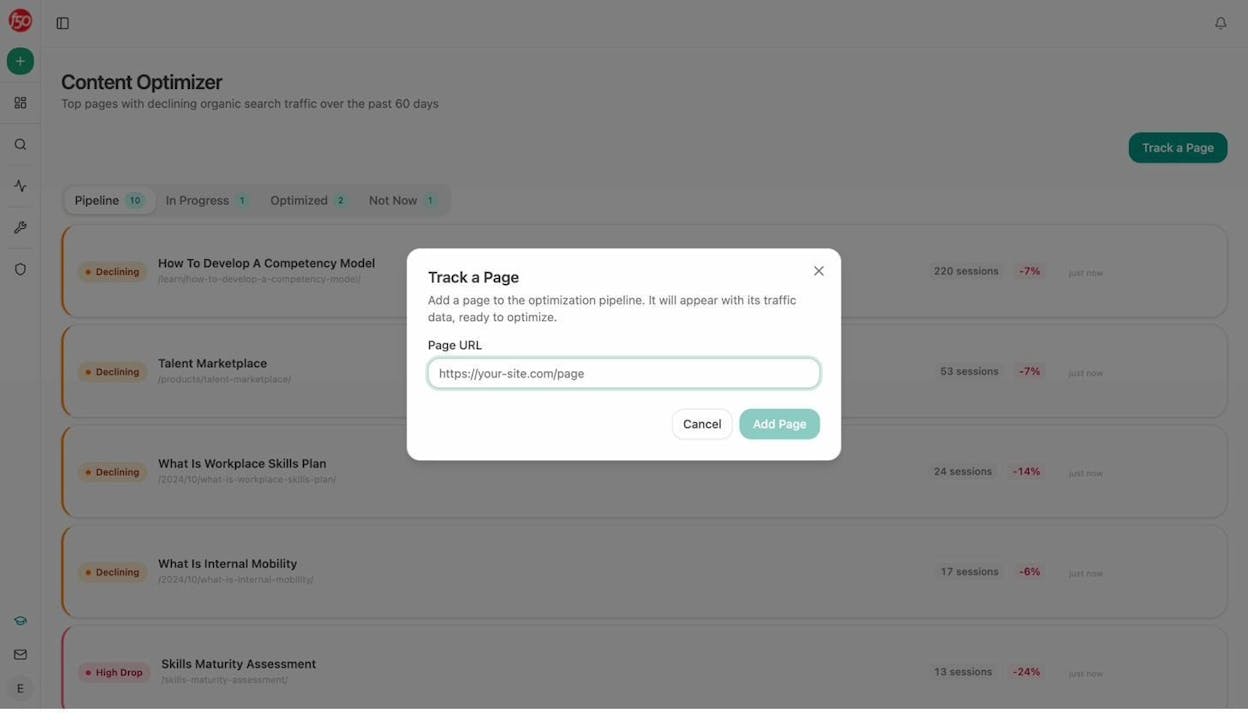
Analyze AI Content Optimizer showing pages with declining traffic and optimization pipeline
This is especially valuable post-consolidation. You have merged your content. Now you need to make sure the merged page is structured in a way that both Google and AI engines find useful and worth citing.
A Quick Decision Framework
To make this actionable, here is a simple framework you can apply to any keyword where you have multiple rankings.
|
Scenario |
Content Types |
Position Behavior |
Diagnosis |
Action |
|---|---|---|---|---|
|
Two articles on the same topic |
Same format, same intent |
Positions swap frequently |
Cannibalization |
Consolidate into one |
|
Article + free tool |
Different formats, different intents |
Stable parallel rankings |
Diversification |
Keep both, maintain each |
|
Two guides, one older |
Same format, similar intent |
Old guide losing position |
Cannibalization |
Merge old into new, redirect |
|
Blog post + glossary entry |
Different formats, definition vs. depth |
Blog ranks organically, glossary in featured snippet |
Diversification |
Keep both |
|
Product page + comparison page |
Different formats, commercial vs. informational |
Both stable |
Diversification |
Keep both |
|
Two product pages for same feature |
Same format, same intent |
Positions swap |
Cannibalization |
Canonicalize to one |
The pattern is consistent. Same format + same intent = cannibalization. Different format or different intent = diversification. When in doubt, check whether positions are stable over 3-6 months. Stability is the strongest signal that Google views the pages as complementary rather than redundant.
Final Thoughts
Multiple rankings in Google create two effects, and classic SEO theory only recognizes the negative one.
Cannibalization is real, and it needs to be fixed. But diversification is just as real, and it should be protected and cultivated. The difference between the two comes down to intent alignment and content type differentiation.
The most important takeaway from this data is practical. You do not need to panic every time you see two of your pages ranking for the same keyword. Instead, audit the relationship between those pages, classify it correctly, and act accordingly.
And as AI search grows alongside traditional search, the concept of diversification becomes even more relevant. AI engines cite brands across multiple content types within a single response. The sites that produce diverse, high-quality content for multiple audiences and intents are the ones that show up everywhere, both in Google and in the answers that ChatGPT, Perplexity, and Gemini generate.
SEO is not dying. It is expanding. The brands that treat AI search as an additional organic channel, not a replacement, are the ones that will compound their visibility across every surface where buyers search.
Start by auditing your multiple rankings. Fix the cannibalization. Protect the diversification. And build the content variety that earns you more real estate, everywhere people and AI look for answers.

Ernest

Ibrahim


