



Summarize this blog post with:


In this article, you’ll learn what SEO and PPC actually are, how they differ, and what each one is good (and bad) at. You’ll also get a clear framework for deciding which channel deserves your budget right now, how to use both together, and why the smartest teams are adding a third organic channel that most guides ignore entirely.
Table of Contents
What Is SEO?
SEO (search engine optimization) is the process of improving your website so it ranks higher in organic search results. Organic results are the unpaid listings that appear below the ads on Google, Bing, and other search engines.
![[Screenshot: Google SERP showing the difference between paid ads at the top and organic results below, with labels pointing to each section]](https://www.datocms-assets.com/164164/1777496345-blobid1.png?auto=format,compress&w=1248&fit=max)
When someone searches “best CRM software” and your page appears on page one without you paying for that click, that’s SEO at work. The goal is to earn traffic consistently by matching what searchers want with the best possible answer.
SEO typically involves four areas.
1. Keyword Research
Keyword research is finding the words and phrases your target customers type into search engines. It’s the foundation of every other SEO activity because you can’t optimize for terms you don’t know exist.
The process usually starts with brainstorming. Think about what your customers would search for, then plug those ideas into a keyword research tool to expand your list and check the data.
For example, if you sell project management software, you’d start with seed terms like “project management tool” and “task management app.” A keyword tool will then surface related queries like “best project management software for small teams” or “free task management tools” along with search volume and difficulty scores.
![[Screenshot: A keyword research tool showing a list of keyword ideas with search volume, keyword difficulty, and CPC columns for project management-related terms]](https://www.datocms-assets.com/164164/1777496373-blobid2.png?auto=format,compress&w=1248&fit=max)
The best keywords balance three things: enough search volume to drive meaningful traffic, low enough difficulty that you can realistically rank, and strong commercial intent that attracts your target buyer.
Recommended reading: SEO Keywords: How to Find and Use Them to Rank Higher
2. On-Page SEO
On-page SEO means creating content that matches what searchers are actually looking for. The most important concept here is search intent, which is the reason behind a search query.
Someone searching “how to create a project timeline” wants a tutorial. Someone searching “project management software pricing” wants to compare costs before buying. The content you create for each query should reflect those different needs.
![[Screenshot: Google SERP for “how to create a project timeline” showing blog posts and tutorials as the top results]](https://www.datocms-assets.com/164164/1777496376-blobid3.png?auto=format,compress&w=1248&fit=max)
Beyond intent, on-page SEO also involves placing your target keyword in strategic spots like the title tag, URL, and first 100 words. You’ll also want to write a compelling meta description, use descriptive headings, optimize images with alt text, and link to related pages on your site.
Recommended reading: How to Use Keywords in SEO: 14 Practical Tips
3. Off-Page SEO
Off-page SEO is everything you do outside your own website to convince search engines your content is trustworthy and authoritative. The biggest factor here is backlinks, which are links from other websites pointing to yours.
Think of each backlink as a vote of confidence. When a respected industry blog links to your article, Google sees that as a signal that your content is worth ranking. The more quality votes you earn, the higher you tend to rank.
![[Screenshot: A backlink analysis tool showing referring domains, backlinks count, and domain authority for a website]](https://www.datocms-assets.com/164164/1777496390-blobid4.png?auto=format,compress&w=1248&fit=max)
Other off-page signals include brand mentions, reviews on third-party sites, and social proof. For local businesses, citations on directories like Google Business Profile and Yelp also play a role.
Recommended reading: Off-Page SEO: 11 Strategies That Work
4. Technical SEO
Technical SEO ensures search engines can actually find, crawl, and index your pages. You could have the best content on the internet, but if Google can’t access it, you won’t rank.
The basics include having a clean site structure, submitting an XML sitemap, making sure your pages load fast, ensuring your site works on mobile devices, and avoiding common crawl errors like broken links and redirect chains.
![[Screenshot: Google Search Console showing a coverage report with indexed pages, excluded pages, and crawl errors]](https://www.datocms-assets.com/164164/1777496393-blobid5.png?auto=format,compress&w=1248&fit=max)
You can use a broken link checker to catch dead links on your site before they hurt your rankings. And tools like Google Search Console give you a direct view of how Google sees your website.
Recommended reading: 18 Types of SEO: 40+ Techniques to Rank Higher
SEO: Pros and Cons
Pros of SEO
1. Organic traffic compounds over time
The biggest advantage of SEO is that the work you do today keeps paying off for months and years. A well-optimized article can generate consistent traffic without additional spend.
![[Screenshot: Google Analytics showing organic traffic growth over a 12-month period, with a steady upward trend line]](https://www.datocms-assets.com/164164/1777496402-blobid6.png?auto=format,compress&w=1248&fit=max)
This compounding effect is what makes SEO so powerful. You publish a page, it starts ranking, and it keeps bringing in visitors while you move on to creating the next piece. Over time, your library of ranked content creates a moat that competitors can’t easily replicate.
2. SEO is cheaper per visitor in the long run
Upfront, SEO requires investment in content, tools, and sometimes technical fixes. But once a page ranks, you’re getting traffic for free. Compare that to PPC, where every single visitor costs you money.
Here’s a useful way to frame it. If your blog ranks for 500 keywords and drives 10,000 monthly visits, you can check what that same traffic would cost in Google Ads using the “traffic value” metric in most SEO tools. The gap is usually massive. A single article could be delivering $5,000 per month in equivalent ad spend.
3. Organic results get more clicks than ads
Multiple studies show that organic results receive more total clicks than paid ads. According to research from BrightEdge, organic search drives over 53% of all website traffic. Most users scroll past the ads and go straight to the first few organic results, especially for informational queries.
This means SEO doesn’t just deliver cheaper traffic. It delivers more of it for queries where people trust organic results over paid placements.
Cons of SEO
1. SEO takes months to show results
If you need traffic tomorrow, SEO won’t help. New pages typically take 3 to 6 months to start ranking, and competitive keywords can take a year or more. An analysis of Google rankings found that only about 22% of top-10 pages were less than one year old.
![[Screenshot: A chart showing the average age of pages ranking in Google’s top 10, with the majority being over 1 year old]](https://www.datocms-assets.com/164164/1777496403-blobid7.jpg?auto=format,compress&w=1248&fit=max)
This is the single biggest drawback. If your business needs immediate results because you’re launching a new product, running a seasonal campaign, or simply burning cash, SEO alone won’t solve the problem fast enough.
2. Competitive keywords require serious investment
Try ranking for “CRM software” as a startup. You’ll be competing against HubSpot, Salesforce, and dozens of well-established brands with thousands of backlinks and years of domain authority.
![[Screenshot: A SERP overview for a competitive keyword showing top-ranking pages with high domain ratings and backlink counts]](https://www.datocms-assets.com/164164/1777496410-blobid8.png?auto=format,compress&w=1248&fit=max)
For competitive terms, you’ll need exceptional content, a sustained link-building strategy, and patience. This isn’t impossible, but it’s expensive. The most practical approach is to start with long-tail, lower-difficulty keywords and build your authority gradually using a keyword difficulty checker to find realistic targets.
3. You need genuinely expert content
Google evaluates content based on experience, expertise, authoritativeness, and trustworthiness (E-E-A-T). This matters especially for topics that affect people’s health, finances, or safety.
Thin, generic content written by someone with no real knowledge of the subject won’t rank well in 2026. You need content created by people who actually understand the topic, backed by original data, real examples, and firsthand experience. That’s expensive if you have to hire those experts.
What Is PPC?
PPC (pay-per-click) is a form of online advertising where you pay each time someone clicks on your ad. The most common type is search ads on Google, but PPC also covers social media ads on platforms like Facebook, LinkedIn, and Instagram, as well as display ads across the web.
When you run a Google Ads campaign, your ad appears above the organic results for your target keywords. You only pay when someone actually clicks. The amount you pay per click depends on how competitive the keyword is, how relevant your ad is, and how much you’re willing to bid.
Here’s what a typical PPC campaign involves.
1. Keyword Research
Just like SEO, PPC starts with figuring out what people search for. The difference is that you’re choosing keywords to bid on rather than keywords to create content around.
The key metric here is cost-per-click (CPC). Some keywords cost $0.50 per click. Others cost $50 or more. You need to find terms where the cost per click makes sense given what a converted customer is worth to your business.
![[Screenshot: Google Ads Keyword Planner showing a list of keywords with average monthly searches, competition level, and CPC estimates]](https://www.datocms-assets.com/164164/1777496412-blobid9.png?auto=format,compress&w=1248&fit=max)
You can use a keyword generator tool to brainstorm initial ideas, then validate them in Google Ads Keyword Planner for CPC and competition data.
2. Bid Setting
Bid setting determines how much you’re willing to pay per click. You can set manual bids or use automated bidding strategies that let Google optimize for conversions, clicks, or impression share.
If your competitors bid higher, Google will show their ads more often. But bidding isn’t everything. Google also factors in your ad’s Quality Score, which measures how relevant and useful your ad and landing page are to the searcher.
Higher Quality Scores mean you can win better ad positions while paying less per click. The formula is roughly: Ad Rank = Bid × Quality Score.
3. Ad Creation
Your ad copy has to accomplish two things in about 90 characters of headline space. It needs to match the searcher’s intent and convince them to click your result instead of the others.
![[Screenshot: Google Ads interface showing the responsive search ad creation screen with multiple headlines and descriptions]](https://www.datocms-assets.com/164164/1777496420-blobid10.jpg?auto=format,compress&w=1248&fit=max)
The best ads are specific. Instead of “Great Project Management Software,” try “Manage 50+ Projects in One Dashboard. Free 14-Day Trial.” The more specific you are about the outcome, the higher your click-through rate will be.
4. Audience Targeting
PPC platforms let you target specific groups of people based on demographics, location, interests, behavior, and even what websites they’ve visited before. This level of precision is something SEO simply can’t match.
On Google, you can target people who are actively searching for your product right now. On Facebook and LinkedIn, you can reach people based on their job title, company size, industry, and interests, even if they haven’t started searching yet.
PPC: Pros and Cons
Pros of PPC
1. PPC delivers immediate traffic
You can set up a Google Ads campaign in the morning and start receiving clicks by the afternoon. No other marketing channel delivers qualified traffic this fast. If you need results today, PPC is the answer.
This speed is especially valuable for testing. You can validate whether a keyword converts, whether a landing page works, or whether a new audience segment is worth pursuing, all within days instead of months.
2. PPC gives you precise targeting control
With PPC, you choose exactly who sees your message. You can target by location down to a zip code, by time of day, by device type, by age and income, and by specific search behaviors. SEO gives you no such control.
This precision means less waste. If you sell enterprise software and only want to reach companies with 500+ employees, PPC lets you do that. With SEO, anyone searching your target keyword will find your page regardless of whether they’re your ideal customer.
3. PPC enables rapid experimentation
Want to test two different value propositions? Run A/B tests on your ad copy and get statistically significant results within a week. Want to know if “Save 30% on Your CRM” outperforms “Free CRM Migration Included”? PPC gives you the answer fast.
SEO testing, by contrast, takes months. You change a title tag, wait for Google to re-index, and then wait weeks more to see if rankings shift. The feedback loop in PPC is 100x faster.
Cons of PPC
1. Costs can spiral quickly
In competitive industries, PPC gets expensive fast. Keywords in insurance, legal, and financial services routinely cost $20 to $80 per click. Even in less competitive spaces, a poorly optimized campaign can burn through your budget without generating meaningful returns.
![[Screenshot: Google Ads Keyword Planner showing high CPC keywords in a competitive industry like insurance or legal services, with CPCs ranging from $20 to $80]](https://www.datocms-assets.com/164164/1777496423-blobid11.png?auto=format,compress&w=1248&fit=max)
Here’s the math that kills most campaigns. If your CPC is $10, your conversion rate is 3%, and your average deal size is $200, you’re paying $333 to acquire a single customer. That leaves very little room for profit.
2. The moment you stop paying, traffic stops
Unlike SEO, there’s no compounding effect with PPC. Turn off your campaigns and your traffic drops to zero immediately. Every single visitor requires an ongoing investment.
This creates a dependency. If your business relies heavily on PPC and your budget gets cut, or if a competitor outbids you, your revenue can drop overnight. SEO traffic, on the other hand, keeps coming even during budget crunches.
3. Ad fatigue is real
The longer your campaigns run, the less effective they tend to become. People see the same ads over and over and start ignoring them. Click-through rates decline, costs go up, and you’re forced to constantly refresh your creative.
This means PPC is never truly passive. You need someone monitoring campaigns, testing new ad copy, adjusting bids, and refreshing targeting regularly. That ongoing management cost adds up beyond just the ad spend itself.
SEO vs. PPC: Key Differences at a Glance
Here’s a side-by-side comparison of the most important factors:
|
Factor |
SEO |
PPC |
|---|---|---|
|
Time to results |
3–6+ months |
Hours to days |
|
Cost structure |
Upfront investment, low ongoing cost |
Ongoing cost per click |
|
Traffic when you stop |
Continues (organic rankings persist) |
Stops immediately |
|
Click-through rates |
Higher for informational queries |
Higher for commercial “buy now” queries |
|
Targeting precision |
Limited (based on content relevance) |
Granular (demographics, location, behavior) |
|
Trust level |
Higher (users trust organic results more) |
Lower (users know it’s an ad) |
|
Testing speed |
Slow (weeks to months) |
Fast (days to weeks) |
|
Scalability |
Compounds over time |
Linear with budget |
|
Best for |
Building long-term authority |
Fast results and testing |
|
Skill requirement |
Content creation and technical SEO |
Campaign management and analytics |
Neither channel is universally better. The right choice depends on your budget, timeline, and goals.
SEO vs. PPC: Which Should You Choose?
There’s no single right answer. The better question is: which channel makes sense for your situation right now? Here are the most common scenarios.
When SEO Makes More Sense
You’re targeting informational keywords.
When people search “how to write a business plan” or “what is CRM software,” they’re looking to learn, not buy. Running ads for these terms is expensive and rarely profitable because the searcher is too early in their journey to convert.
SEO is the right channel here. Create a detailed, genuinely helpful article, rank for the keyword, and capture thousands of visitors per month for free. Over time, a percentage of those visitors will move down the funnel and become customers.
![[Screenshot: A SERP for an informational query like “how to write a business plan” showing that all top results are blog posts and guides, not product pages]](https://www.datocms-assets.com/164164/1777496426-blobid12.png?auto=format,compress&w=1248&fit=max)
Analyze AI’s Content Writer can help you identify these opportunities by surfacing content ideas based on gaps between what AI engines recommend and what your site currently covers.
You have a limited budget but plenty of time.
If you’re a bootstrapped startup or a small team without a big ad budget, SEO is your best friend. It requires time and effort, but the actual spend on tools and hosting is minimal compared to PPC.
Many successful SaaS companies built their initial traffic base entirely through SEO and content marketing. The compound nature of organic traffic means your early investments keep paying dividends as your content library grows.
You’re building long-term brand authority.
SEO forces you to create genuinely useful content, and that content becomes an asset. It builds your reputation, earns backlinks, gets shared, and signals expertise to both search engines and potential customers.
A strong organic presence also makes your brand more defensible. Competitors can outbid you in PPC overnight. They can’t outrank you in organic search overnight.
You’re in a niche with low to moderate keyword difficulty.
Check the keyword difficulty for your target terms using a keyword difficulty checker. If the top-ranking pages have relatively low domain authority and few backlinks, you have a realistic shot at ranking within a few months.
![[Screenshot: A keyword difficulty checker showing a keyword with moderate difficulty, along with the top-ranking pages and their domain authority scores]](https://www.datocms-assets.com/164164/1777496429-blobid13.png?auto=format,compress&w=1248&fit=max)
These are your low-hanging fruit. Target them first to build momentum before going after more competitive terms.
When PPC Makes More Sense
You have an innovative product nobody is searching for yet.
If you’re launching something truly new, there’s no search volume to optimize for. People can’t search for what they don’t know exists.
When Uber launched, nobody was searching “ride hailing app.” They needed to reach people through paid ads, social media, and word of mouth. If your product creates a new category, PPC and social ads are the faster path to awareness.
You need results for a time-sensitive campaign.
Launching a new product next month? Running a holiday promotion? Hosting a one-time event? SEO won’t deliver results fast enough. By the time your page starts ranking, the event will be over.
PPC gives you immediate visibility for these situations. You can spin up a campaign, drive traffic to your landing page, and shut it down when the campaign ends.
You’re targeting high-intent commercial keywords.
When someone searches “buy CRM software” or “project management tool pricing,” they’re ready to make a purchase decision. These searchers convert at much higher rates, which means the cost per click is often justified by the revenue per conversion.
For these high-intent terms, PPC lets you appear at the very top of the page, above every organic result. That prime real estate can make the difference between winning and losing the deal.
You want to validate demand before investing in content.
Before spending months creating a comprehensive SEO strategy around a topic, use PPC to test whether the traffic converts. Run a small campaign, send traffic to a landing page, and measure the conversion rate.
If the numbers work, you’ve found a topic worth investing in for SEO. If they don’t, you’ve saved yourself months of effort. Think of PPC as a fast, affordable way to run market research.
How to Use SEO and PPC Together
The most effective marketing teams don’t choose between SEO and PPC. They use both strategically, with each channel reinforcing the other. Here’s how.
1. Use PPC to test keywords before committing to SEO
Creating a comprehensive SEO article takes 10 to 20 hours of research, writing, and editing. Before investing that time, run a small PPC campaign targeting the same keyword. If the traffic converts well, you know the keyword is worth pursuing organically.
If the traffic doesn’t convert, you’ve spent $100 on ads instead of $2,000 worth of content creation time. That’s a smart trade.
2. Run ads while you wait for organic rankings to build
The gap between publishing content and ranking for it is 3 to 6 months. During that gap, use PPC to drive traffic to your new pages. Once your organic rankings mature, you can scale back or turn off the ads.
This approach gives you the speed of PPC in the short term while building the compound value of SEO in the long term. Your traffic never dips because one channel picks up as the other ramps down.
3. Use PPC data to improve your SEO strategy
Your Google Ads campaigns generate valuable data about which search terms drive clicks, which ad copy resonates, and which landing pages convert. All of that data can inform your SEO strategy.
Look at your highest-converting PPC keywords and create optimized organic content targeting those same terms. Look at your best-performing ad headlines and use similar language in your SEO title tags and meta descriptions.
4. Retarget your organic visitors with paid ads
Someone visits your blog through an organic search, reads your article, and leaves without converting. With retargeting, you can show that visitor a paid ad as they browse other websites, reminding them of your brand and driving them back to a conversion-focused page.
This turns your SEO traffic into a retargeting audience, giving PPC a warm pool of prospects who already know your brand.
5. Spy on competitor ad strategies to find SEO opportunities
Tools that show competitor paid keywords reveal what terms your competitors think are valuable enough to spend money on. If a competitor is bidding aggressively on a keyword, that’s a strong signal the keyword drives revenue.
Target those same keywords with SEO content. You’ll be competing for the same traffic, but without paying per click.
Recommended reading: 6-Step SEO Competitor Analysis (Plus How to Track AI Search Rivals)
The Channel Most Teams Are Missing: AI Search
Here’s the part that no SEO vs. PPC guide talks about. While you’re deciding between organic and paid search, millions of people are getting answers from a completely different source. They’re asking ChatGPT, Perplexity, Google AI Mode, Claude, and Copilot.
This isn’t a replacement for SEO or PPC. It’s a new organic channel that works alongside both. And it’s growing fast.
AI search engines don’t show a list of 10 blue links. They generate a direct answer and cite the sources that informed it. If your content gets cited, you get traffic. If it doesn’t, your competitor does.
The rules for earning visibility in AI search overlap heavily with SEO best practices. Clear, well-structured, original, and authoritative content tends to get cited. But there are differences in how AI models choose which sources to trust, and that’s where most teams have a blind spot.
How to Know If You’re Already Getting AI Search Traffic
Most analytics setups lump AI traffic in with other referral sources or miss it entirely. The first step is figuring out whether ChatGPT, Perplexity, or Gemini are already sending visitors to your site.
Analyze AI’s AI Traffic Analytics connects to your GA4 account and breaks down traffic by AI engine. You can see exactly how many sessions come from each platform, which landing pages receive that traffic, and how those visitors behave compared to your organic and paid visitors.
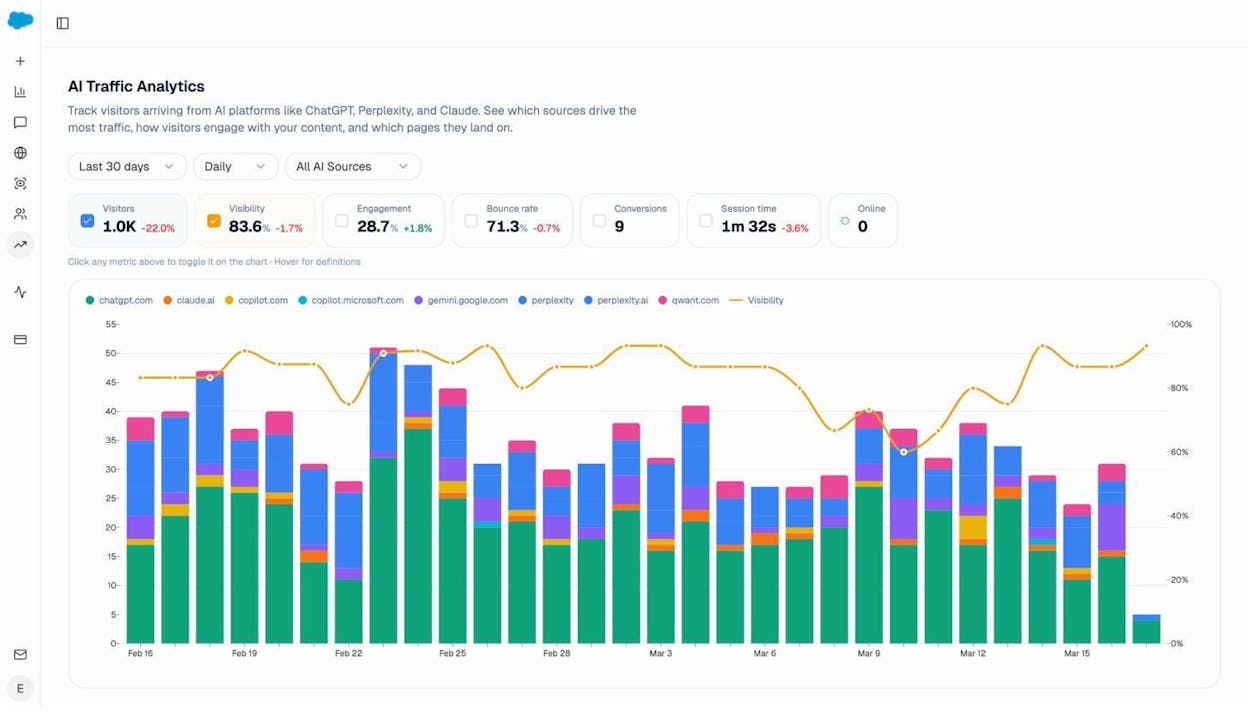
In this dashboard, you can see traffic broken down by source (ChatGPT, Claude, Gemini, Copilot) along with engagement metrics, bounce rates, session duration, and conversions. This data tells you whether AI search is already contributing to your pipeline.
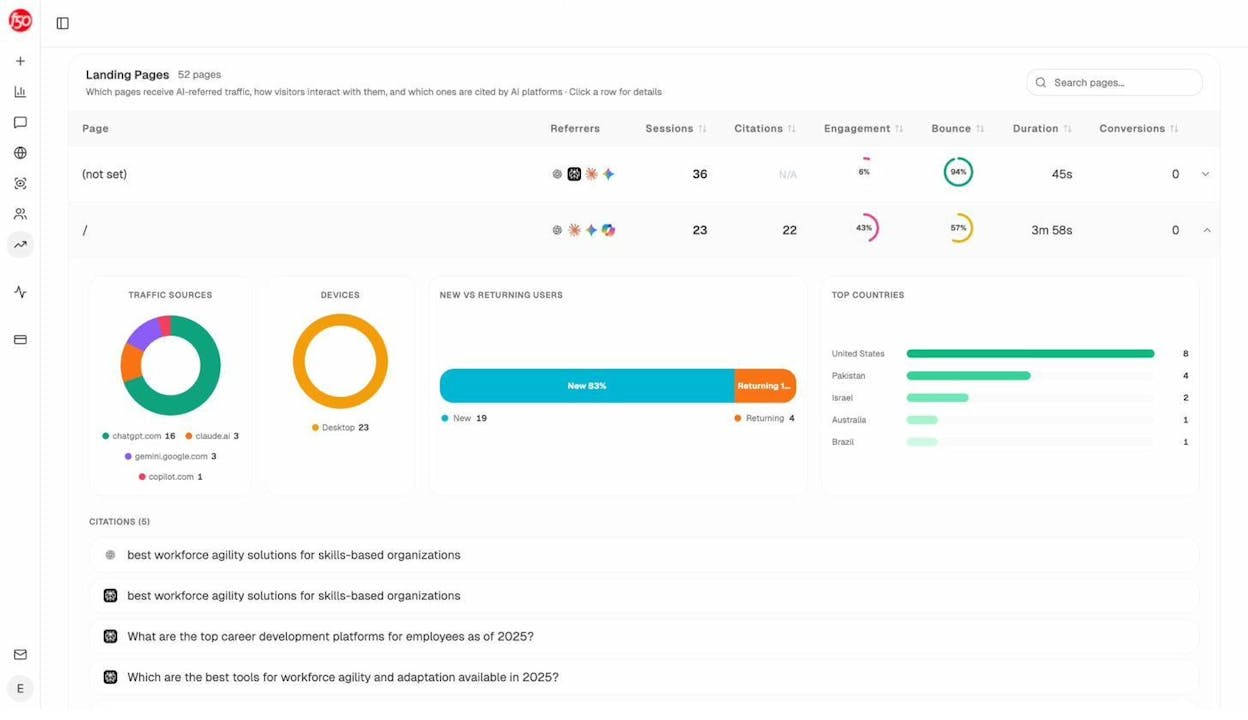
The Landing Pages view goes deeper. It shows which specific pages on your site receive AI-referred traffic, how visitors interact with them, and which AI prompts drove those visits. This is where you start to see patterns in what types of content AI engines prefer to cite.
How to See Where You Rank in AI Search (and Where Competitors Beat You)
In traditional SEO, you check your rankings on Google. In AI search, you need to check whether AI engines mention your brand when users ask relevant questions.
Analyze AI’s Prompt Tracking lets you track specific prompts across multiple AI engines and see where your brand ranks compared to competitors. You can monitor visibility, sentiment, position, and which competitors get mentioned alongside you.
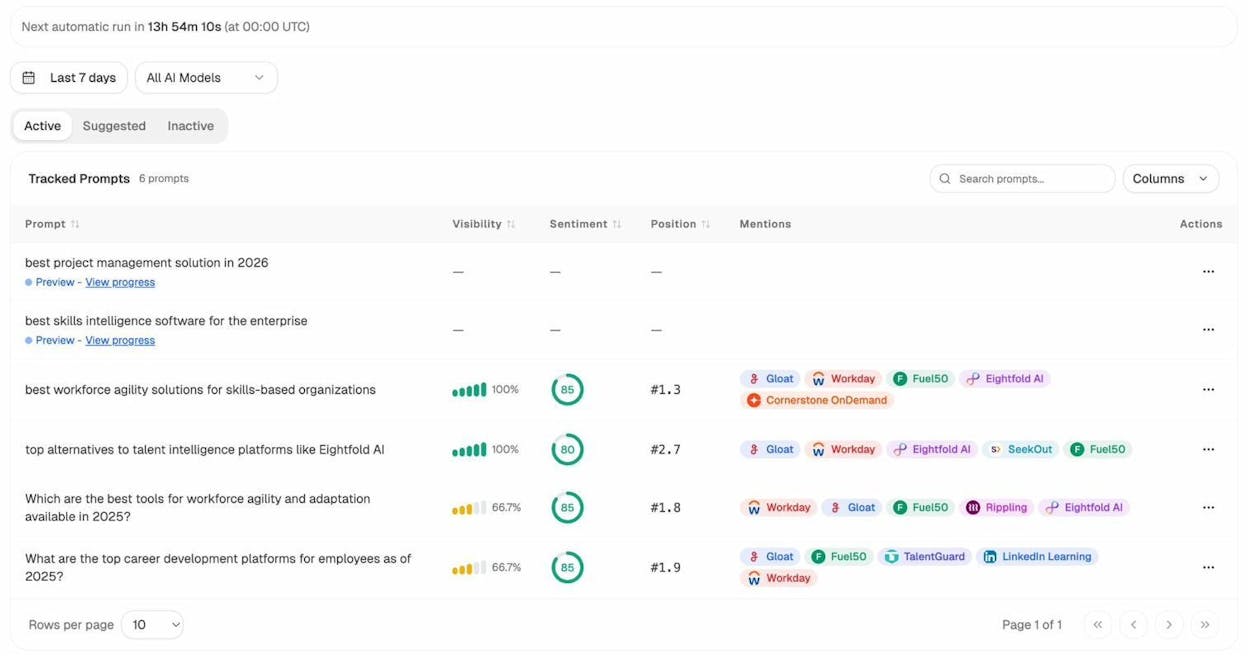
Each row shows a prompt you’re tracking. You can see your visibility percentage (how often you appear in responses), the sentiment of how AI portrays you, your average position in the response, and which competitors show up. This is the AI search equivalent of a rank tracker.
How to Find Competitors You Didn’t Know You Had
AI search surfaces competitors you might never encounter in traditional Google rankings. A brand that doesn’t rank on page one of Google might still be the top recommendation when someone asks ChatGPT.
Analyze AI’s Competitor Intelligence automatically discovers entities that get mentioned frequently in your space, even ones you haven’t started tracking yet.
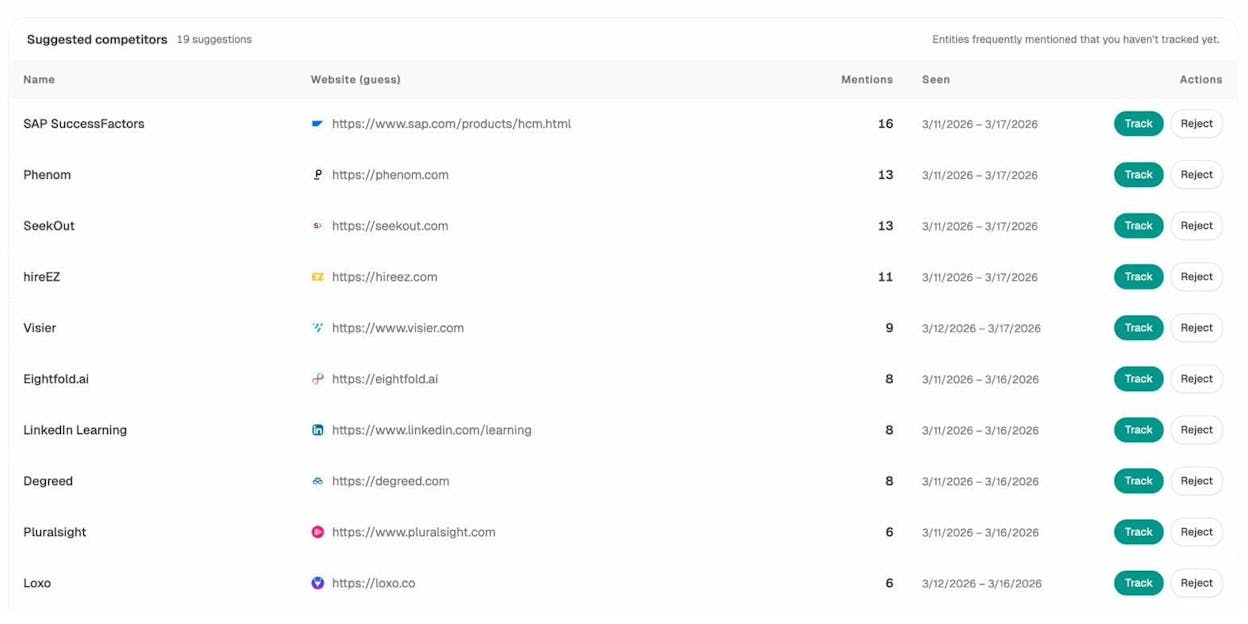
In this view, you can see suggested competitors with their mention counts and the date range they were spotted. Clicking “Track” adds them to your monitored set so you can watch their visibility over time.
How to Understand What AI Engines Actually Say About Your Brand
Beyond just showing up, what matters is how AI engines portray you. Are they recommending you positively or flagging weaknesses? Are they comparing you favorably to competitors or positioning you as a secondary option?
Analyze AI’s Perception Map plots your brand and competitors on a two-axis grid. One axis measures visibility (how often you appear), and the other measures narrative strength (how compelling the story AI tells about you is).
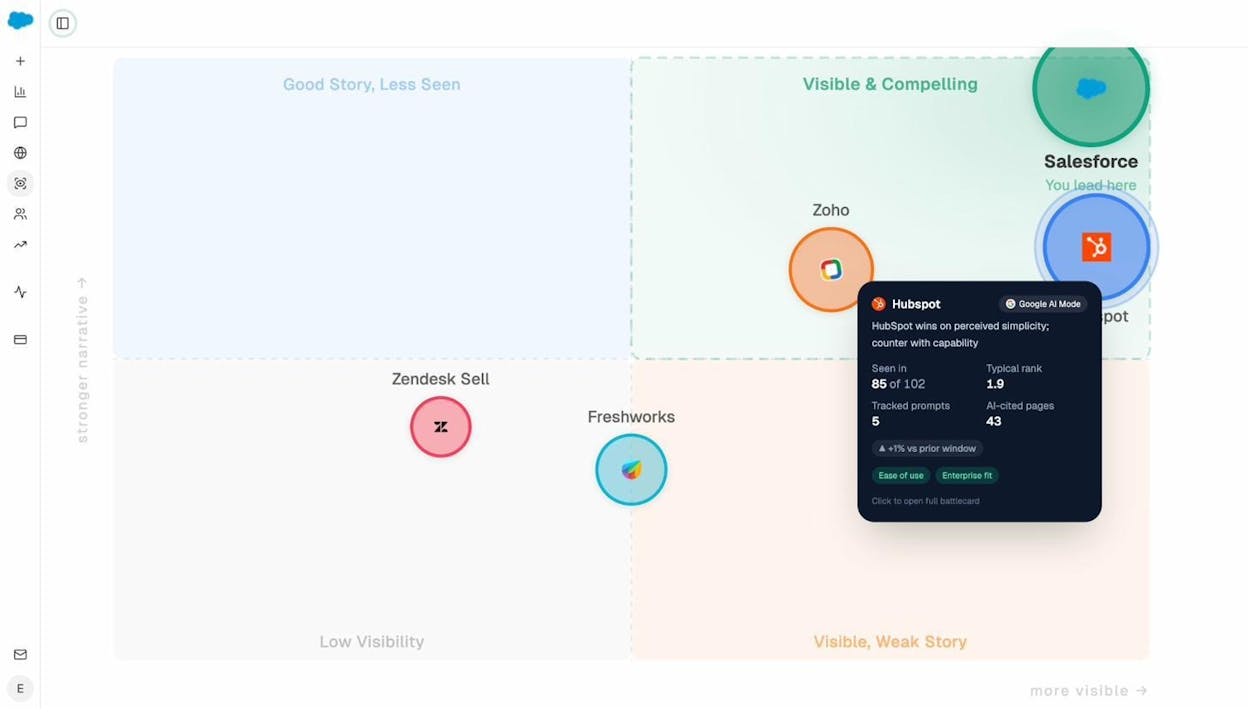
The ideal position is the top-right quadrant: Visible and Compelling. If you’re in the bottom-left, AI engines rarely mention you and when they do, the narrative is weak. This map tells you exactly where to focus your improvement efforts.
How to Find the Sources AI Engines Trust in Your Space
AI models build their answers by drawing on specific sources. If you know which domains and content types get cited most in your niche, you can create content that earns those citations.
Analyze AI’s Citation Analytics shows you the content type breakdown and top cited domains in your industry.
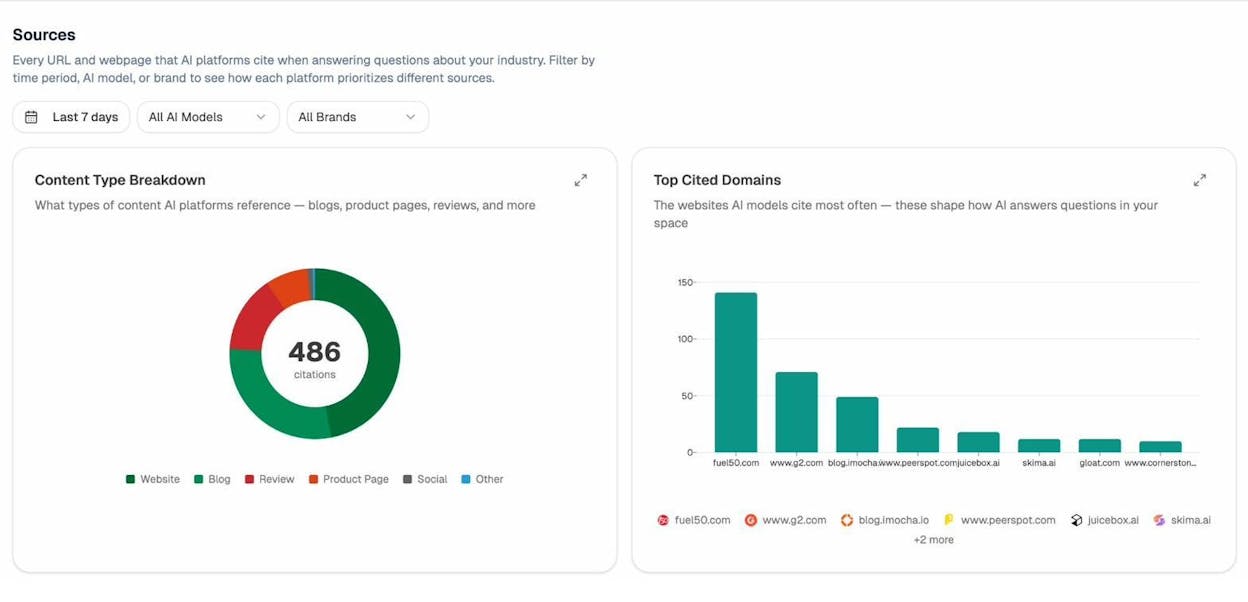
If blogs get the most citations, invest in blog content. If review sites like G2 dominate, focus on building your review presence. This data replaces guesswork with evidence.
Why This Matters for Your SEO vs. PPC Decision
AI search traffic behaves like organic traffic in one critical way: once your content is good enough to get cited, you keep getting traffic without paying per click. There’s no ad spend. There’s no bidding war.
But unlike traditional SEO, AI search is still early. The competition is lower, the audience is growing, and most of your competitors haven’t even started tracking their visibility. That’s an advantage you shouldn’t ignore.
The Analyze AI manifesto puts it plainly: SEO is not dead. AI search is an additional organic channel that compounds alongside your existing search strategy. The brands that win will be the ones that treat AI search as a natural extension of what they’re already doing in SEO, not a replacement for it.
Recommended reading: GEO vs SEO: Key Differences and Similarities Explained
A Simple Decision Framework
If you’re still not sure where to start, use this framework.
Start with SEO if:
-
You have more time than money
-
Your target keywords have informational or research-oriented intent
-
You’re building a brand for the long term
-
Your space has achievable keyword difficulty scores
Start with PPC if:
-
You need traffic and leads within the next 30 days
-
You’re targeting high-intent commercial keywords
-
You’re launching a new product or running a time-bound campaign
-
You want to test demand before investing in content
Add AI search tracking if:
-
You want to see what people hear about your brand when they ask AI engines
-
You want to find content opportunities that your competitors haven’t covered
-
You want to attribute AI-referred traffic to actual sessions and conversions
-
You want a complete view of all three organic and paid channels
You can start tracking your AI search visibility for free with Analyze AI’s AI Search Explorer, which lets you run one-off prompt searches across ChatGPT, Gemini, and Perplexity to see who shows up.
Final Thoughts
SEO and PPC are not competing strategies. They’re complementary channels that serve different purposes at different stages of your marketing maturity. The best results come from using both, with SEO building your long-term traffic foundation and PPC filling in the gaps where you need speed and precision.
But the landscape is shifting. AI search is already driving measurable traffic to websites, and the teams tracking that traffic are finding conversion rates that rival or exceed their organic search benchmarks. If you’re only thinking about SEO vs. PPC, you’re missing a third channel that’s compounding while you debate the first two.
Start with whichever channel fits your current situation. Then add the others as you grow. The goal isn’t to pick one winner. It’s to build a portfolio of traffic sources that keeps your pipeline full regardless of which algorithm changes next.
Recommended reading:

Ernest

Ibrahim


