



Summarize this blog post with:


In this article, you’ll learn why most guaranteed SEO services are scams (or close enough), what the only legitimate type of SEO guarantee looks like, and how to choose a trustworthy SEO provider that actually grows your business. You’ll also learn how to verify an agency’s performance claims yourself — using both traditional SEO tools and AI search analytics — so no one can pull the wool over your eyes.
Table of Contents
Why You Should Avoid Most Guaranteed SEO Services
There is at least one legitimate option for guaranteed SEO services, and we’ll share it below. But first, you need to understand why the vast majority of SEO guarantees should be treated as red flags.
1. Rankings Cannot Be Guaranteed — Period
If this article had a single thesis, it would be this: what cannot be controlled, cannot be guaranteed.
With paid ads, you can spend more to push your ad to the top of search results immediately. But SEO rankings are earned. They are built over time through content quality, technical optimization, authority, and relevance. They are 100% at the discretion of the search engine, and no SEO provider can predictably manipulate them.
Rankings can also change overnight when algorithms change. You can’t throw more money at the problem to fix it. SEO simply does not work that way.
Google itself warns business owners about this directly:
![[Screenshot: Google’s official guidance confirming that no one can guarantee a #1 ranking on Google]](https://www.datocms-assets.com/164164/1776873127-blobid1.png?auto=format,compress&w=1248&fit=max)
Anyone who guarantees specific rankings is either overconfident in their ability or lying to you. There is no third option.
This applies even more forcefully to AI search results. AI engines like ChatGPT, Perplexity, Claude, and Gemini generate their responses dynamically. There is no fixed ranking position. There is no page 1. There is no algorithm you can reverse-engineer with any certainty to guarantee placement in an AI-generated answer. If someone offers you a “guaranteed AI search visibility” package, you should be just as skeptical — if not more — than you’d be about a guaranteed Google ranking.
2. Fast Results Usually Mean Dangerous Tactics
There are no shortcuts to earning SEO results legitimately. SEO has always been a long-term growth channel that compounds over time. This is its greatest strength and, for impatient buyers, its greatest frustration.
The most common way agencies deliver short-term results is by using black hat SEO tactics. These are practices aimed at manipulating search algorithms to rank content higher. They often violate search engine policies and can lead to penalties or your site being completely blacklisted.
Common black hat tactics include:
-
Private blog networks (PBNs): Networks of low-quality sites built solely to link to your website, inflating your backlink profile artificially.
-
Keyword stuffing: Cramming a page with unnaturally high keyword density to trick ranking algorithms.
-
Cloaking: Showing search engines different content than what human visitors see.
-
Link buying: Purchasing backlinks from link farms or brokers instead of earning them through genuine content.
-
Content scraping: Stealing and republishing other sites’ content at scale.
Business owners who try to minimize financial risk by choosing a low-cost, guaranteed SEO service are often exposing themselves to far greater risks. Fear of losing money in the short term is a dangerously short-sighted way to think about SEO.
Consider these two scenarios:
Scenario A (no guarantee): You invest in an SEO service without a guarantee. The campaign runs at a loss initially because you don’t start seeing meaningful results until month 6. But by month 12, you’ve made your money back and are earning a strong return. Growth continues to compound.
Scenario B (with a guarantee): You invest in an SEO service with a guarantee that you’ll rank on page 1 in 30 days, or you get your money back. Within 30 days, you do rank on page 1 for some keywords — the guarantee is technically met. But a few months later, Google penalizes your site and you lose all of your SEO performance. The agency keeps your money.
Scenario B is obviously worse. But it’s also the far more common experience for businesses that chase guaranteed results.
Here’s what it looks like in practice. This is the performance graph of a website that experienced multiple traffic losses before being penalized entirely. Recovering from this kind of penalty often requires rebuilding on a completely new domain:
![[Screenshot: Ahrefs Site Explorer showing a penalized website’s organic traffic graph dropping to zero]](https://www.datocms-assets.com/164164/1776873133-blobid2.jpg?auto=format,compress&w=1248&fit=max)
Most business owners don’t think this far ahead when shopping for SEO. They pass up the agencies that deliver results like Scenario A — steady, compounding, legitimate — because they can’t resist the false certainty of a guarantee.
3. Guaranteed SEO Results Rarely Deliver an ROI
SEO, like any marketing channel, needs to provide a return on investment. You put money in and you’re supposed to get more money out.
Guaranteed SEO results sound great in theory. But when you dig deeper, the results these agencies guarantee are almost always based on:
-
Keywords unrelated to your business — They pick terms no one competes for, then celebrate when you rank for them.
-
Keywords with negligible search volume — Ranking #1 for a keyword that gets 10 searches a month does nothing for your pipeline.
-
Keywords with purely informational intent — These keywords attract researchers, not buyers. They won’t generate leads or sales.
In short, the keyword rankings that get guaranteed are the ones that don’t matter. The keywords that actually grow your business — high commercial intent, high volume, high competition — take longer to rank for. There is no shortcut, and no reputable agency can guarantee performance for them.
Another problem: most SEO guarantees only focus on vanity metrics. Vanity metrics look good in a report, but they don’t grow your business or help you make better decisions.
Rankings alone won’t feed your family. Neither will raw traffic numbers.
If an agency only guarantees vanity metrics — rankings, impressions, total traffic — and can’t connect those numbers to conversions, revenue, or ROI, their guarantee is meaningless.
4. Short-Term Guarantees Do Not Protect Long-Term Investments
SEO is not a cheap service. Monthly retainers for reputable agencies range from $2,000 to $10,000 or more for mid-market businesses. And the biggest risk most business owners overlook is the financial implication of signing a long-term contract based on a short-term guarantee.
Here’s how it usually plays out:
You sign a 12-month contract with a guarantee like “first page rankings in 30 days or your money back.” Within 30 days, the agency ranks your website for a single keyword — any keyword — on page 1 of Google. The guarantee has been met. Technically.
But it doesn’t matter how long that ranking lasts. It doesn’t matter what keyword it was. And it doesn’t matter what happens after day 31. The guarantee doesn’t cover:
-
Performance plateaus — Your growth stalls, but the contract keeps running.
-
Performance losses — Rankings drop, traffic falls, but you’re still paying.
-
Site penalties — Your site gets penalized for the very tactics the agency used to deliver on the guarantee.
You might end up paying for the remaining eleven months without the agency completing any further meaningful work on your site.
An extreme example: the website conch-house.com. This site scraped content from Amazon and published 6,000 posts per day. In two months, it grew to over 6 million monthly users and nearly $20,000 in revenue per day. During its third month at this peak, Google penalized and blacklisted it. All of that growth vanished overnight.
![[Screenshot: Conch-house.com’s traffic graph from a third-party SEO tool, showing a dramatic spike and crash]](https://www.datocms-assets.com/164164/1776873138-blobid3.png?auto=format,compress&w=1248&fit=max)
Hypothetically, this website’s results would have met most SEO guarantees: “Rank #1 in 90 days.” “First page in 30 days, guaranteed.” “Explode your traffic in 60 days.” All technically achieved. None of it sustainable.
The takeaway: Don’t sign a long-term contract on a short-term guarantee. There are too many loopholes and technicalities that protect the agency, not you.
What About Guaranteed AI Search Visibility?
Here’s something the traditional SEO guarantee conversation misses entirely: the rise of AI search as a meaningful organic channel.
As AI search engines like ChatGPT, Perplexity, Claude, Gemini, and Copilot become more popular, a new category of “visibility guarantee” is emerging. Some agencies are now promising guaranteed mentions or placements in AI-generated answers.
This should raise even bigger red flags than traditional SEO guarantees. Here’s why:
AI search results are non-deterministic. Unlike Google, which maintains a relatively stable index that can be tracked and measured over time, AI engines generate responses dynamically. The same prompt can produce different answers at different times. There is no fixed ranking position to guarantee.
There is no direct way to “force” an AI model to mention your brand. With traditional SEO, you can at least point to a set of best practices — title tags, backlinks, content quality — that correlate with rankings. With AI search, the relationship between your actions and the model’s outputs is much less predictable. You can influence it by being authoritative, well-cited, and structured for AI readability, but you cannot control it.
AI visibility is still a very young channel. Most businesses are only now beginning to understand how AI engines surface brands in their responses. Anyone who claims to guarantee results in a channel this nascent is either misleading you or doesn’t understand the channel themselves.
That said, AI search is a real and growing source of traffic and brand exposure. The right approach isn’t to chase guarantees — it’s to invest in measurement and optimization so you can understand your actual AI search presence and improve it systematically.
This is where tools like Analyze AI come in. Instead of making promises about where your brand will appear, Analyze AI gives you the data to see where you actually appear across AI engines, which prompts trigger mentions of your brand, and which AI platforms are driving real traffic to your site.
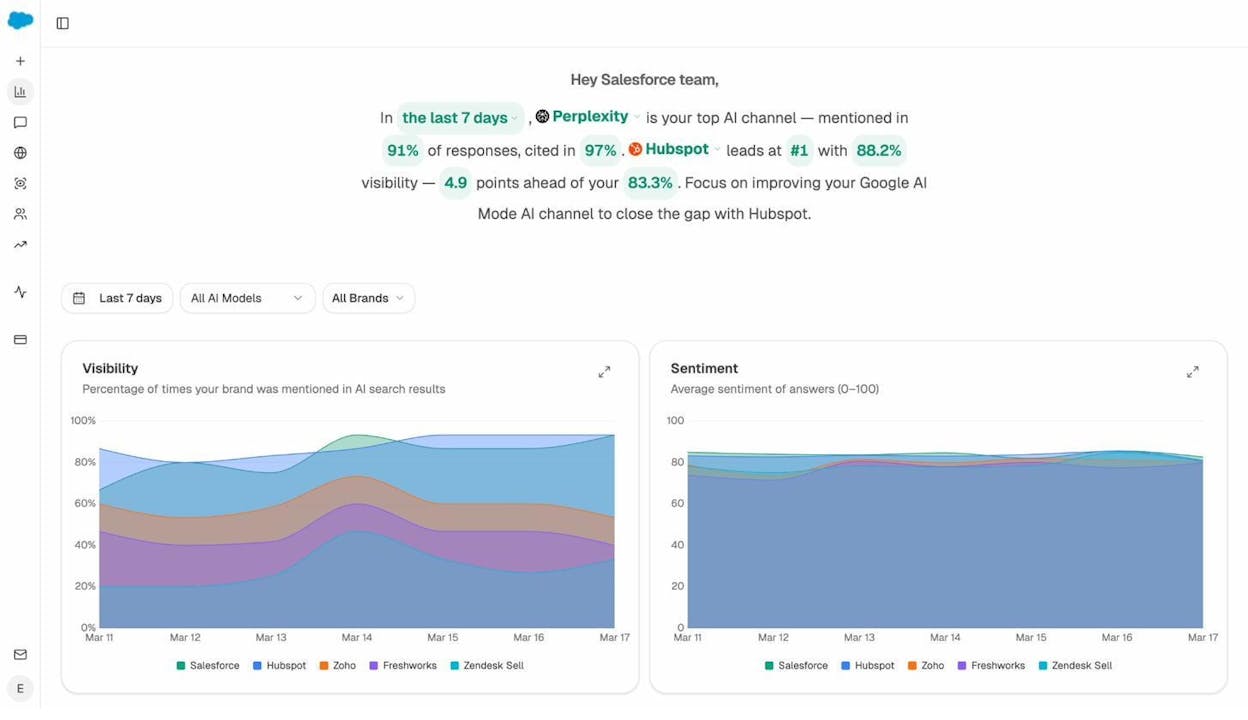
The dashboard above shows a brand’s visibility percentage across AI engines like Perplexity, ChatGPT, and Google AI Mode — along with sentiment trends and competitive positioning. This is measurable, verifiable data. The opposite of a vague guarantee.
The Only Type of SEO Guarantee That Isn’t a Scam
There is one type of SEO performance guarantee that can be both legitimate and fair. It focuses not on promising specific rankings or traffic numbers, but on holding the agency accountable for the quality, transparency, and business impact of their work.
Here’s what a legitimate SEO guarantee includes:
-
It holds the service provider accountable for delivering relevant results. Not just any rankings — results that are meaningfully connected to your business goals. If they fail, they work for free.
-
It has long-term performance built in. The guarantee isn’t based on a 30-day window. It measures performance over the full engagement period.
-
It considers all metrics that indicate SEO performance, including organic revenue, conversions, and qualified leads — not just rankings and traffic.
-
It explicitly excludes vanity metrics as the basis for meeting the guarantee.
-
It clearly communicates what is and isn’t covered, with no fine print designed to create loopholes.
-
It doesn’t assume the provider can control specific search engine results. Instead, it acknowledges that rankings and traffic improvements are byproducts of high-quality work.
-
It has been written or reviewed by a lawyer who understands both SEO and contract law.
The critical difference between this kind of guarantee and the scammy versions is that it doesn’t promise specific outcomes the agency can’t control. Instead, it promises a standard of service — and ties that standard to business results that actually matter.
When evaluating any SEO agency’s guarantee, ask yourself: Does this guarantee protect me, or does it protect them? If the guarantee can be met by ranking for a single irrelevant keyword for one day, it protects the agency. If it requires sustained, relevant business growth over the contract period, it protects you.
How to Choose a Trustworthy SEO Service Provider
Legitimate SEO service providers can take your business’ growth to the next level. Here’s what to look for — and what to run from.
They Focus on Business Growth, Not Vanity Metrics
A good SEO provider aligns their strategies with your core business goals and measures success according to the metrics that matter. These include:
-
Conversions and qualified leads
-
Sales and revenue
-
Return on investment (ROI)
-
Customer acquisition cost (CAC) from organic channels
Unlike rankings and raw traffic, these metrics connect directly to your bottom line.
If an agency’s proposal is entirely focused on “getting you to page 1” or “increasing your keyword rankings by X%,” that’s a warning sign. Those metrics only matter insofar as they drive business outcomes. A competent provider knows this and leads the conversation with business results, not vanity dashboards.
They Show a Track Record of Long-Term Results
A track record of success is far more valuable than a guarantee. An agency with multiple case studies showing sustained results over months and years is more trustworthy than one offering a money-back promise.
When evaluating case studies, look for:
-
Multiple success stories across different industries and business sizes.
-
Long-term projects spanning more than 12 months. This is a strong indicator of client satisfaction and retained results.
-
Proof of ROI, revenue, or sales increases — not just traffic or ranking improvements.
-
The average time to ROI. This gives you a realistic sense of how patient you’ll need to be.
-
A clear description of the services and methodology used. This helps you understand what you’re actually paying for.
Go beyond face value. Verify the agency’s performance claims using third-party tools. For traditional SEO, you can use tools like Ahrefs’ Site Explorer or Analyze AI’s free Website Traffic Checker to verify organic traffic trends, backlink growth, and keyword improvements for any website an agency cites in a case study.
![[Screenshot: Using a third-party SEO tool to verify organic traffic trends for a website mentioned in an agency case study]](https://www.datocms-assets.com/164164/1776873144-blobid5.png?auto=format,compress&w=1248&fit=max)
If an agency claims they helped a client grow organic traffic by 300%, plug the client’s domain into a traffic checker and see for yourself. If the data doesn’t match their claims, that tells you everything you need to know.
For AI search performance, you can also verify claims using Analyze AI. If an agency says they improved your brand’s visibility across AI search engines, you can check the Prompts dashboard to see exactly which prompts mention your brand, your visibility score, and how it has changed over time.
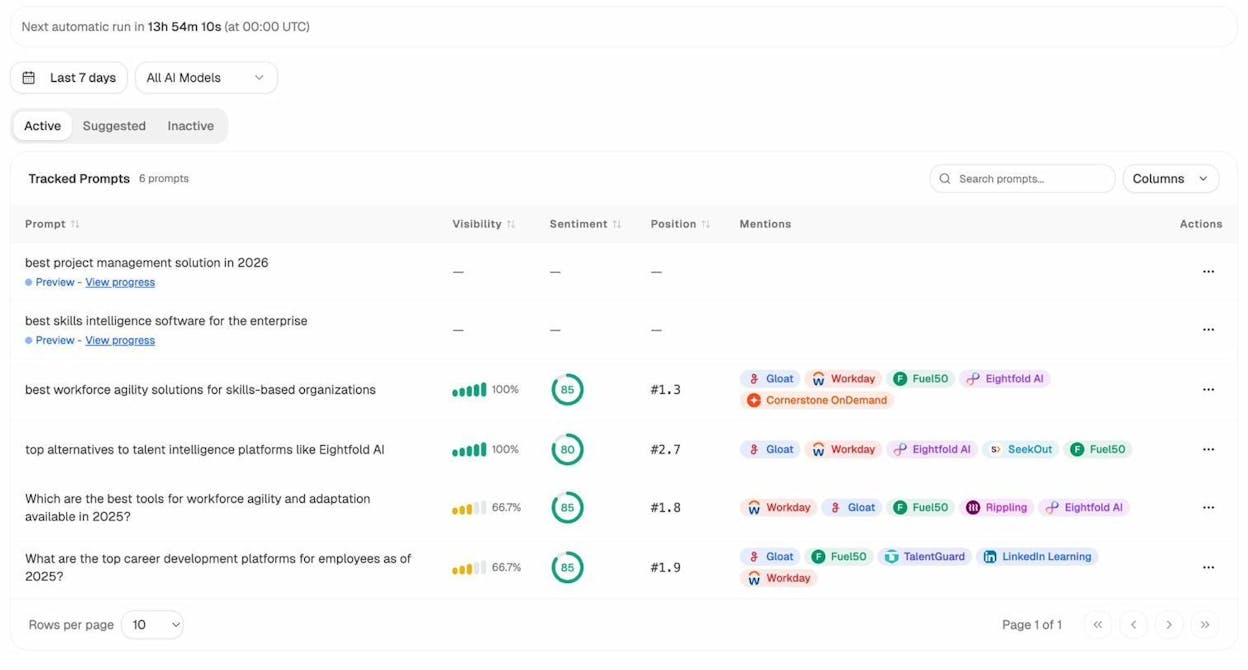
This dashboard shows tracked prompts with visibility percentages, sentiment scores, positions, and which competitors appear alongside your brand. It’s hard data, not sales talk.
They Are Transparent About Their Tactics
It pays to educate yourself on black hat SEO tactics so you can spot them when an agency describes their approach.
When talking to SEO providers about how they work, listen for red flags like:
-
“We’ll build hundreds of links in the first month.” Genuine link building is slow. A mass link campaign in month one is almost certainly low-quality or PBN-driven.
-
“We have a network of blogs we can publish on.” This usually means PBNs or pay-for-post sites that offer no real authority.
-
“We’ll publish 50 pages of content in the first 60 days.” Volume without quality is a recipe for thin content that gets penalized.
-
“We use proprietary traffic techniques.” Vague language about traffic generation often hides manipulative practices like click bots or redirect schemes.
Instead, choose a provider that uses a white hat approach: earning links through genuine outreach and quality content, publishing content that’s thorough enough to be genuinely useful, and building technical foundations that help search engines — and AI models — understand and trust your site.
The best agencies also offer transparency on their monthly deliverables. They’ll show you the hours worked, the specific tasks completed, the quality standards they met, and their efficiency. All of these things are 100% within the SEO provider’s control and are the safest elements to include in any guarantee.
They Track and Report on Performance Regularly
Accountability separates professional agencies from the rest. Many SEO providers do not hold themselves accountable for delivering long-term results. They send a generic monthly report with ranking numbers and call it a day.
Ask potential providers how often you’ll receive performance updates. Some agencies offer dashboards you can check anytime. Others schedule monthly or quarterly calls to walk through progress. Either approach is fine, but the critical question is: Are they reporting on what you care about?
The most important metrics to discuss in client meetings are organic revenue and ROI — if the tracking and attribution are properly set up.
|
Month |
SEO Spend |
Organic Revenue |
SEO ROI % |
|---|---|---|---|
|
Jan |
$5,000 |
$98,000 |
1,860% |
|
Feb |
$5,000 |
$142,000 |
2,740% |
|
Mar |
$5,000 |
$210,000 |
4,100% |
A table like this tells you exactly how much money you’ve earned for every dollar invested in SEO. As long as these numbers trend upward, you don’t need to worry about which individual keywords moved up or down. That’s a distraction from what actually matters: growing your bottom line.
If the agency can’t report on revenue or ROI because you haven’t shared sales data with them, the best alternative is reporting on traffic value — the estimated dollar value of your organic traffic based on what it would cost to generate the same traffic through paid ads. Most SEO reporting tools can calculate this.
How to Verify SEO (and AI Search) Performance Yourself
Don’t take any agency’s word at face value. Whether you’re working with a guaranteed service or a more reputable provider, tracking your own performance is the best way to avoid getting swindled.
Verify Traditional SEO Performance
For traditional SEO, you should independently track:
-
Organic traffic trends — Use Google Analytics or Google Search Console to monitor organic sessions over time. If your agency claims traffic is up, you should see it in your own analytics.
-
Keyword ranking movements — Use a tool like Analyze AI’s free Keyword Rank Checker or SERP Checker to spot-check rankings for your most important keywords.
-
Backlink quality — Use Analyze AI’s Website Authority Checker or a backlink analysis tool to check whether the links your agency built are from real, authoritative websites — or from spam.
-
Technical health — Run periodic technical audits using Analyze AI’s Broken Link Checker or Google Search Console to make sure your site isn’t accumulating errors.
![[Screenshot: Google Search Console performance report showing organic traffic trends over time]](https://www.datocms-assets.com/164164/1776873151-blobid7.png?auto=format,compress&w=1248&fit=max)
Verify AI Search Performance
If your SEO provider is also working on your AI search presence — or if you want to track it independently — you need a different set of tools. Traditional SEO tools don’t cover AI search visibility at all.
Analyze AI fills this gap. Here’s what you can track:
Which AI engines mention your brand and how often. The Overview dashboard shows your visibility percentage across ChatGPT, Perplexity, Claude, Gemini, and others — broken down by time period, AI model, and brand.
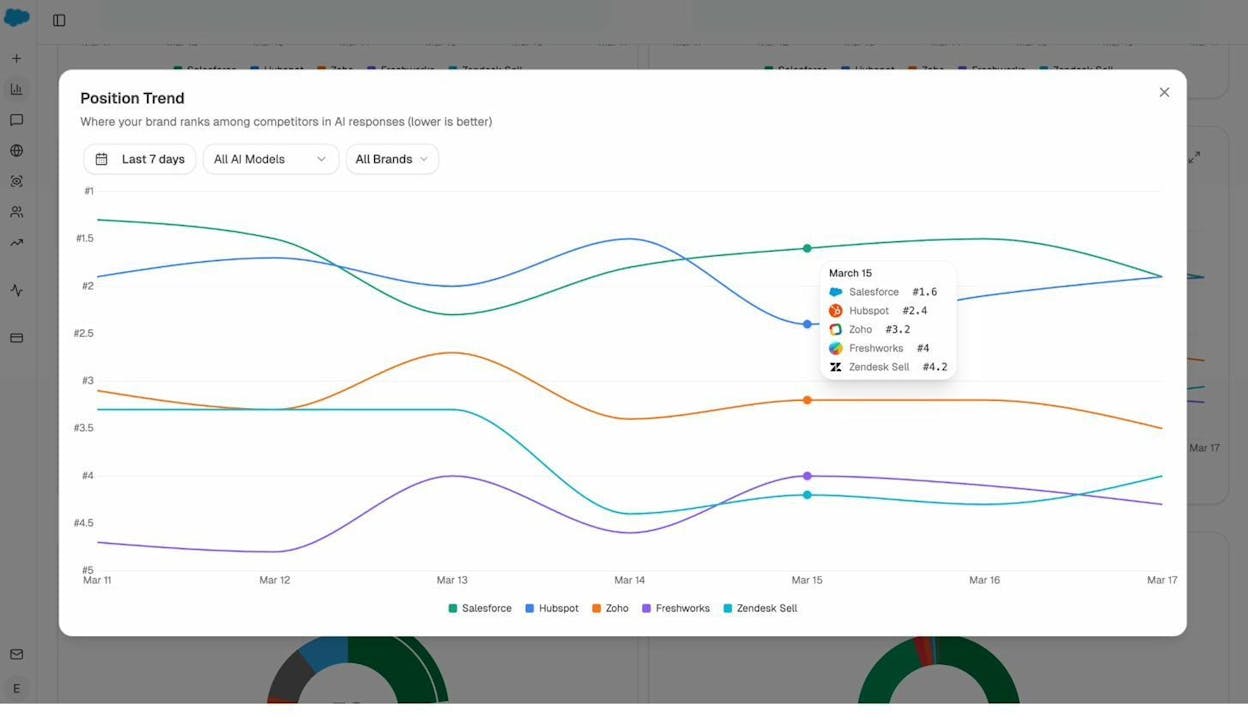
Which competitors appear alongside you in AI answers. The Competitors view surfaces brands that AI engines mention alongside yours. You can track their visibility share and identify where they’re winning prompts that you’re losing.
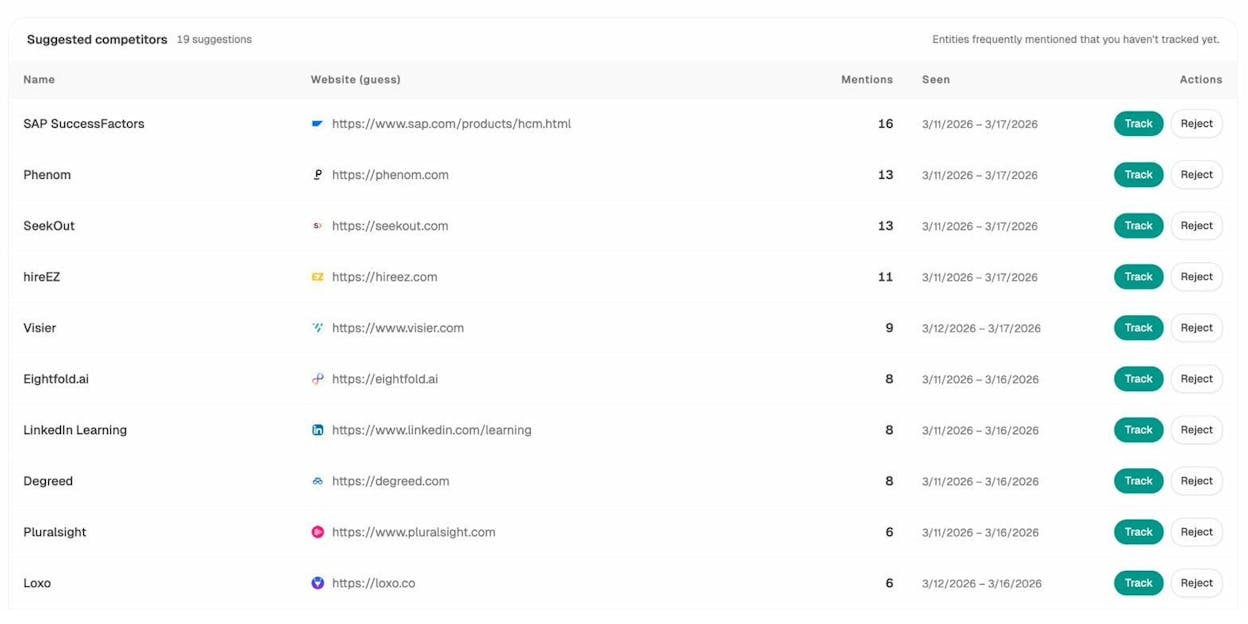
This view also suggests competitors you haven’t tracked yet, based on how frequently they’re mentioned in the same AI responses as your brand. One click to start tracking them.
Which pages on your site actually receive AI-referred traffic. The Landing Pages report in Analyze AI’s AI Traffic Analytics shows exactly which URLs on your site are getting visits from AI engines, which engines are sending traffic, and how those visitors behave once they land.
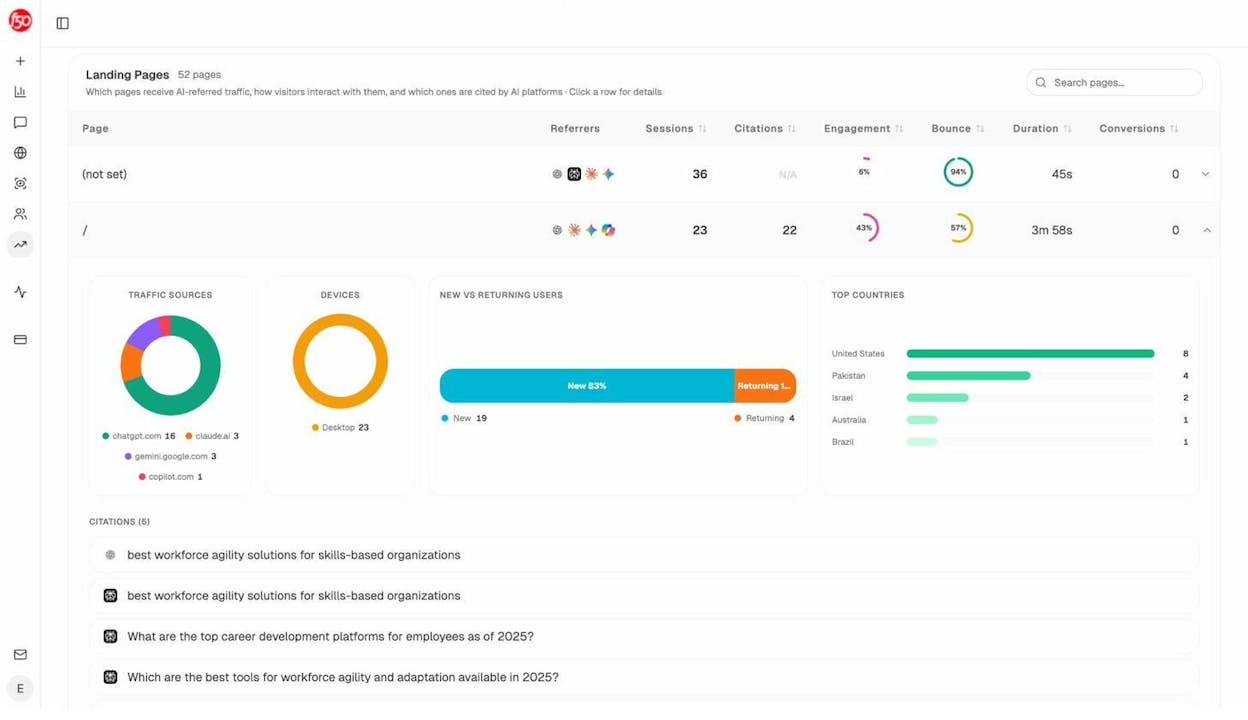
This is how you identify what’s actually working in AI search — and double down on it. If your “/pricing” page gets 36 sessions from ChatGPT but your “/features” page gets zero, that pattern tells you something actionable about what AI models find valuable on your site.
Which sources AI models cite when answering questions in your industry. The Sources dashboard reveals the websites AI engines reference most often in your space. If a competitor’s blog gets cited 140 times while yours gets cited 12, you know where to focus your content investment.
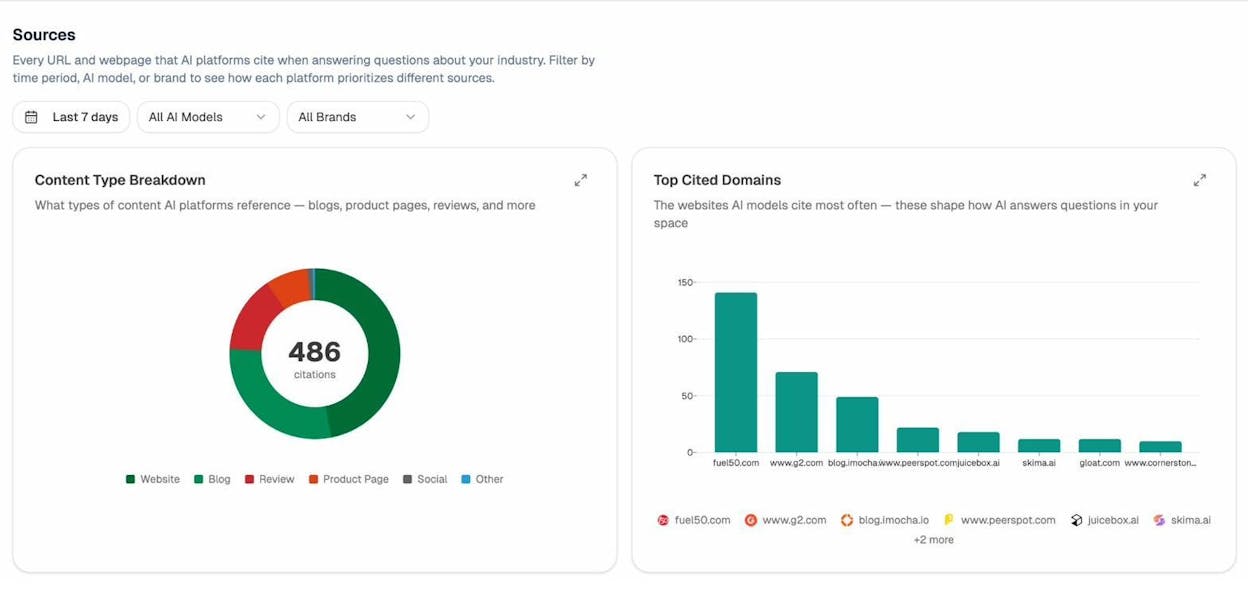
How AI search traffic is trending over time. You can monitor whether your AI referral traffic is growing, flat, or declining — and break it down by engine to see which platforms are driving the most value.
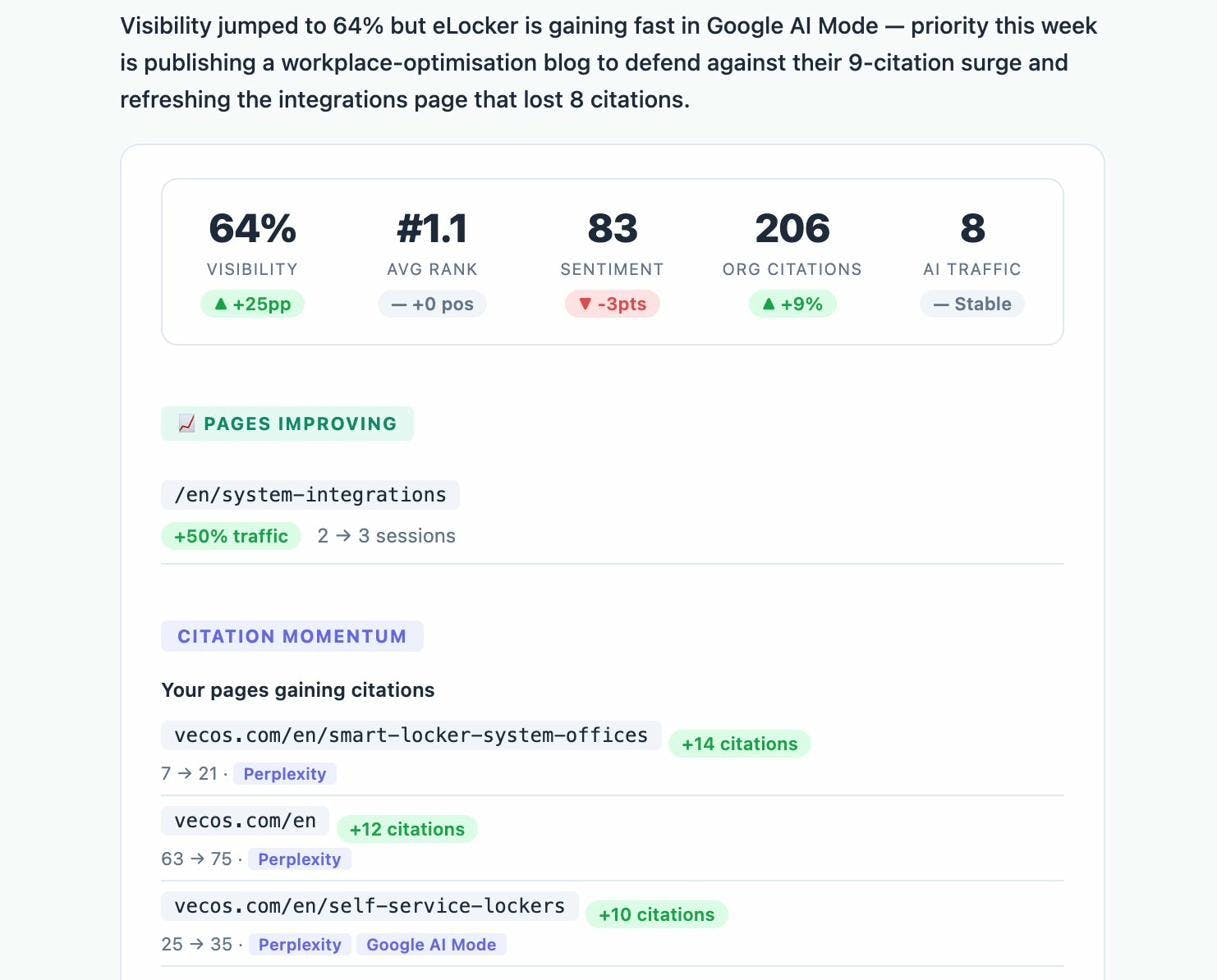
All of this data is available through Analyze AI’s weekly email reports, which summarize your visibility changes, competitive movements, and citation momentum without you needing to log into any dashboard.
Why Both Matter
The agencies worth working with understand that SEO is evolving. Traditional search and AI search aren’t competing channels — they’re complementary. A solid SEO content strategy that produces high-quality, structured, authoritative content will improve your visibility in both Google and AI engines.
The brands that will win are the ones that track both channels and invest in the content and technical quality that makes them visible everywhere people search — whether that’s a Google results page, a ChatGPT response, or a Perplexity answer.
If your current SEO provider only reports on traditional search metrics and has no strategy for AI search, that’s not necessarily a dealbreaker. But it’s a conversation worth having. AI-referred traffic is growing for most industries, and the earlier you start measuring it, the sooner you can identify which content and pages are driving value from this emerging channel.
A Checklist for Evaluating Any SEO Agency
Before signing with any SEO provider — guaranteed or not — run through this checklist:
|
Question |
Red Flag Answer |
Green Flag Answer |
|---|---|---|
|
Do you guarantee rankings? |
“Yes, page 1 in 30 days.” |
“No. We guarantee the quality of our work and align results with your business goals.” |
|
What metrics do you report on? |
“Rankings and traffic.” |
“Revenue, ROI, conversions, and qualified leads — alongside rankings and traffic.” |
|
How do you build links? |
“We have a network of sites.” |
“We earn links through outreach, original research, and high-quality content.” |
|
How quickly will I see results? |
“Within 30 days.” |
“Usually 4–6 months for meaningful organic growth.” |
|
Can I see case studies? |
“We can’t share client details.” |
“Here are three case studies with verifiable performance data.” |
|
Do you track AI search visibility? |
“What do you mean?” |
“Yes, we monitor brand mentions across AI engines and track AI-referred traffic.” |
|
What happens if results don’t improve? |
“You get your money back.” (Only within the guarantee window.) |
“We adjust strategy, communicate transparently, and align on new milestones.” |
This table isn’t exhaustive, but it covers the most important signals. An agency that gives mostly “green flag” answers is one worth talking to further. An agency that hits several red flags should be avoided.
The Bottom Line
SEO guarantees are built to sell you a service, not to protect your investment. The vast majority of them are structured so that the agency wins regardless of whether your business grows.
The only legitimate SEO guarantee holds the provider accountable for the quality of their work and ties results to meaningful business outcomes — not vanity metrics, not irrelevant keyword rankings, and certainly not short-term spikes that can’t be sustained.
Whether you’re evaluating agencies for traditional SEO, AI search optimization, or both, the principles are the same: focus on business results, verify claims with your own data, and never sign a long-term contract based on a short-term promise.
The best protection against SEO scams isn’t a guarantee. It’s knowledge, transparency, and the tools to track your own performance.
You can start tracking your AI search visibility for free with Analyze AI. For traditional SEO performance, use tools like Analyze AI’s free Keyword Rank Checker, Website Authority Checker, and Website Traffic Checker to verify any agency’s claims before you hand over a dollar.

Ernest

Ibrahim


