



Summarize this blog post with:


In this article, you’ll learn what enterprise SEO is, why it matters for large organizations, and how to build an enterprise SEO strategy that covers content, links, and technical foundations. You’ll also learn how to extend your enterprise SEO program into AI search — an emerging organic channel that forward-thinking teams are already using to compound visibility beyond Google alone.
Table of Contents
What Is Enterprise SEO?
Enterprise SEO is the practice of optimizing a large organization’s website to improve its visibility and rankings in search engines. What separates enterprise SEO from regular SEO is scale, complexity, and stakes.
Enterprise websites can be defined in several ways: by company size (typically hundreds or thousands of employees), by website scale (millions of indexed pages), by technical complexity (multiple CMSs, tech stacks, and dev teams), or by global reach (operations in many countries and languages). Think publicly traded companies, large ecommerce retailers, multi-location businesses, and organizations that manage multiple web properties.
Enterprise SEO differs from standard SEO in three important ways. First, scale: you might be managing optimizations across millions of pages, not hundreds. Second, complexity: the technology, internal politics, and cross-team coordination required to get anything shipped are significantly harder. Third, competition: enterprise companies go after the most competitive head terms in their industry, where even small ranking improvements can translate to millions in revenue.
You know you’re in enterprise SEO when everyone speaks a new language made of three-letter acronyms, there are teams of people for everything, and shipping a single redirect can require three meetings and a Jira ticket.
Now here’s the shift many enterprise teams are beginning to navigate: buyers are not just searching on Google anymore. They are asking ChatGPT, Perplexity, Gemini, and Copilot for direct answers. This does not mean SEO is dead — far from it. It means that organic visibility now includes a second channel, and enterprise teams that add AI search monitoring alongside their existing SEO programs are the ones building a durable competitive advantage.
Benefits of SEO for Enterprise Companies
There are several reasons enterprise companies should invest in SEO, and why extending that investment to AI search multiplies the return.
Credibility. Every touchpoint where your brand appears — whether on a SERP or inside an AI-generated answer — reinforces your position as the expert. When a buyer sees your brand on Google and then again in a ChatGPT recommendation, the compounding trust effect is real.
Growth. SEO drives brand awareness at scale. When your content ranks for hundreds of high-volume terms, you build a growth engine that compounds over time. Adding AI search visibility extends that reach to a growing audience that may never visit a traditional search engine.
Revenue. Every organic touchpoint is a chance at a conversion. Enterprise SEO programs that perform well reduce customer acquisition costs and increase customer lifetime value. Teams that also attribute AI search traffic to pipeline can show leadership an entirely new revenue stream. Analyze AI’s AI Traffic Analytics makes this attribution possible by connecting GA4 data to AI referral sources.
Supports other channels. SEO content fuels retargeting campaigns, sales enablement, email nurture sequences, and social media. Content that ranks well in organic search often becomes the content that AI engines cite — meaning one well-optimized asset can work across multiple channels simultaneously.
Enterprise Content Marketing Strategy & Tactics
Making content marketing work at the enterprise level takes coordination, quality standards, and a clear process. Here are the strategies and tactics that drive results.
Create New Content
There are many types of content an enterprise team can produce: blog posts, whitepapers, case studies, videos, courses, tools, and more. But with limited resources, start with informational content and videos. These deliver the highest return for the effort because they capture demand across the full funnel.
A common mistake at enterprise companies is skipping top-of-funnel content and focusing only on bottom-of-funnel pages that convert directly. This narrows your pipeline and gives competitors the opportunity to establish expertise with your audience before you ever reach them.
Start with bottom-of-funnel content, but build toward a full content strategy that covers awareness, consideration, and decision stages.
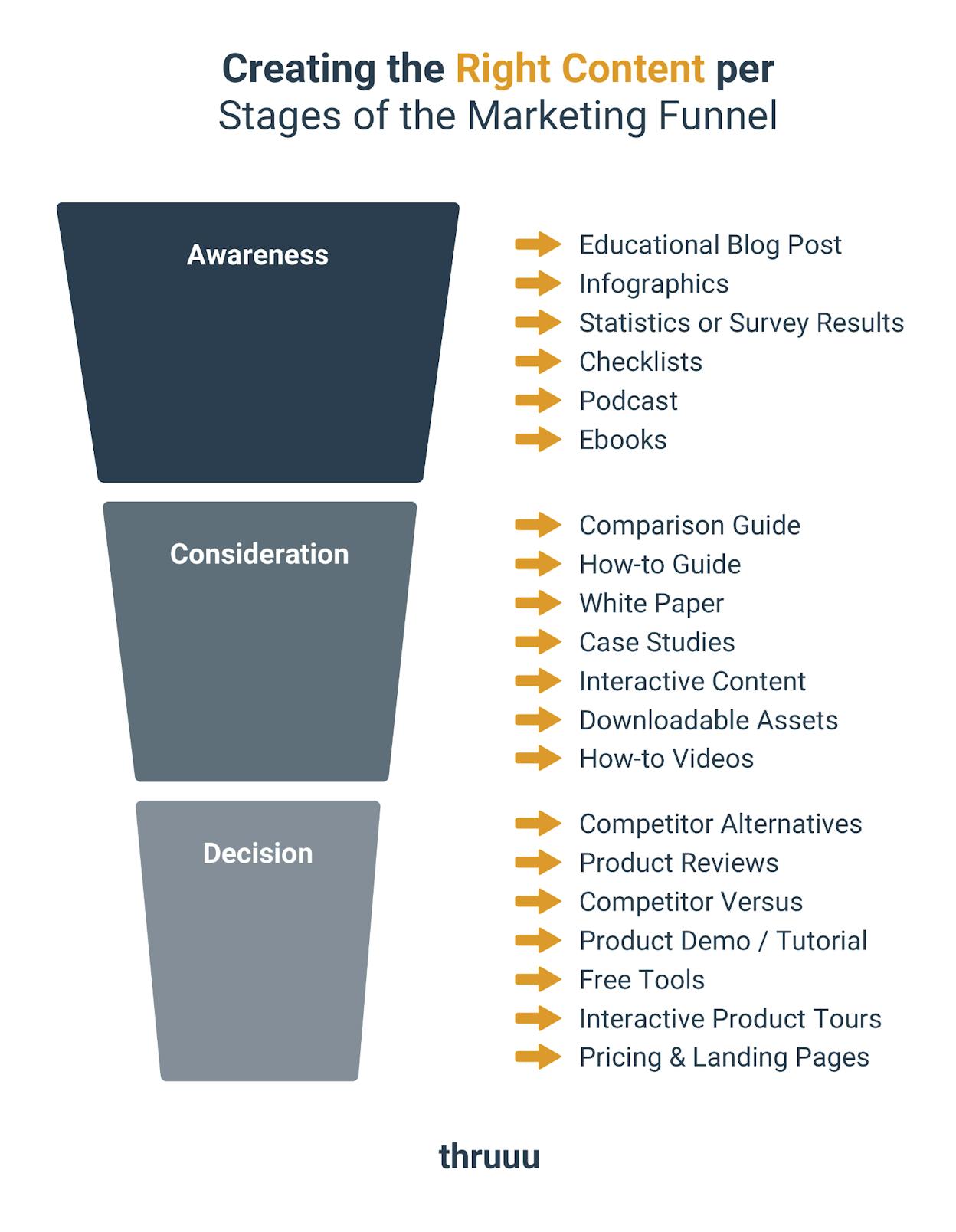
What Content Should You Create?
Start with your competitors’ top-performing pages rather than a raw keyword list. Export their top pages from an SEO tool, combine the data across multiple competitors, and you’ll have a list of content topics that are already proven to drive value. This saves you from guessing and gives you a strong starting point.
![[Screenshot description: Competitor top pages export in an SEO tool showing traffic, keywords, and URL columns]](https://www.datocms-assets.com/164164/1776866166-blobid2.png?auto=format,compress&w=1248&fit=max)
You can also run a content gap analysis to find keywords your competitors rank for that you don’t. Export the results, paste them into a keyword clustering tool, and group them by parent topic. This reduces noise and gives you distinct content opportunities instead of a list of duplicate keyword variations.
![[Screenshot description: Content gap tool showing competitor keywords you don’t rank for, filtered and clustered]](https://www.datocms-assets.com/164164/1776866166-blobid3.png?auto=format,compress&w=1248&fit=max)
For your keyword research, you can use dedicated tools or start with free options like the Analyze AI Keyword Generator to surface initial ideas. Check difficulty with the Keyword Difficulty Checker before committing resources.
How to Find Content Opportunities in AI Search
Beyond traditional keyword research, enterprise teams should also look at what prompts and questions AI engines are answering in their space — and whether their brand appears in those answers.
Here’s how to do this with Analyze AI:
-
Go to the Prompts dashboard. Review the prompts being tracked in your topic cluster. You’ll see which prompts mention your brand and which don’t.
-
Check the Suggested Prompts tab. Analyze AI surfaces prompts that are relevant to your industry but that you haven’t started tracking yet. These represent content gaps — topics where buyers are asking AI engines for answers and you’re invisible.
-
Use Ad Hoc Prompt Searches to test any prompt across ChatGPT, Perplexity, Gemini, and Copilot simultaneously. This lets you validate content ideas before committing to production.
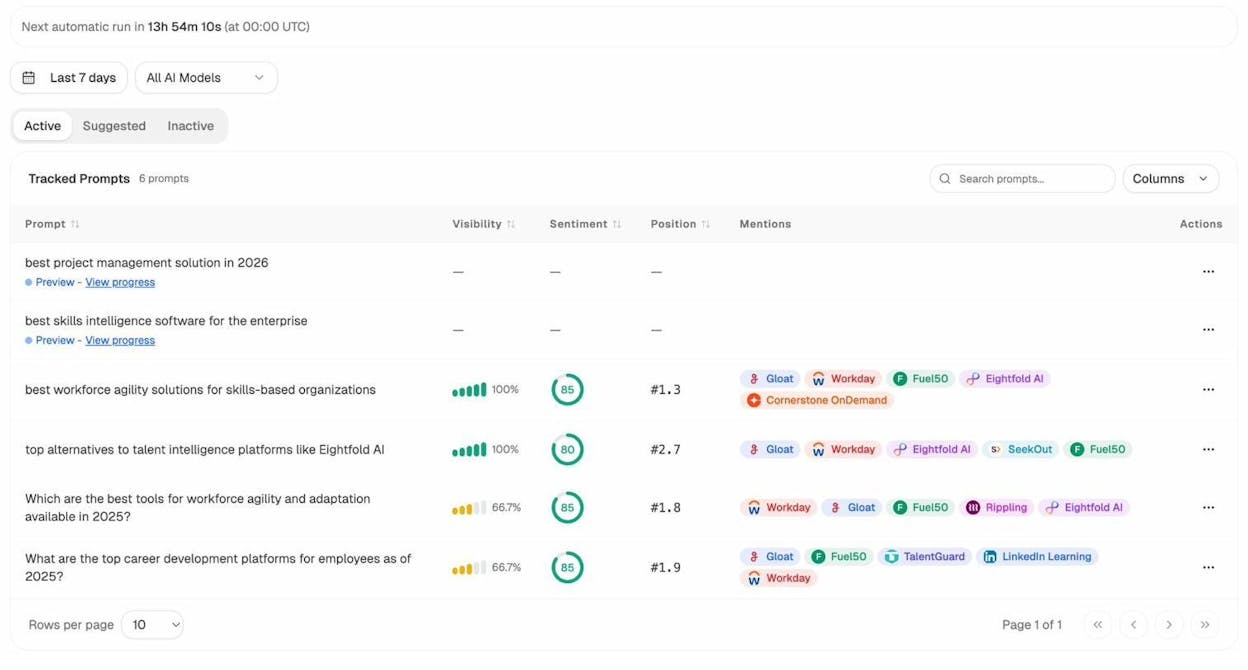
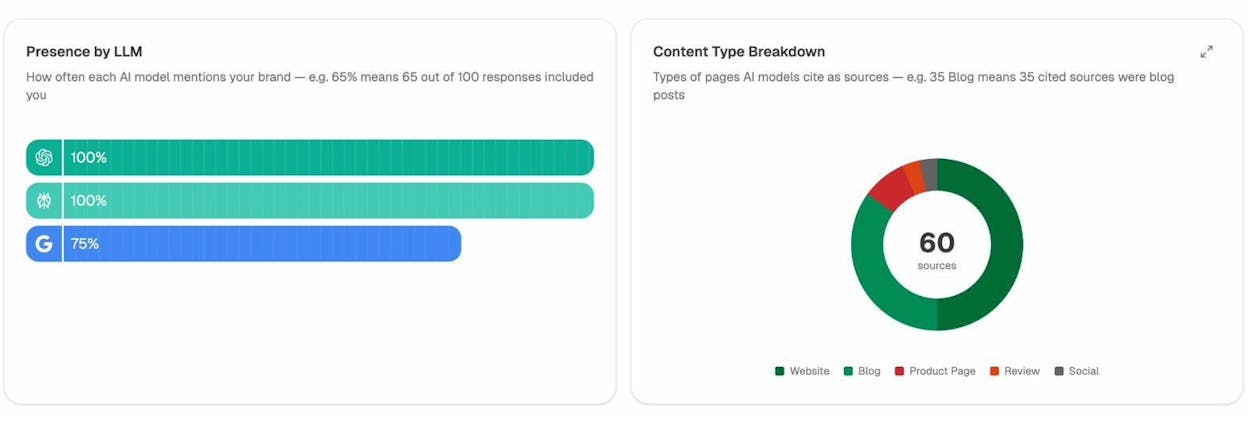
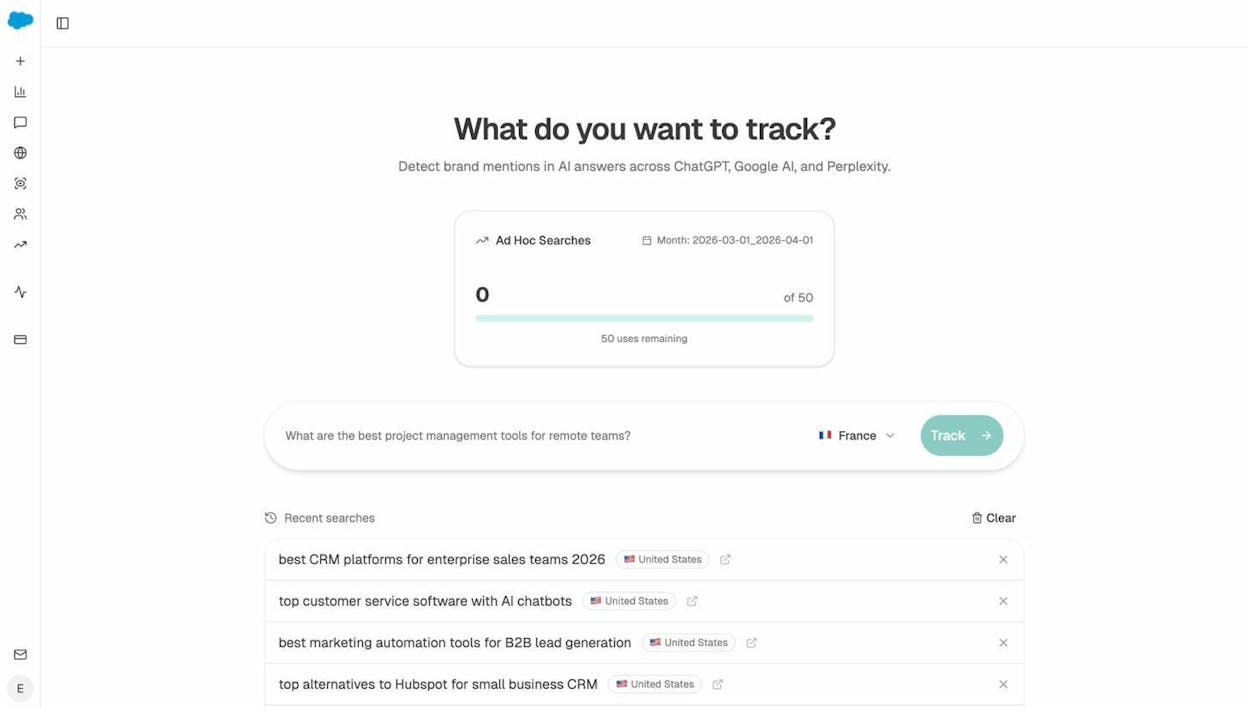
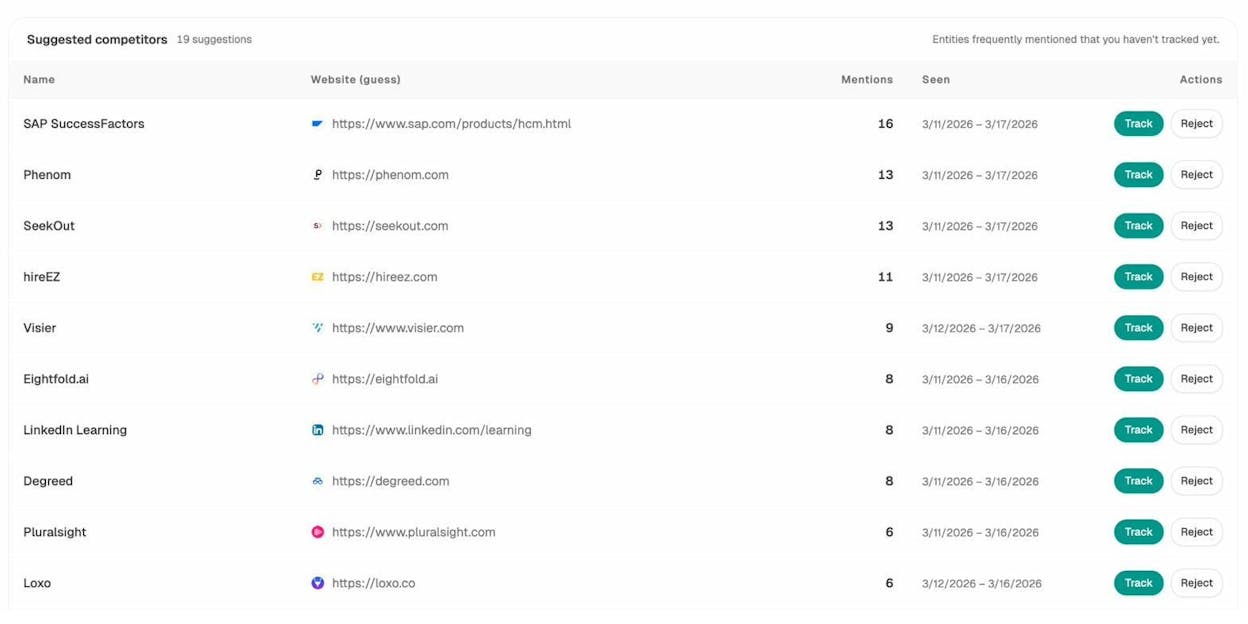
The logic is simple: if an AI engine is answering a question and your brand is absent, that’s a content opportunity. If a competitor appears and you don’t, that’s an even higher-priority opportunity.
You can cross-reference this with the Competitors dashboard to see exactly which brands AI engines recommend instead of yours — and for which prompts.
SEOs Creating Content
If your SEO team is writing the content, talk to internal subject matter experts. Interview them. Ask them about the problems customers actually have, not just what the keyword data says. Your salespeople are another rich source of insight — they hear objections and questions every day that rarely show up in keyword tools.
Many organizations fall into the trap of creating copycat content — articles that say the same thing as every other result on page one. This is not a future-proof strategy. If you can add even one original insight, data point, or framework to the information that already exists, your content will outperform.
Writers Creating Content
If you have a dedicated content team, empower them to do topic research themselves. One technique that works well is card-sorting: take the subtopics and questions people search around a topic, put them on index cards, and have your writers organize them into a logical structure.
This trains writers to think about content architecture, not just prose. There’s no single right answer for how the cards should be grouped — the exercise itself builds the strategic muscle your team needs.
Alternatively, your SEO team can provide writers with a content brief that covers the target keyword, search intent, topics to address, and competitive gaps to fill.
Experts Creating Content
Your best content often comes from employees who are genuine experts in the topic. Their insights may not be available anywhere else. If they don’t have time to write, interview them. Most people are happy to share insights verbally for fifteen minutes — and those insights can become the foundation for a piece of content that no competitor can replicate.
Improve Existing Content
Updating and improving your existing content can produce faster results than creating new content from scratch. Here’s where to look.
Content With Declining Traffic
Use an SEO tool to filter your top pages by traffic decline over the last six to twelve months. Look for pages that lost significant traffic and that are important to your business. These are prime candidates for a content refresh.
![[Screenshot description: SEO tool Top Pages report filtered for declining traffic over 6 months]](https://www.datocms-assets.com/164164/1776866185-blobid8.jpg?auto=format,compress&w=1248&fit=max)
Low-Hanging Fruit Keywords
Look for pages ranking in positions four through fifteen for their primary keyword. These are close enough to the first page that small improvements — better content depth, stronger internal links, improved on-page optimization — can push them into top positions.
Use Google Search Console or an SEO tool’s organic keywords report to find these opportunities. Filter for your target position range and sort by search volume to prioritize the biggest opportunities first.
![[Screenshot description: Organic keywords report filtered for positions 4-15, sorted by volume]](https://www.datocms-assets.com/164164/1776866186-blobid9.png?auto=format,compress&w=1248&fit=max)
Optimize for Featured Snippets
For informational content, targeting featured snippets can move you from position five to position zero. Here’s the process:
-
Open your SEO tool and go to the organic keywords report for your domain
-
Filter for keywords where you rank in positions one through five
-
Filter for keywords that trigger a featured snippet where your site doesn’t hold it
-
Review each keyword to find where your page is missing the direct answer, then add it
![[Screenshot description: SEO tool filtered for featured snippet opportunities where site ranks 1-5 but doesn’t hold the snippet]](https://www.datocms-assets.com/164164/1776866191-blobid10.png?auto=format,compress&w=1248&fit=max)
This is one of the highest-ROI content optimization tactics for informational queries. You’re already ranking near the top — you just need to provide a clearer, more direct answer than the current snippet holder.
Optimize Existing Content for AI Search
Content that ranks well on Google does not automatically get cited by AI engines. AI models have their own preferences for what they cite — and you can find the gaps.
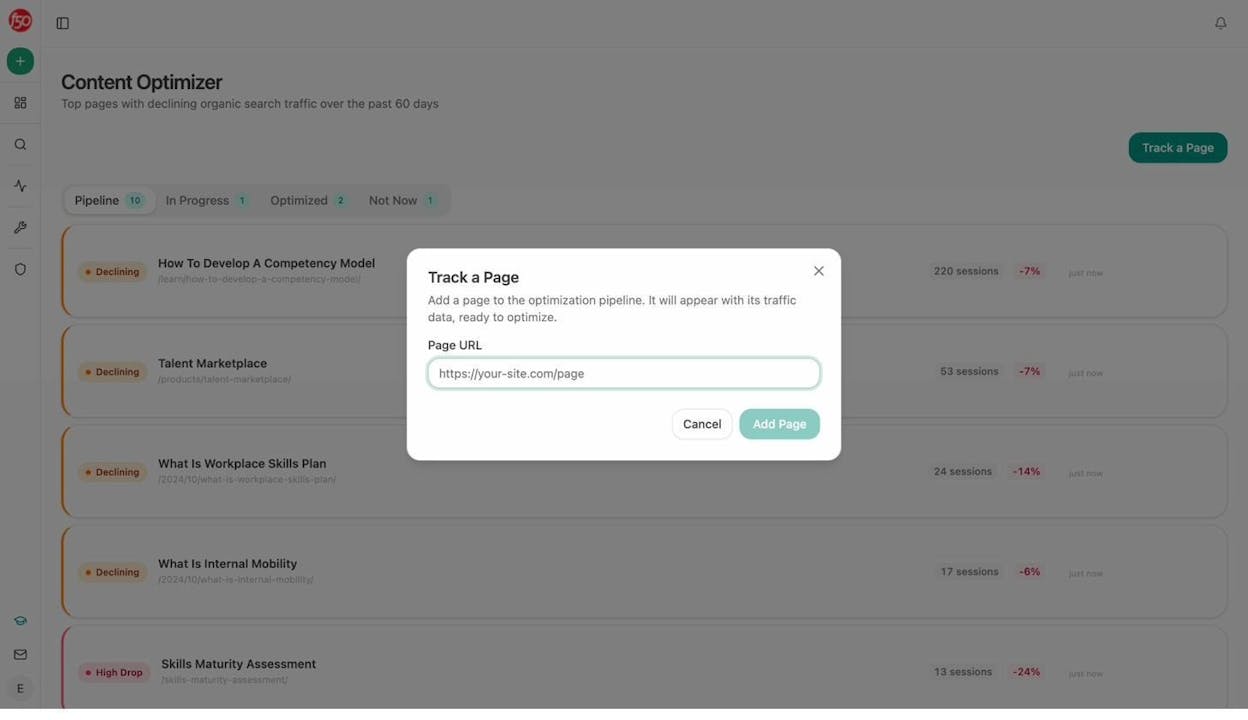
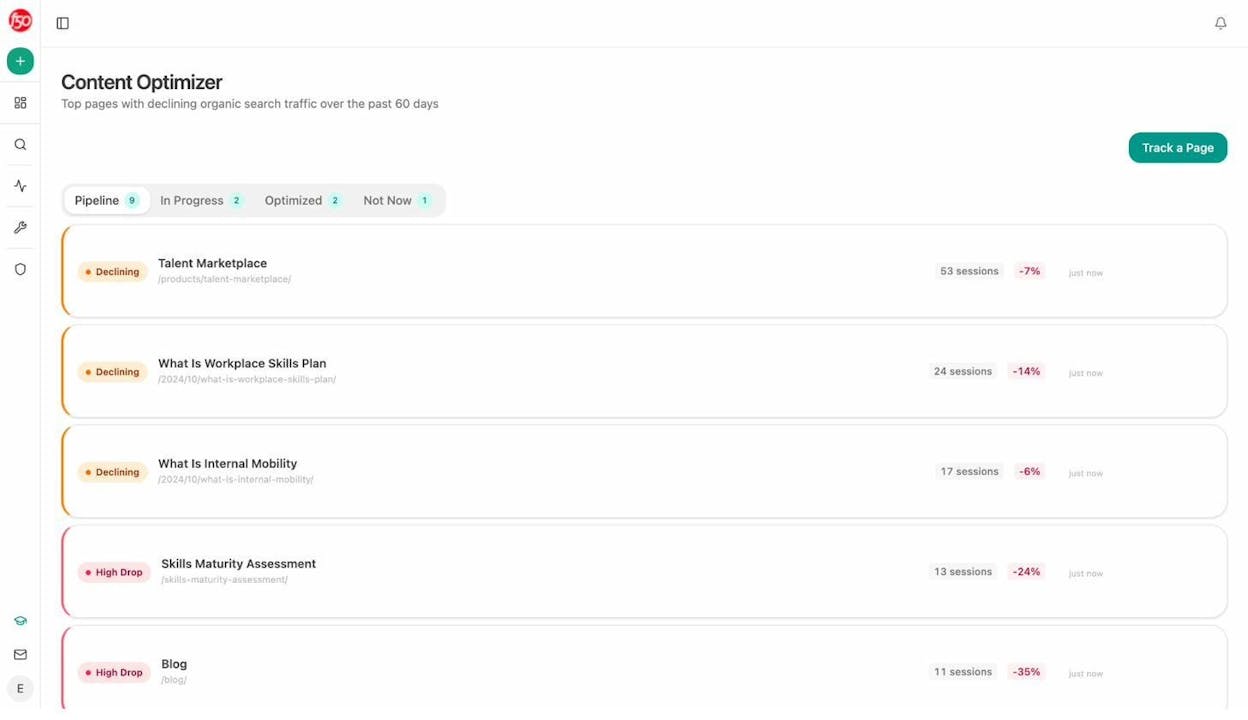
With Analyze AI’s Content Optimizer, paste any URL and get a content score along with specific suggestions for improving AI visibility. The tool identifies entity gaps, missing citations, structural issues, and areas where your content falls short of what AI engines prefer.
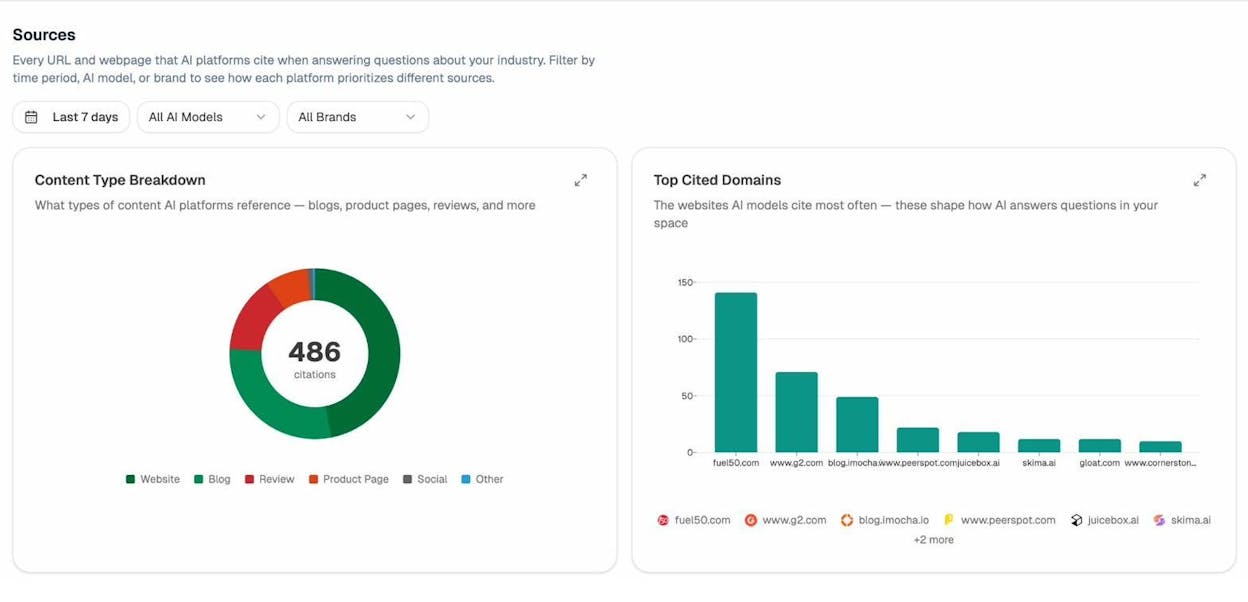
You can also use the Sources dashboard to see which domains AI engines cite most in your space. If a competitor’s blog is being cited but yours isn’t, that tells you exactly which content to prioritize for improvement.
Translate Successful Content
Most enterprise companies operate globally. If a piece of content performs well in English, it will likely perform well in other languages too. Translating your top-performing content for other markets is one of the most reliable ways to scale organic traffic with minimal content creation effort.
Don’t machine-translate and publish. Work with native speakers who understand local search behavior and cultural context. For enterprise teams managing international SEO, this is a multiplier — you get the benefit of proven content without starting from scratch.
Create Branded Content (Sometimes)
You’ll encounter requests from internal stakeholders to rank product pages for informational keywords. The classic ask: “Can you sprinkle some keywords into our product page so it ranks for this informational term?”
The answer is almost always no. Search intent matters. If the top results for a keyword are all informational blog posts, a product page is unlikely to rank there. Use a keyword tool’s intent classification to show stakeholders the mismatch between what they want and what the SERP rewards.
![[Screenshot description: Keyword intent analysis showing informational intent dominance for an enterprise keyword]](https://www.datocms-assets.com/164164/1776866203-blobid14.png?auto=format,compress&w=1248&fit=max)
There are exceptions. Brand-adjacent keywords — especially related to acquired companies or renamed products — may need dedicated content to retain existing traffic and redirect users to current offerings. But as a general rule, don’t optimize product pages for informational queries. Create separate informational content instead.
Create Free Tools
Free tools are one of the most effective lead generation tactics for enterprise companies. They attract links, drive organic traffic, and introduce potential customers to your product ecosystem.
Analyze AI uses this strategy with a suite of free marketing tools including a Keyword Generator, SERP Checker, Website Authority Checker, Website Traffic Checker, Broken Link Checker, and more.
If you have proprietary data or functionality that can be packaged as a free tool, do it. These pages consistently attract both organic traffic and backlinks.
Create Programmatic Content
If you have structured data — product catalogs, location databases, industry benchmarks — you can use it to generate landing pages programmatically. Done well, this scales quickly. Done poorly, it creates thin, low-quality pages that hurt more than they help.
The key is making sure each programmatic page provides genuine value. A template with swapped city names and no unique information is not a good page. A template that pulls real local data, reviews, and market-specific information is.
Create Video Content
Video works well for enterprise companies because it builds trust faster than text. A viewer who watches a fifteen-minute walkthrough of your product or methodology is far more engaged than someone who skimmed a blog post.
Structure your videos the same way you’d structure blog content: around the questions and topics people are actively searching for. This makes them discoverable through both YouTube search and Google’s video results. You can use the YouTube Keyword Tool to find relevant video topics in your industry.
Enterprise Link Building Strategy & Tactics
At the enterprise level, a lot of link building happens naturally. Companies are active across PR, events, social media, content syndication, partnerships, and advertising. Each of these activities generates links without the SEO team being directly involved.
Your job as an enterprise SEO is to guide these teams with best practices and capture opportunities they might otherwise miss. Here are the most effective enterprise link building tactics.
Create Linkable Assets
Linkable assets are content specifically designed to attract backlinks. In an enterprise context, these include industry surveys and original research, online tools and calculators, awards and rankings, comprehensive how-to guides, and coined terminology or frameworks.
Your organization likely has access to proprietary data, industry experts, and resources that smaller companies don’t. Use these advantages to create content that other sites want to reference and link to.
There’s also a compounding effect: high-ranking pages attract more links over time because they’re more visible. If your content is good enough to reach the top of the SERPs, the links will follow.
Combine Similar Content Into Stronger Pages
Keyword cannibalization — when multiple pages on your site compete for the same keyword — is common on enterprise websites that have been publishing content for years. The result is diluted rankings where neither page performs as well as a single consolidated page would.
Audit your content for overlapping topics. When you find two or more pages targeting the same keyword with similar content, merge them into one comprehensive page and redirect the others. This concentrates your link equity and ranking signals into a single, stronger URL.
Promote Your Content
Leverage your organization’s existing channels to amplify content reach. Your PR team, social media team, paid media team, and partnership managers can all help distribute content to audiences that are likely to link to it.
Be selective about what you ask other teams to promote. If you ask them to promote everything, they’ll promote nothing. Focus their efforts on your best linkable assets — original research, tools, and comprehensive guides.
Go After Unlinked Brand Mentions
Enterprise companies get talked about frequently across the web. Many of those mentions don’t include a link back to your site. Each unlinked mention is an opportunity to request a link.
Use a content research tool to find pages that mention your brand without linking to you. Reach out to the site owners and ask them to add a link. This is one of the highest-conversion link building tactics because the site has already demonstrated interest in your brand.
Also look for unlinked mentions of key employees, proprietary research, or statistics your company has published.
Recover Lost Links With Redirects
Enterprise websites accumulate broken URLs over time — from site redesigns, product launches, content migrations, and URL structure changes. When those old URLs had backlinks pointing to them, those links are lost unless you redirect the old URLs to current equivalents.
Here’s how to find these opportunities:
-
Enter your domain into an SEO tool’s backlink analysis
-
Go to the best-by-links or broken backlinks report
-
Filter for 404 (not found) responses
-
Sort by referring domains to find the highest-value pages first
-
Map each broken URL to the most relevant current page and implement 301 redirects
![[Screenshot description: Best by links report filtered for 404 pages, sorted by referring domains]](https://www.datocms-assets.com/164164/1776866203-blobid15.png?auto=format,compress&w=1248&fit=max)
This is a high-impact, low-effort tactic. You’re not building new links — you’re reclaiming links you already earned.
Build Internal Links
Internal links are one of the most reliable ways to help pages rank higher, and one of the most overlooked at enterprise companies. The challenge at the enterprise level is political: different teams own different sections of the site, and getting a link added from one team’s page to another team’s page can require meetings, approvals, and follow-ups.
Despite the friction, the payoff is worth it. Look for pages on your site that mention a topic but don’t link to your main resource on that topic. Also audit your anchor text — generic phrases like “learn more” and “click here” waste link equity. Replace them with descriptive anchor text that signals to search engines what the linked page is about.
For step-by-step guidance, check out our internal linking guide.
Build Links From Other Websites You Own
If your company owns multiple web properties — from acquisitions, regional domains, or sub-brands — add relevant cross-links between them. This consolidates authority across your portfolio of sites. Keep it natural and relevant; linking for the sake of linking will be counterproductive.
Enterprise Technical SEO Strategy & Tactics
Enterprise sites often run on complex, legacy infrastructure with multiple tech stacks, CMS platforms, and development teams. Technical SEO in this environment requires patience, diplomacy, and a ruthless focus on high-impact issues.
One mistake at scale can keep millions of pages out of the index. There are so many moving parts and so many things that can go wrong that you have to prioritize aggressively.
Here are the technical SEO projects that matter most for enterprise sites, organized by priority.
Check and Fix Indexing (Priority: High)
Indexing issues are the foundation. If your pages aren’t indexed, nothing else matters. Check for two common problems:
Pages that should be indexed but aren’t. Look for noindex tags, canonical misconfigurations, and robots.txt blocks that are accidentally preventing important pages from being indexed. Your site audit tool’s indexability report will surface these quickly.
![[Screenshot description: Site audit indexability report showing noindex warnings on important pages]](https://www.datocms-assets.com/164164/1776866209-blobid16.png?auto=format,compress&w=1248&fit=max)
Pages that are indexed but shouldn’t be. Thin pages, duplicate content, and internal utility pages that are indexed dilute your site’s overall quality signals. Noindex or remove these.
Also check your site structure report for pages that are receiving organic traffic but shouldn’t be — this often indicates canonicalization issues.
Add Schema Markup (Priority: High)
Schema markup earns you enhanced search features — rich snippets, FAQ dropdowns, review stars, and more. For enterprise sites, the most impactful schema types are typically organization, product, FAQ, how-to, breadcrumb, and article.
Focus on schema that gets you a visible search feature. Schema for the sake of schema adds complexity without benefit.
Fix Page Experience (Priority: Medium)
Page experience signals include Core Web Vitals (loading speed, interactivity, visual stability), HTTPS, mobile-friendliness, and absence of intrusive interstitials. While these may not individually drive large ranking changes, they matter for user experience and conversion rates — and at enterprise scale, even small improvements in bounce rate or conversion translate to significant revenue.
![[Screenshot description: Site audit showing Core Web Vitals metrics with CrUX data]](https://www.datocms-assets.com/164164/1776866210-blobid17.png?auto=format,compress&w=1248&fit=max)
General Website Health and Maintenance (Priority: Low-Medium)
These items keep your site running smoothly:
Broken links. Find and fix them. Use a tool like the Analyze AI Broken Link Checker or your site audit tool to identify broken internal and external links.
Redirect chains. Google follows up to ten redirect hops, but long chains slow down crawling and waste crawl budget. Look for chains of more than three hops and collapse them to a single redirect.
XML sitemaps. Automate sitemap generation. Manual sitemaps are never kept up to date. Your sitemap should include only indexable, canonical URLs.
Fix Hreflang Issues (Priority: Depends on Site)
For enterprise companies operating internationally, hreflang tells search engines which version of a page to show to users in different languages and regions. Hreflang issues are common and expensive — showing the wrong language or region to a user increases bounce rates and hurts conversions.
![[Screenshot description: Site audit showing hreflang issues with cluster visualization]](https://www.datocms-assets.com/164164/1776866215-blobid18.png?auto=format,compress&w=1248&fit=max)
Optimize Crawl Budget (Priority: Depends on Site)
Crawl budget is mainly a concern for very large sites (millions of pages) or sites that are frequently updated. If you have many important pages that aren’t being crawled regularly, you may need to improve internal linking to those pages, remove low-quality pages from the index, or improve server response times.
Fix JavaScript SEO Issues (Specialized Task)
Large enterprises often have sections built on JavaScript frameworks like React, Angular, or Vue. These can cause indexing issues if not rendered properly for search engine crawlers. Ensure critical content is available in the initial HTML or is server-side rendered.
Manage Site Migrations (Specialized Task)
Enterprise companies love redesigns, platform changes, and URL restructures. Each of these is a migration that can destroy organic traffic if not handled carefully. Document your migration process, create comprehensive redirect maps, and monitor traffic closely before and after launch.
How to Track Enterprise SEO Performance in AI Search
This is where most enterprise SEO programs stop: they track Google rankings, organic traffic, and conversions. That’s necessary but no longer sufficient.
AI engines like ChatGPT, Perplexity, Gemini, and Copilot are now answering the same questions that used to drive clicks to your website. Buyers are using these tools to research products, compare vendors, and make decisions. If your brand doesn’t appear in those answers, you’re invisible to a growing segment of your market.
Here’s how to add AI search tracking to your enterprise SEO program using Analyze AI:
Step 1: Set Up Your AI Visibility Baseline
Create a project in Analyze AI and define the topic clusters that matter to your business. Add your competitors. Analyze AI will immediately begin tracking how each brand appears across AI engines.
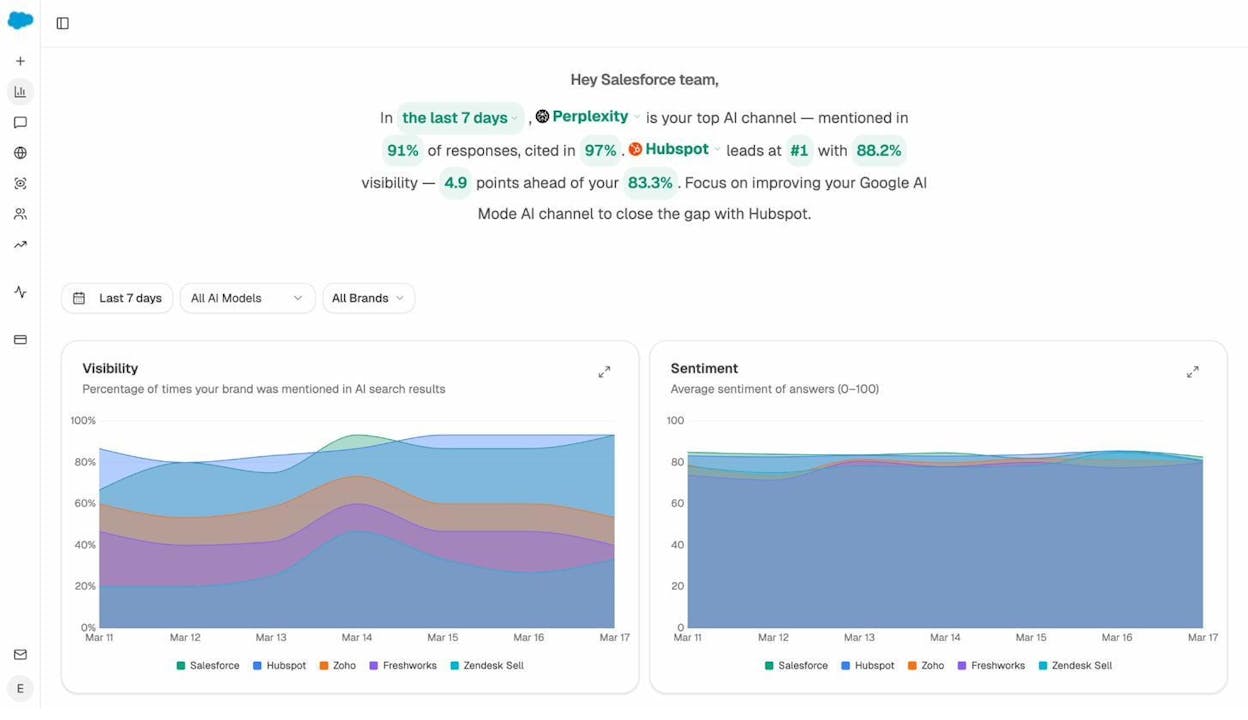
The Overview dashboard gives you a high-level view: your visibility percentage, which AI engine is your strongest channel, where your top competitor leads, and what to focus on next.
Step 2: Monitor Prompts and Brand Mentions
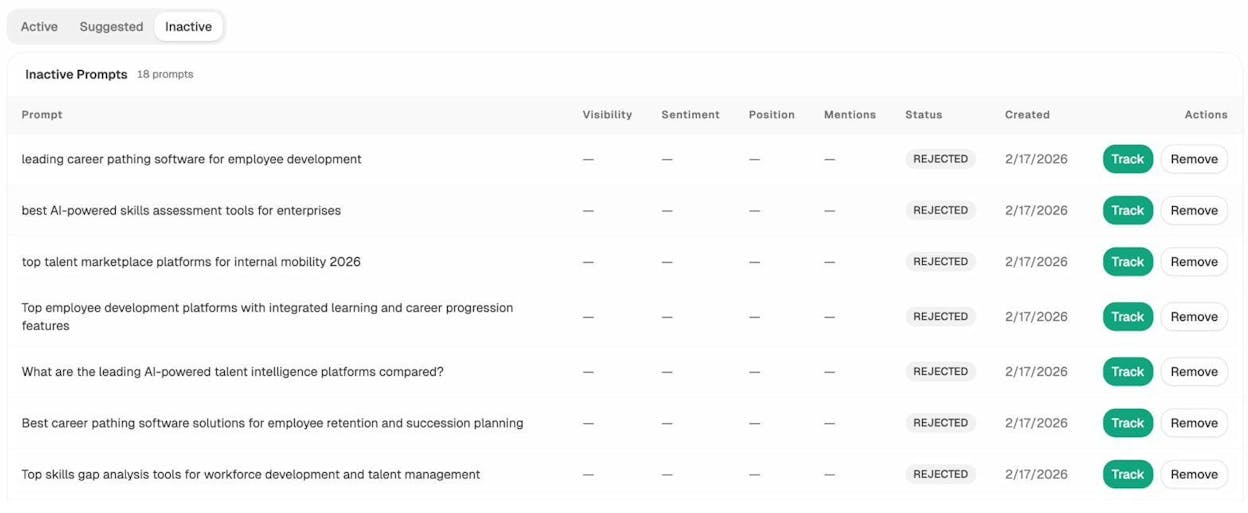
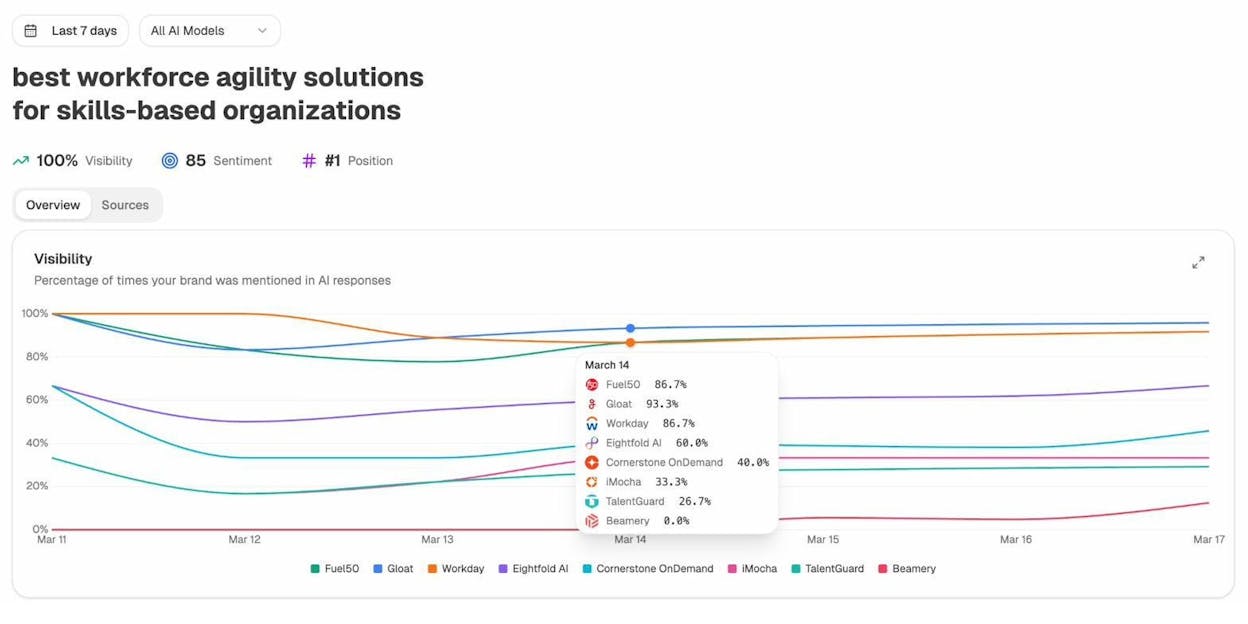
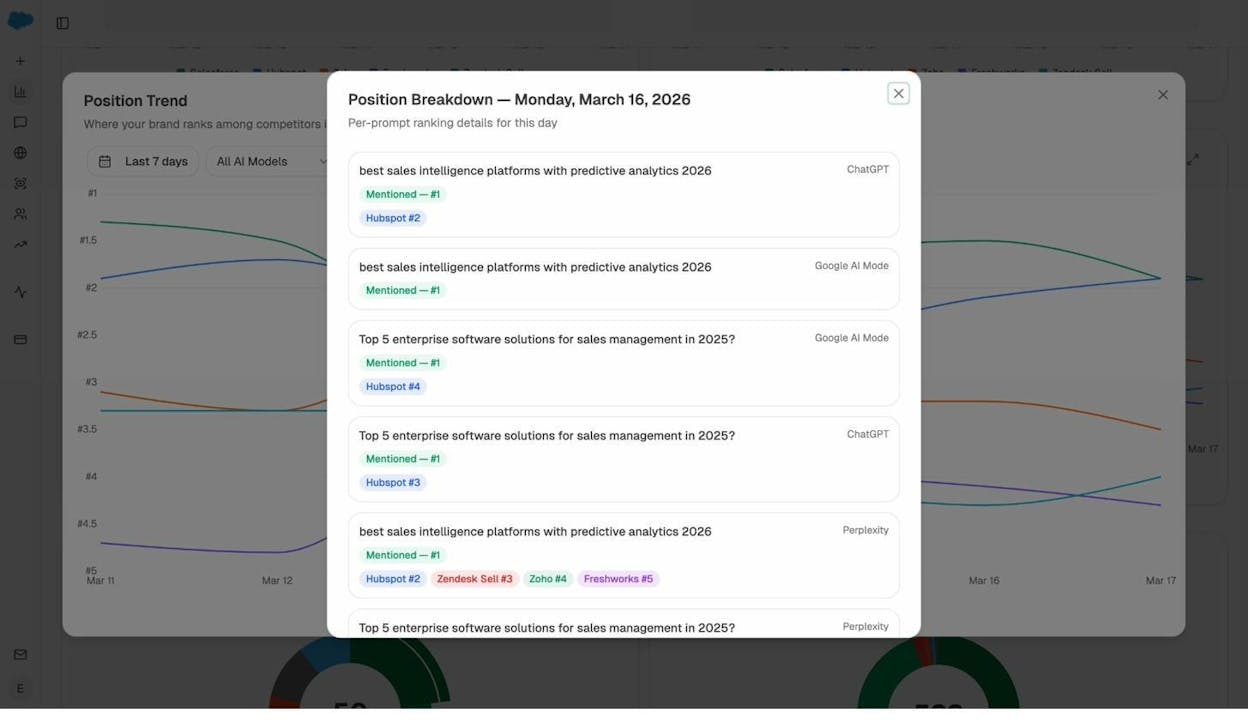
The Prompts dashboard shows you exactly how AI engines respond to queries in your space. For each tracked prompt, you’ll see which brands are mentioned, in what order, and with what sentiment.
Use the prompt-level detail view to see the full AI response and understand why a competitor is ranked higher than you. Is it because they have more citations? Better content depth? A stronger brand signal?
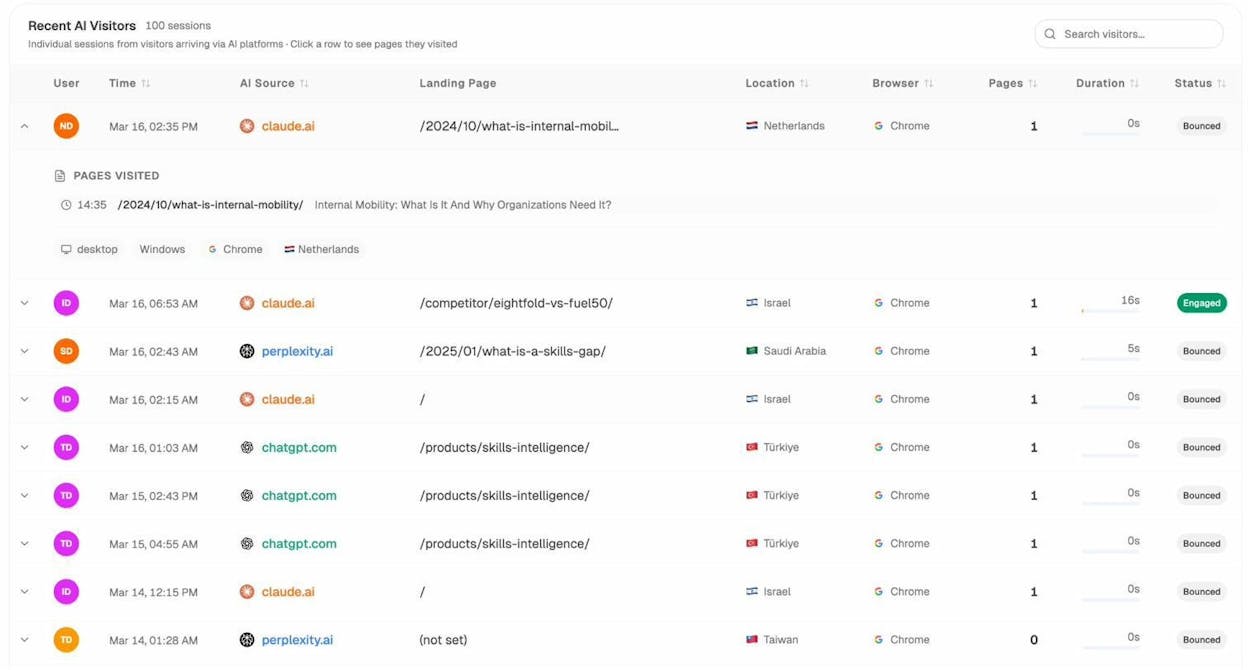
Step 3: Track AI Referral Traffic and Conversions
Connect GA4 to Analyze AI to unlock attribution. The AI Traffic Analytics dashboard shows you how many visitors arrive from each AI engine, which pages they land on, how long they stay, and whether they convert.
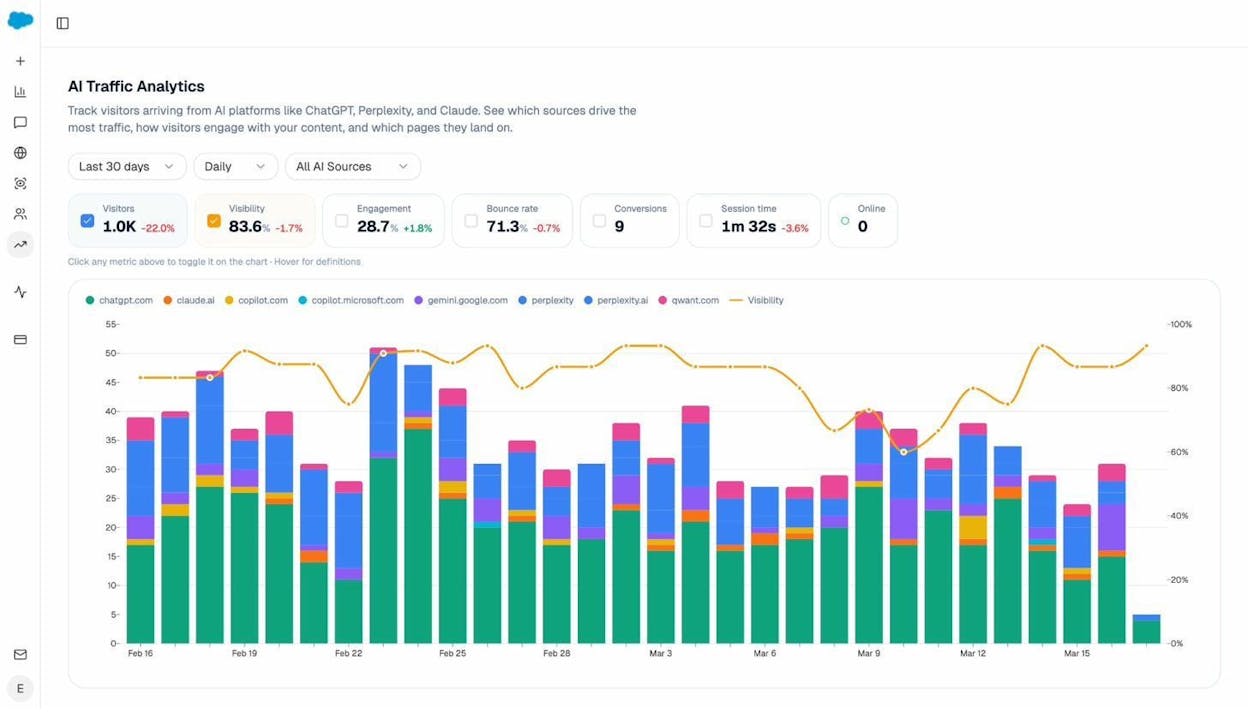
This is the data your CMO cares about. It turns “we need to be visible in AI search” from a vague assertion into a measurable revenue channel.
The Landing Pages report shows which of your pages receive AI traffic. Look for patterns: are certain content types (guides, comparison posts, documentation) over-represented? If so, create more content in those formats.
Step 4: Analyze the Competitive Landscape
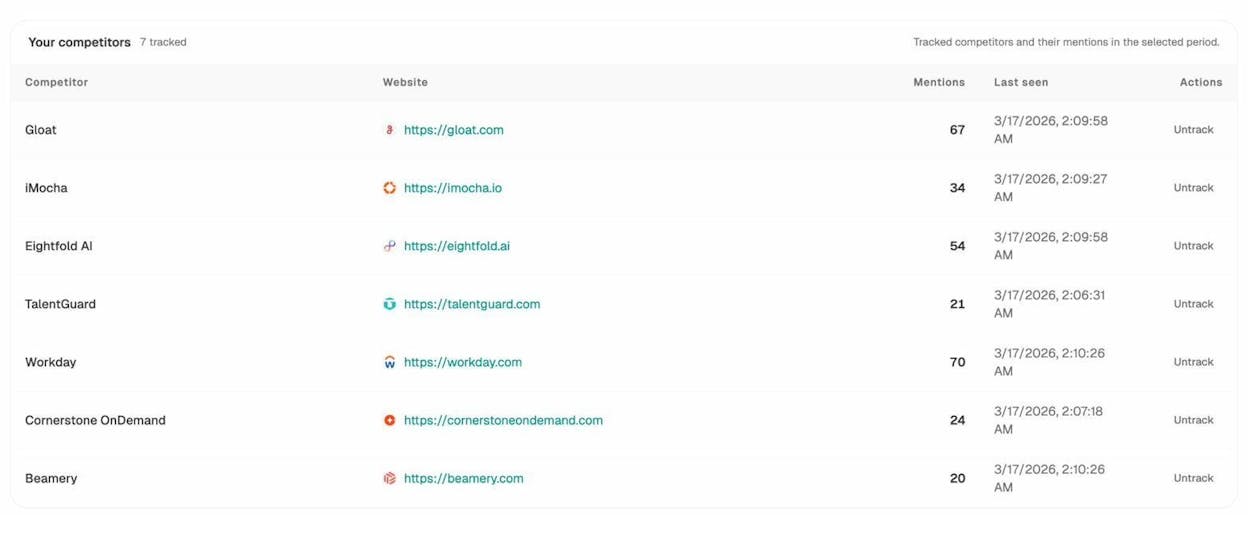
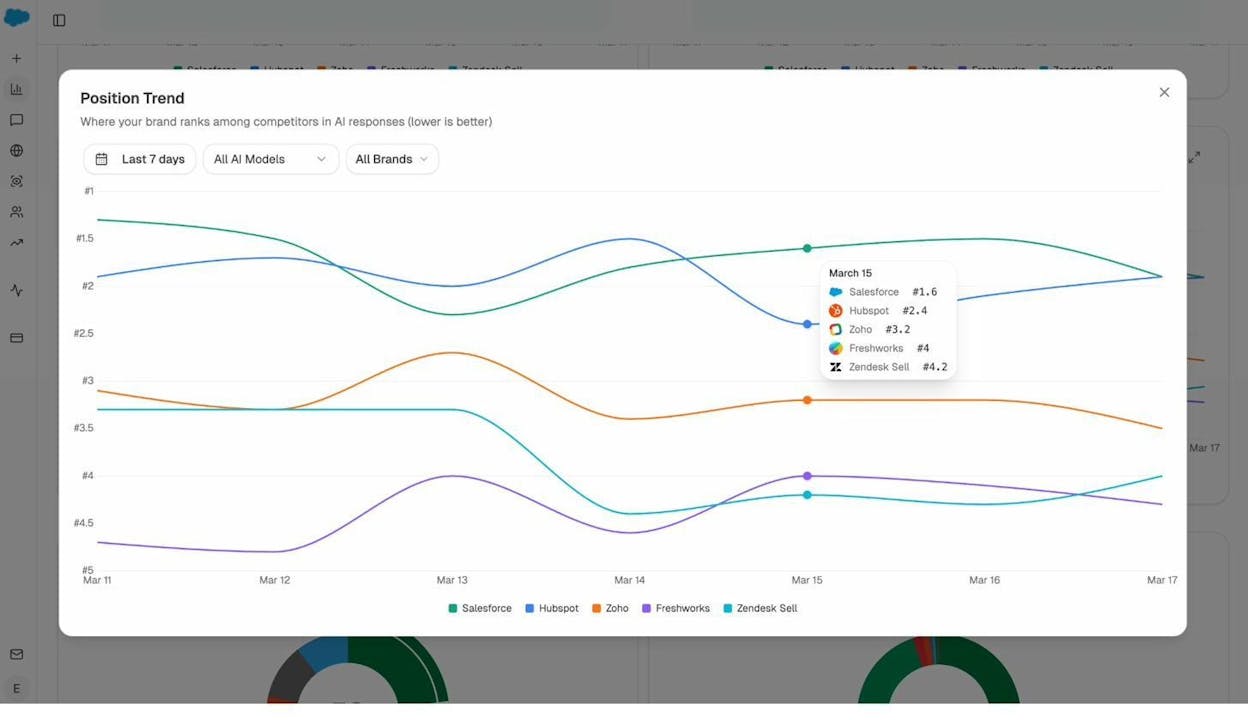
The Competitors dashboard provides a rolling scoreboard of how your brand compares to competitors across AI engines. You’ll see who’s winning and losing on specific prompts, which brand has the highest visibility share, and where you have the best opportunity to gain ground.
Step 5: Understand How AI Frames Your Brand
The Perception dashboard shows you the narrative AI engines are building about your brand. Is the sentiment positive, neutral, or negative? What specific attributes do AI engines associate with your brand?
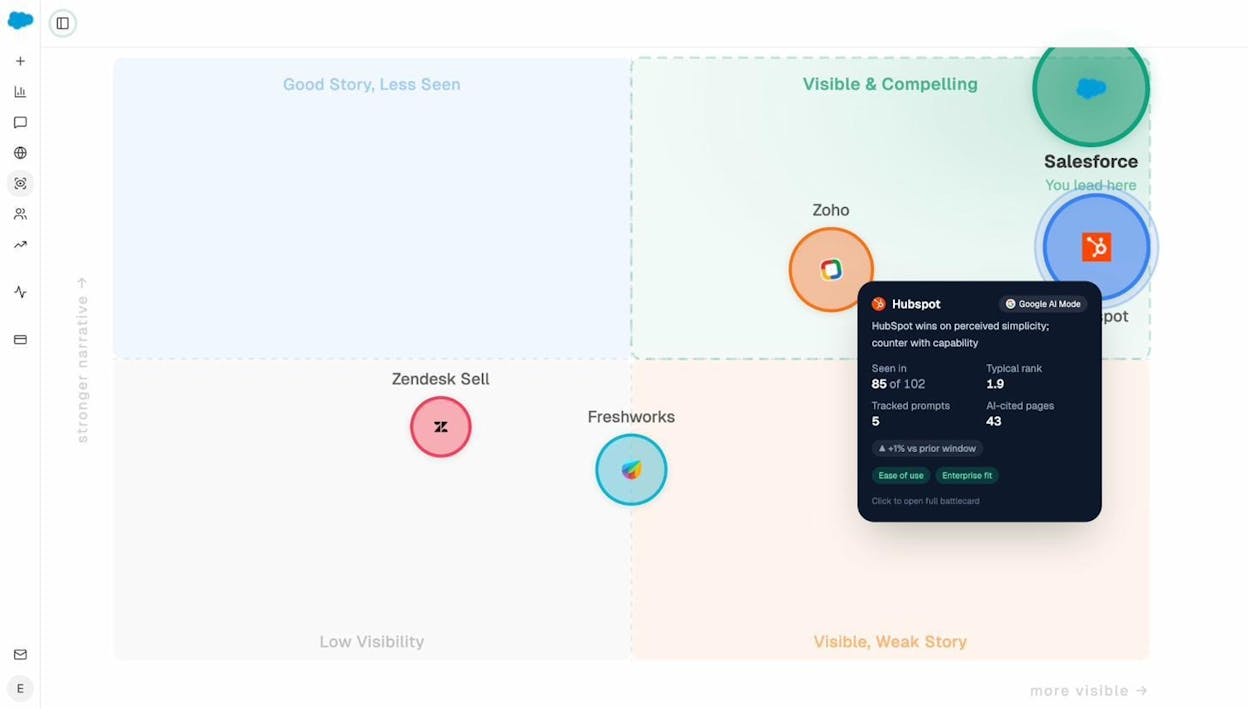
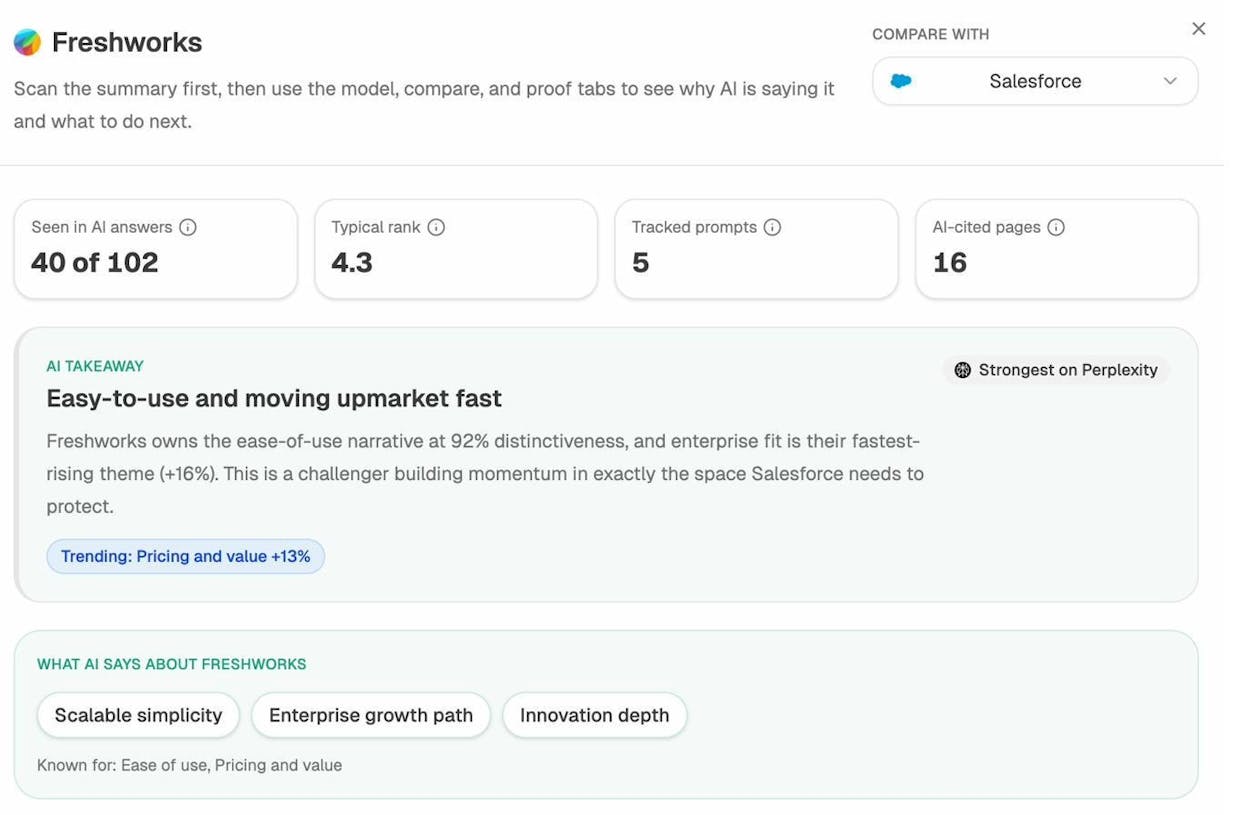
This matters because AI engines don’t just list your brand — they describe it. If the narrative is inaccurate or unfavorable, you can trace it back to specific content or source gaps and take corrective action.
Step 6: Get Actionable Insights Without Logging In
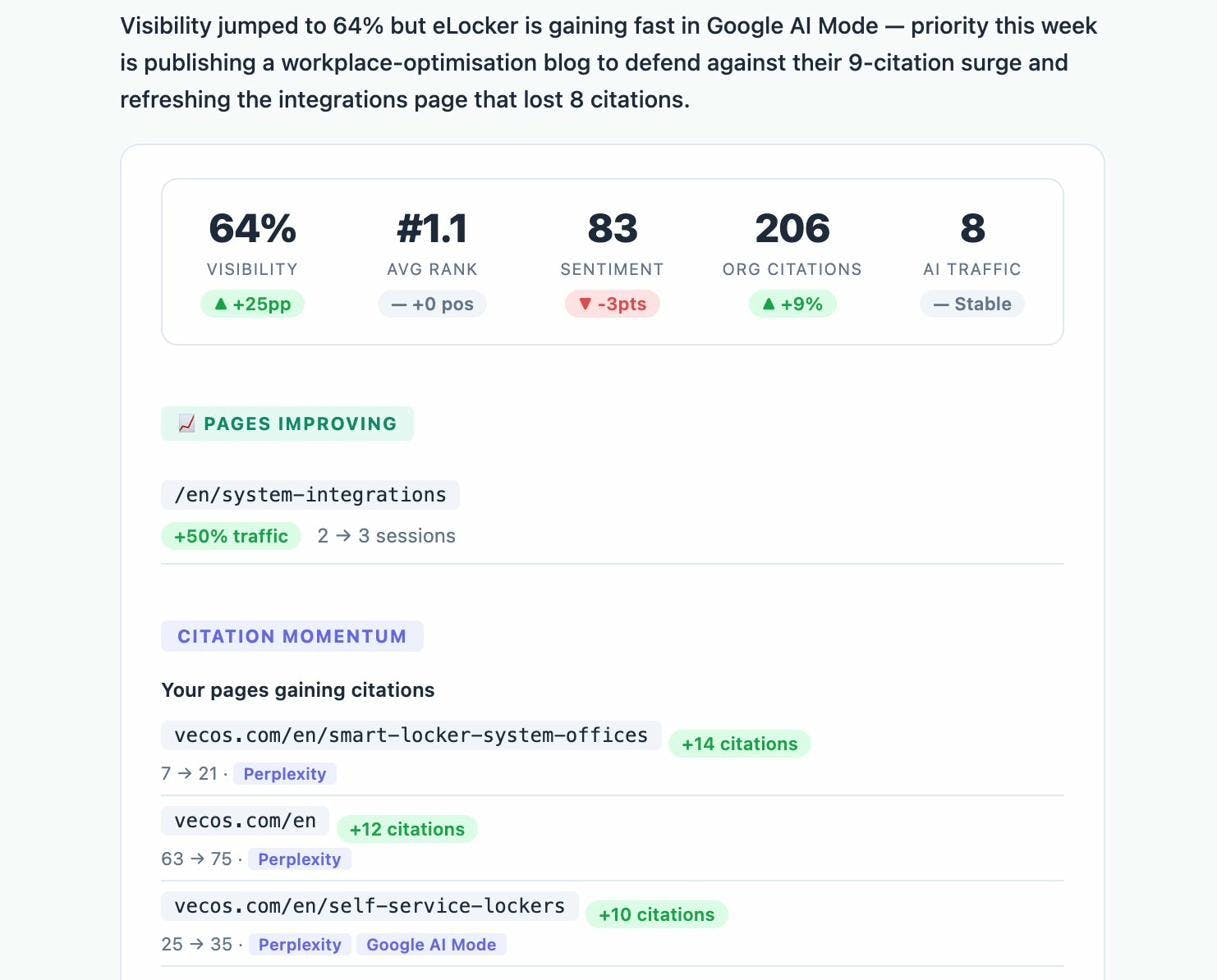
Analyze AI sends a Weekly Email Digest every Monday with prioritized actions: citation changes, competitor movements, new opportunities, and risk alerts. This keeps your team aligned without requiring everyone to check the dashboard daily.
Enterprise Local SEO
Enterprise local SEO is about optimizing a large business’s presence across multiple geographic locations. This matters for businesses with many branches, franchises, or service areas where local search drives foot traffic and conversions.
On top of the standard enterprise SEO challenges, local SEO adds the complexity of bulk verification and management of Google Business Profile (GBP) listings, consistent NAP (name, address, phone) data across all locations, and performance variation between locations.
Focus on two things: ensuring every location has a complete, optimized GBP listing, and creating unique, useful location pages on your website. Location pages should include genuine local information — not just a template with the city name swapped in.
For enterprise teams, AI search adds another dimension to local SEO. When someone asks ChatGPT or Perplexity “best enterprise CRM in Chicago,” the answer engine cites sources and mentions brands. Monitoring these location-specific prompts lets you catch opportunities that traditional local SEO tools miss.
Enterprise SaaS SEO
Enterprise SaaS SEO is the practice of improving the organic visibility of a SaaS company that serves enterprise customers. The goal is to attract people searching for solutions your product provides.
The SaaS SEO playbook differs from other enterprise verticals in a few important ways. First, the buyer journey is longer and involves more stakeholders, which means you need content for every stage of the funnel. Second, competitors are often investing heavily in SEO, making content quality and depth critical differentiators. Third, comparison and “alternative” keywords are some of the most valuable terms to target because they capture high-intent buyers who are actively evaluating solutions.
For SaaS companies competing in AI search, the stakes are high. When a buyer asks an AI engine “what’s the best [category] tool?”, the brands mentioned in the response have a significant advantage. You can monitor whether your brand appears in these high-intent prompts using Analyze AI’s prompt tracking, and use the competitor analysis to understand where rivals are winning.
Enterprise Ecommerce SEO
Enterprise ecommerce SEO covers the optimization of large-scale online stores with extensive product catalogs and complex site architectures. The goal is to drive organic traffic to product and category pages at scale.
Ecommerce Technical SEO
Technical SEO is especially important for ecommerce sites because of the scale involved. Key areas to focus on include faceted navigation (preventing duplicate content from filter combinations), URL parameter handling, pagination, JavaScript rendering, crawl budget management, and hreflang (for international stores).
Product Description Pages (PDPs)
For PDPs, using the manufacturer description is acceptable and often the most efficient approach. Rather than rewriting descriptions, add value in other ways: original product reviews, comparison sections, detailed attribute breakdowns, and user-generated content.
Product Listing Pages (PLPs) and Category Pages
Your product selection and relevance to the query determine whether a category page ranks — not keyword-stuffed copy hidden at the bottom. Focus on showing the right products across important facets (brand, price range, features) and make the page genuinely useful to a shopper.
Enterprise SEO Challenges
Enterprise SEO is as much about navigating organizational complexity as it is about technical optimization. Here are the challenges you’ll face and how to handle them.
Getting Buy-In for SEO
If leadership doesn’t see the value of SEO, you’ll lose resources and prioritization. The solution is to frame everything in terms of revenue. Some data points that sell SEO internally:
-
“There are [X] monthly searches for [keyword]. We don’t rank for it. Our competitor does.” — This creates urgency.
-
“Organic search drives [X]% of our website’s revenue.” — This proves current value.
-
“The average top-ranking page also ranks for nearly 1,000 additional keywords.” — This shows the compounding nature of good content.
For AI search, the sell is even simpler: “Our competitors are being recommended by ChatGPT when buyers search for [category]. We’re not.” Showing the actual AI response in a meeting is far more persuasive than any slide deck.
Resources and Planning
Resources are never unlimited, even at enterprise companies. You’ll need to plan projects quarterly or annually, align them to company goals, and prioritize ruthlessly.
Use an impact-effort matrix to sort your projects:
|
Category |
Effort |
Impact |
Action |
|---|---|---|---|
|
Quick wins |
Low |
High |
Do first |
|
Major projects |
High |
High |
Plan and schedule |
|
Fill-ins |
Low |
Low |
Do when time allows |
|
Money pits |
High |
Low |
Probably never |
Internal linking improvements, redirect reclamation, and content refreshes are typical quick wins. New content creation and platform migrations are major projects. Don’t get caught in busy work — focus on what moves the needle at scale.
Reporting and Data
Reporting at the enterprise level can consume enormous amounts of time. The key is matching your reports to your audience. Your SEO team wants keyword rankings and technical health metrics. Product teams want competitive positioning. Executives want one number — ideally, revenue from organic search.
For SEO reporting, focus on visualizations over raw data. A chart showing year-over-year organic traffic growth communicates more than a spreadsheet with 10,000 keyword rankings.
When it comes to AI search reporting, Analyze AI provides executive-ready dashboards that show visibility trends, competitive positioning, sentiment analysis, and AI-attributed revenue — all in one place. The weekly email digest means leadership gets updates without having to log in.
Organization and Team Structure
Enterprise SEO teams sit in many different departments — marketing, product, engineering, content, digital, analytics. There’s no universally correct answer for where SEO should live. What matters is that the SEO team has visibility into what other teams are working on and the authority (or at least the access) to influence technical and content decisions.
Build relationships across the organization. Attend other teams’ standups. Host office hours. Offer to share your data — keyword research, competitor insights, and search trend data are valuable to teams beyond SEO.
For AI search, the same principle applies. Share AI visibility data with your PR, content, and product teams. When they see that competitors are being recommended by AI engines and your brand isn’t, you’ll get their attention and their cooperation.
Training and Evangelism
The more people in your organization who understand SEO basics, the fewer mistakes they’ll make and the more opportunities they’ll catch. Train content teams on search intent. Train developers on technical SEO fundamentals. Train PR teams on how their work influences link acquisition and AI citations.
Create internal resources: cheat sheets, training videos, and documentation. Host lunch-and-learns. Start an internal newsletter with SEO wins and industry updates. Every time you help another team succeed through SEO, you build an advocate who will prioritize SEO work in the future.
Enterprise SEO Tools
Enterprise SEO requires robust tooling. Here’s a comparison of popular enterprise SEO tools:
|
Tool |
Best For |
Pricing |
|---|---|---|
|
Ahrefs |
Backlink analysis, keyword research, content research |
Starts at $14,990/year |
|
Semrush |
All-in-one SEO and PPC |
Custom enterprise pricing |
|
Conductor |
Enterprise content and performance optimization |
Custom pricing |
|
Botify |
Technical SEO for very large sites |
Custom pricing |
|
BrightEdge |
Enterprise SEO with AI recommendations |
Custom pricing |
|
seoClarity |
Rank tracking and content optimization |
Starts at $3,600/month |
For AI search visibility tracking, the market is newer and the tools are purpose-built for monitoring how brands appear across AI engines:
|
Tool |
Best For |
Key Differentiator |
|---|---|---|
|
AI search analytics + SEO |
GA4 attribution, content optimization, citation analytics |
|
|
Profound |
AI visibility monitoring |
Prompt tracking and competitor intelligence |
|
Peec AI |
Brand mention tracking in AI |
Real-time monitoring |
|
AthenaHQ |
GEO optimization |
Content recommendations |
For an in-depth comparison, see our guide to enterprise SEO tools and AI search monitoring tools.
Final Thoughts
Enterprise SEO is a long game. Progress is measured in quarters, not days. The organizations that win are the ones that get the fundamentals right — quality content, strong technical foundations, consistent link building — and then compound those advantages over time.
What’s changed is the surface area for organic visibility. AI search is not replacing Google. It’s adding a second organic channel that operates on different rules and rewards different signals. Enterprise teams that add AI search tracking to their existing SEO programs — instead of treating it as a separate initiative — are building the most durable competitive advantage.
If you want to see where your brand stands in AI search today, you can test your visibility with a free Ad Hoc Prompt Search in Analyze AI. In a few seconds, you’ll see whether AI engines recommend your brand — or your competitors — when buyers ask the questions that matter most to your business.

Ernest

Ibrahim


