



Summarize this blog post with:


In this article, you’ll learn which Surfer SEO alternatives actually fill the gaps Surfer leaves open, what each tool does best, what it skips, how much you’ll pay, and how to pick the one that matches your workflow. You’ll also see how to extend every tool’s value by adding AI search visibility to your stack, a channel most Surfer alternatives ignore completely.
Table of Contents
Why Teams Look for Surfer SEO Alternatives
Surfer SEO is a strong content optimization tool. Its Content Editor scores your drafts against top-ranking pages. Its NLP term suggestions help writers cover topics more completely. And its Topical Map feature helps you plan content clusters around authority.
But here is where teams run into walls.
The content score is the ceiling. Surfer tells you whether your draft matches what already ranks. It does not tell you whether the content you optimized actually drove traffic, converted visitors, or showed up in AI-generated answers from ChatGPT, Perplexity, or Gemini. You get a score. You do not get attribution.
Pricing adds up fast. The Essential plan starts at $99/month with 30 content editor credits. The AI Tracker is a $95/month add-on for just 25 prompts. The Scale plan jumps to $219/month. And unused credits expire monthly unless you pay annually.
No SEO infrastructure. Surfer does not include backlink analysis, technical audits, or rank tracking. You still need a separate tool for the fundamentals.
If any of these limitations sound familiar, you need an alternative that covers what Surfer does not.
Here are the seven best options, starting with the one that extends furthest beyond content scoring.
1. Analyze AI: Best for Teams That Need Content, SEO, AI Search, and Automation in One Platform
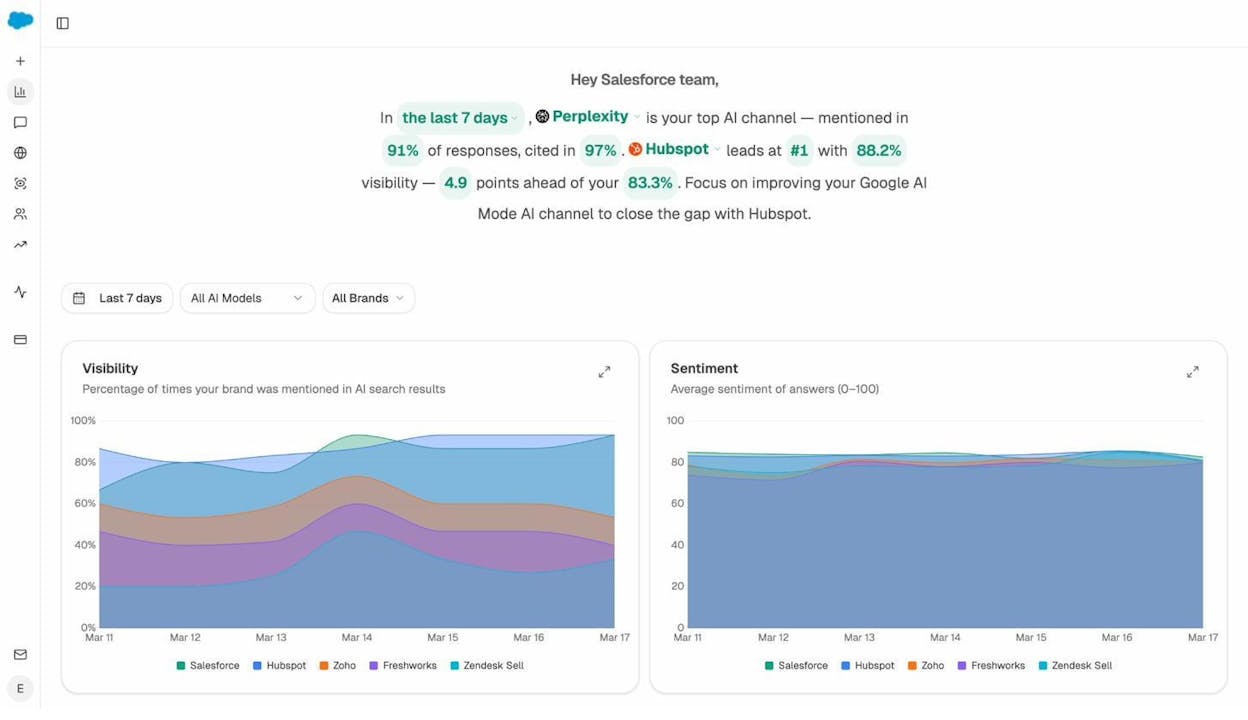
Most Surfer alternatives solve one problem well. Analyze AI solves four. It is an agentic platform for SEO, AEO, content, and GTM operations that covers content optimization, AI search visibility, revenue attribution, and workflow automation from a single workspace.
Where Analyze AI goes beyond Surfer
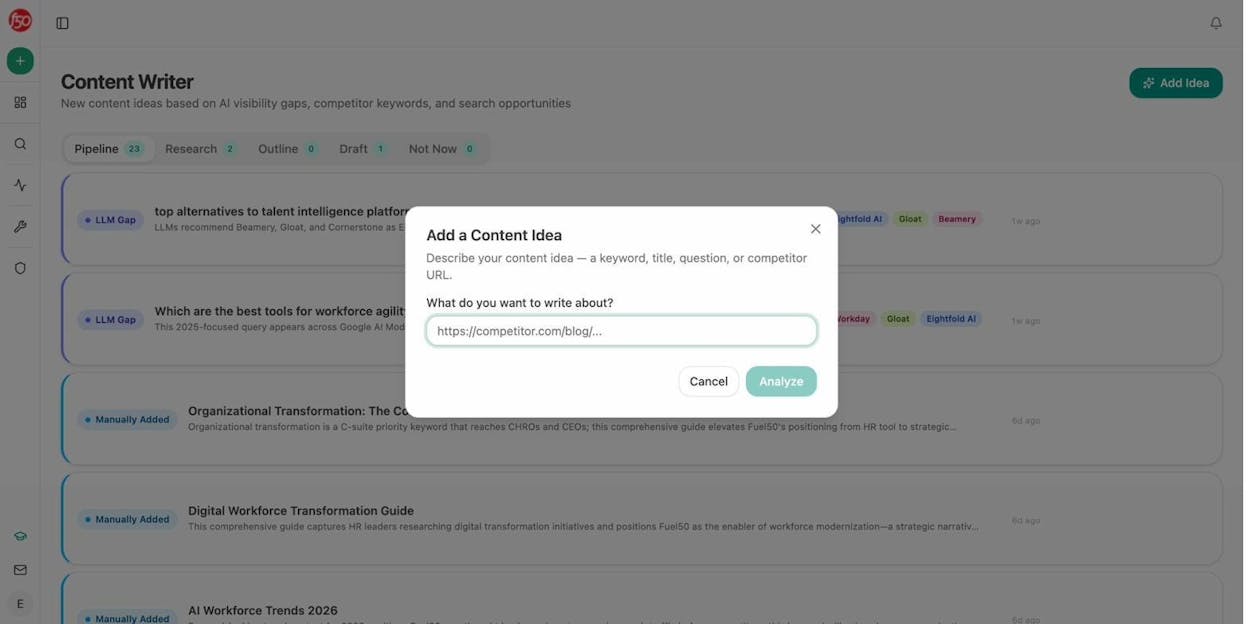
Content Writer and Optimizer that produce better outputs. The AI Content Writer takes you from idea to research to outline to draft with AI visibility gaps, competitor analysis, and editorial comments built into every step. Unlike Surfer’s basic AI article generation, Analyze AI’s writer runs multi-step research before drafting. It pulls competitor data, identifies citation gaps, and injects your brand voice rules automatically.
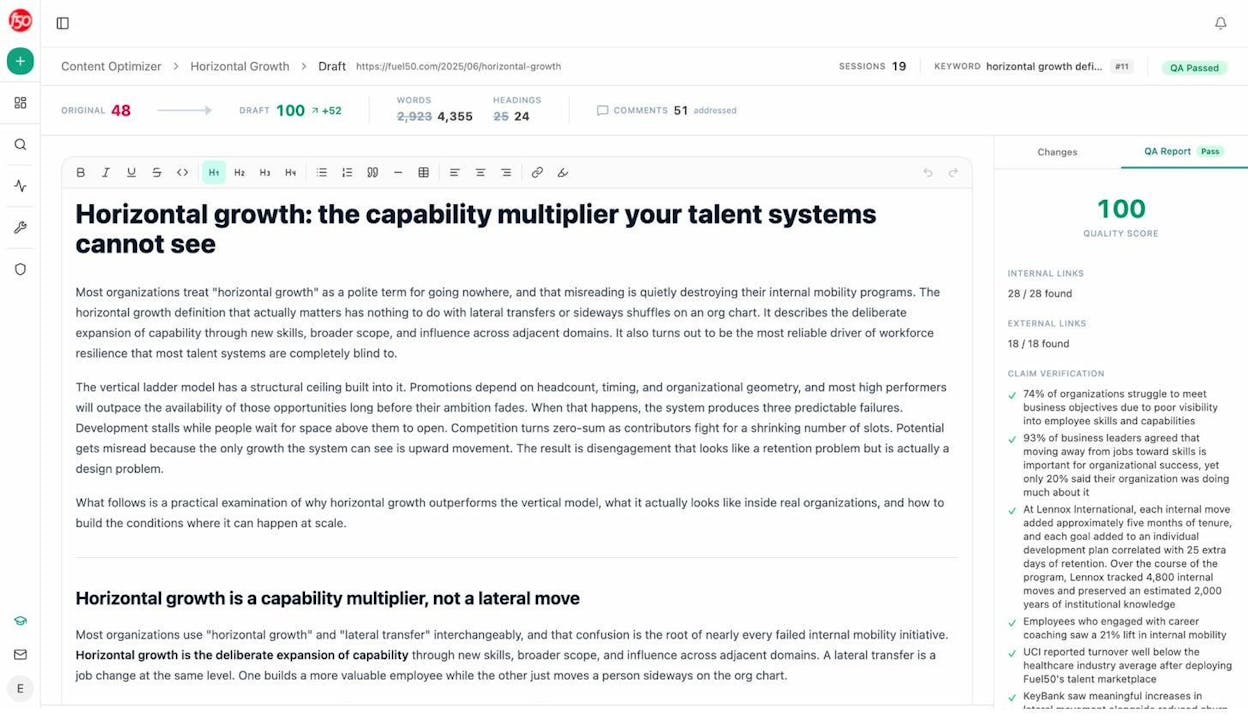
The AI Content Optimizer does not just grade your content. It fetches the original page, scores it for argument flow and clarity, adds line-by-line editorial comments, identifies specific gaps in claims and proof points, and then produces an optimized version. Surfer gives you a content score. Analyze AI gives you a better page.
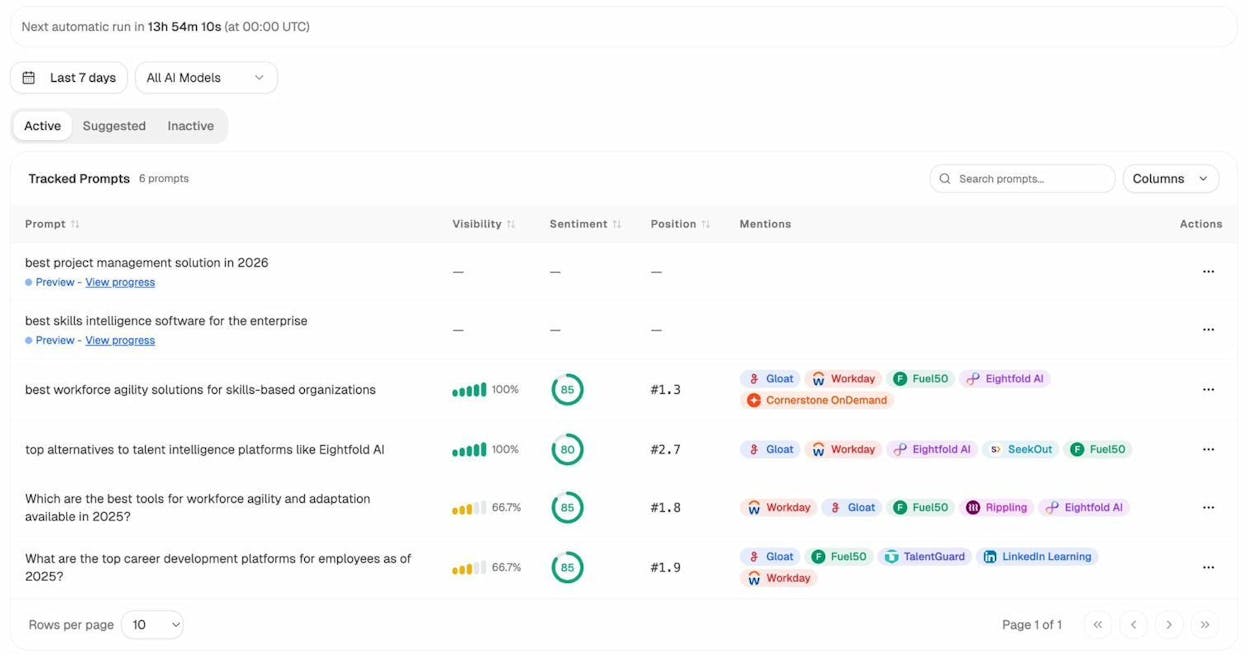
AI search visibility with revenue attribution. This is the biggest gap Surfer cannot fill. Analyze AI tracks how your brand appears across ChatGPT, Perplexity, Claude, Gemini, and Copilot. It shows which prompts mention your brand, which competitors appear instead of you, and which sources AI engines cite as evidence.
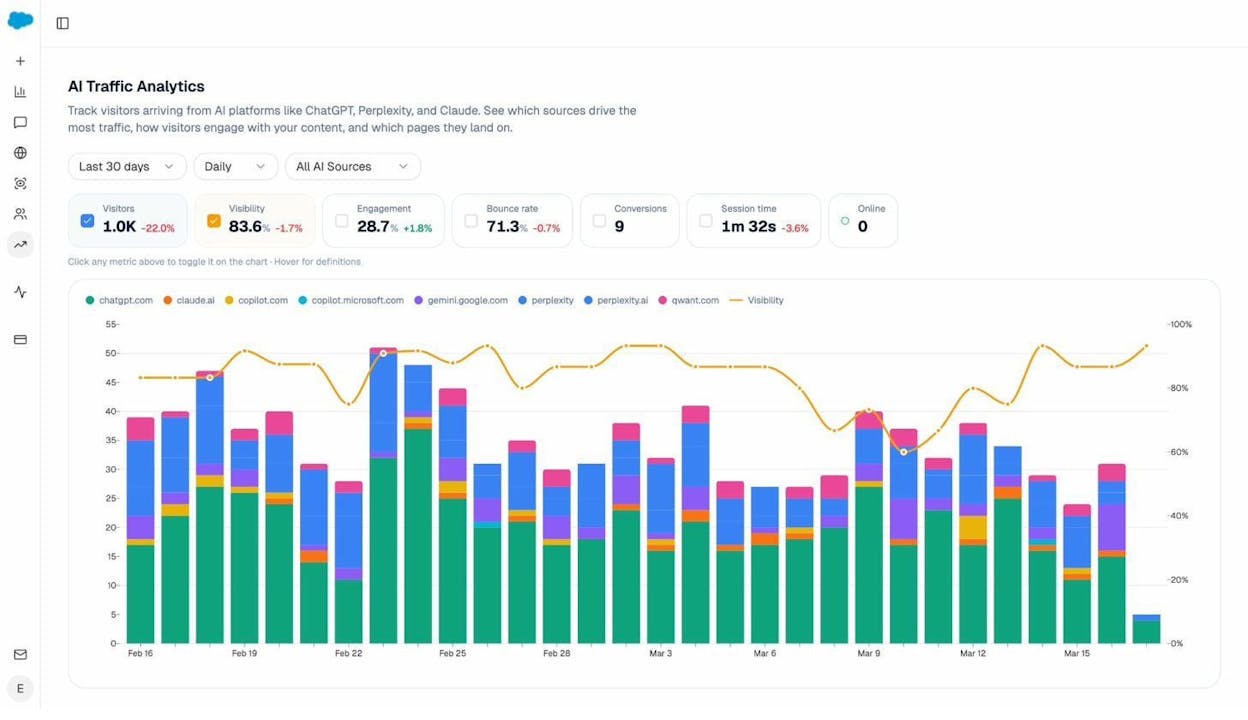
Then it connects those appearances to real traffic. The AI Traffic Analytics feature ties assistant-driven referrals to GA4 sessions, shows which AI engine sends the most visitors, and shows which landing pages those visitors convert on. You can tell your CMO that Perplexity drove 200 sessions to your pricing page last month and 12 of them became pipeline. Try getting that from Surfer.
An Agent Builder that runs your operations. This is where Analyze AI separates from every other tool on this list. The Agent Builder gives you 180+ nodes, 34 pre-built data recipes, and direct integrations with GA4, Google Search Console, DataForSEO, Semrush, HubSpot, Notion, WordPress, Slack, and every major LLM.
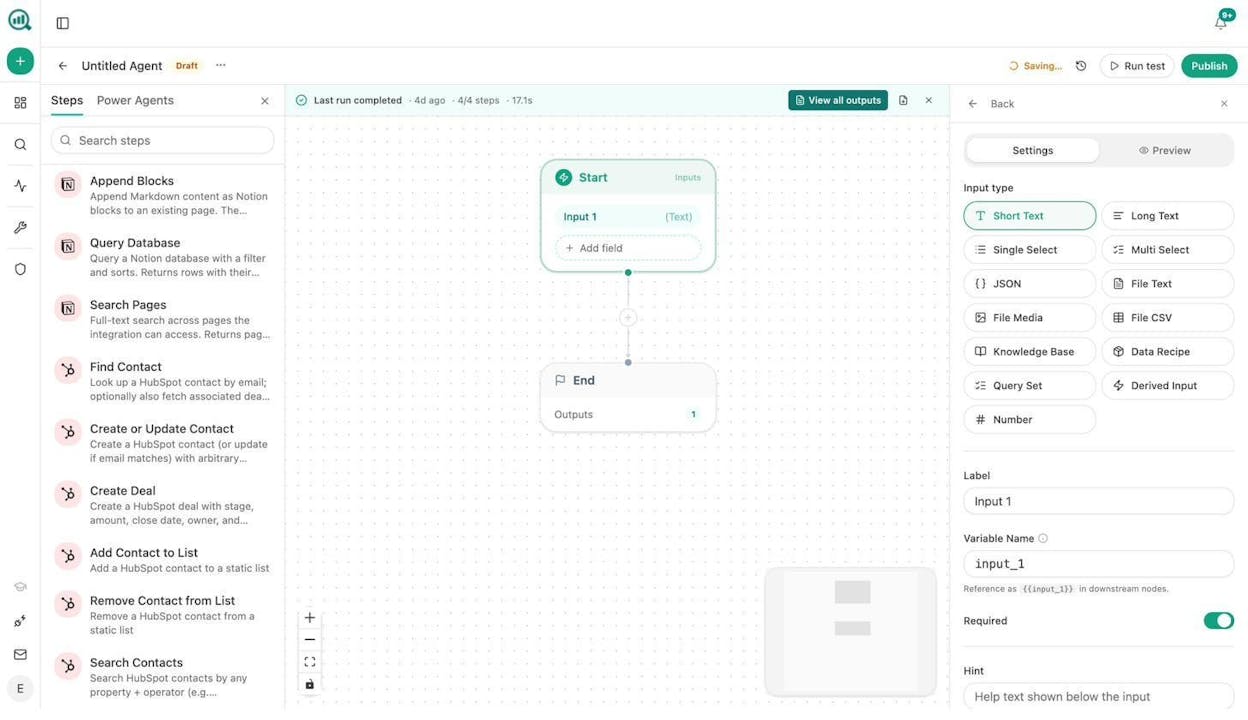
You are not limited to templates. You compose from primitives. A content team can build a brief-to-publish pipeline that gates on quality automatically. An agency can generate a Monday client briefing pack for every account with one scheduled run. A CMO can have a board-ready intelligence report in Slack every Monday at 7am without an analyst touching it. A PR team can fire a crisis response brief the second negative coverage hits. The Agent Builder runs on three trigger modes (manual, scheduled, webhook), so your workflows execute on demand, on a cadence, or the moment an event fires.
This is not “an automation layer.” It is the operational substrate for your entire marketing org.
Pricing: Simpler than Surfer’s credit-based system. No hidden add-ons for AI tracking. Check current pricing.
Best for: Content teams, agencies, and marketing leaders who need content optimization, AI search visibility, and operational automation without stitching together five separate tools.
2. SE Ranking: Best All-in-One SEO Suite With AI Visibility Built In
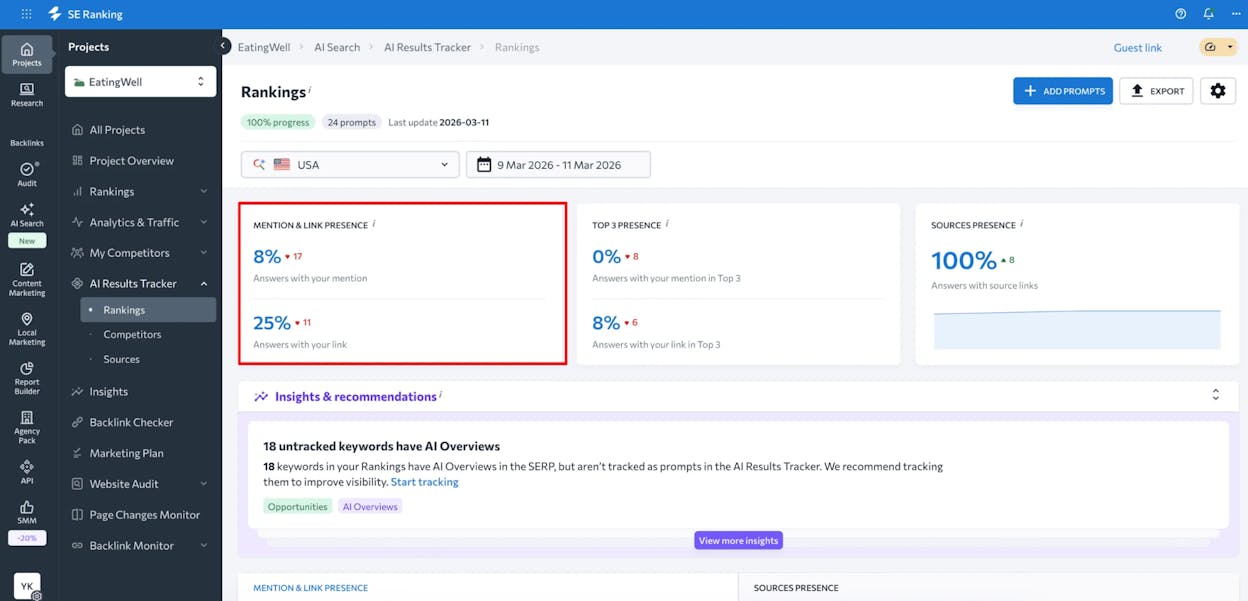
SE Ranking combines traditional SEO with AI visibility tracking in a single platform. You get rank tracking, keyword research, site audits, backlink monitoring, and competitor analysis alongside an AI Results Tracker that shows when your brand appears in AI-generated answers and Google AI Overviews.
What SE Ranking does well
The AI Results Tracker monitors whether your brand gets mentioned or linked inside AI answers across engines. The AI Overviews Tracker shows which keywords trigger Google AI Overviews and which sites get cited in them. And unlike Surfer, SE Ranking includes full rank tracking with SERP feature history, technical site audits, and backlink analysis.
This combination matters if you want one tool for both traditional SEO software needs and the emerging AI answer layer.
Where SE Ranking falls short
The interface is dense. New users often struggle to find the right report because modules for rank data, audits, AI answer snapshots, and competitor charts live on adjacent screens. Some advanced AI features require higher-tier plans, which raises total cost. And the AI visibility tracking is still more of a monitoring add-on than a core workflow.
Pricing: Core plan starts at $129/month ($103/month billed annually). Growth plan at $279/month ($223/month annually). 14-day free trial.
Best for: Teams that want SEO fundamentals and AI visibility in one tool without managing multiple subscriptions.
3. Clearscope: Best for Editorial Teams That Prioritize Content Quality
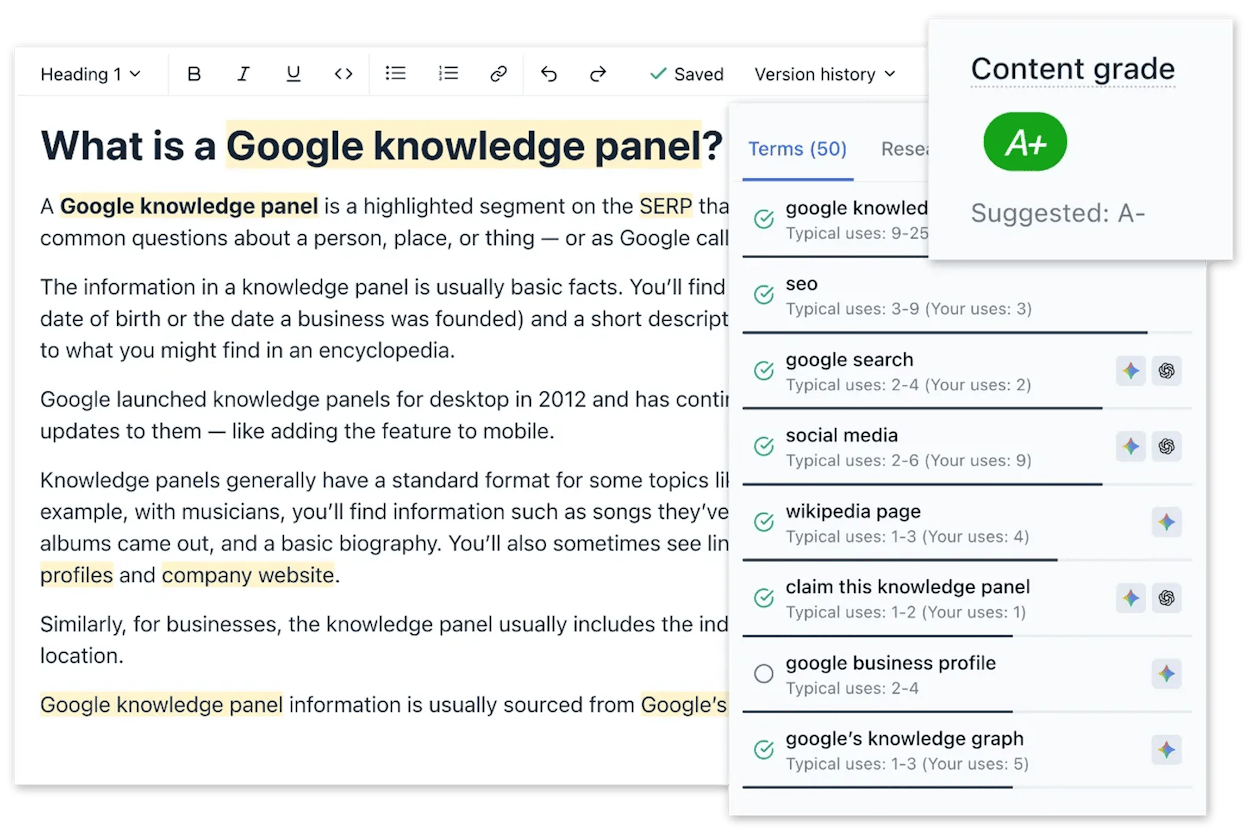
Clearscope is built for teams whose problem is not finding what to write but writing it at the highest quality. Its semantic topic modeling analyzes what top-ranking pages cover and shows you which terms, questions, and subtopics your draft needs.
What Clearscope does well
The content grading system is the most respected in the industry. It does not just count keywords. It evaluates semantic coverage, readability, and structural completeness against the competitive landscape. The Google Docs and WordPress integrations let writers optimize without leaving their editor. And the “Draft with AI” feature embeds Clearscope’s topic intelligence directly into the writing process.
Where Clearscope falls short
Premium pricing filters out smaller teams. Essentials starts at $129/month with just 20 AI Drafts and 50 Content Inventory pages. Business jumps to $399/month. There is no technical SEO, no backlink analysis, no AI search visibility tracking, and no rank tracking. You are paying exclusively for content quality.
Some writers also chase the content grade at the expense of natural writing. A perfect Clearscope score does not guarantee rankings if your domain authority, backlinks, and technical foundation are weak.
Pricing: Essentials at $129/month. Business at $399/month. Enterprise is custom.
Best for: Enterprise editorial teams that value content precision over breadth of features and have the budget to pair Clearscope with a separate SEO suite.
4. Frase: Best for Intent-Driven Content Strategy on a Budget
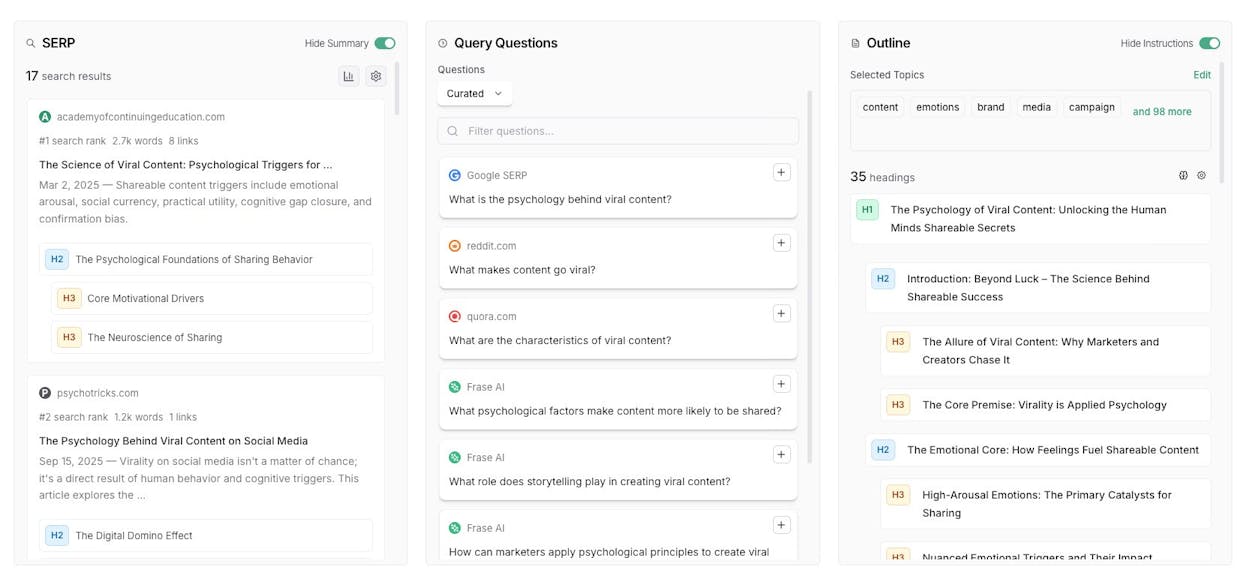
Frase focuses on understanding why people search, not just what they search for. Its SERP analysis tab pulls real user questions, related searches, and competitor structures into one workspace. You see which topics and subtopics dominate the conversation before you write a word.
What Frase does well
The automated content briefs are strong. Frase generates outlines, FAQs, and heading structures from real ranking data. During writing, its editor scores your draft against competitors and surfaces missing topics. The workflow from research to brief to draft to optimization happens in one tool.
For teams that create content around user questions and search intent, Frase provides a faster path from “what should we write” to “here is the structure.”
Where Frase falls short
Frase is content-first. No backlink tracking, no site audits, no rank tracking. Pricing tiers impose limits on search volume and document quotas, which restricts scalability for high-volume operations. And like Surfer, Frase has no AI search visibility capabilities.
Pricing: Plans start around $45/month, making it one of the most affordable options on this list.
Best for: Content strategists and editorial teams on tighter budgets who care more about matching intent than inflating keyword scores.
5. Scalenut: Best for Teams That Want Research-to-Draft in One Workflow
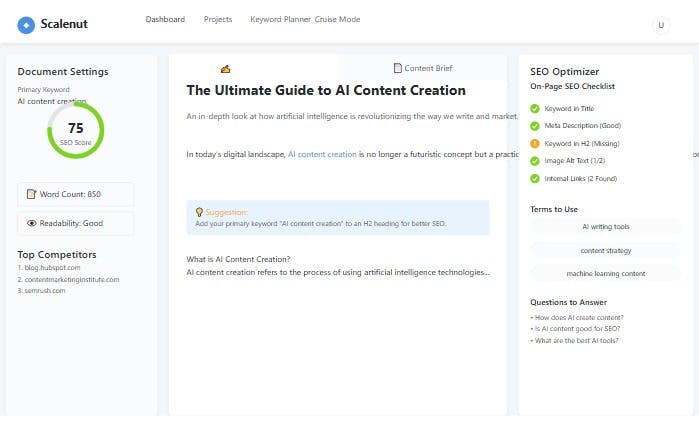
Scalenut treats content optimization as a pipeline rather than a set of disconnected steps. It clusters related keywords, generates AI briefs from competitor data, and uses Cruise Mode to turn topics into structured drafts with minimal manual input.
What Scalenut does well
The keyword clustering groups related phrases and follow-up queries so you can plan around topics rather than isolated terms. Cruise Mode generates full article drafts from topic and keyword input. And the GEO AI Editor adds feedback on how your content might perform in generative environments like Google AI Overviews.
Where Scalenut falls short
Cruise Mode drafts often sound repetitive, generic, or keyword-stuffed. They need heavy editing before publication. The platform packs planning, clustering, writing, and GEO optimization into one dense interface with a real learning curve. And like most tools on this list, it lacks deeper integrations for technical SEO, backlink analysis, or rank tracking.
Pricing: Plans start around $39/month. Higher tiers unlock more features.
Best for: Content teams producing at high volume who want faster first drafts and cluster-based content planning.
6. Peec AI: Best for Tracking AI Visibility Across Multiple Engines
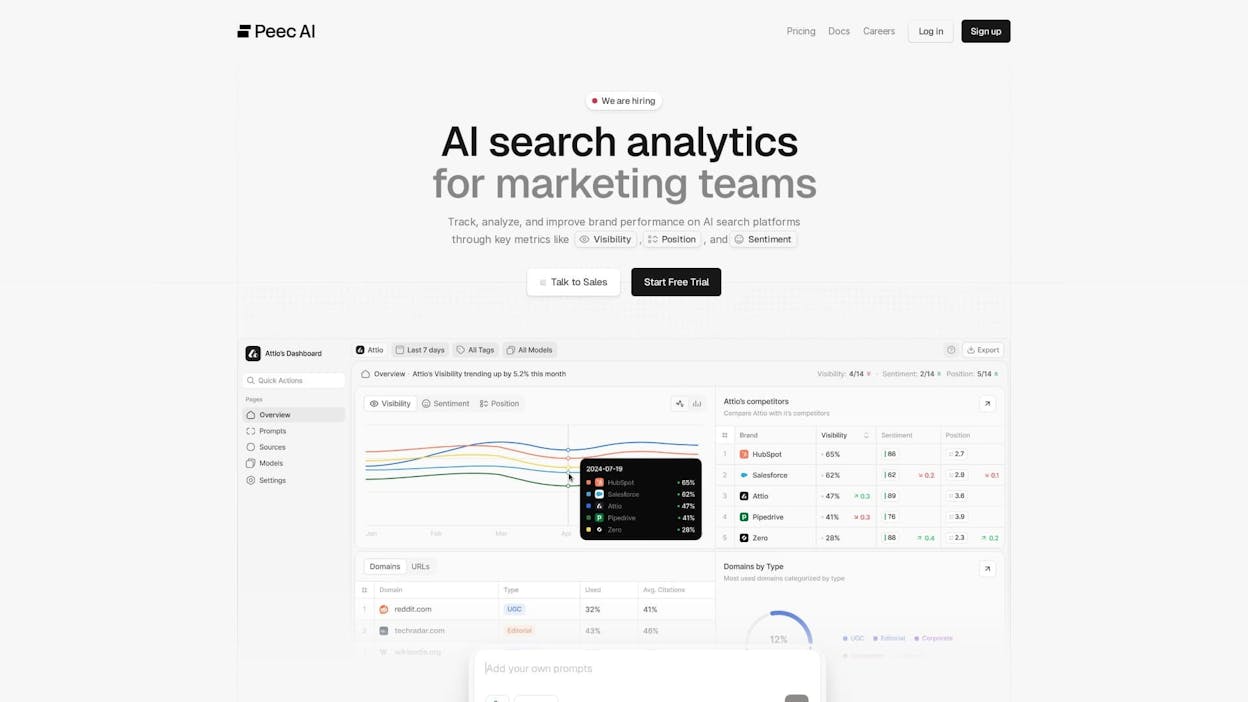
Peec AI is a dedicated visibility tracker for the AI search era. It measures how your brand shows up across ChatGPT, Gemini, Claude, and Perplexity through direct citations, source links, and mention frequency.
What Peec AI does well
Peec records full AI answers for every tracked prompt, identifies which URLs were cited, and calculates share-of-voice by comparing your mentions to competitors. The automatic prompt suggestion system analyzes your website and recommends relevant prompts to track. Looker Studio integration and CSV exports make reporting straightforward.
Where Peec AI falls short
Peec shows what is happening. It does not tell you how to fix it. There is no optimization advice, no content editor, no writing tools. Certain features like prompt counts and engine coverage are locked behind higher plans. And compared to Analyze AI’s full attribution layer, Peec does not connect AI visibility to traffic, landing pages, or conversions.
Pricing: Free tier available. Paid plans scale with prompt volume.
Best for: Teams that need proof of AI visibility for reporting and stakeholder conversations, and already handle SEO optimization elsewhere.
7. Otterly.ai: Best for Brand Citation Tracking in AI-Generated Answers
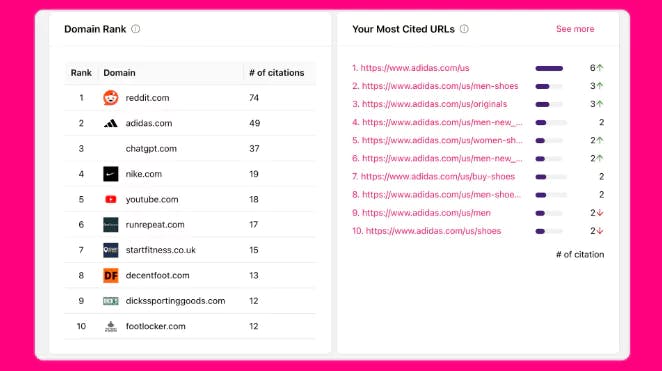
Otterly.ai was built for one purpose. It reveals when and where your brand appears inside AI-generated answers. It tests prompts across ChatGPT, Perplexity, Gemini, Google AI Overviews, and Copilot, then captures full answer outputs, domain mentions, and links.
What Otterly.ai does well
The Brand Visibility Index aggregates citation data to show how often your domain is surfaced compared to competitors. You can drill into specific URLs to see which pages earn citations and which models reference them most. GEO audit tools then evaluate on-page factors that influence AI citation likelihood.
Where Otterly.ai falls short
Otterly is a measurement instrument, not an optimization tool. It shows where visibility occurs but does not prescribe how to improve it. There is no content editor, no writing tools, no brief generation. Teams that need strategic recommendations or content optimization guidance will need to pair Otterly with complementary tools.
Pricing: Plans scale with prompt volume and engine coverage.
Best for: PR, content, and SEO teams that need verifiable proof of brand presence inside AI answers for reporting.
How to Choose the Right Surfer SEO Alternative
Your best pick depends on what problem you are actually trying to solve.
If you need content optimization only, Clearscope or Frase give you the best editorial guidance. Clearscope for quality-obsessed teams with budget. Frase for intent-driven teams on tighter margins.
If you need a full SEO suite, SE Ranking covers rank tracking, audits, backlinks, and AI visibility in one platform.
If you need AI search visibility, Peec AI and Otterly.ai track how your brand appears across AI engines, but they stop at measurement.
If you need content, SEO, AI search, and automation together, Analyze AI is the only tool on this list that covers content writing and optimization, AI visibility with revenue attribution, competitive intelligence, sentiment monitoring, and a programmable Agent Builder with 180+ nodes and integrations with GA4, GSC, Semrush, HubSpot, and more. It replaces the three-tool stack most teams currently manage.
The AI Search Angle You Cannot Ignore
Here is the larger point most Surfer SEO alternatives miss completely. SEO is not dead. But AI search is now an additional organic channel alongside traditional search, not a replacement for it.
Buyers are asking ChatGPT and Perplexity for recommendations in your category right now. If your brand is not showing up in those answers, or if a competitor is being recommended instead of you, no amount of content scoring will fix the gap.
The teams winning in 2026 are doing both. They optimize content for Google rankings. And they track, measure, and improve how AI engines portray their brand. That means monitoring which prompts mention you, which sources AI cites as evidence, which competitors appear where you do not, and which AI-referred sessions actually convert.
Most tools on this list handle the first part. Only Analyze AI handles both, and then automates the operational layer between them.
If you want to see how your brand currently shows up in AI search, you can run a free check with the AI Visibility Checker before committing to any tool.

Ernest

Ibrahim


![6 AthenaHQ Alternatives That Skip the Credit Math [2026]](/_next/image?url=https%3A%2F%2Fwww.datocms-assets.com%2F164164%2F1778742681-blobid0.png&w=3840&q=75)


