



Summarize this blog post with:


In this article, you’ll see what multiple studies reveal about how clicks distribute across Google’s search results, why the top 10 captures almost every click, how zero-click search and AI Overviews are reshaping that pie, and a practical playbook for ranking in the top 10 across both traditional search and AI search engines.
The data is consistent across every study we reviewed. If your page sits outside the top 10, it does not get organic traffic. We’ll show you the numbers, then walk through what to actually do about it.
Table of Contents
How clicks distribute across the SERP
A recent analysis of billions of clicks and impressions from Google Search Console found that 96.98% of US desktop clicks in August 2025 happened within the top 10 organic results. On mobile, the figure climbed to 97.56%, meaning fewer than 1 in 40 mobile clicks landed beyond Google’s first page.
|
Position bucket |
Desktop clicks |
Mobile clicks |
|---|---|---|
|
Top 10 |
96.98% |
97.56% |
|
11–20 |
1.77% |
1.52% |
|
21–30 |
0.56% |
0.49% |
|
Beyond 30 |
0.70% |
0.42% |
That pattern is not a one-off. Across two years of clickstream data, clicks to pages outside the top 10 have never crossed 4.37% of total clicks. In recent months, mobile has tilted even further toward page one, with clicks to positions 11+ shrinking month over month since June 2025.
![[Screenshot of click share trend chart over 24 months showing top 10 dominance]](https://www.datocms-assets.com/164164/1778177135-blobid1.png?auto=format,compress&w=1248&fit=max)
The same conclusion shows up in older studies that used very different methods. An analysis of 4 million Google search results found that the #1 organic position alone earned a 27.6% click-through rate, and that ranking #1 earned roughly 10x more clicks than ranking #10. A Sistrix study covering billions of search results across 80 million keywords landed on the same shape.
When five separate methodologies all point to the same conclusion, you can stop debating it and start acting on it.
Click-through rate by exact position
The “top 10” framing is useful, but it hides how steeply attention drops inside the first page. The clearest breakdown comes from First Page Sage’s 2026 meta-analysis, which combined research from multiple panels into a single set of position-level CTRs.
|
Search position |
Average CTR |
|---|---|
|
Position 1 |
39.8% |
|
Position 2 |
18.7% |
|
Position 3 |
10.2% |
|
Position 4 |
7.2% |
|
Position 5 |
5.1% |
|
Position 6 |
4.4% |
|
Position 7 |
3.0% |
|
Position 8 |
2.1% |
|
Position 9 |
1.9% |
|
Position 10 |
1.6% |
The top three results capture 68.7% of all clicks. Position 1 alone earns more clicks than positions 3 through 10 combined. That number is up from 39.6% in 2024 and continues to climb each year.
The practical implication is that ranking math is not linear. Moving from position 6 to position 3 roughly doubles your clicks. Moving from position 3 to position 1 nearly quadruples them. Small ranking gains compound into outsized traffic gains, especially in the top three.
If you only have budget to invest in one or two pages, invest in the ones already ranking 4 to 8. That range is where a small lift produces an outsized gain in absolute clicks.
Why the top 10 dominates so heavily
Three things explain why clicks concentrate so tightly at the top.
The first is reading behavior. Eye-tracking research going back to a 2004 Cornell study shows users scan results in an F-shaped pattern, starting top-left and moving down. Most users decide on a result within the first three positions and never see what is below the fold.
The second is trust. Users assume the top results are the best. A 2020 user-intent study from Ignite Visibility found that 15.6% of searchers click the very first result without reading anything else. Another 17.4% read three results, then click. The act of reaching position 5 or below already implies dissatisfaction with what came before.
The third is mobile reality. Mobile screens fit roughly two organic results above the fold, sandwiched between ads, snippets, People Also Ask boxes, and AI Overviews. By position 5, a user has scrolled past more than a full screen of competing elements. Every scroll thins out the audience.
Add these together and you get the click distribution we see. The top spot is not three times more visible than position 5. It is twenty times more visible.
Zero-click search compounds the problem
The 96.98% figure tells you where the clicks go. It does not tell you how many searches produce a click in the first place. That is the more uncomfortable number.
The SparkToro and Datos 2024 Zero-Click Search Study analyzed millions of search sessions and found that 58.5% of US Google searches end without a click to any external site. In the EU, that number was 59.7%. Out of every 1,000 US Google searches, only 360 result in a click to the open web. The rest end on Google itself, on a Google-owned property like YouTube, or on a refined search query.
|
Outcome of a US Google search |
Share |
|---|---|
|
Zero click (session ends) |
~37% |
|
Refined search |
~21.5% |
|
Click to Google property |
~14–30% |
|
Click to open web |
~36% |
Stack this on top of the position data and the picture sharpens. Of the searches that do click through, almost all of those clicks go to the top 10. So the realistic top-10 click rate per query is closer to 30–40% of the total search volume, not 100%.
That is the reality of modern SEO. The funnel is narrower at every stage.
How AI Overviews and SERP features shrink the click pie further
AI Overviews are the newest squeeze on click-through rates, and they are accelerating the trend. A 2024 BrightEdge study found AI Overviews reduce organic CTR by 9 to 15% for queries where they appear. Animalz reported declines in the 15 to 35% range across their client portfolio. By 2025, AI Overviews were appearing on 13.14% of all US desktop queries, up from roughly 6% the prior year, according to Similarweb data.
Other SERP features chip away in similar ways. The 2026 First Page Sage data breaks it down clearly.
|
SERP feature |
CTR for the feature |
|---|---|
|
Featured snippet (1st) |
42.9% |
|
AI Overview (1st cite) |
38.9% – 42.9% |
|
#1 organic result |
39.8% |
|
Top paid ad |
1.2 – 2.1% |
|
People Also Ask box |
3.0% |
|
Knowledge Panel |
1.4% |
|
Image result |
1.4 – 4.9% |
|
Video result |
2.3 – 6.4% |
A page that owns both the featured snippet and the #1 organic position simultaneously can pull a combined CTR of 52.3%, nearly double what position 1 earns alone. That is the prize for ranking strategically, not just ranking high.
The flip side is that for queries that trigger AI Overviews, the median zero-click rate now sits around 80% according to Similarweb’s aggregated 2026 data. Informational queries are the worst affected. Commercial queries (where users still need to compare options) hold up better.
How to actually rank in the top 10
Knowing the distribution is the easy part. Earning a top-10 spot is the work. Here is the playbook we recommend, in the order we run it.
1. Pick keywords you can realistically win
Most pages stuck on page two are stuck because they targeted keywords that were too competitive on day one. Before you write anything, validate that the keyword is winnable for a domain at your authority level.
Use Analyze AI’s free Keyword Difficulty Checker to score the keyword on a 0–100 scale. As a rule, target keywords below your domain’s authority score. You can check your authority with the Website Authority Checker and your competitor’s with the same tool.
![[Screenshot of Analyze AI Keyword Difficulty Checker showing a scored keyword]](https://www.datocms-assets.com/164164/1778177142-blobid2.png?auto=format,compress&w=1248&fit=max)
Pair difficulty with intent. Use the Keyword Generator Tool to expand a seed keyword into 50+ related terms, then sort by difficulty and search volume. The sweet spot is medium-volume keywords with low difficulty and clear commercial intent. For a deeper walkthrough, our SEO keywords guide covers the full process.
2. Match search intent before anything else
Open the SERP for your target keyword and look at what already ranks. Use the SERP Checker to see the top 10 results, their content format, their length, and the SERP features Google is showing.
![[Screenshot of Analyze AI SERP Checker showing top 10 results for a sample keyword]](https://www.datocms-assets.com/164164/1778177142-blobid3.png?auto=format,compress&w=1248&fit=max)
If the top 10 is full of listicles, do not write a 5,000-word ultimate guide. If the top 10 is buyer-comparison content, do not write a definition piece. Search intent is the floor, not the ceiling. You cannot outrank pages that match intent better than yours, no matter how well-written your draft is.
3. Build genuine content depth, not word count
A common mistake is treating “longer” as a synonym for “better.” It is not. The pages that rank in 2026 cover the topic completely, answer the obvious follow-up questions, and add at least one piece of original information that competitors do not have. That can be original data, a teardown, a screenshot walk-through, or a contrarian take.
Look at the top 10 results and list every subtopic they cover. Then list what they all miss. That gap is your opportunity.
4. Earn backlinks to the page, not just to the homepage
Backlinks remain one of the strongest correlates with ranking position. Pages in position 1 typically have more referring domains than positions 2 through 10 in the same SERP, all else being equal. Focus your link-building on the specific page you want to rank, not the homepage.
Run a quarterly check with the Broken Link Checker to find dead links pointing at competitors in your niche. Reach out to those sites and offer your page as a replacement. It is one of the highest-conversion link-building tactics that still works.
5. Optimize titles and meta descriptions for the click
Even on page one, a weak title bleeds clicks. Industry analyses have found that title tags between 40 and 60 characters tend to earn stronger CTRs, and that titles containing the target keyword earn around 45% more clicks than titles without it. Long-tail titles (10–15 words) can earn close to 1.76x more clicks than short ones at position 1.
Test your titles against the SERP. If every other result starts with a number or a year, leading with neither makes you invisible. Match the pattern, then differentiate on the value proposition.
6. Track your rankings without the guesswork
Once your page is live, track its position weekly using the Keyword Rank Checker. Pair that with Google Search Console to see impressions and CTR by query. If you have impressions but low clicks, your title or snippet is the bottleneck. If you have neither, you are not in the top 10 yet.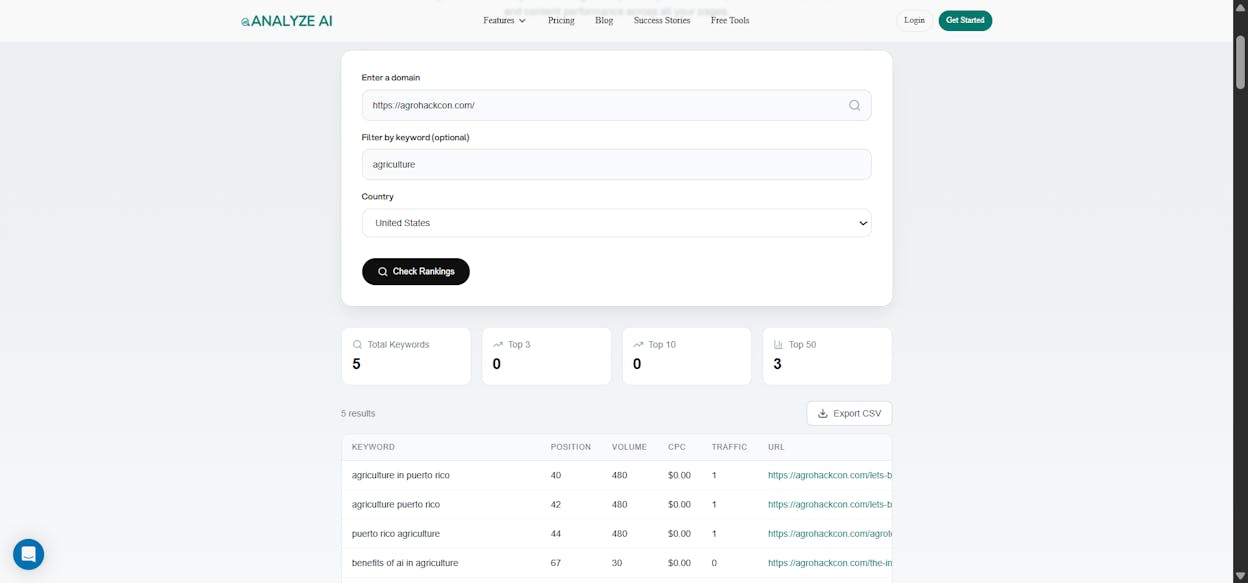
For a deeper look at the full ranking process, our content strategy breakdown walks through the full operating system end to end.
What the “top 10” looks like in AI search
Here is where the playbook needs an extra layer. The top 10 still captures almost every traditional Google click, and that channel is not going away. But a growing share of search now starts on ChatGPT, Perplexity, Gemini, Copilot, or Claude, and those engines do not show 10 blue links. They synthesize an answer and cite three to five sources.
So the AI-search equivalent of “ranking in the top 10” is being one of the sources an AI engine actually quotes. The competition is tighter (5 cited sources versus 10 organic positions), and the rules for getting cited are not the same rules for getting ranked.
This does not replace SEO. We’ve written about why SEO is not dead and why AI search is best understood as another organic channel that runs alongside Google, not over it. Both compound when you treat them as complementary.
Here is how to extend each of the six steps above to AI search.
Find prompts you can win, the same way you find keywords
Traditional keyword research starts with seed terms. AI search research starts with prompts. The questions buyers actually type into ChatGPT or Perplexity rarely match the keywords they Google. They are longer, more conversational, and often comparative (“best X for Y”, “X vs Y for [use case]”).
Analyze AI’s Prompt Discovery feature generates the prompts your buyers are likely running, then tracks who gets cited for each one. This is the AI-search analog to keyword research.
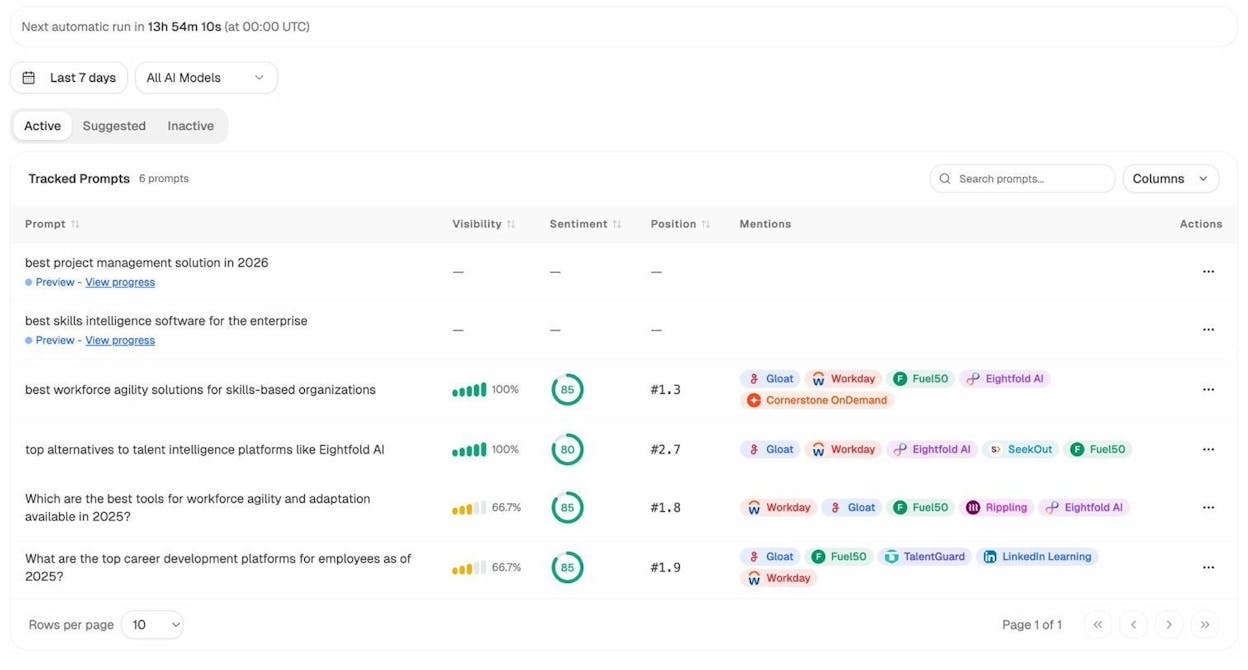
For each tracked prompt you see the visibility score, the sentiment of the answer, your average position in the citation list, and which competitors are being mentioned alongside or instead of you.
Audit which sources AI engines already trust in your space
In SEO, you study who ranks in the top 10. In AI search, you study which domains AI engines cite most often. The list almost never matches the SEO leaderboard. Review sites, Reddit threads, niche blogs, and documentation pages tend to over-index in AI citations relative to their organic ranking.
Analyze AI’s Citation Analytics maps every URL and domain that AI platforms cite when answering questions in your category. Filter by AI model or time period to see how each engine prioritizes different sources.
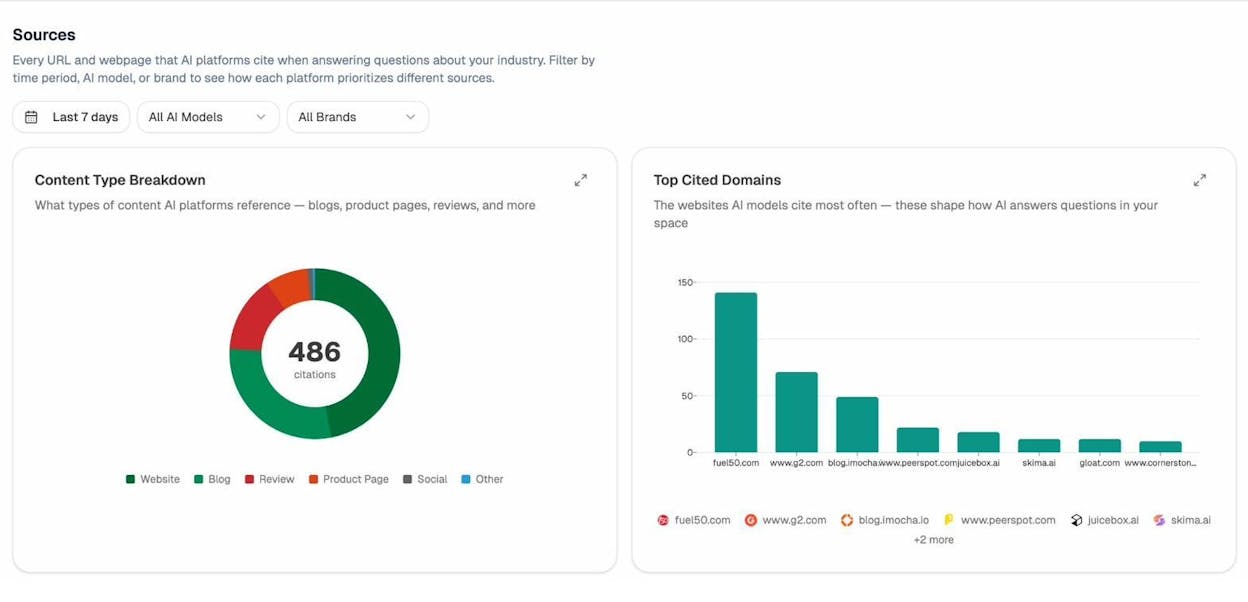
That domain ranking is your target list. If a site cites your category 50 times a week, you want them citing you. If they cite a competitor instead, you have a clear gap to close.
Track AI traffic the same way you track organic traffic
You cannot improve what you do not measure. The AI Traffic Analytics dashboard breaks down visitors arriving from AI platforms, which engines drive the most sessions, which pages they land on, and how those visitors engage.
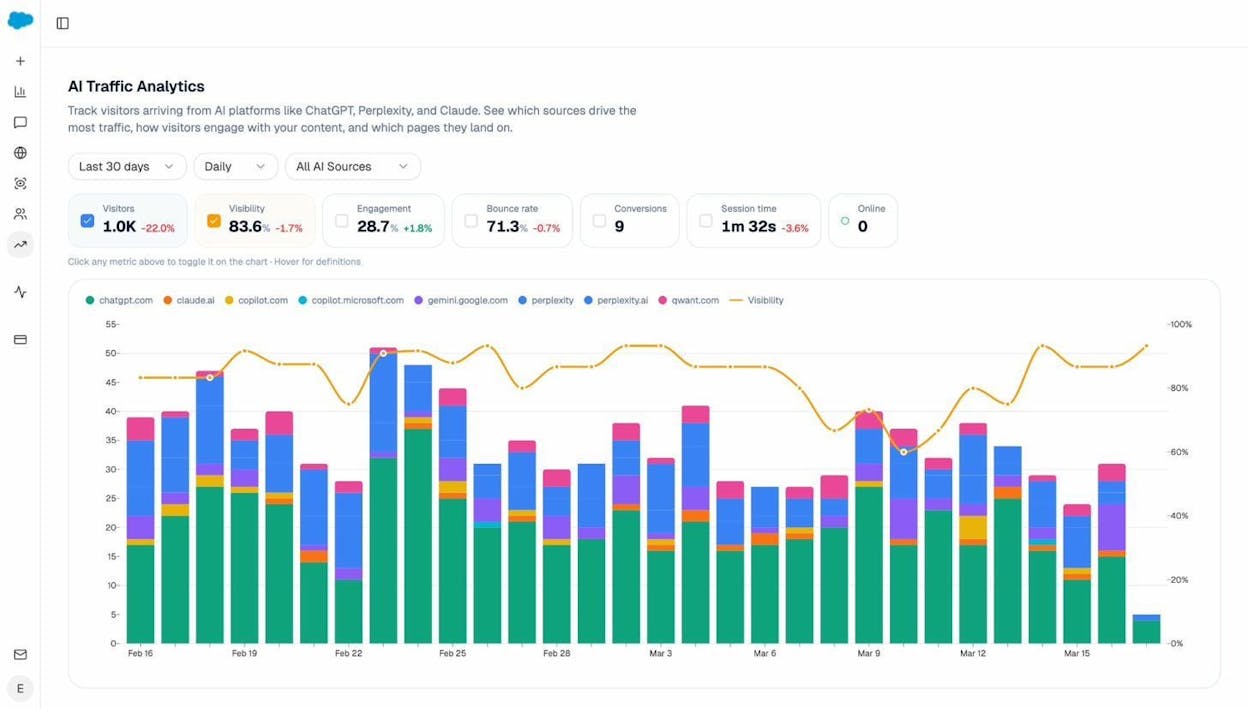
This is how you find out which pages already work in AI search. Once you know which pages convert, you can double down on the format. We’ve seen customers report conversion rates of 5% to 8% on AI-sourced traffic, well above the 1–2% blog benchmark. Those pages deserve more of your investment.
See where competitors win the prompts you don’t
The cleanest signal for AI search opportunity is a prompt where a competitor is being cited and you are not. Analyze AI’s Competitor Intelligence module surfaces these gaps automatically.
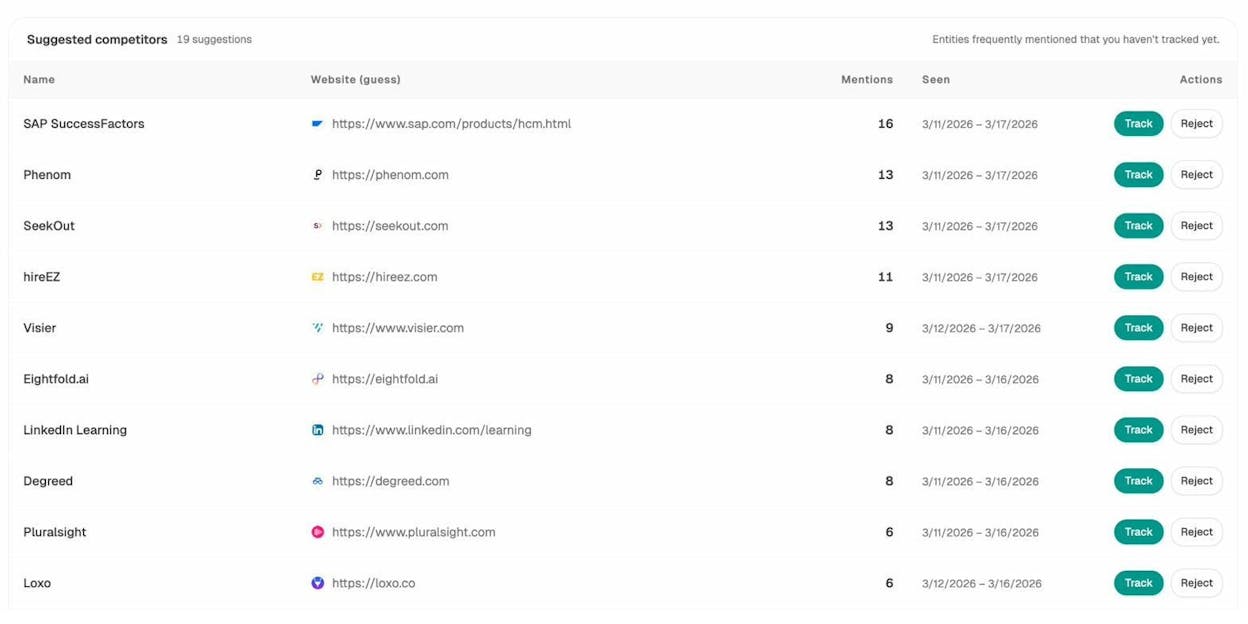
It also surfaces companies you are not yet tracking but that AI engines mention alongside you, which is how you discover competitors you didn’t know you had.
Optimize content for citation, not just ranking
Pages that earn AI citations tend to share a few traits. They lead with the direct answer (BLUF format), use clear declarative sentences, structure information with semantic HTML, and are rich in named entities (products, people, concepts). For a deeper guide to the citation rules, see our breakdown of how to rank on ChatGPT and how to get mentioned in AI search.
The Analyze AI Content Optimizer audits any URL against the patterns AI engines cite most, then returns line-by-line suggestions to close the gaps. It works the same way an SEO content tool works, but optimized for citation likelihood instead of keyword density.
Get a weekly summary instead of logging in every day
The compound part of AI search is that small wins early lead to bigger wins later, but only if you keep watching. The Weekly Email Digest sends you a Monday morning brief covering priority actions, citation changes, competitor shifts, and AI traffic trends. You walk into the week knowing exactly what moved.
Final thoughts
The data has not changed in the way most headlines suggest. The top 10 still captures 96.98% of clicks. Position 1 still earns nearly 40% of all CTR. Google still drives more search traffic than every AI engine combined.
What has changed is that the click pie is shrinking on the Google side and growing on the AI side, and most teams are only measuring half of it. If you are tracking your top 10 organic rankings without also tracking your AI citations, you are missing a channel that is compounding right now.
The fix is not to abandon SEO. It is to extend it. Same rigor, same playbook, two layers of measurement. Rank in Google’s top 10 and earn citations in AI answers. Both channels will be drivers of qualified traffic for years. The teams that win in 2026 will be the ones who treat them as one strategy with two surfaces, not two strategies fighting for budget.
Start with the data you already have. Run a free website traffic check on your top page. Then ask a follow-up question. Is that page also being cited by ChatGPT, Perplexity, or Gemini? If you don’t know, you have your next priority.

Ernest

Ibrahim


