



Summarize this blog post with:


In this article, you’ll learn how to rank for a keyword in eight concrete steps. The steps cover both Google search and the AI search engines that now answer questions before users see a list of links. You will not find an “AI search section” tacked on at the end. Each step shows what to do for traditional rankings and, where it matters, what to do for citations in ChatGPT, Perplexity, and Gemini.
Table of Contents
1. Make sure you’re targeting the right keyword
Just because a keyword exists in a tool’s database does not mean it is worth ranking for. Three things can go wrong before you write a single word.
The first is that the keyword has no real demand. A keyword with 50 monthly searches will never move the needle, even at position one. You can check real volume in any keyword research tool. Our free keyword generator and keyword difficulty checker cover the basics for free. If you want depth, our 9 keyword research tools roundup compares the paid options.
The second is that the keyword is a subtopic of a bigger one Google ranks the same page for. The classic example is “how to do keyword research” versus “keyword research.” Both pull the same SERP, so you should target the broader version and pick up the long tail by accident. Look at the top three ranking pages in any SERP checker and check the URL slug they use. If the slug names a different topic than yours, you are aiming at the wrong keyword.
![[Screenshot of a keyword research tool showing search volume, parent topic, and traffic potential for a sample keyword]](https://www.datocms-assets.com/164164/1778179030-blobid1.png?auto=format,compress&w=1248&fit=max)
The third is the AI search angle most teams skip. A keyword has a search volume on Google, but it has a separate prompt volume across AI engines. People rarely paste keywords into ChatGPT. They ask things like “what’s the best CRM for a five-person sales team in Europe.” If you are only chasing keywords, you are missing half the demand.
Inside Analyze AI, the Prompts view surfaces the actual questions people ask AI engines in your category, and Suggested Prompts flags new ones the platform finds for you to track.
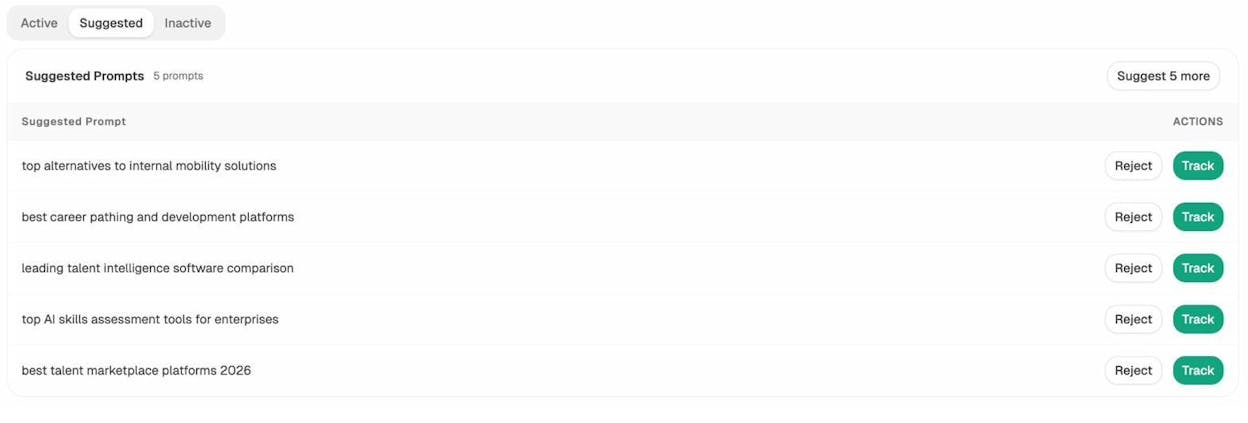
The action. Pick a target keyword that has search volume, is the parent topic on the SERP, and maps to at least one prompt people actually ask AI engines.
2. Check the keyword has business potential
Ranking number one for a keyword that does not bring you customers is a vanity exercise. Before you commit to a topic, score its business potential.
The framework most teams use is a simple 0-3 score. A “3” is a keyword where your product is the obvious answer to the problem the searcher has, like “keyword clustering tool” for an SEO platform. A “2” is a keyword where the problem can be solved without your product but is solved better with it, like “how to do keyword clustering.” A “1” is a keyword where your product is one of many possible mentions. A “0” is a keyword where your product cannot fit naturally at all, no matter how creative the writer is.
Ignore everything that scores below a 2. We have seen too many blogs full of high-traffic posts that drive zero pipeline. Grow and Convert calls this mirage content, and it is the most common reason a content program fails to convert.
Here is how to score quickly without overthinking it.
|
Score |
Test |
Example for an AI visibility tool |
|---|---|---|
|
3 |
The product is the answer to the query |
“AI search monitoring tool” |
|
2 |
The query describes a problem the product solves |
“how to track brand mentions in ChatGPT” |
|
1 |
The product can be mentioned alongside others |
“marketing dashboards for SaaS” |
|
0 |
No natural product fit |
“history of search engines” |
The action. Assign a 0-3 score to your shortlist and cut anything below a 2.
3. Figure out search intent (and answer intent)
Once you know the keyword is worth chasing, you need to know what the searcher actually wants. Google ranks pages that satisfy intent. AI engines cite pages that satisfy intent. If your content does not match what users expect, neither channel rewards you.
The fastest way to read intent is to look at the top ten ranking pages and notice patterns. Are they listicles or single-product pages? Long guides or short answers? Tutorials or definitions? Whatever pattern dominates is the format Google has decided wins. Fight it at your peril.
![[Screenshot of a Google SERP for a competitive keyword, with the top ten organic results visible and the result types annotated]](https://www.datocms-assets.com/164164/1778179041-blobid3.png?auto=format,compress&w=1248&fit=max)
For “how to rank for a keyword,” the SERP is dominated by long step-by-step guides. So that is what we are writing. The format is not optional, it is a constraint inherited from what Google has decided ranks.
Now the AI search angle. Run your target keyword as a question in ChatGPT, Perplexity, and Gemini and read the answer. Three things matter. First, what specific subtopics does the AI cover? Second, which sources does it cite, and where do those sources rank in Google? Third, is your brand mentioned at all? If the AI answer is missing a subtopic, that is a content gap you can fill. If your competitors are cited and you are not, you have a visibility problem you can fix.
![[Screenshot of ChatGPT or Perplexity answering the target keyword as a question, with the citations panel visible]](https://www.datocms-assets.com/164164/1778179049-blobid4.png?auto=format,compress&w=1248&fit=max)
You can do this manually, or you can use the Ad-Hoc Prompt Search inside Analyze AI to run the prompt across all engines at once and see who gets cited.
The action. Write down the dominant SERP format and the three most-cited domains in AI answers. Your draft must match the first and challenge the second.
4. Identify every subtopic the page must cover
Google’s helpful content guidelines ask whether the page provides a “substantial, complete, or comprehensive description of the topic.” That is the bar for ranking. The same bar applies in AI search, because the engines pick the page they can lift the most facts from. A thin page is invisible in both channels.
To find subtopics, do four passes. The first pass is to open the top three ranking pages and list every H2 they share. Shared H2s across three pages are not optional, they are the spine of the topic.
![[Screenshot of three competitor articles open in side-by-side tabs with H2 headings highlighted]](https://www.datocms-assets.com/164164/1778179052-blobid5.png?auto=format,compress&w=1248&fit=max)
The second pass is to pull the People Also Ask questions from the SERP. They map directly to subtopics readers expect. If you want a deeper guide on this, our breakdown of how to optimize for People Also Ask walks through the tactics in detail.
Pass three is the AI fan-out. AI search engines decompose a single question into many sub-questions to assemble their answer. Gemini’s AI Mode, for example, runs a “query fan-out” that fires off dozens of related searches behind the scenes. Each of those sub-questions is a subtopic you should cover. The cleanest way to see them is to ask the AI itself. Try a prompt like “what are all the questions someone asking ‘[your keyword]’ might also have?”
Pass four is the related-keyword sweep. Pull the related terms from any keyword generator and see if any reveal an angle the SERP is missing. For B2B topics, our guide to keyword clustering shows how to group these into a single page versus splitting into a hub.
The action. Combine all four passes into a single subtopic list. That list is your outline.
5. Develop an angle nobody else has
The internet does not need another generic article on your topic. There are already thousands. AI Overviews are getting better at summarizing all of them into a single paragraph, which means generic content is becoming invisible in both Google and AI answers.
The way to break out is information gain, the term Google uses internally for content that adds something new to a topic. There are three reliable ways to create it.
The first is original data. Run a small experiment, audit a sample of websites, survey your customers, or analyze your own product data. We did this with our analysis of 65,000 AI citations, and it now drives more links than the rest of our blog combined. Original data is the highest-leverage form of information gain.
The second is firsthand experience. Anyone can write theory. Few writers actually do the thing they are writing about. If you are writing about ranking for a keyword, share the exact keyword you ranked, the timeline, the screenshots, and the mistakes. Anecdotes from your own work are not filler, they are the proof that you are not an outsider summarizing other outsiders.
The third is effort. Most content is lazy. Going one level deeper than competitors is unreasonably effective because your competitors will not follow. If everyone else is writing a 1,500-word listicle, write a 3,000-word listicle that actually tested every tool. If everyone else lists “use a SERP checker,” show the screenshots and the click path.
![[Screenshot of a competitor article and your draft side-by-side, with annotations showing the additional sections, data, or screenshots that create information gain]](https://www.datocms-assets.com/164164/1778179056-blobid6.png?auto=format,compress&w=1248&fit=max)
The action. Pick at least one of the three sources of information gain (data, experience, effort) and commit to it before you start writing. If you cannot, the article is not worth writing.
6. Write content people will actually finish
Your outline is set. Your subtopics are mapped. Your angle is locked. Now write the thing.
A few rules tend to separate articles that rank from articles that get skimmed and closed.
Open with a promise, not a preamble. The first three sentences should tell the reader exactly what they will leave with. “In this article, you’ll learn…” is one way. A bold claim or a counterintuitive statistic is another. What does not work is a 200-word setup about how SEO is changing.
Write the way you talk. Read your draft out loud. If a sentence makes you stumble, rewrite it. If a paragraph runs longer than four sentences, break it. If a word makes you sound like a press release, replace it with the word a colleague would use over coffee.
Back every claim with a detail. The most common writing mistake we see is making a claim and moving on. “Search intent matters” is a claim. “Search intent matters because if your format is a listicle and Google ranks tutorials for that keyword, you will not crack page two no matter how many backlinks you build” is a sentence with a detail that proves the claim. Grow and Convert calls this the detail principle, and it is the difference between a post that ranks and a post that gets ignored.
Make every step tangible. If you tell the reader to “audit competitor backlinks,” show the exact tool, the exact filter, and the exact decision. Vague advice is worse than no advice, because it wastes the reader’s time without solving their problem.
If drafting from scratch is the bottleneck, the AI Content Writer inside Analyze AI generates an outline and first draft from a target keyword and the prompts you are tracking, and the AI Content Optimizer catches gaps in coverage before you publish.
The action. Write the draft, read it out loud, cut twenty percent.
7. Handle on-page SEO (and make the page easy for LLMs to lift)
On-page SEO is the part where you tell Google what the page is about in the way Google expects. The checklist is short.
Put the target keyword in the title tag, the URL slug, the H1, and the first paragraph. Write a meta description that earns the click, not one that summarizes the article. Add descriptive alt text to every image. Link out to authoritative sources where claims need backing up. Link internally to your other pages where the reader’s next question is answered. If you have not built that internal linking habit yet, our guide to internal linking for SEO walks through it.
Now the part most on-page guides skip. AI search engines do not parse pages the way Google does. They lift facts in chunks, and they prefer chunks that are easy to extract. Three habits make your page easier to cite.
First, write declarative claim sentences that stand on their own. “The average AI Overview cites four to six sources” is a claim an LLM can lift verbatim. “There has been a lot of research recently into how AI Overviews work” is a sentence an LLM cannot use, because it has no fact in it.
Second, use clean headings that match the question they answer. An H2 reading “What is keyword clustering” is more liftable than one reading “Let’s talk about clustering.”
Third, structure data where it makes sense. Comparison tables, numbered steps, and short definition paragraphs are the formats AI engines reach for first. The LSI keywords guide goes deeper into the semantic side of this.
![[Screenshot of a webpage’s HTML view with structured H2s, declarative sentences, and a comparison table highlighted]](https://www.datocms-assets.com/164164/1778179062-blobid7.png?auto=format,compress&w=1248&fit=max)
The action. Review your draft against this checklist before publishing.
8. Build links, earn citations, and track both
Links are still a Google ranking factor. If you are competing for a high-difficulty keyword, you will need them. The fastest way to earn links is to give people a reason to link, which loops back to step five. If your article has data, an angle, or a tool nobody else has, the link-building work is half done.
The traditional plays still work. Guest posts on relevant blogs, podcast appearances with the link in the show notes, and digital PR around original data all earn links. Our roundup of backlink building tools covers the software side, and the free broken link checker is useful for the broken-link-building tactic specifically.
Citations in AI search are a different mechanic. AI engines pull from a wider pool than just the top ten Google results, and they weigh things like topical authority and citation density across the open web more than raw backlink count. The way to earn AI citations is mostly upstream of links. You want to be the most-cited source on the specific subtopic, get mentioned across third-party comparison and listicle pages, and keep your structured data clean.
The only way to know if any of this is working is to track both. Track Google rankings with a rank tracking tool or our free keyword rank checker. Track AI citations and traffic inside Analyze AI’s AI Traffic Analytics.
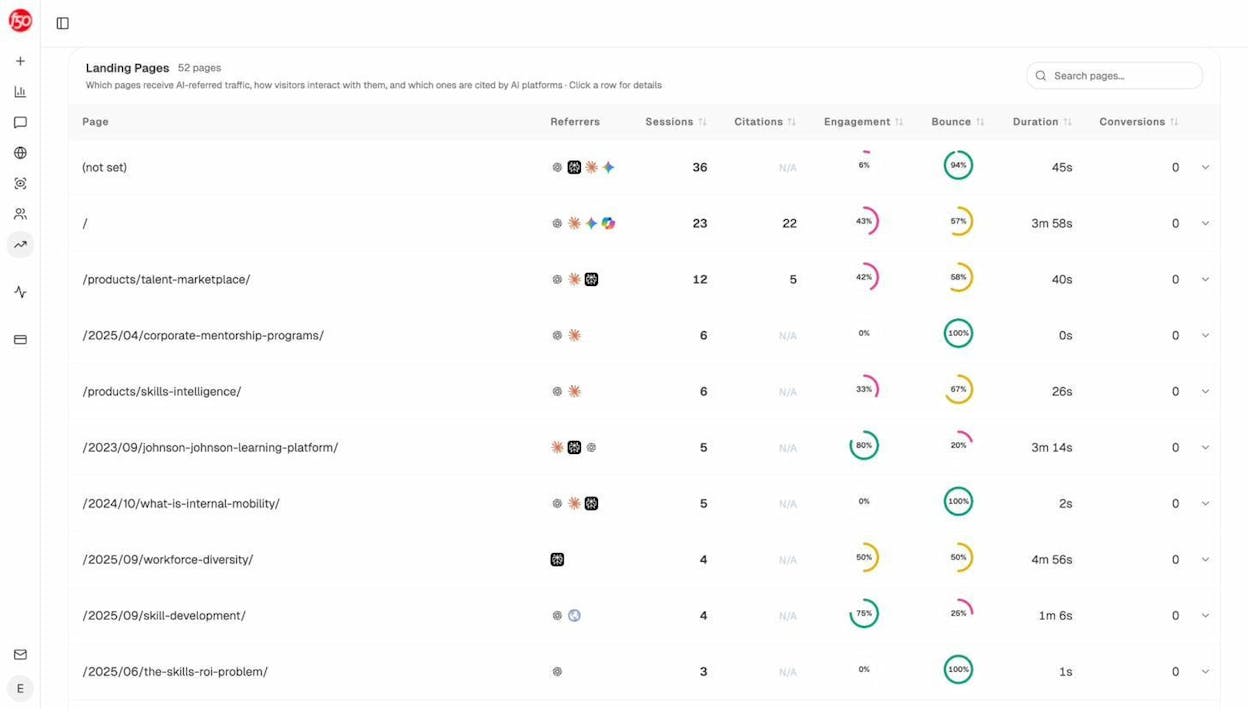
The Landing Pages view is where the real insight lives. It shows you which of your pages already attract AI-referred traffic, which engines send it, and how visitors engage. You will see patterns. The pages that win in AI search tend to share a structure, a depth, and a citation profile. The job, once you spot the pattern, is to do more of it.
The Sources view shows the inverse. It tracks every URL across the open web that AI engines cite when answering questions in your category, broken down by content type and domain.
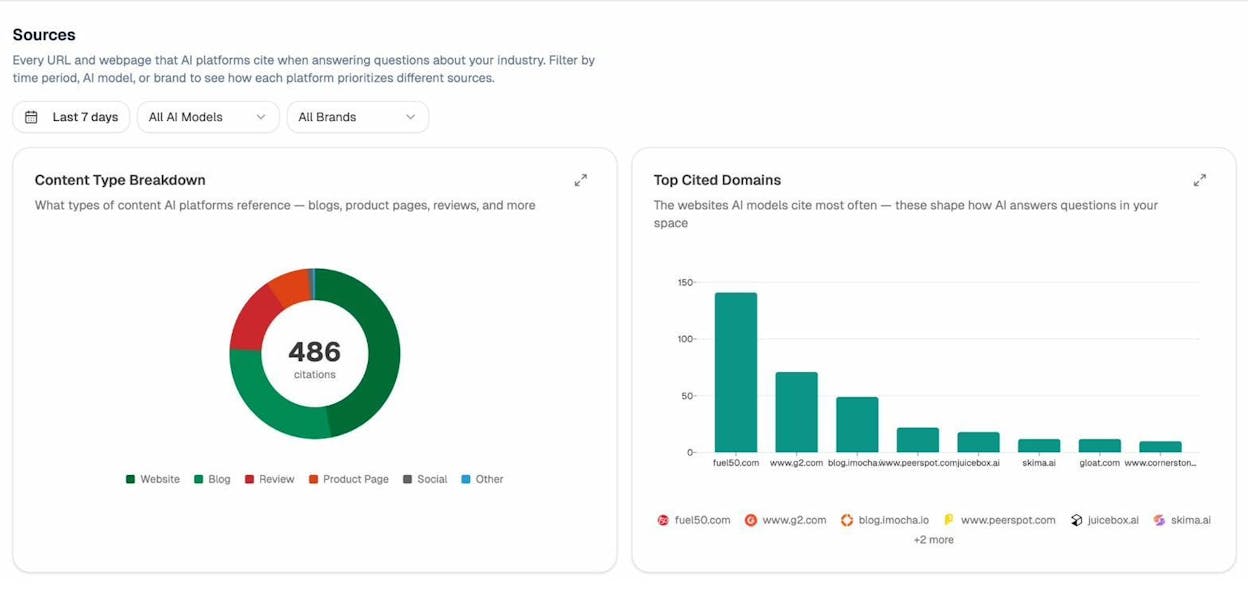
The action. Ship the article, build links, and check both your rankings and your AI citations weekly for the first month.
What to do after you publish
Publishing is not the finish line. Most pages need a refresh within twelve months to hold position. The keyword that got you to page one in March may have new SERP features, new AI answers, and new competitors by September.
The pattern we use is simple. Once a quarter, pull the list of pages that have lost rankings or AI citations, sort by business potential, and refresh the top five. The Content Optimizer inside Analyze AI surfaces declining pages automatically and tells you what coverage gaps to fix, so you do not have to guess.
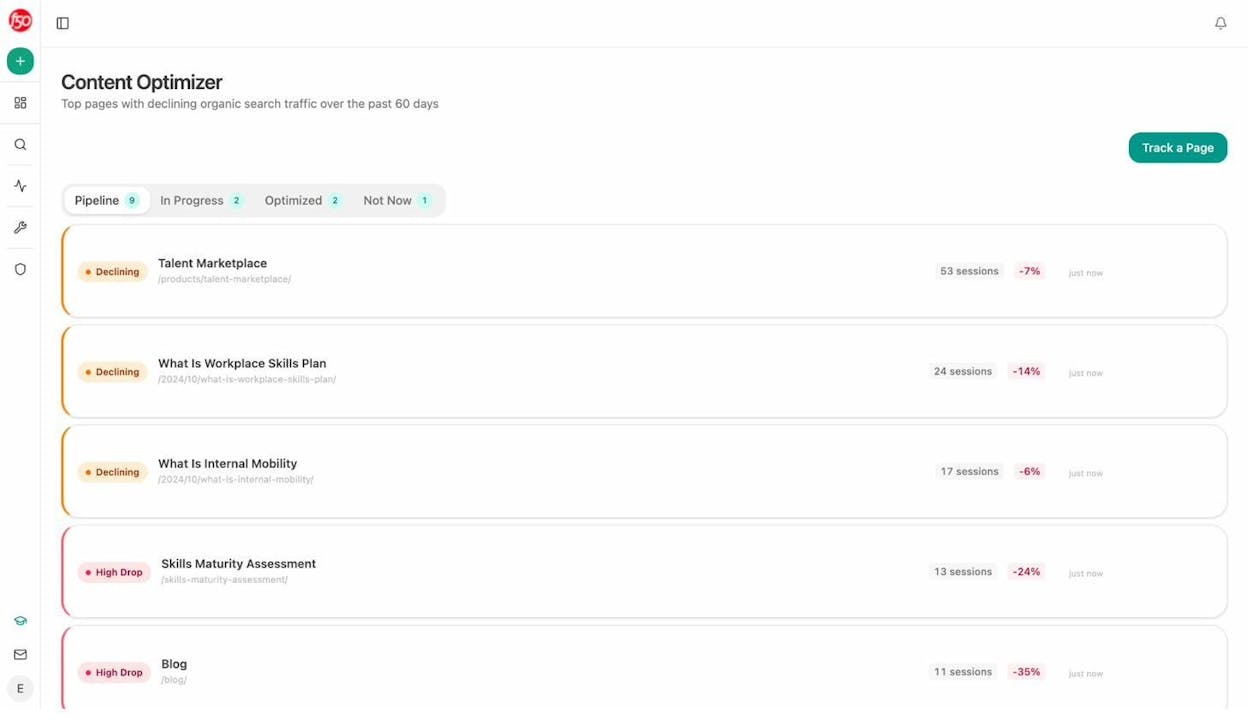
The eight steps above are the work. The refresh loop is what compounds it. Start with one keyword, run the full sequence, and watch what happens in both Google and AI search before you scale.

Ernest

Ibrahim


