



Summarize this blog post with:


Search “how to get customers” online and you’ll see 47 different tactics in 47 different articles. The truth is simpler. Almost every customer acquisition strategy fits into one of four buckets.
![[Description for editor: Custom 4-quadrant graphic showing the four buckets (Search, Advertising, Direct, Word-of-mouth), each with a one-line description. Same visual style as the rest of the Analyze AI blog.]](https://www.datocms-assets.com/164164/1778175127-blobid1.png?auto=format,compress&w=1248&fit=max)
-
Search. Show up where buyers are already looking.
-
Advertising. Pay a platform or a creator to access an audience they’ve built.
-
Direct. Reach specific buyers one at a time.
-
Word-of-mouth. Make others recommend you.
Many companies end up using two or three of these. The rest of this article shows you how to run each one and how to pick which to lead with.
In this article, you’ll learn the four ways every business gets customers, how to run each one, and how to choose the right mix for the stage your company is in. We’ll cover what’s changed in 2026, including how AI search now sits inside your customer acquisition stack alongside Google.
Table of Contents
1. Search
Search is where you understand the questions your buyers ask, find the platforms they ask them on, and show up with content that answers those questions well.
What’s changed in 2026 is the definition of “search.” Buyers still use Google and Bing. They also use ChatGPT, Perplexity, Gemini, Copilot, YouTube, TikTok, and Reddit. Each platform runs on slightly different rules, but the underlying playbook (find the questions, answer them well) carries across.
Google and Bing
To rank on Google or Bing you need three things. Topics your audience searches for, content that satisfies their intent, and signals (mainly links) that tell search engines you’re worth ranking.
Start with keyword research. Our free keyword generator and Bing keyword tool return seed-driven keyword lists with search volume and difficulty. For an ecommerce store selling coffee equipment you’d start with seed terms like “coffee,” “french press,” and “espresso machine.”
![[Screenshot of the Analyze AI keyword generator returning a list of related keywords for the seed term “coffee.”]](https://www.datocms-assets.com/164164/1778175137-blobid2.png?auto=format,compress&w=1248&fit=max)
That returns more keywords than you can use. Filter for keywords with enough search volume to matter and low enough difficulty that you can rank. Our keyword difficulty checker scores every keyword on a 0 to 100 scale.
![[Screenshot of the keyword difficulty checker showing scores for a handful of coffee-related keywords.]](https://www.datocms-assets.com/164164/1778175138-blobid3.png?auto=format,compress&w=1248&fit=max)
Once you have a shortlist, study the current top results for each keyword. Look at the format (listicle, how-to, product roundup), the angle, and what the page covers. That tells you the search intent. Our SERP checker returns the top 10 results for any keyword in a single view.
![[Screenshot of the SERP checker results page for a target keyword like “best coffee maker.”]](https://www.datocms-assets.com/164164/1778175143-blobid4.png?auto=format,compress&w=1248&fit=max)
Now write a page that covers the topic better than what’s currently ranking. Add original data, real examples, and direct experience. For the structure, follow the four pillars of an effective SEO strategy for AI search.
Links still matter for Google. They matter less than they used to but they still move the needle on competitive keywords. Build them through digital PR, original research, and outreach. See our roundup of the 9 best backlink building tools and 11 off-page SEO strategies that work.
AI search (ChatGPT, Perplexity, Gemini, Copilot)
Buyers no longer just type queries into Google. They ask ChatGPT for software recommendations, Perplexity to compare products, and Gemini to summarize options. A serious B2B buyer in 2026 typically touches both Google and at least one AI engine before reaching your site.
This is where many marketers panic. They think AI search is killing SEO. It is not. As we lay out in our manifesto, quality content still wins. The brands cited in AI answers are usually the ones already ranking on page one of Google. AI search is an additional organic channel, not a replacement.
The work splits into three steps.
Step 1. Find the prompts your buyers actually ask.
Keyword research for AI search means finding prompts, not just keywords. A prompt is the full question a buyer types into ChatGPT. “Best CRM for a 20-person sales team” is a prompt. So is “Hubspot vs Pipedrive for a B2B SaaS startup.”
To research prompts at scale, use the prompt discovery feature in Analyze AI. It scans your industry and surfaces prompts where your buyers are asking AI engines for recommendations. Review the suggestions and track the ones that matter to you.
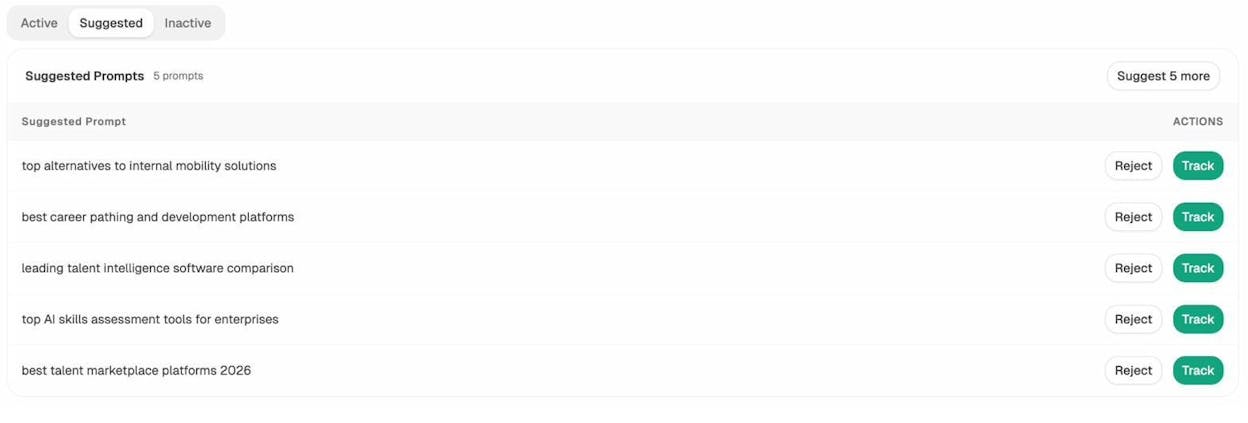
You can also do this manually for free. Open ChatGPT or Perplexity, ask a question your buyer would ask, and study the answer. Note which brands are cited, which sources the model pulls from, and how each competitor is positioned. Repeat for the 10 to 20 prompts that matter for your category. For more, see how to rank on ChatGPT and how to rank on Perplexity.
![[Screenshot of Perplexity answering a sample prompt like “best email marketing software for ecommerce” with the brand citations panel visible.]](https://www.datocms-assets.com/164164/1778175149-blobid6.png?auto=format,compress&w=1248&fit=max)
Step 2. Create content that AI engines cite.
Two things drive citations. Ranking on Google, since AI engines pull heavily from organic results, and content structure. AI engines reward pages with clear answers, original data, structured sub-sections, and topical depth. If you’ve built strong SEO foundations, you’ve already done much of the work.
For more on how the two channels connect, see GEO vs SEO and what is generative engine optimization.
Step 3. Track whether it’s working.
If you’re investing in AI search you need to measure it. Use AI visibility tracking to see how often your brand appears across ChatGPT, Perplexity, Gemini, and Copilot for the prompts you care about.
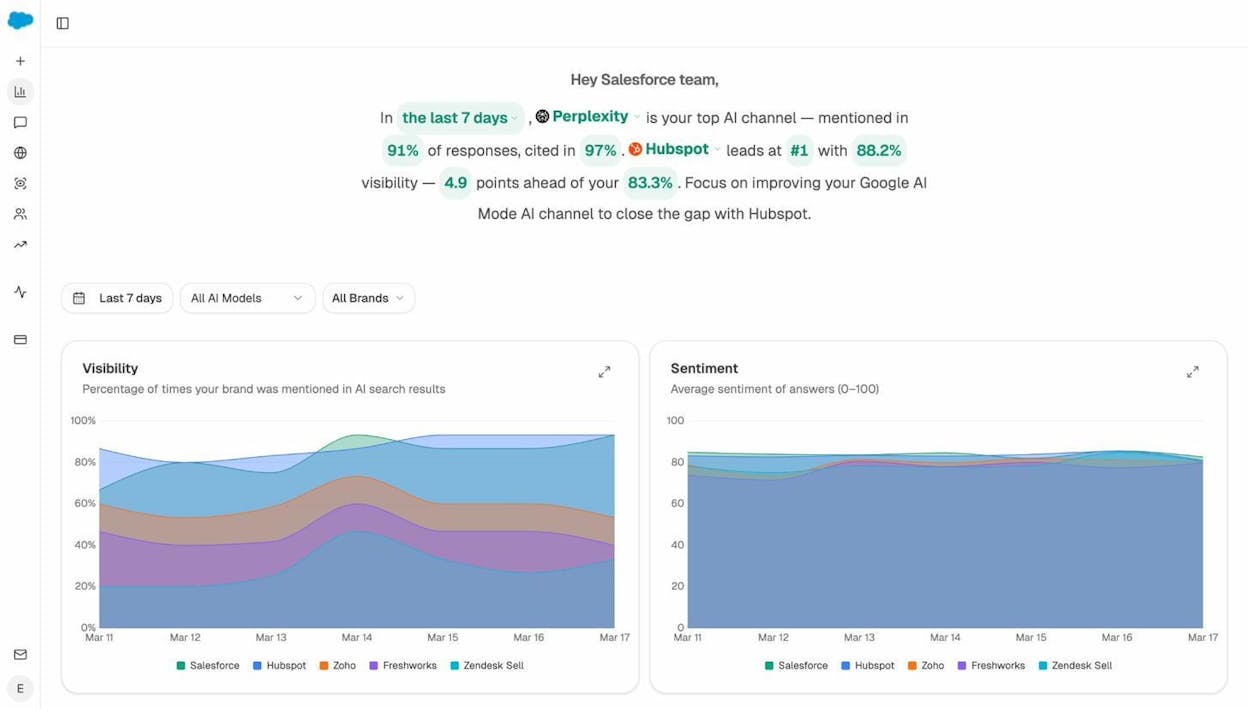
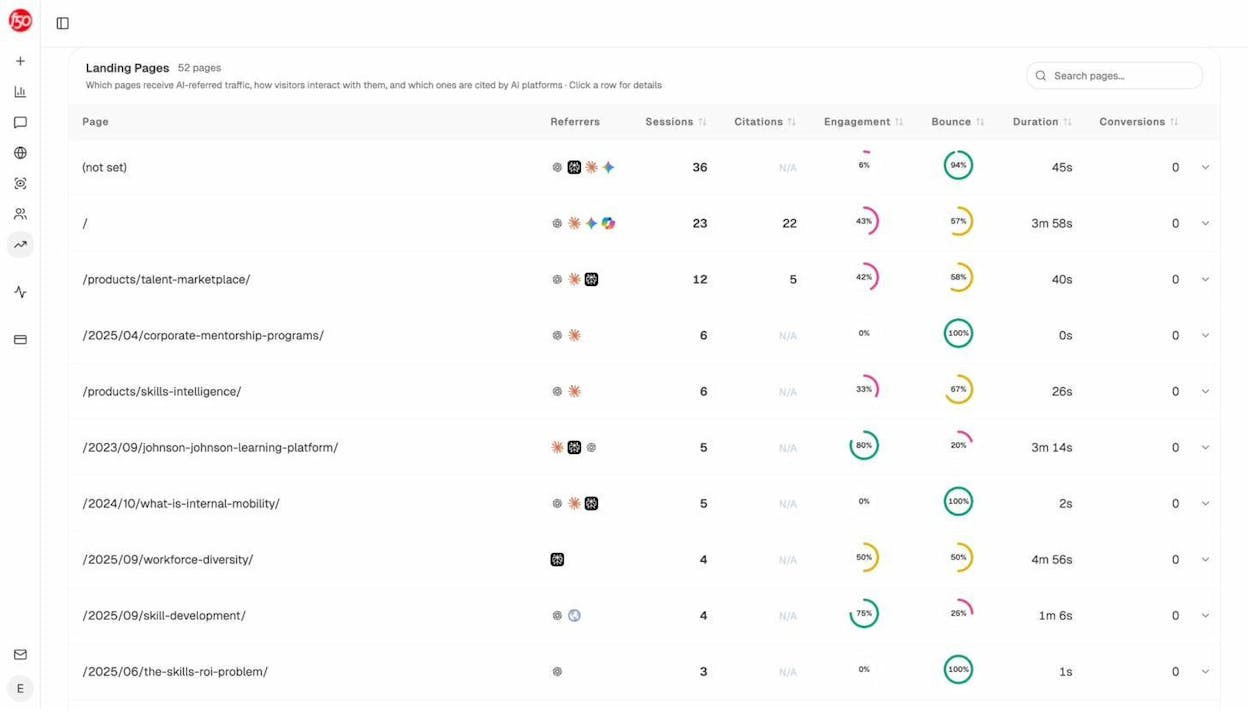
Layer on AI traffic analytics to see which pages are receiving traffic from AI engines and how those visitors behave once they land. Look at the AI-referred landing pages with strong engagement, find what they have in common (data, structure, topical depth, freshness), and produce more of the same.
YouTube
YouTube has over 2.5 billion monthly active users and is a search engine in its own right. For software, finance, education, and home improvement, ranking a how-to video can outperform a blog post.
Here’s the basic playbook.
-
Find topics with steady search demand. Our free YouTube keyword tool returns autocomplete-driven topic ideas for any seed.
-
Place the target keyword in the title, description, and first 30 seconds of the video.
-
Cover the subtopics that come up around the main keyword.
-
Add timestamps with descriptive labels.
-
Hook viewers in the first 30 seconds. If they drop, the video drops in the algorithm.
![[Screenshot of the YouTube keyword tool returning autocomplete-driven keyword ideas for a seed like “personal finance.”]](https://www.datocms-assets.com/164164/1778175162-blobid9.png?auto=format,compress&w=1248&fit=max)
![[Screenshot of YouTube Studio analytics showing audience retention with the typical 30-second viewer drop-off.]](https://www.datocms-assets.com/164164/1778175164-blobid10.png?auto=format,compress&w=1248&fit=max)
Thumbnails matter as much as titles. A/B test thumbnails on every upload and swap them out if a video underperforms in the first 24 hours.
TikTok and Instagram
A 2024 Adobe study found that 2 in 5 Americans use TikTok as a search engine and 1 in 10 Gen Z users say TikTok is their first search engine.
The optimization playbook on these platforms is short and unforgiving.
-
Research keywords using TikTok’s autocomplete and the “Others searched for” suggestions.
-
Open with a 3-second hook.
-
Edit the auto-captions to match your target keyword exactly.
-
Use 3 to 7 hashtags.
-
Reply to comments with text that contains your target keyword.
The same approach largely applies to Instagram Reels.
2. Advertising
Pay a platform or a creator to access their audience. The math is simple. Spend less to acquire a customer than the customer is worth to you.
Paid search and paid social (Google, Meta, LinkedIn, X)
These are PPC channels. You bid for placement and pay each time someone clicks. The mechanics are well-documented, so we’ll focus on the parts that drive outcomes.
Pick the platform where your buyers are. LinkedIn for B2B with ACVs over $25K. Meta for ecommerce with broad audiences. Google for high-intent keywords. TikTok and YouTube for visual products.
![[Screenshot of the LinkedIn Campaign Manager targeting interface showing job title, company size, and industry filters.]](https://www.datocms-assets.com/164164/1778175168-blobid11.png?auto=format,compress&w=1248&fit=max)
Targeting drives outcomes. Failed PPC campaigns usually fail because they reached the wrong people, not because the creative was bad. For Google search ads, look at which keywords your competitors are paying for using a competitor research tool, then target the ones that match your buyer’s intent.
Creative comes second but compounds. Platforms reward ads that perform above their peers with cheaper distribution. Ship 5 to 10 creative variations per campaign and let the platform pick the winner.
Out-of-home (billboards, transit, street)
OOH ads are billboards, taxi tops, transit, and street signage. They’ve come back into fashion for B2B SaaS that wants to reach a specific city’s tech workers.
Start small. Pick one geofenced city, run for one to two months, and measure the lift in branded search volume, direct site traffic, and AI search mentions. If you see a clear lift, expand. If not, kill the program.
This is where AI search measurement becomes useful. When someone sees your billboard, they often go to ChatGPT or Perplexity to research you. With Analyze AI you can track whether your brand starts appearing more in AI answers in the cities where you ran ads.
Podcast advertising
There are over 4 million active podcasts globally. Your audience is listening to one of them.
Pricing is negotiable. Mid-roll ads cost more than pre-roll or post-roll. The tactic that wins consistently is to give the host the topic and three key points and let them say it in their own voice. Scripted reads underperform organic mentions every time.
Influencers and partnerships
Working with influencers is structurally similar to working with podcasts. You’re paying for access to a built audience.
Three rules of thumb.
-
Smaller and more relevant beats bigger and broader. A 50K-follower influencer whose audience matches your buyer is worth more than a 1M-follower account whose audience is mostly strangers.
-
Pay on performance when you can. Affiliate links and revenue share keep both sides aligned.
-
Be generous with commission. A 20% to 25% rate gets influencers to actually post. A 5% rate gets you ignored.
Affiliates
Affiliate marketing pays third parties a commission for each sale they refer. In the upside case you build a small army of partners who promote you because their income depends on it.
Two things make or break the program.
-
The commission rate. Too low and no one promotes you. Too high and you lose money per customer. Tie it to your customer acquisition cost (CAC) so the program stays profitable.
-
Recruitment. Plenty of affiliates drive zero sales. The top 5% drive the bulk of revenue. Spend your time recruiting that top 5% and giving them custom assets, discount codes, and direct support.
3. Direct
Reach specific buyers one at a time.
If your total addressable market is small (a few thousand companies, not millions) search and advertising have low ceilings. You can’t run an efficient Google ad campaign when only 200 companies in the world buy your product. You need to know them by name.
Account-based marketing (ABM)
ABM is the B2B version of going customer by customer. Marketing and sales pick a list of named accounts, then orchestrate everything (ads, emails, content, events, outbound) to win them. The flavor depends on contract size.
|
ABM type |
Accounts |
Personalization |
|---|---|---|
|
One-to-one |
5 to 50 |
Fully bespoke per account |
|
One-to-few |
50 to 500 |
Industry or persona segments |
|
One-to-many |
500 to 5,000+ |
Automated with light personalization |
A $1M ACV deal earns one-to-one. A $25K ACV deal works better as one-to-few.
The piece teams often skip is matching content to buyer stage. Awareness-stage accounts get retargeting and thought leadership. Consideration-stage accounts get webinars, ROI calculators, and case studies. Decision-stage accounts get demos, custom proposals, and reference calls.
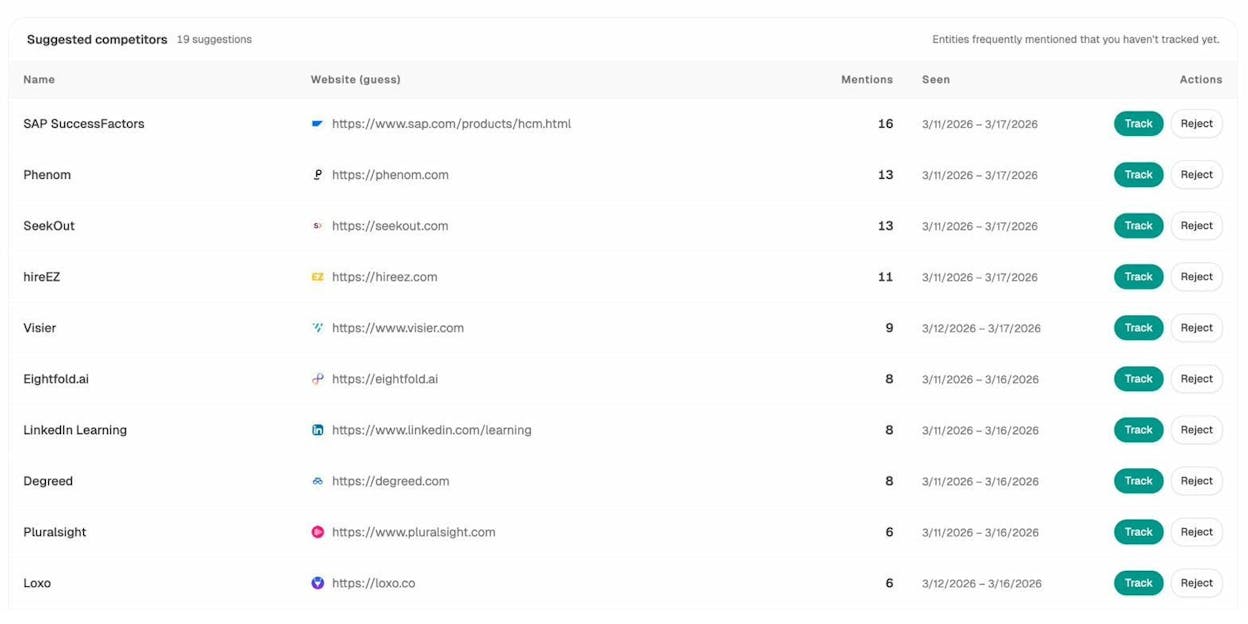
ABM is where AI search starts to matter for sales. When a procurement team Googles your product they also ask ChatGPT for alternatives. If a competitor shows up in that answer and you don’t, the consideration battle is half-lost before sales joins the call. AI battlecards and competitor intelligence in Analyze AI tell your sales team how AI engines describe your brand, what competitors are credited for, and which positioning gaps to address.
Events
Conferences, workshops, dinners, and meetups are a high-trust direct channel. People still buy from people.
Start small before going big. Sponsor a small industry meetup before committing to a 500-person conference. Invite 12 customers to dinner before booking a $200K trade show booth.
Track event ROI by tagging leads sourced from each event in your CRM and following them through the pipeline. Good events show up in pipeline 3 to 6 months later, not the week after.
Outbound
Cold email, cold LinkedIn, cold calls. None of this is dead. What’s dead is generic, blast outbound. What works is highly targeted, deeply researched, and short.
The current playbook is to use AI to research the prospect but to write the email yourself. AI can draft the first version, but every successful outbound program we’ve seen has a human reviewing each message before it ships. For tooling, our 15 best marketing automation tools covers what teams use to run outbound at scale.
4. Word-of-mouth
People recommend you to friends, peers, and online communities. You can’t fully control this, but you can shape it.
Build a product worth talking about
The first prerequisite for word-of-mouth is a product that solves a real problem in a way customers want to talk about. No tactic on this list works if your product is mediocre.
The work that builds a recommend-worthy product looks like this.
-
Ship features customers ask for.
-
Track what they say about you online.
-
Reply quickly when people complain.
-
Treat support like a marketing channel.
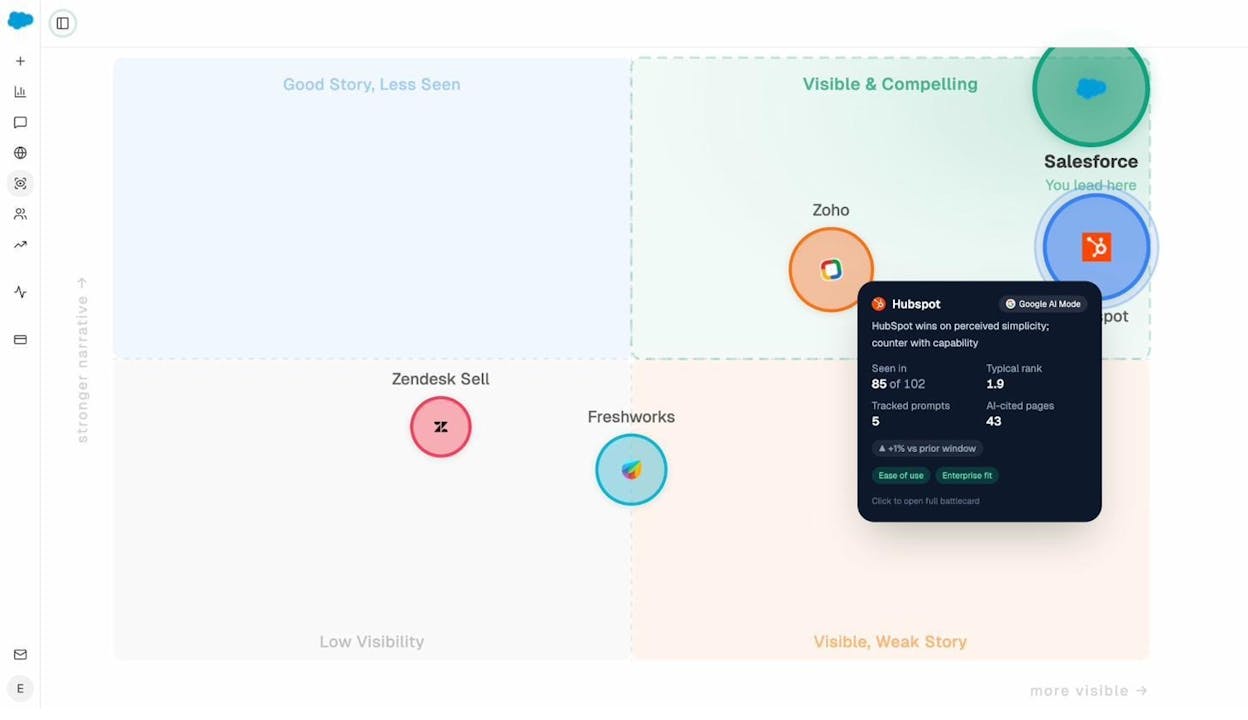
Use the perception map in Analyze AI to see how AI engines describe your brand versus competitors and where you sit on the visibility-and-narrative grid.
Build an audience
Every search post, every YouTube video, every TikTok creates the chance to add a follower. An audience is a compounding asset. The bigger it gets, the more each new piece of content reaches.
Don’t keep your audience on someone else’s platform. Move them to email. Algorithms change, accounts get banned, platforms die. An email list is yours. Drive every touchpoint to a newsletter signup. Our list of content marketing tools covers what teams use to run an audience program.
Public relations and digital PR
PR is the practice of being newsworthy. Reporters need stories. If you can hand them one, they’ll write about you.
Three formats consistently work.
-
Original research. Run a survey, analyze your own product data, or scrape something publicly available. Reporters cite numbers.
-
Reactive commentary. When industry news breaks, send reporters a quote within 24 hours. Speed matters more than polish.
-
Stunts. A well-designed stunt earns coverage. Don’t run one if it doesn’t connect to what you sell.
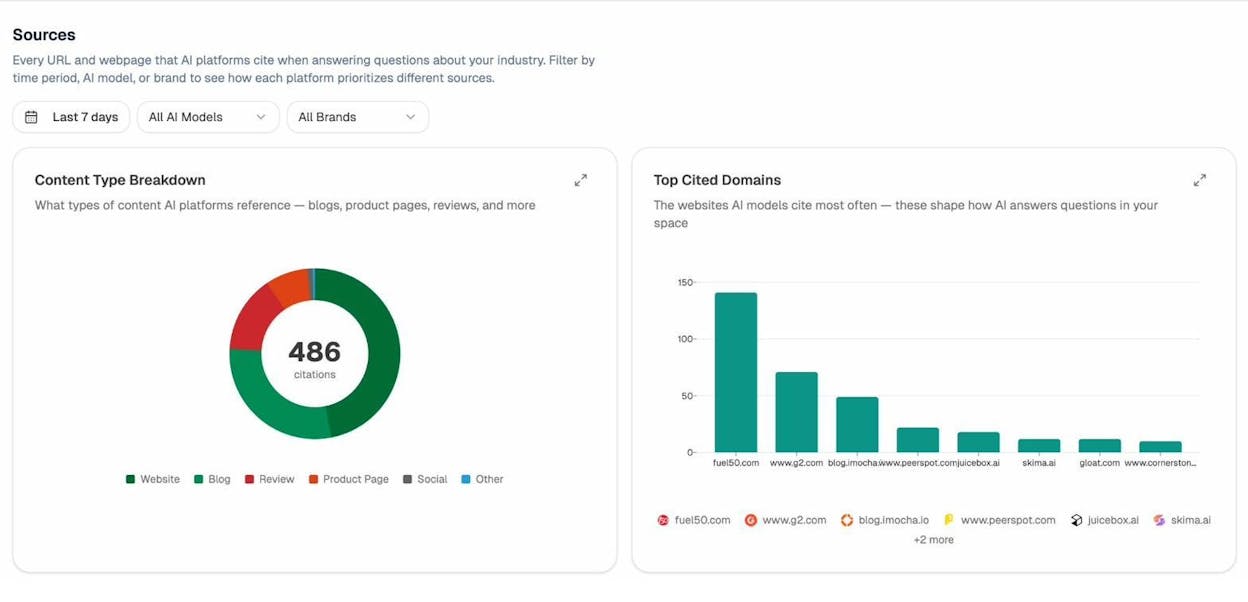
PR is also a powerful lever for AI search visibility. AI engines train on news articles, blog posts, and reference material. A citation in a credible publication directly improves visibility in AI engines.
You can verify this for your brand. The citation analytics view in Analyze AI shows which domains AI engines cite when answering questions in your industry. If your brand is mentioned on the domains that AI engines trust, you’re winning.
Giveaways and free tools
Free is a simple way to get people to share. The trick is giving away the right thing.
Give away your product or something tightly related to it. A free MacBook attracts freebie seekers. A free annual plan attracts buyers who actually want what you sell.
Free tools are an underused version of this. We run a suite of them (website traffic checker, SERP checker, keyword rank checker, website authority checker, and broken link checker) that give people a quick win in exchange for an email or a brand impression. Free tools generate links and AI citations almost on autopilot.
How to choose your channel mix
Not every business should use every channel. The right mix depends on what you sell, who buys it, and what stage of company you’re in.
|
Customer type |
ACV |
Lead with |
Layer in next |
|---|---|---|---|
|
Enterprise |
$100K+ |
Direct (ABM, events, outbound) |
Search and PR for credibility |
|
Mid-market |
$10K to $100K |
Search (SEO + AI search) |
Targeted advertising and ABM |
|
SMB |
$1K to $10K |
Search and paid social |
Word-of-mouth and influencers |
|
Consumer |
Under $1K |
Paid social and influencers |
Word-of-mouth |
A second filter is your stage. Early-stage companies need fast feedback loops, so direct outreach and paid ads usually beat search (which takes 6 to 12 months to compound). Once you have product-market fit, search and word-of-mouth scale efficiently. Enterprise sales motions come last, after a repeatable mid-market motion is in place.
A third filter is what’s working for your competitors. Use competitor intelligence in Analyze AI to see which AI search prompts your competitors win on, which sources get cited for them, and where they’re investing.
Final thoughts
The four channels haven’t changed. Buyers still find you through search, advertising, direct outreach, or word-of-mouth.
What’s changed is that “search” now includes ChatGPT, Perplexity, Gemini, and Copilot alongside Google. SEO is not dead. It’s expanding. The brands that show up across both, and that measure their visibility in both, are the ones building durable customer acquisition in 2026.
Pick one channel to win. Layer a second once the first is producing predictable results. Don’t try to run all four at once.
If you want to add AI search to your stack as a real organic channel, start with Analyze AI and run your first prompt research today.

Ernest

Ibrahim


