



Summarize this blog post with:


This article is a focused breakdown of the nine marketing trends that matter in 2026. You’ll walk away knowing where discovery really happens, how influence is earned before the click, and what to adjust so your strategy reflects how attention, trust, and growth actually move today.
Table of Contents
Bring lead capture to the platform instead of pushing users away
The remark that leads to it
-
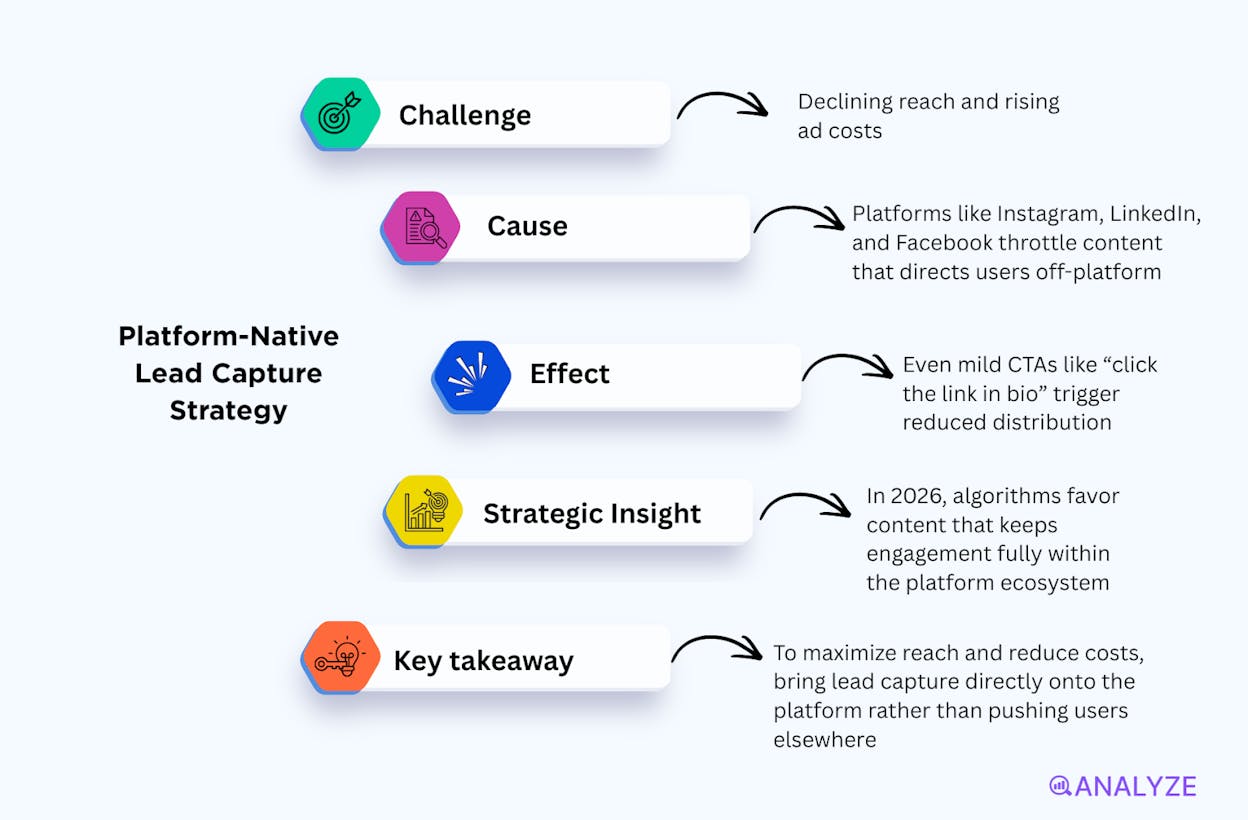
Platforms like Instagram, LinkedIn, and Facebook actively limit distribution the moment your content tries to send users elsewhere.
-
Even simple CTAs such as “click the link in bio” or “visit our site” now signal an exit the algorithm doesn’t want.
-
Reach drops first — often quietly — and ad costs rise to compensate.
-
What looks like declining performance is frequently distribution throttling, not weak messaging.
-
In 2026, platforms reward content that keeps the entire interaction inside their ecosystem.
Causes of this behavior
Most mobile users don’t intend to “visit a website.” They intend to act quickly and move on. When they hit a slow-loading page, a cookie banner, or a form designed for desktop, intent collapses. Platforms see this friction as a broken experience and prioritize native flows that keep users engaged. As a result, content designed to push traffic off-platform is treated as a liability, not a value signal.
How to fix it and actually use the trend
The shift is simple but structural: capture the lead before the click. Instead of routing attention to a landing page, let users convert inside the feed using native forms. For example, a LinkedIn ad offering a demo can collect name, role, and company directly, then route the lead into your CRM for immediate follow-up — preserving momentum while intent is high.
Tools to use
|
Tool |
What it does |
How to use it to handle the task |
|
Meta Lead Ads (Instant Forms) |
Native lead capture on Facebook & Instagram |
Replace landing pages with instant forms for demos, audits, or gated offers |
|
LinkedIn Lead Gen Forms |
Prefilled B2B lead forms using profile data |
Capture high-intent leads without forcing a site visit |
|
TikTok Instant Forms |
In-app lead capture during TikTok ads |
Convert interest mid-scroll, especially for mobile-first audiences |
|
Google Ads Lead Form Assets |
Lead submission directly from Search or YouTube |
Capture demand at intent moments without a landing page |
|
CRM / automation tools |
Lead routing and follow-up |
Sync leads instantly to avoid losing speed-to-lead advantage |
In 2026, the risk isn’t losing traffic — it’s breaking momentum. Every time you force users off-platform, you introduce friction the platform and the audience didn’t ask for. Teams that win stop optimizing for clicks and start capturing demand where attention already lives.
Advertising is shifting from keywords to behavioral intent
The remark that leads to it
-
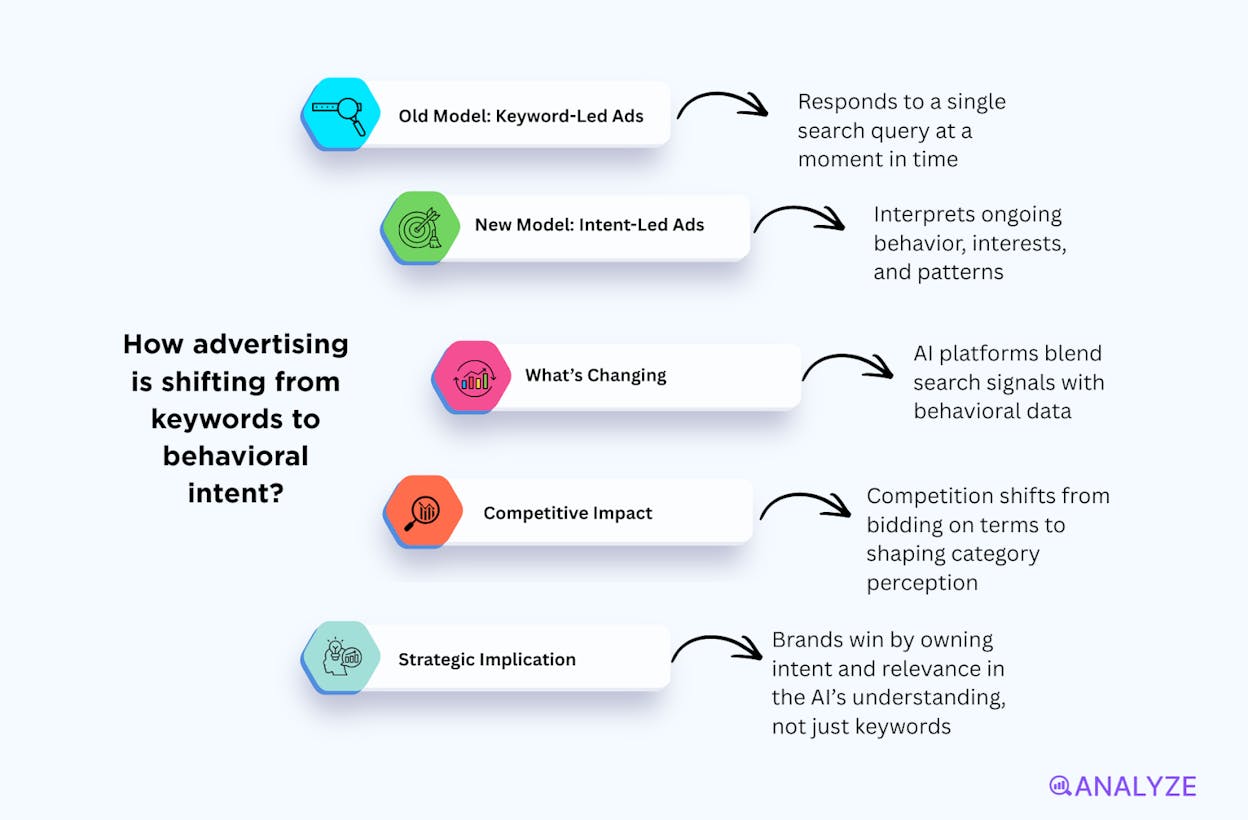
Traditional search ads respond to what someone types in a single moment.
-
Social ads prioritize who someone is based on behavior and patterns.
-
AI-driven platforms are beginning to combine both approaches.
-
Ad relevance is increasingly shaped by intent over time, not isolated searches.
-
This changes competition from bidding on terms to owning a category in the AI’s mind.
Causes of this shift
AI systems don’t interpret intent as a one-off action. They model behavior across sequences: repeated questions, recurring themes, and evolving problems. When advertising is layered on top of this understanding, relevance is no longer tied to a keyword match. Instead, it’s tied to patterns that suggest what matters most right now. This allows ads to align with underlying goals rather than surface-level queries.
How to position for this new ad reality
Brands need to teach AI what category they belong to. That starts with consistency. Publish content that repeatedly addresses the same problems for the same type of audience. Be explicit about who you help and why. Specific positioning signals are stronger than broad claims. Over time, AI systems begin associating your brand with a defined problem space, making it a default option when that intent appears.
Tools to use
|
Tool |
What it does |
How to use it to handle the task |
|
Content systems |
Reinforce topical focus |
Publish repeatedly around one audience and problem set |
|
First-party data platforms |
Provide behavioral signals |
Use CRM, usage, and interaction data to define ideal customers |
|
Ad platforms with AI optimization |
Learn from intent patterns |
Feed consistent signals so models understand relevance |
|
Messaging frameworks |
Clarify positioning |
Describe your offering in specific, outcome-based terms |
|
Analytics /stacks |
Validate associations |
Monitor which problems and audiences your brand is linked to
|
As ads become intent-driven rather than keyword-driven, relevance is earned through consistency and clarity. Brands that define their category early become the default choice when AI decides what fits a user’s needs.
Language is no longer a distribution constraint
.
The remark that leads to it
-
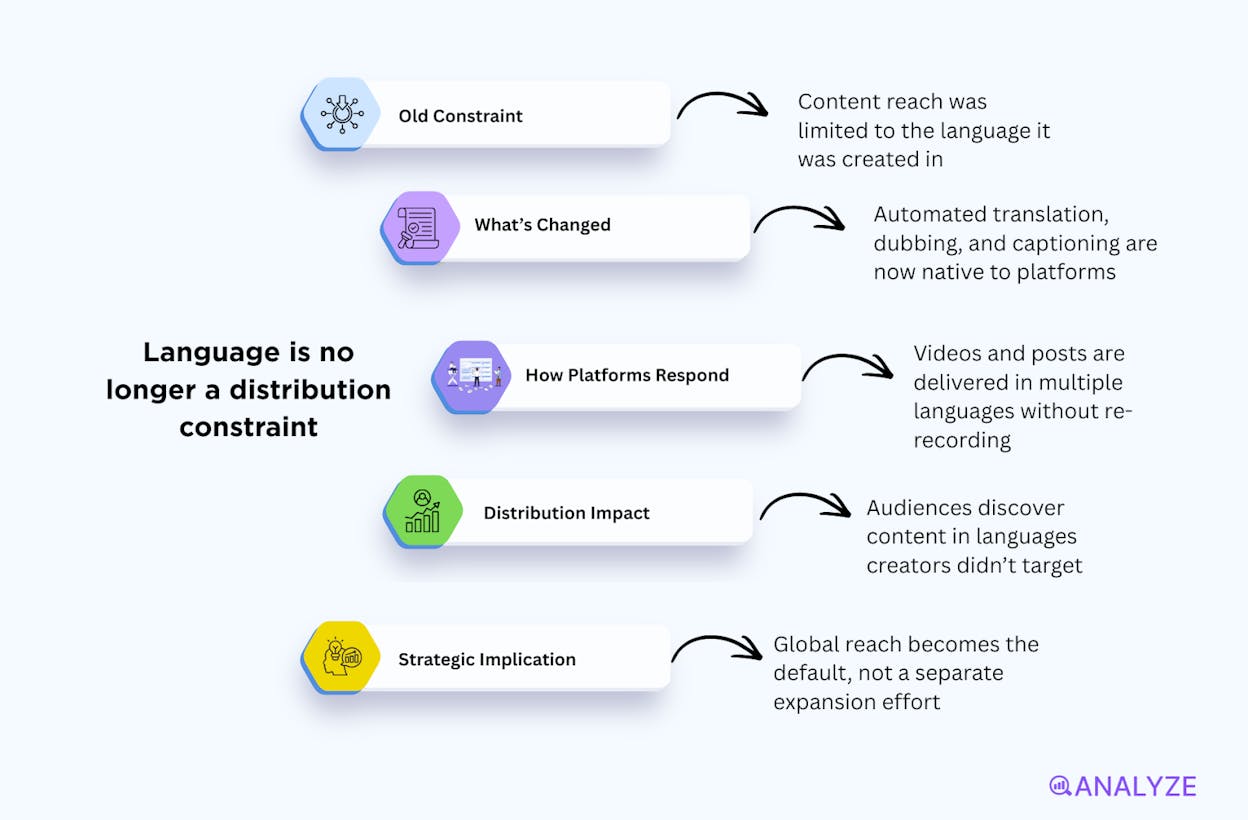
Content reach used to stop at the language it was created in.
-
That limitation is quietly disappearing across major platforms.
-
Videos can now be delivered in multiple languages without re-recording.
-
Audiences are discovering content in languages creators never intended to target.
-
Global reach is no longer an expansion project — it’s becoming the default.
Causes of this shift
Platforms are removing friction from localization by embedding it directly into distribution. Instead of requiring separate translations, voice actors, or duplicated uploads, systems now adapt content at the playback layer. This means the same asset can surface to entirely different audiences based on language preferences alone. As a result, creators and brands gain international exposure without changing how they produce content.
How to activate global reach intentionally
The opportunity isn’t just technical — it’s strategic. Enable multilingual audio wherever it’s supported so platforms can route your content globally. Then make sure the experience holds once viewers arrive. Pages should detect language preferences, CTAs should match the viewer’s language, and conversion flows shouldn’t force users back into English. The goal is continuity: discovery, understanding, and action all aligned.
Tools to use
|
Tool |
What it does |
How to use it to handle the task |
|
Platform language settings |
Enables multilingual playback |
Activate multi-language audio on every published video |
|
Website localization setup |
Supports global visitors |
Add language selectors and localized pages |
|
Hreflang tags |
Signals language targeting |
Help platforms route users to the right version |
|
Multilingual checkout flows |
Removes conversion friction |
Ensure key actions work across languages |
|
CTA localization |
Aligns messaging with audience |
Match calls to action to the viewer’s language |
When language stops limiting distribution, reach scales automatically. Teams that align content, platforms, and conversion paths turn global visibility into real opportunity instead of accidental traffic.
Live content is becoming a trust advantage
The remark that leads to it
-
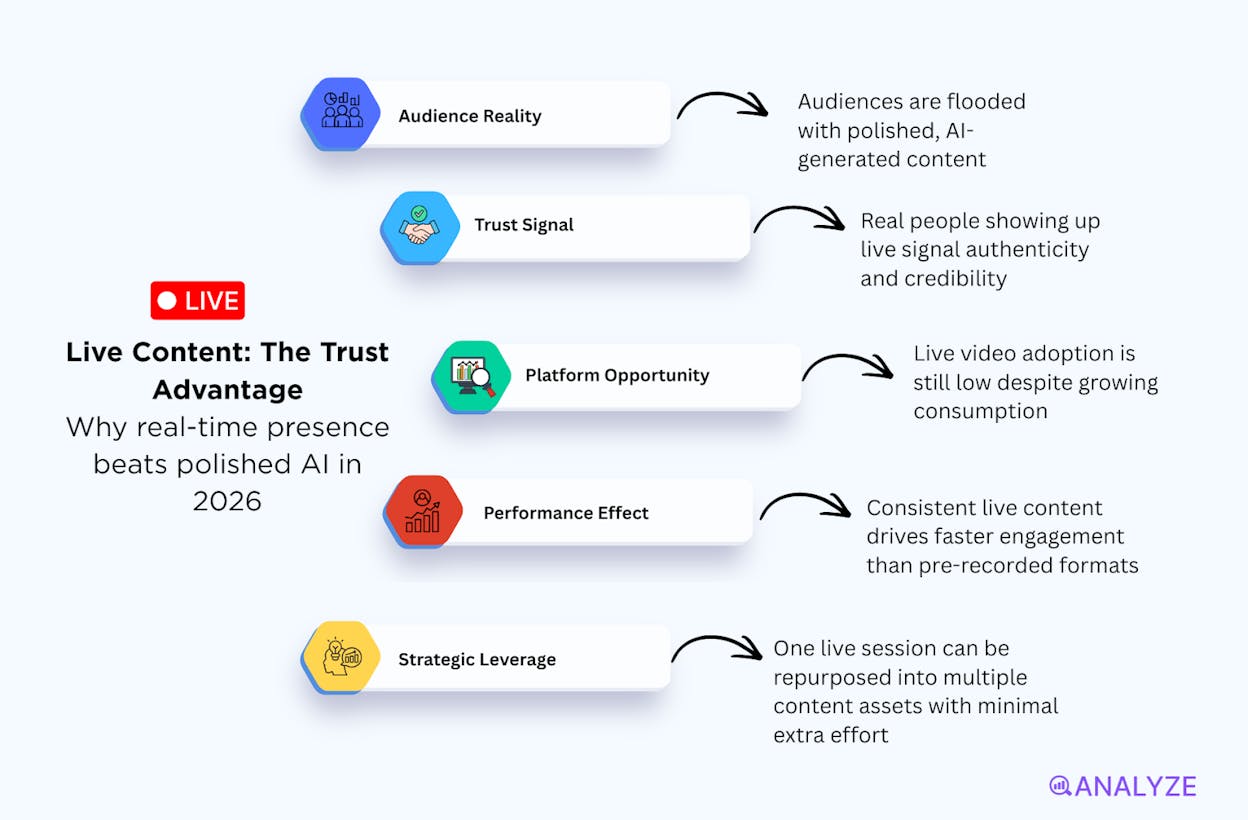
Audiences are surrounded by AI-generated content that looks polished but feels interchangeable.
-
Trust increasingly comes from seeing real people show up in real time.
-
Live video consumption continues to grow, yet most brands still avoid it.
-
When brands go live consistently, engagement rises faster than with pre-recorded formats.
-
One live session now produces multiple pieces of content without extra production effort.
Causes of this shift
As AI-generated content becomes ubiquitous, audiences look for signals that something is real. Live formats provide that signal by default. There are no heavy edits, no perfect scripts, and no artificial pacing. Viewers see how people think, respond, and explain ideas in the moment. Platforms recognize this behavior and reward it with stronger reach, higher engagement, and built-in repurposing mechanisms.
How to use live content strategically
The advantage comes from consistency, not production value. Going live once a week to teach, answer questions, or break down a topic is enough to build momentum. Platforms now handle much of the distribution work automatically, generating clips and formats from a single session. The focus shifts from polishing content to showing up with clarity and value, then letting the system amplify it.
Tools to use
|
Tool |
What it does |
How to use it to handle the task |
|
Live streaming platforms |
Enable real-time video |
Host weekly live sessions without heavy setup |
|
Automatic clipping features |
Repurpose long-form live content |
Let platforms generate vertical and short-form clips |
|
Content libraries |
Store and reuse live moments |
Extract high-impact segments for future posts |
|
Short-form platforms |
Expand reach across surfaces |
Distribute clips where attention already exists |
|
Simple content plans |
Maintain consistency |
Commit to a repeatable live cadence |
Live content builds trust faster than polished output. Brands that show up in real time gain reach, credibility, and reusable content without increasing production complexity.
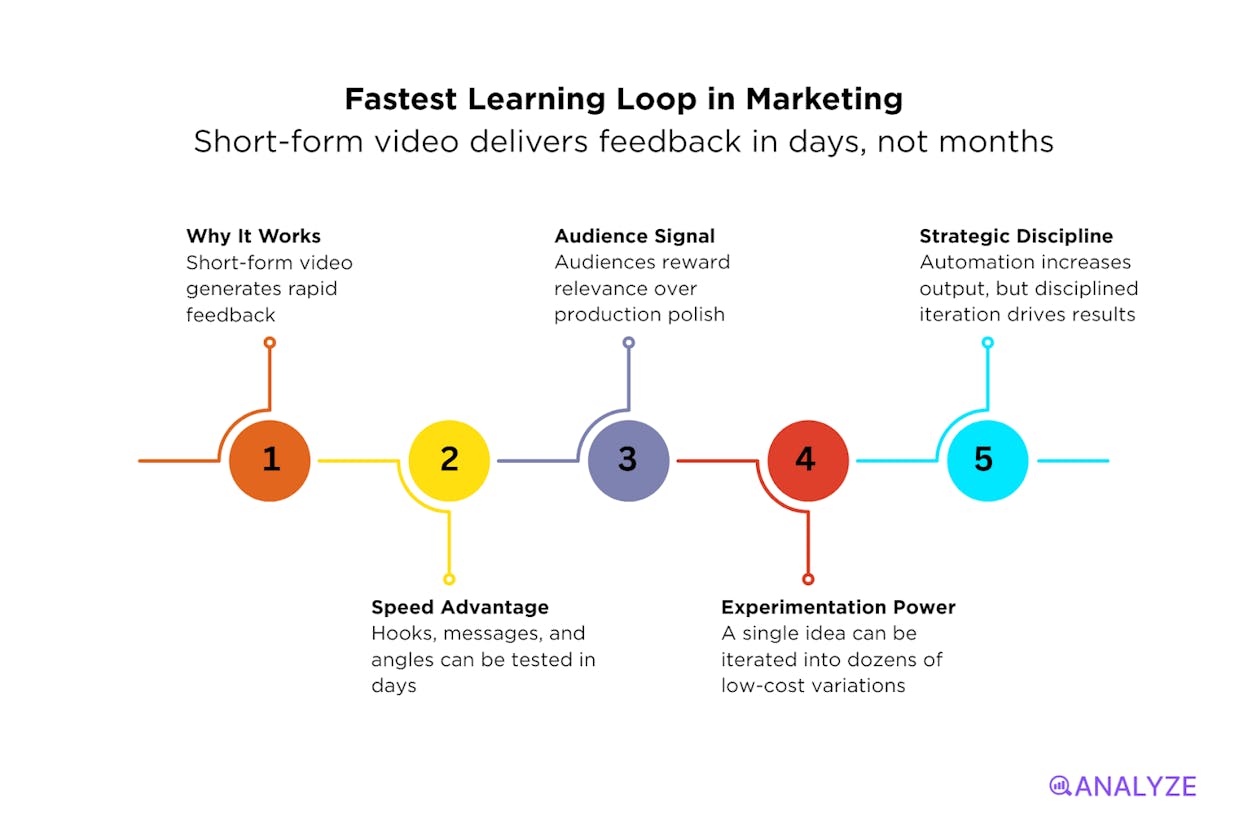
Short-form video remains the fastest learning loop in marketing
The remark that leads to it
-
Short-form video keeps outperforming because it produces feedback quickly.
-
Teams can test hooks, messages, and angles in days instead of months.
-
Audiences reward relevance, not production quality.
-
One idea can be explored through dozens of variations at low cost.
-
Automation now accelerates output, but results still depend on iteration discipline.
Causes of this dynamic
Short-form video compresses the distance between idea and signal. Instead of committing to one campaign, teams can release multiple lightweight executions and observe what earns attention.
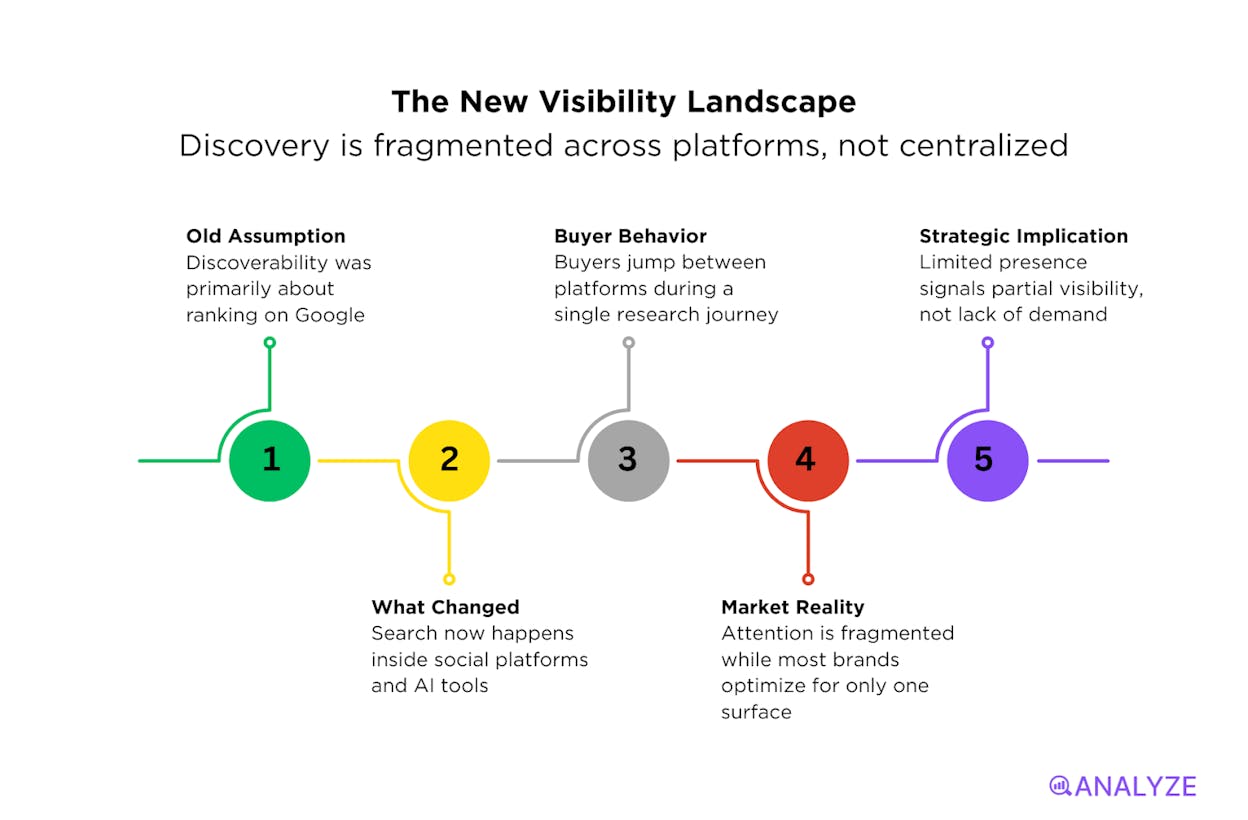
Visibility is now spread across platforms (not just Google and/or its peers)
The remark that leads to it
-
For years, being “discoverable” meant ranking on Google. That assumption no longer holds.
-
Search now happens inside Instagram, YouTube, TikTok, LinkedIn, Snapchat, and conversational tools like ChatGPT.
-
Buyers don’t move linearly — they jump between platforms like stepping stones during the same research journey.
-
Most brands still optimize for one surface, while attention is fragmented across many.
-
Limited presence doesn’t mean low demand — it means partial visibility.
Causes of this shift
People didn’t stop searching — they changed how they search. Instead of typing short keywords into a single engine, they explore through videos, feeds, comments, and conversations. Each platform became its own discovery layer, optimized around its native format. Relying on traditional search alone now leaves blind spots where competitors influence perception before a buyer ever reaches Google.
How to adapt and use the trend effectively
The goal isn’t to be everywhere, but to be discoverable where decisions take shape. That starts with structuring content so platforms clearly understand the topic. Use consistent language across scripts, captions, on-screen text, and descriptions. Reinforce authority by publishing multiple pieces around the same core theme so platforms associate your brand with that subject over time.
Tools to use
|
Tool |
What it does |
How to use it to handle the task |
|
YouTube |
Video-based discovery and long-form search |
Publish topic-focused videos with clear titles, transcripts, and descriptions |
|
Instagram / TikTok |
Feed-based and visual search |
Reinforce key topics through captions, on-screen text, and repeatable formats |
|
|
Professional discovery and intent-driven search |
Build topical authority through consistent posts around one problem space |
|
ChatGPT / AI interfaces |
Conversational discovery |
Create content that answers questions clearly and contextually so it’s referenced |
|
Content planning systems |
Topic consistency across platforms |
Coordinate themes so each platform reinforces the same narrative |
Visibility is no longer won in a single channel. Brands that treat search as a multi-surface behavior show up earlier, shape decisions sooner, and avoid competing for attention only at the last click.
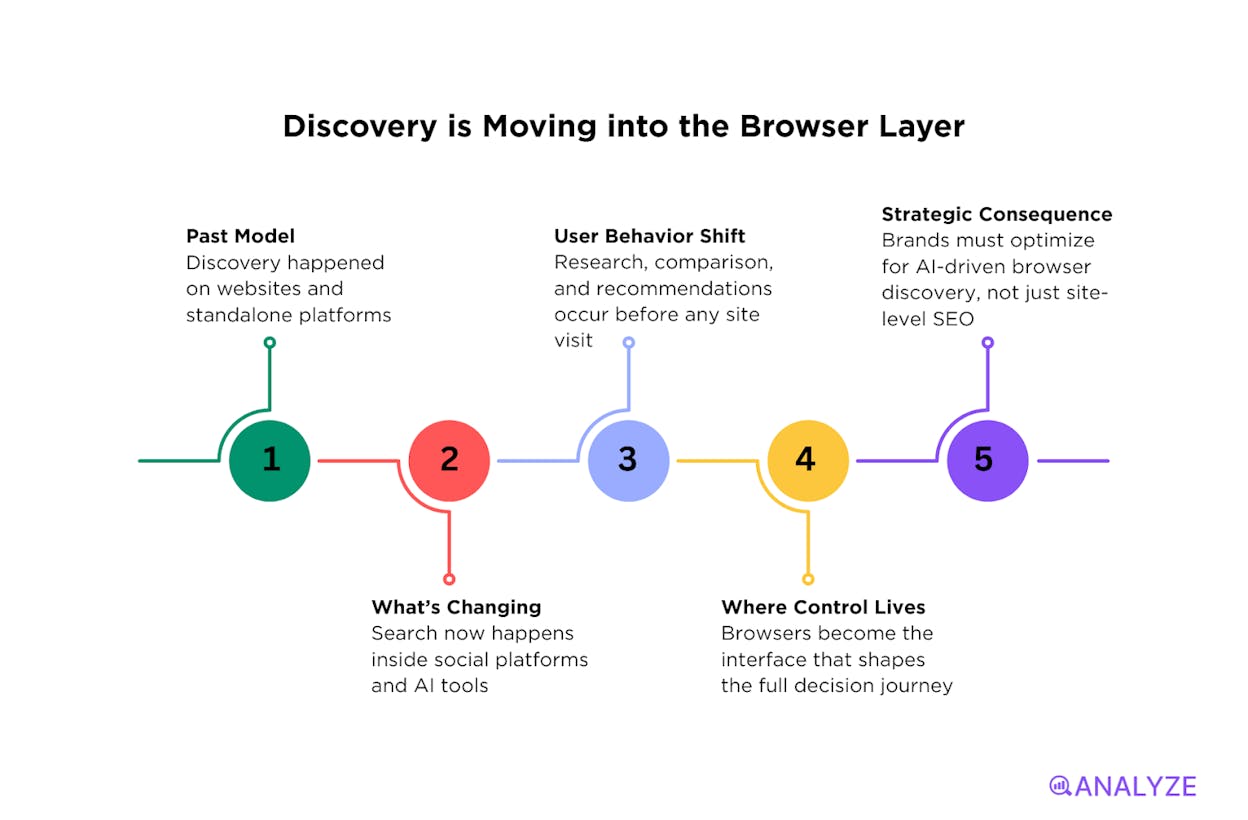
Discovery is moving into the browser layer
The remark that leads to it
-
AI is no longer limited to websites or standalone platforms.
-
Browsers are beginning to embed AI directly into the browsing experience.
-
Comparison, research, and recommendations increasingly happen before a site visit.
-
Users can ask questions, evaluate options, and see suggestions without leaving the browser.
-
This shifts discovery from destinations to interfaces that control the entire journey.
Causes of this shift
Browsers already sit at the center of user behavior. Adding AI at this layer allows them to summarize content, compare options, and surface recommendations instantly. Instead of sending users across multiple sites, browsers can keep them inside a single environment and monetize attention directly. As AI capabilities mature, the browser becomes the most efficient place to intercept research and decision-making.
How to prepare for this shift now
Websites need to be treated as data sources, not just conversion endpoints. Structured pages, clear sections, and consistent formatting make it easier for browser-based AI to extract and reuse information. Early experimentation with AI-driven ad formats helps platforms learn who your audience is and when your brand should appear. The goal is to be visible even when no click happens.
Tools to use
|
Tool |
What it does |
How to use it to handle the task |
|
Browser-level AI features |
Surface summaries and recommendations |
Ensure your content is easy to extract and interpret |
|
Structured data & schema |
Clarifies page meaning |
Help AI systems understand what each page represents |
|
Clean content architecture |
Improves extractability |
Use clear headers, sections, and tables |
|
AI-optimized ad campaigns |
Expand reach across surfaces |
Start early so systems learn your relevance patterns |
|
Site audits |
Maintain accuracy |
Keep content updated so summaries stay reliable |
When AI moves into the browser, discovery happens before the click. Brands that structure their sites for extraction stay visible even when users never reach the page.
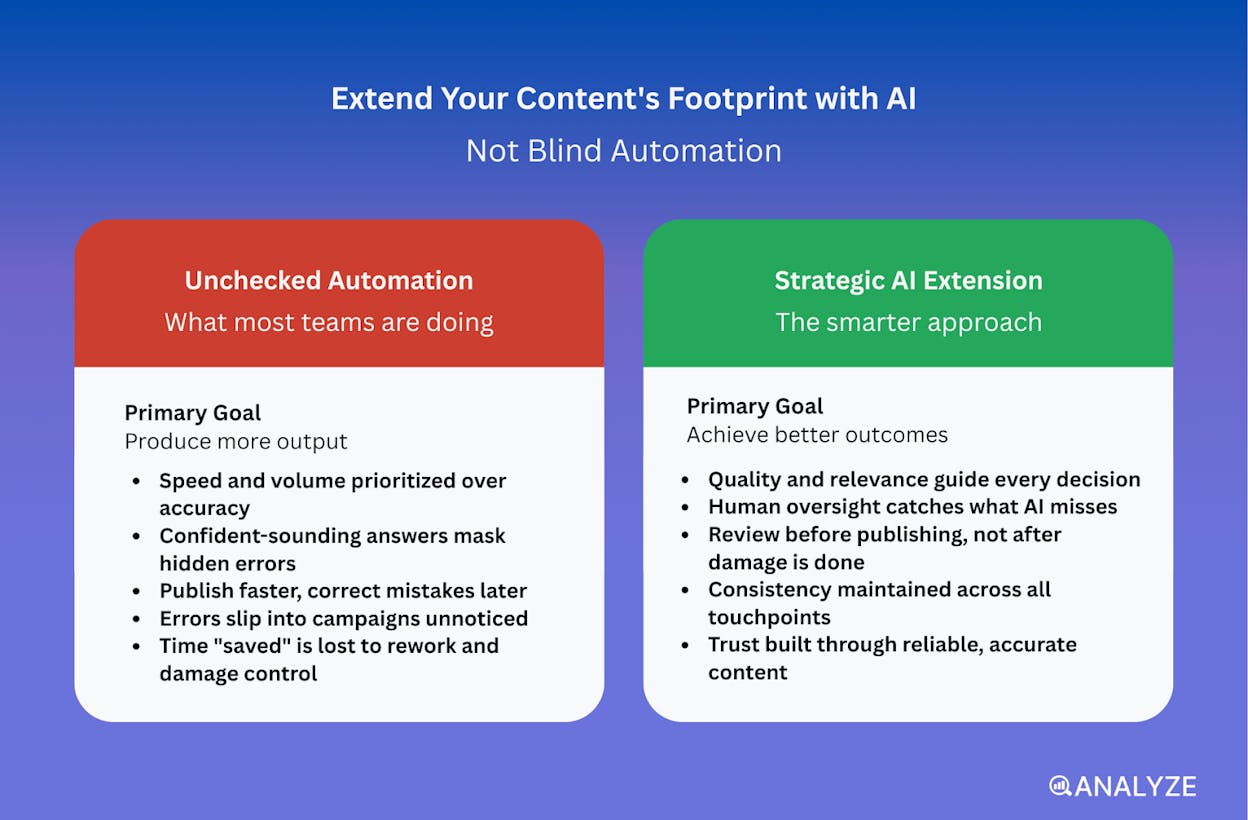
Extend your content’s footprint with AI, not blind automation
The remark that leads to it
-
AI didn’t fail marketing teams — unchecked automation did.
-
Most teams use AI to produce more output, not better outcomes.
-
Confident-sounding answers hide errors that slip into campaigns unnoticed.
-
Time isn’t saved when teams publish faster only to correct mistakes later.
-
The real cost of AI misuse shows up as rework, inconsistency, and eroded trust.
Causes of this problem
AI is often treated as a replacement layer instead of a support layer. Teams feed prompts, accept outputs at face value, and move on. Without validation steps, small inaccuracies compound across content, analysis, and messaging. Over time, speed creates fragility: more content, less confidence in what’s accurate, and more internal time spent fixing what should have been filtered upfront.
How to use AI to extend reach without losing control
Strong teams separate creation from distribution. AI handles first drafts, idea expansion, and format adaptation — turning one core asset into multiple platform-ready versions. Humans then verify claims, align messaging, and decide what ships. The leverage comes from using AI to multiply surfaces, not to finalize strategy. One validated idea becomes many consistent touchpoints instead of many unverified messages.
Tools to use
|
Means |
What it does |
How to use it to handle the task |
|
Chat-based AI platforms |
Drafting and ideation |
Generate outlines, angles, and variations — never final copy |
|
Internal review checklists |
Accuracy control |
Validate stats, claims, sources, and alignment before publishing |
|
Repurposing workflows |
Multi-platform adaptation |
Turn one approved asset into captions, scripts, summaries, and descriptions |
|
Content calendars |
Consistency across surfaces |
Ensure AI-assisted outputs reinforce the same core theme everywhere |
AI delivers its highest return when it expands where validated ideas appear. Teams that use it to extend content footprints — not automate decisions — move faster, stay accurate, and remain credible.
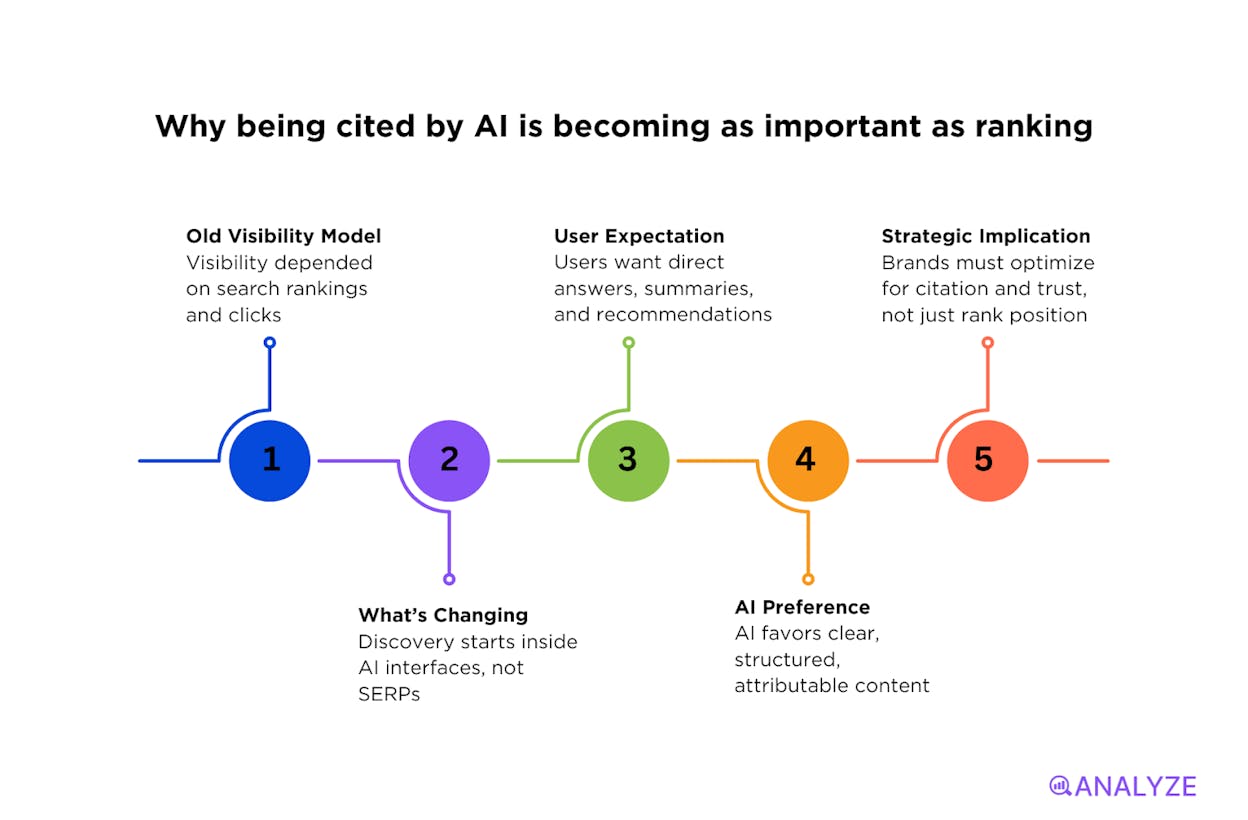
Being cited by AI is becoming as important as ranking
The remark that leads to it
-
Discovery increasingly starts inside AI interfaces, not search result pages.
-
Users expect direct answers, summaries, and recommendations instead of links.
-
Brands can be visible in AI responses even when they don’t rank first on Google.
-
Content that is clear, structured, and attributable is surfaced more often.
-
Visibility now depends on whether AI systems can retrieve and trust your information.
Causes of this shift
AI systems don’t browse the web the way humans do. They assemble answers by pulling from sources that are easy to parse, consistent in how they describe entities, and reinforced across multiple surfaces. As these interfaces become common entry points for research, brands that rely only on traditional rankings miss early discovery moments where perceptions and shortlists are formed.
How to adapt content and distribution strategy
The goal isn’t to abandon SEO — it’s to expand it. Content needs to be written so it can stand alone as an answer: clearly scoped, well-structured, and grounded in verifiable context. Distribution also matters more. When the same narratives appear across your site, third-party content, videos, and communities, AI systems gain confidence in citing you. Monitoring where and how your brand appears inside AI responses then becomes a core visibility signal, not a nice-to-have.
Tools to use
|
Tool |
What it does |
How to use it to handle the task |
|
Analyze AI |
AI search visibility and attribution |
Track where your brand is mentioned, cited, and positioned inside AI answers |
|
Monitor AI-driven discovery |
Understand how content performs beyond traditional SERPs |
|
|
Structured content frameworks |
Improve retrievability |
Create answer-ready pages with clear sections and entities |
|
Digital PR workflows |
Reinforce authority signals |
Support citations through third-party mentions |
|
Classic SEO tooling |
Maintain fundamentals |
Ensure crawlability, clarity, and topical coverage remain strong |
As AI interfaces become a primary discovery layer, visibility is earned through clarity, structure, and repetition across surfaces. Brands that measure and manage how they’re cited gain an advantage long before clicks ever happen.

Ernest

Ibrahim


