



Summarize this blog post with:


In this article, you’ll see how Peec AI and Profound compare on the four lines that actually decide a renewal. Real pricing, default engine coverage, prompt-level workflows, and the execution gap both tools leave behind. You’ll also see where a third option fits if you’re tired of paying for a dashboard that just tells you what already happened.
Table of Contents
The 30-second verdict
|
Peec AI |
Profound |
|
|---|---|---|
|
Real entry price |
€89 (~$99) per month |
$399 per month for a working setup |
|
Engines included by default |
3 (ChatGPT, Perplexity, Google AI Overviews) |
1 on Starter, 3 on Growth |
|
Cost to add an extra engine |
€30–€140 per month, per model |
Most engines locked behind Enterprise |
|
Multi-region tracking |
Pro and up |
Enterprise only |
|
API access |
Advanced and up |
Enterprise only |
|
GA4 / native traffic attribution |
Not native |
Not native on Starter or Growth |
|
Right fit |
SMB and mid-market marketing teams |
Fortune 500 with a dedicated GEO program |
Peec AI is the right pick for most teams that need solid visibility data on a real budget. Profound is the right pick if you already have the analysts, the global footprint, and the procurement cycle to justify enterprise pricing. Neither one solves the work that happens after the dashboard.
Real pricing, not the marketing page
Here’s what each tool actually costs once you stack the engines you’ll want.
Peec AI pricing in 2026
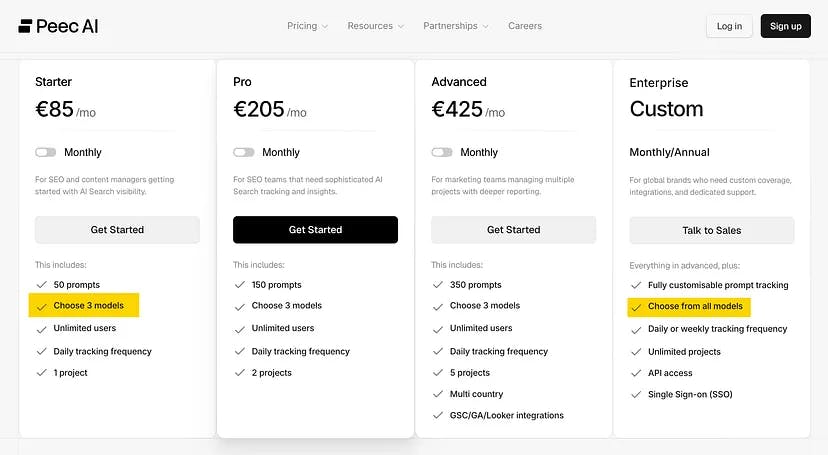
Peec AI publishes pricing transparently and gives every plan unlimited seats. Plans are billed in EUR.
|
Plan |
Price |
Tracked prompts |
Models included |
Notable limits |
|---|---|---|---|---|
|
Starter |
€89 (~$99) per month |
50 prompts |
Choose 3 |
1 project, no Looker, no API |
|
Pro |
€205 (~$199) per month |
150 prompts |
Choose 3 |
2 projects, 3 countries per project |
|
Advanced |
€425 per month |
More prompts, more projects |
Choose 3, all-model upgrade available |
Multi-country, API, SSO |
|
Enterprise |
Custom |
Unlimited |
All models |
Dedicated support, custom onboarding |
The footnote that matters is the add-on engine fee. To track Claude, Gemini, DeepSeek, Grok, or Copilot on top of the default three, you’ll pay €30 per model on Starter, €70 on Pro, and €140 on Advanced. Two extra engines on Pro adds €280 to a €205 plan, so a $200 base price can quietly become $500.
Profound pricing in 2026
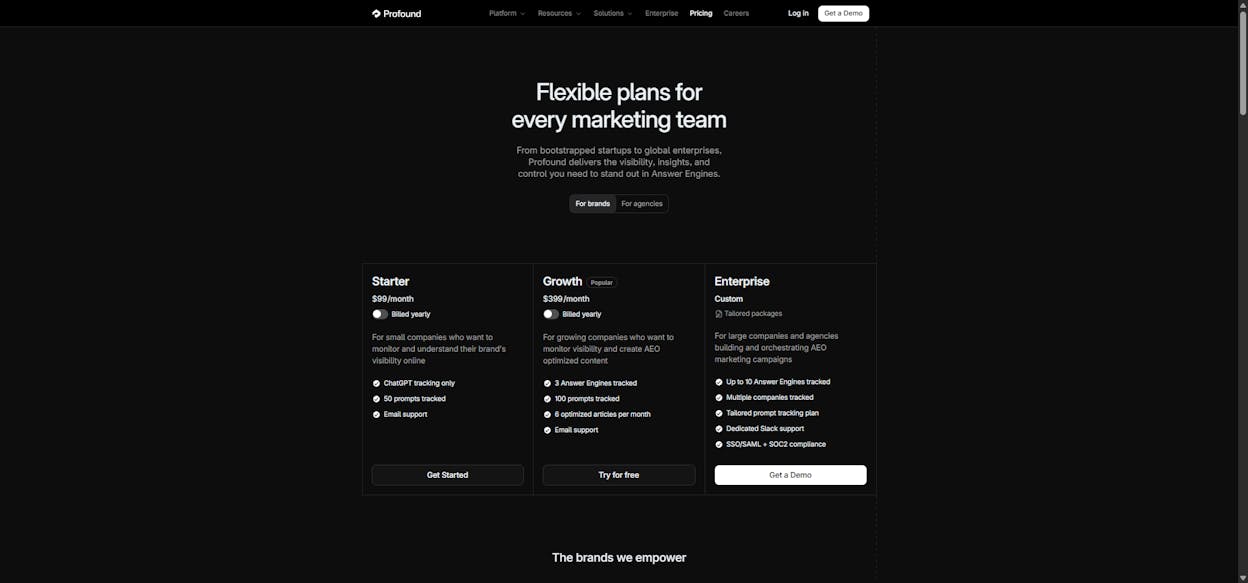
Profound has a three-tier structure that gets more honest the further down the page you scroll.
|
Plan |
Price |
What you get |
|---|---|---|
|
Starter |
$99 per month |
ChatGPT only, limited prompts, one region, one seat |
|
Growth |
$399 per month |
ChatGPT + Perplexity + AI Overviews, ~100 prompts |
|
Enterprise |
Custom (typically $2,000+ per month) |
10+ engines, 150+ regions, SOC 2 Type II, SSO, white-glove onboarding |
The $99 Starter plan is a single-engine demo. Independent reviewers and Profound’s own positioning push Growth as the practical floor. Native tracking for Claude, Gemini, Grok, DeepSeek, and Copilot lives inside custom Enterprise contracts.
Side-by-side, with real engines added
A fair like-for-like comparison is a mid-market team that wants daily tracking across five engines (ChatGPT, Perplexity, Gemini, Claude, and Copilot).
|
What you need |
Peec AI |
Profound |
|---|---|---|
|
100 prompts, 5 engines, daily |
Pro at €205 plus €140 for two extra engines = ~€345 |
Growth at $399 covers 3 engines. Five engines = Enterprise contract. |
|
Multi-country coverage |
Pro and up |
Enterprise only |
|
API access |
Advanced and up |
Enterprise only |
|
Unlimited seats |
Yes, every plan |
Tier-dependent |
Peec AI wins at the SMB-to-mid-market band because the math has more give. Profound’s reporting depth is real, but you pay enterprise prices to unlock it.
Engine coverage matters more than you think
If a tool only tracks ChatGPT and Perplexity, you’re missing engines that quietly drive traffic in B2B (Claude in dev workflows, Copilot in Microsoft 365), consumer (Gemini in Google’s product surface), and APAC markets (DeepSeek). The engine your buyers use may not be on your pricing tier.
Peec AI covers ChatGPT, Perplexity, and AI Overviews on every plan, with paid add-ons for the rest. Profound’s Starter is ChatGPT-only, Growth adds Perplexity and AI Overviews, and Enterprise unlocks the long tail. The “starting at $99” headline is a sample. The working price is a contract.
Prompt tracking and prompt discovery
Prompt visibility is the bedrock of any AI search platform. You need to see which questions surface your brand, how that changes across engines and weeks, and which prompts are worth adding next.
How Peec AI handles it
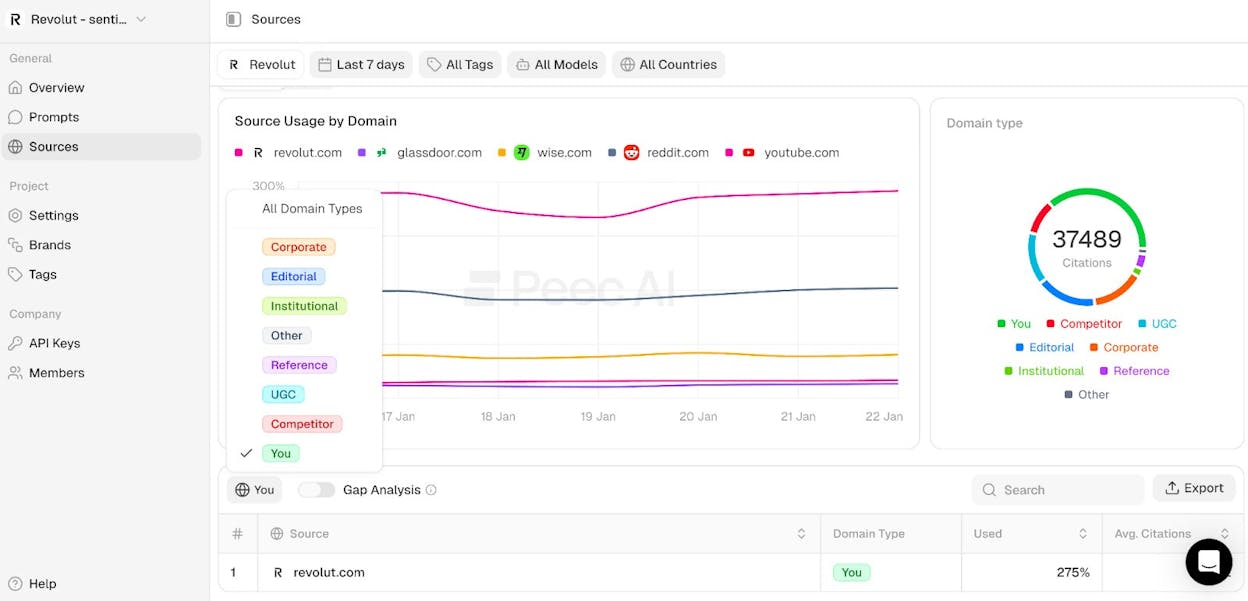
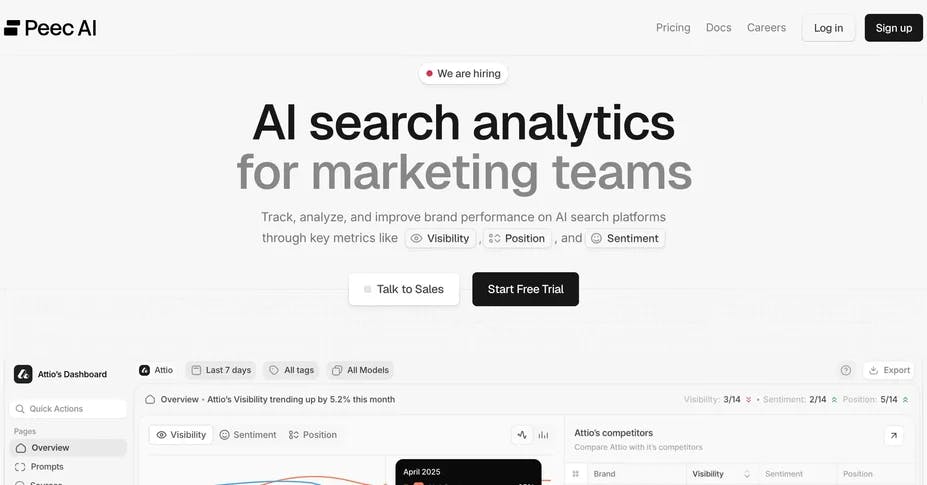
Peec AI’s interface reads cleanly on day one. You see visibility, position, sentiment, and the competitor stack on every tracked prompt. The downside is that prompt discovery is light. Peec surfaces related prompts, but the suggestions feel like a nudge on top of your existing strategy rather than a research engine.
How Profound handles it
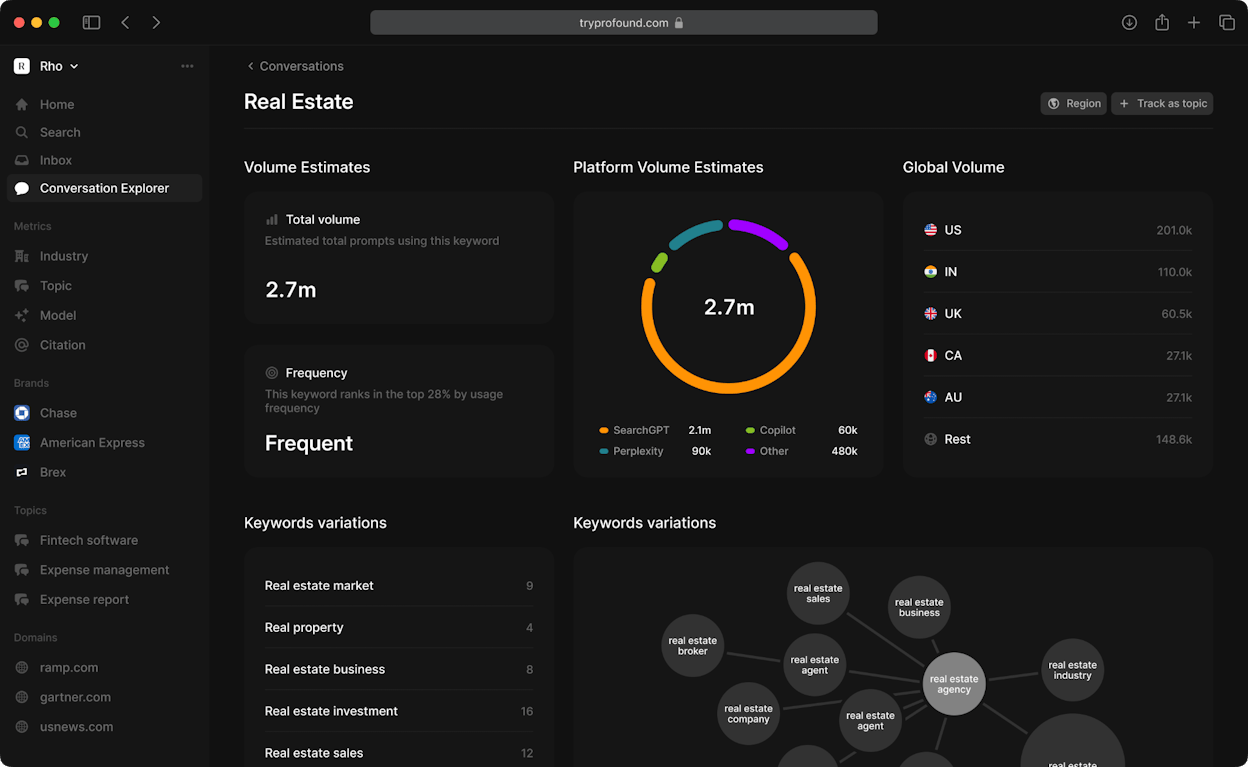
Profound goes deeper on slicing. You can group prompts into clusters, track them over longer time windows, and see provider-level patterns Peec keeps simpler. It reads less like a monitor and more like an analytics platform. The cost is cognitive load. Someone on your team needs to live in the dashboard and translate it into briefs.
Where the gap shows up
Neither tool turns a tracked prompt into a published page. You see the gap, you export the data, and your team picks up the work somewhere else. That handoff is the friction point most teams underestimate.
Citations and sources
Citations are how you reverse-engineer why AI engines mention competitors and not you. Both tools cover this, but the depth differs.
Peec AI shows cited URLs and domains for each tracked prompt in a clean view. The recent Actions feature clusters citations into owned-media opportunities (articles, comparisons, how-to guides) and earned-media gaps (Reddit threads, reference sites, press coverage). Each action gets a relative opportunity score. Useful, still in beta.
Profound goes deeper on the graph. You see which domains shape answers across providers and how that shifts month over month. The data density is the strength. The same density is the weakness when a marketing manager wants to know which three pages to brief next.
Both stop at telling you what to fix. Neither writes the fix.
Competitive analysis
Peec AI’s competitive view is digestible. You see who outranks you on which prompts, how visibility stacks up, and where the gaps live. For a five-person team, this is usually enough to inform messaging and content priorities.
Profound treats competitive analysis as market intelligence. Share of voice trends, citation share by domain, and prompt-level displacement at a level that fits a leadership reporting cadence. Profound’s outputs format more naturally for a CMO. Peec’s outputs ship faster.
AI traffic attribution is the wall both tools hit
This is where the diagnostic-tool ceiling shows up.
Peec AI does not estimate AI-referred traffic natively. You can pair it with Google Analytics, but the platform doesn’t tie tracked prompts to sessions or conversions inside its UI. You see visibility, not pipeline.
Profound has some traffic visibility, but native GA4 integration on Starter and Growth is limited. Full attribution lives further up the tier ladder.
If you can’t tie a prompt to a session to a deal, you can’t defend the line item. This is the most common reason GEO budgets stall after six months.
What both tools leave on the table
Peec AI and Profound are tracker-first products. They tell you what is happening. They don’t run the work that has to happen next.
After you see a competitor took your spot on a key prompt, someone still has to pull the prompt cluster into a structured brief, cross-reference Search Console keywords for the page, write the rewrite, run an AEO audit on the draft, push it to your CMS, schedule a follow-up to verify the citation came back, and tell your CMO it worked.
In most teams, that workflow lives across five tools and three people. Visibility tracking is one slice. Execution is the rest. This is the part Analyze AI was built to close.
Where Analyze AI fits
Analyze AI is the agentic SEO and content platform that runs the full loop, from discovery to brief to draft to publish to attribution. Every layer Peec AI and Profound sell exists in Analyze AI, plus the layers they stop short of.
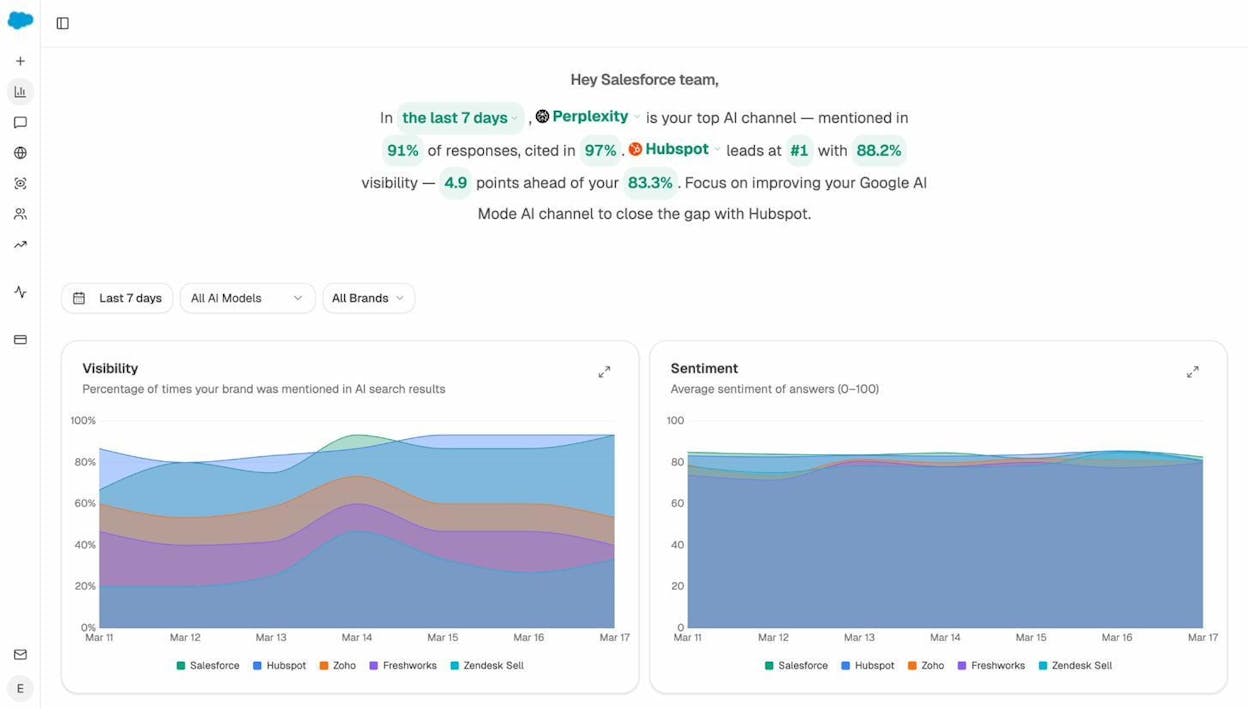
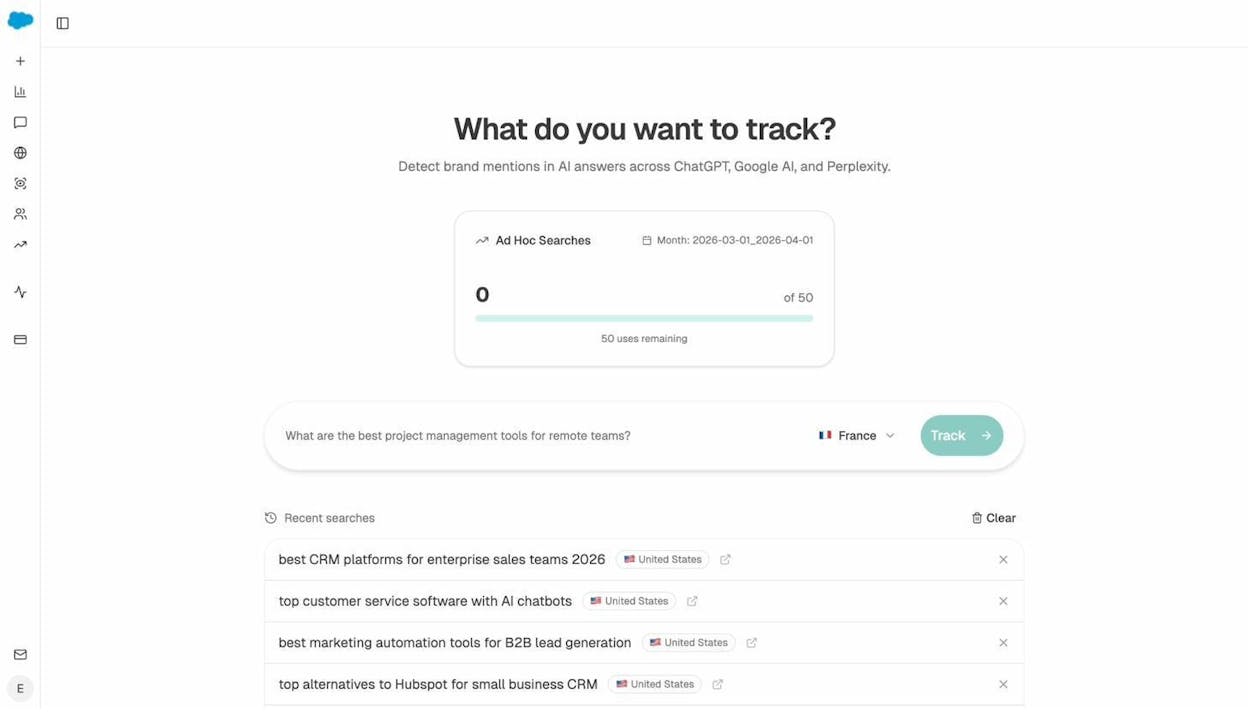
Prompt tracking, prompt discovery, and ad-hoc search in one place
You track prompts the same way you would in either tool. Daily runs across ChatGPT, Claude, Gemini, Perplexity, Copilot, and more, with per-engine breakdowns for visibility, position, sentiment, and citation density.
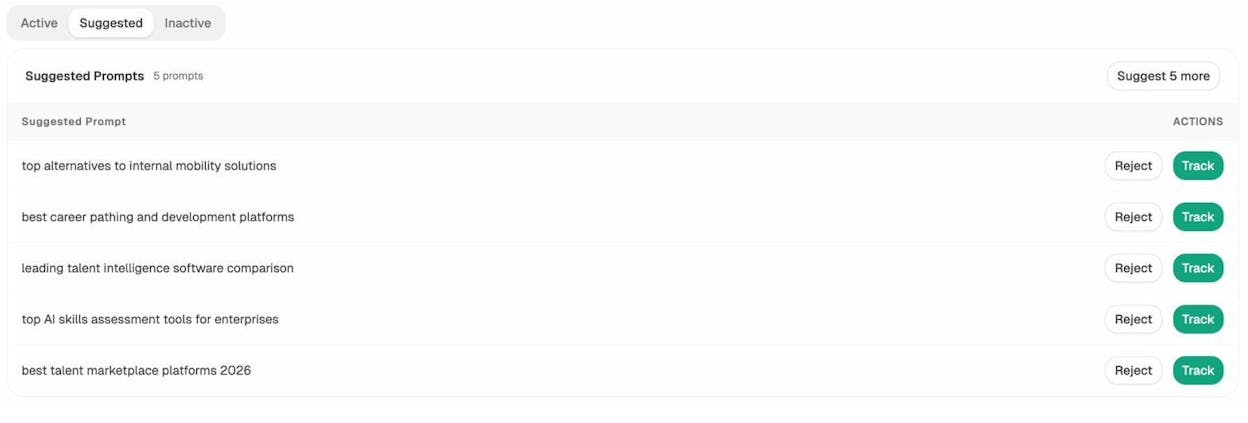
Where it goes further is suggestion. The Prompt Tracking engine reads your existing prompts, your competitors, and emerging clusters, then proposes prompts to add next. Accept or reject with one click, and the new prompts feed straight into daily tracking.
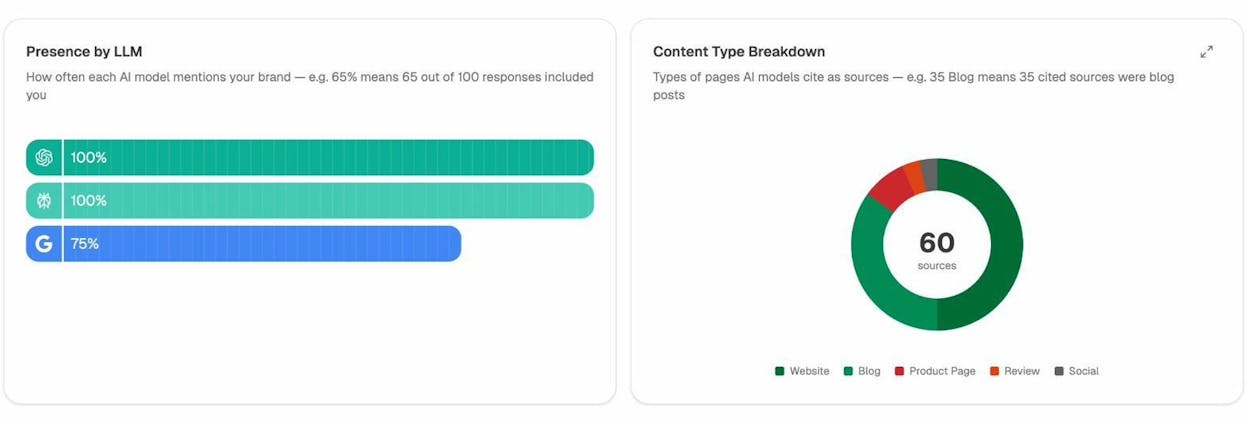
You can also run ad-hoc prompt searches without setting up tracking. Type a query, see how your brand shows up across engines in real time, and decide whether the prompt earns a tracking slot.
Citation analytics that map the full graph
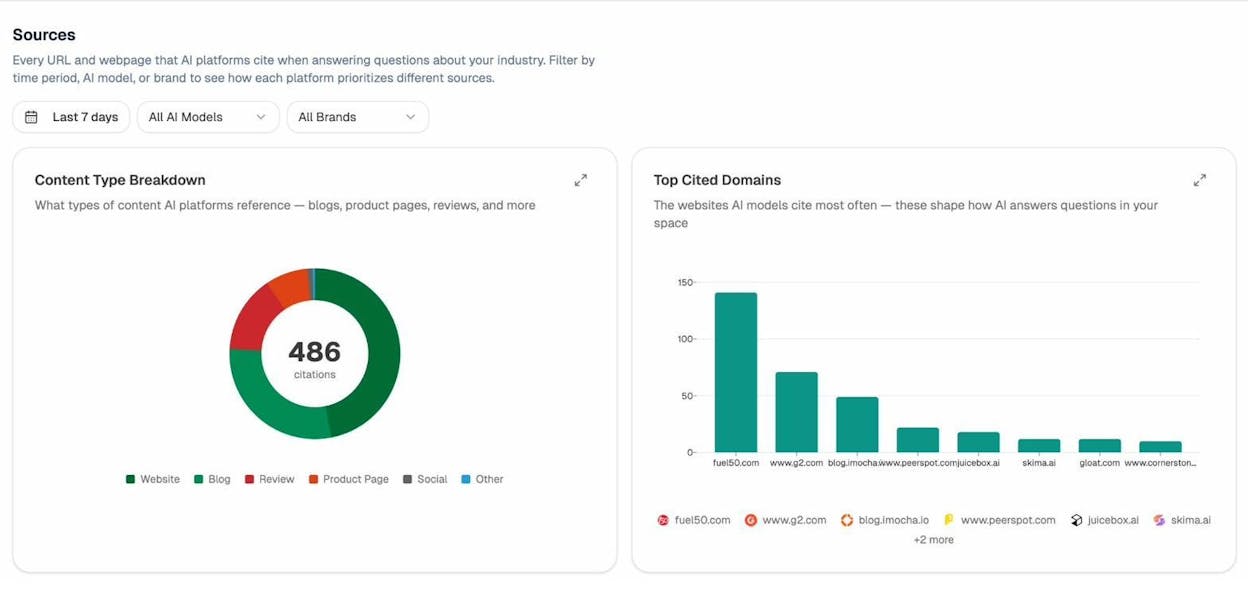
The Citation Analytics view shows the full graph. Which URLs each engine cites, how often, and the difference between citations you earn and citations your competitors earn. Filter by engine, prompt cluster, or domain to find which pages on your site already pull citations and which competitor pages keep taking your spot.
Competitor intelligence that gets specific
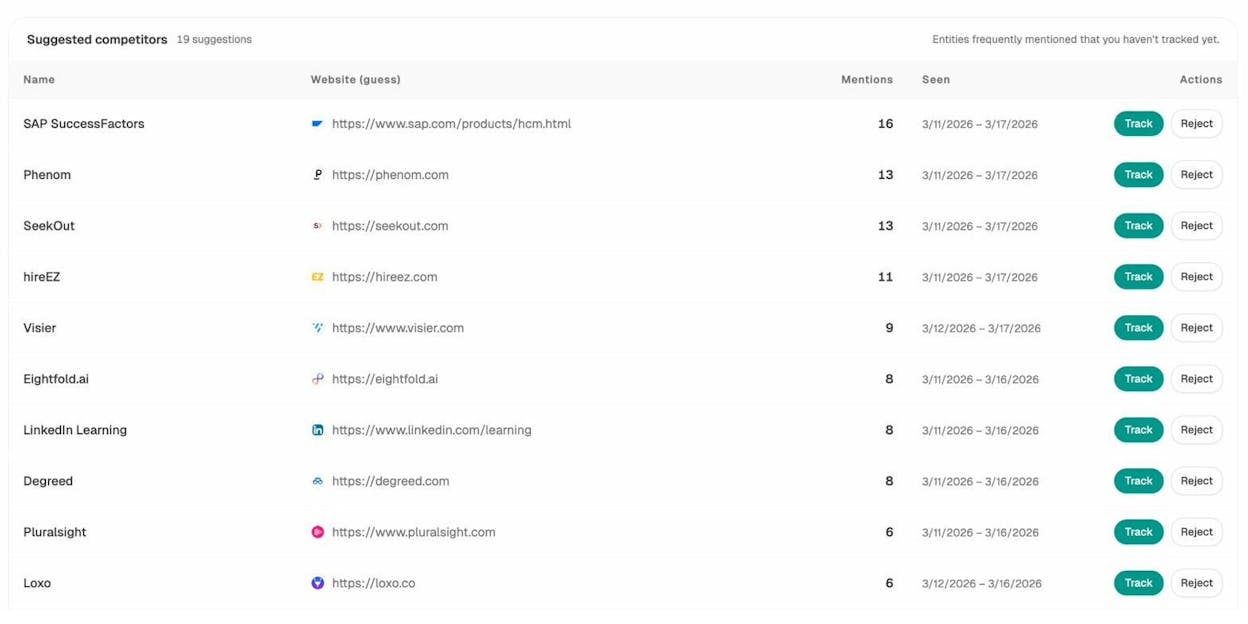
Instead of a generic share-of-voice number, Competitor Intelligence shows prompt-level displacement. Which competitor replaced you, when, and on which engine. You also get suggested competitors based on who keeps appearing alongside you in your tracked prompts, so the rivalry stays calibrated to what AI engines actually think.
AI traffic analytics tied to GA4
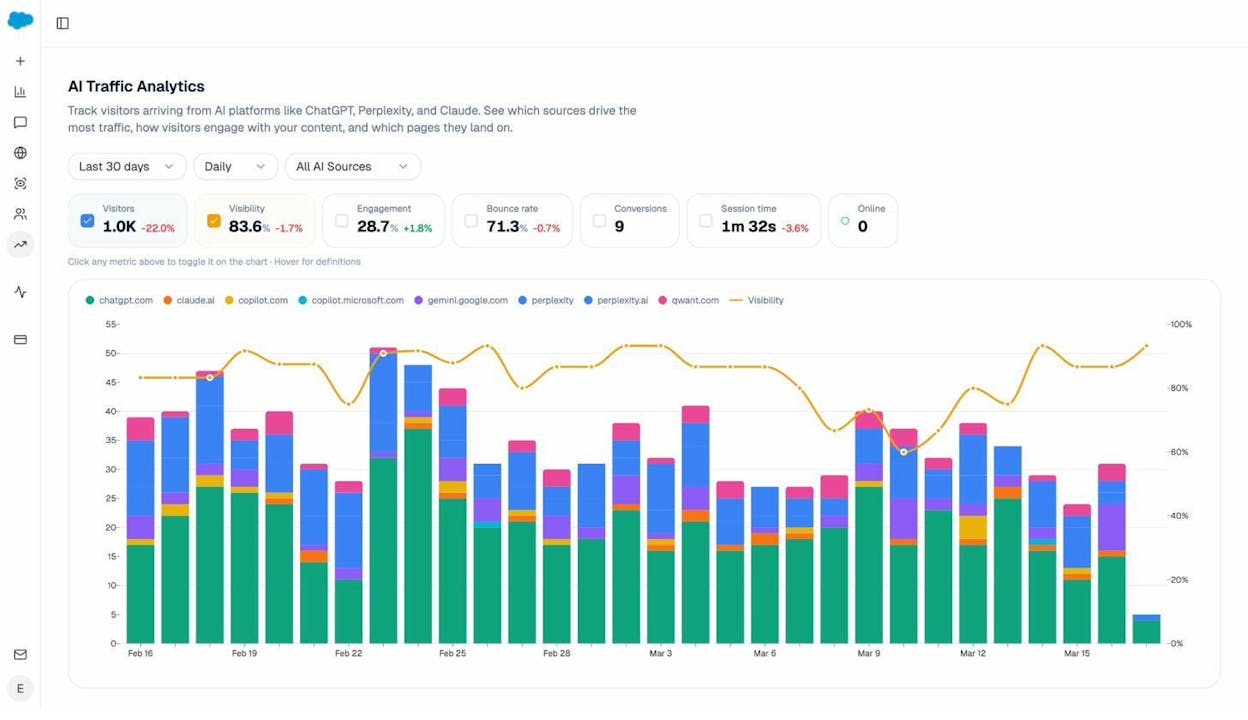
Connect Google Analytics 4 and the AI Traffic Analytics layer ties every AI-referred session to the engine that sent it, the landing page it hit, the conversion event, and the revenue. The Landing Pages report inside this view is the workhorse for finding patterns in which pages already pull traffic from AI engines, so you can write more in that vein.
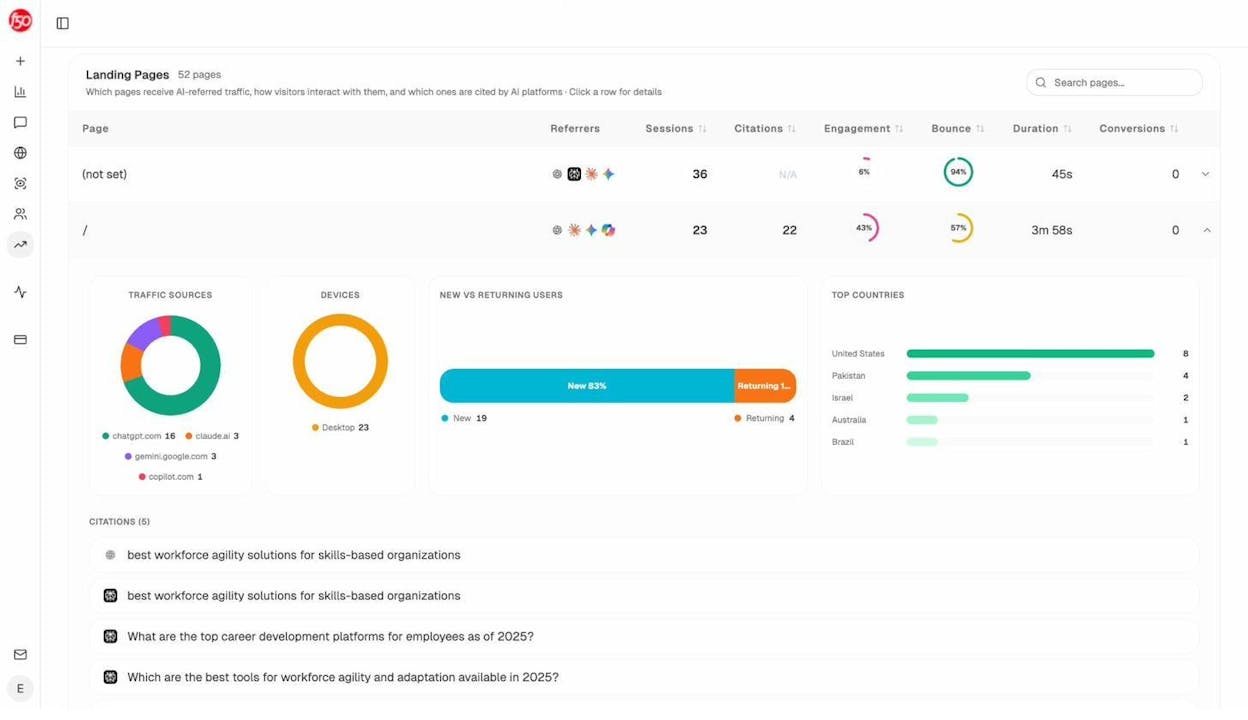
This is the layer Peec AI does not have natively, and the one Profound gates behind enterprise contracts.
Content Writer that runs the full pipeline
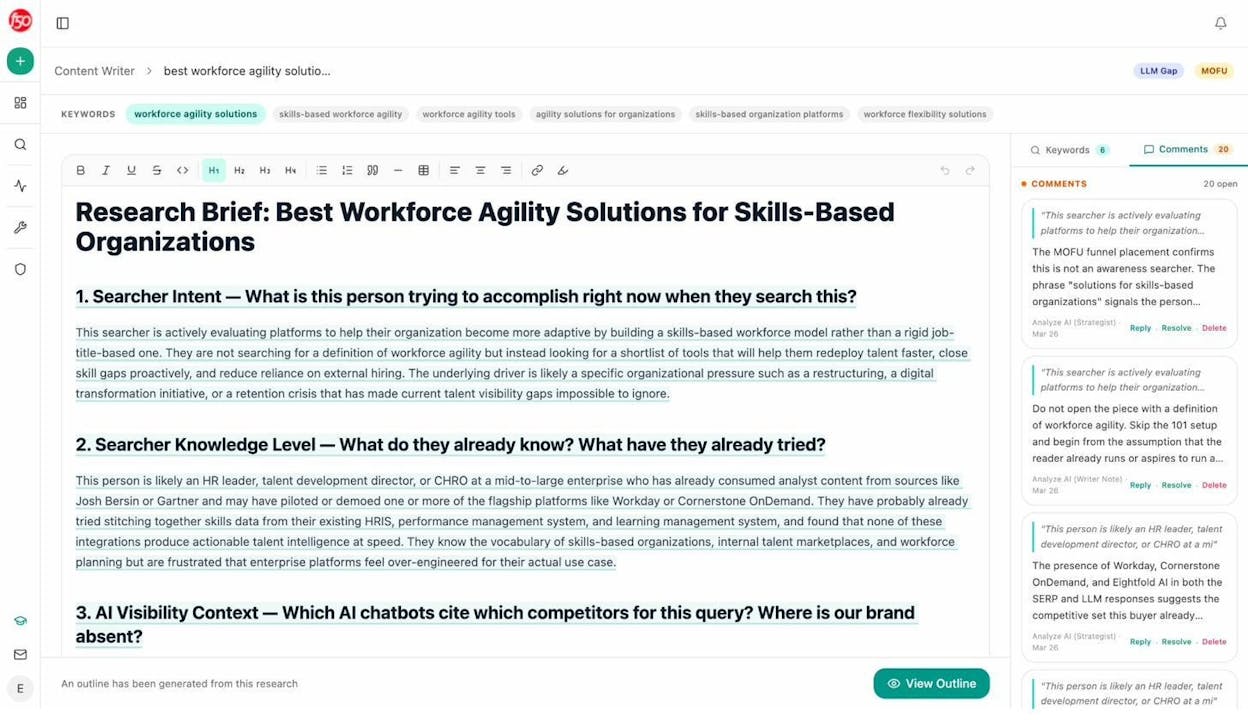
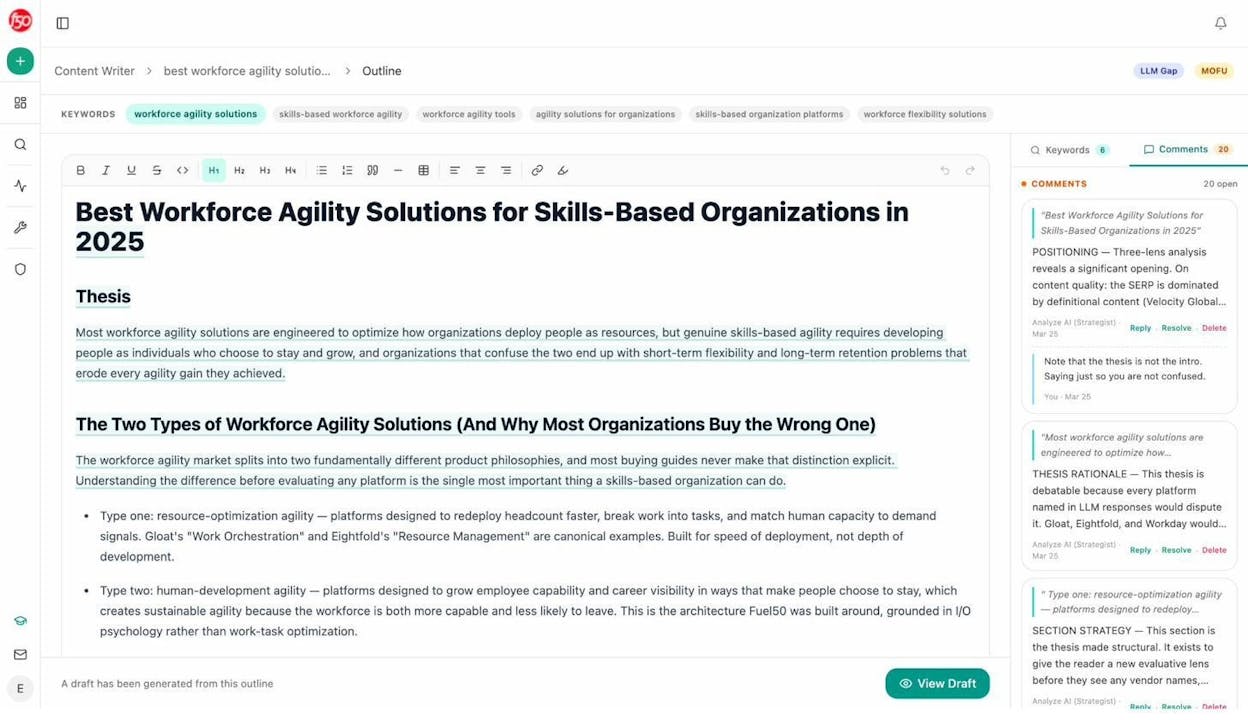
The Content Writer is a four-step pipeline. Research, outline, draft, brand voice. Every step takes the prior step’s structured output and adds an editorial layer on top. Editor comments live in the margin, so a human can intervene at any step instead of waiting until the end.
The difference from a single-shot “generate an article” tool is the method. Each step has its own prompt and its own quality gate. Drafts read like a writer wrote them after a brief, not like a chatbot improvised one.
Content Optimizer that grades and rewrites
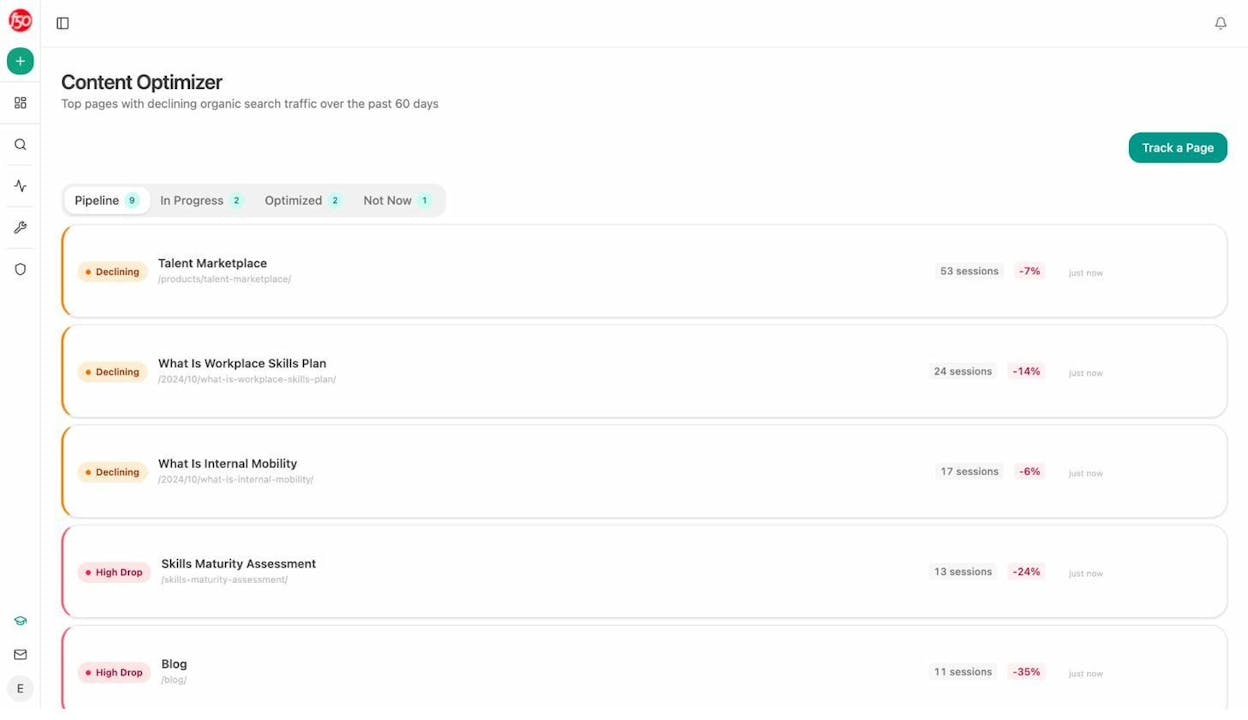
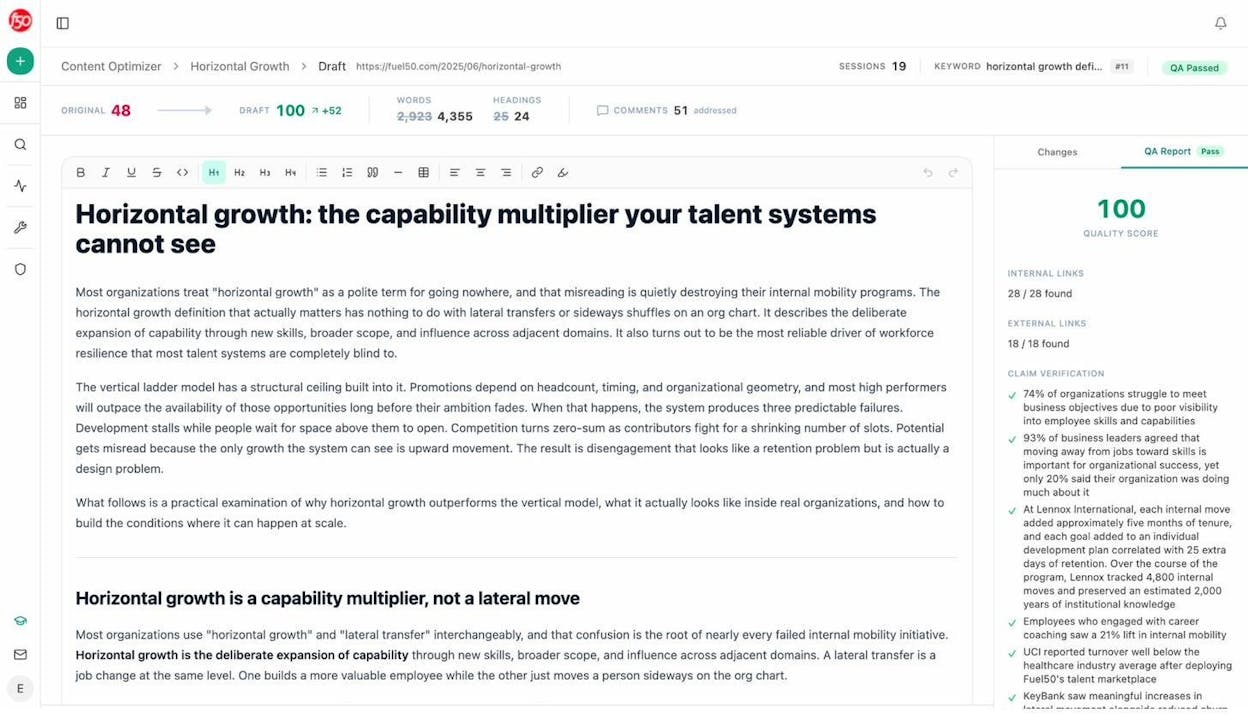
Paste a URL, and the Content Optimizer audits the page for AI Engine Optimization signals (structure, claim density, proof integration, citation patterns), surfaces the gaps, and rewrites the page section by section. Comments from the in-platform editor explain why each change matters. You don’t just get a score. You get the patch.
Agent Builder is the actual differentiator
This is the part neither Peec AI nor Profound has, and it’s the largest reason teams switch.
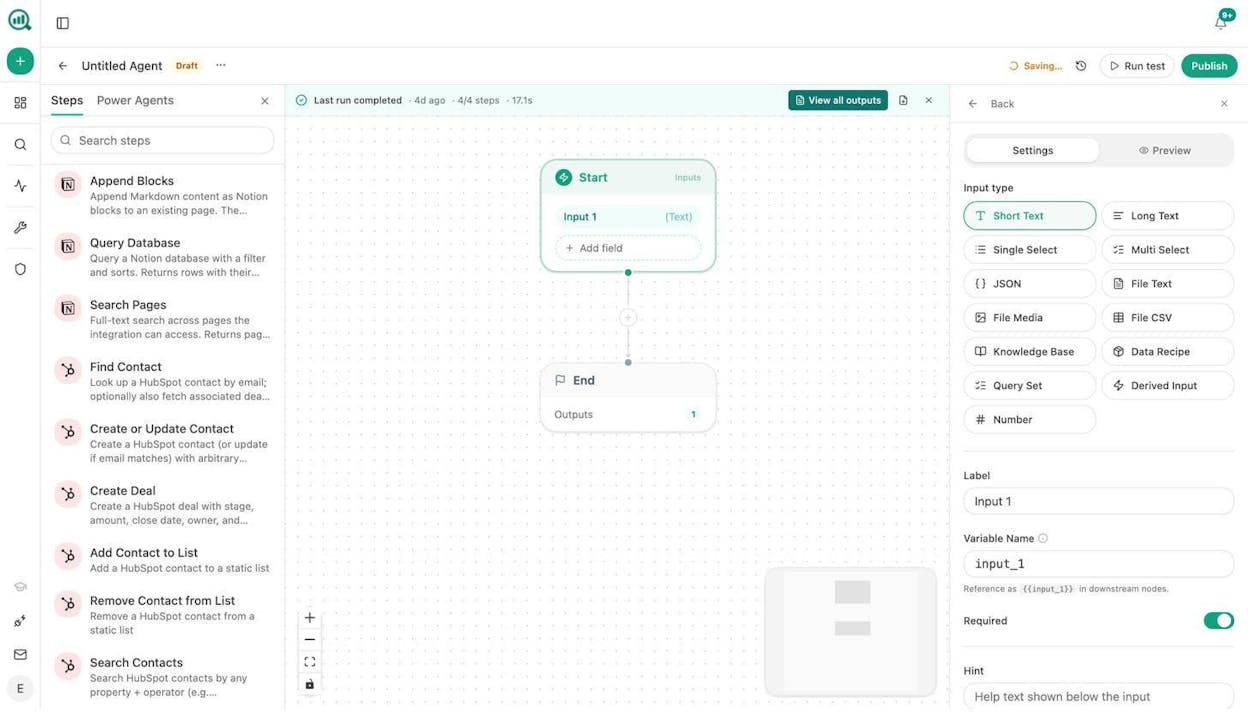
The Analyze AI Agent Builder is a programmable substrate with 180+ nodes and 34 pre-built data recipes covering AI visibility, Search Console, GA4, DataForSEO, Semrush, HubSpot, Notion, WordPress, Sanity, Contentful, Mailchimp, Hunter, Tomba, and image generation. It runs three trigger modes. Manual click for on-demand work, scheduled cron for recurring intelligence, or HMAC-signed webhook for event-driven automation from any external system.
Here’s what teams actually run.
-
Monday board prep. Scheduled every Monday at 7am. Pulls share-of-voice, GA4 AI traffic, GSC top pages, and new HubSpot deals. Drafts a brand-voice executive summary, exports to DOCX, and emails leadership. Replaces a four-hour analyst chase nobody has time for.
-
Brief-to-publish pipeline. Webhook fires when a brief moves to “approved” in Notion. Runs research, outline, draft, brand voice, AEO scorecard. If the score clears 80, publishes to WordPress with a featured image. If not, Slacks the writer with the gaps.
-
Content refresh fleet. Weekly schedule. Pulls stale and declining pages, rewrites for freshness and brand voice, diffs, and pushes a CMS update if the change is substantive.
-
Crisis early warning. Every 15 minutes. Watches brand mentions and news. If sentiment crosses a threshold, Slack and email immediately with the source URL and a draft response.
-
Inbound lead enrichment. Webhook from your CRM. Verifies the email, pulls a domain audit, scans recent news, upserts the contact in HubSpot, and Slacks the assigned AE. The lead is researched before anyone opens it.
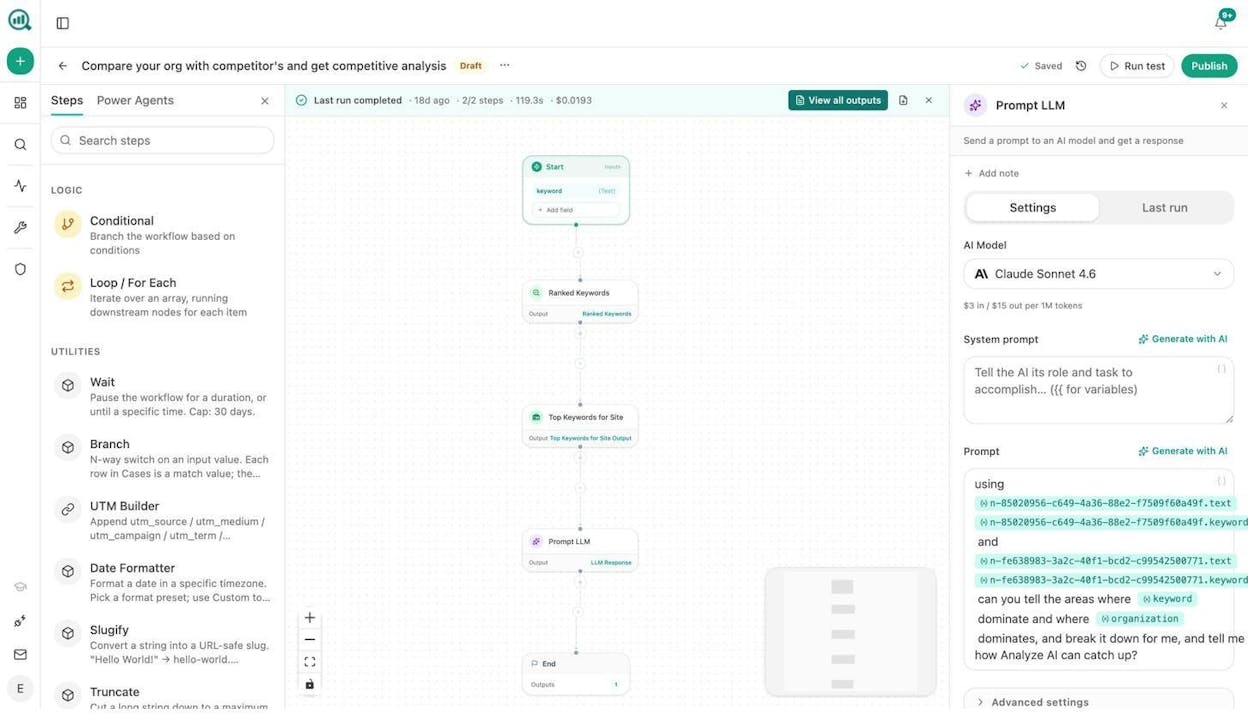
A scheduled agent does the same job every Monday at 7am and never forgets. A webhook agent collapses the lag between event and action from days to seconds. A manual agent is the on-demand specialist for one-off briefs and audits. This is why AI search visibility is one of the things you can do with Analyze AI, not the only thing.
Weekly Email Digests that arrive without you asking
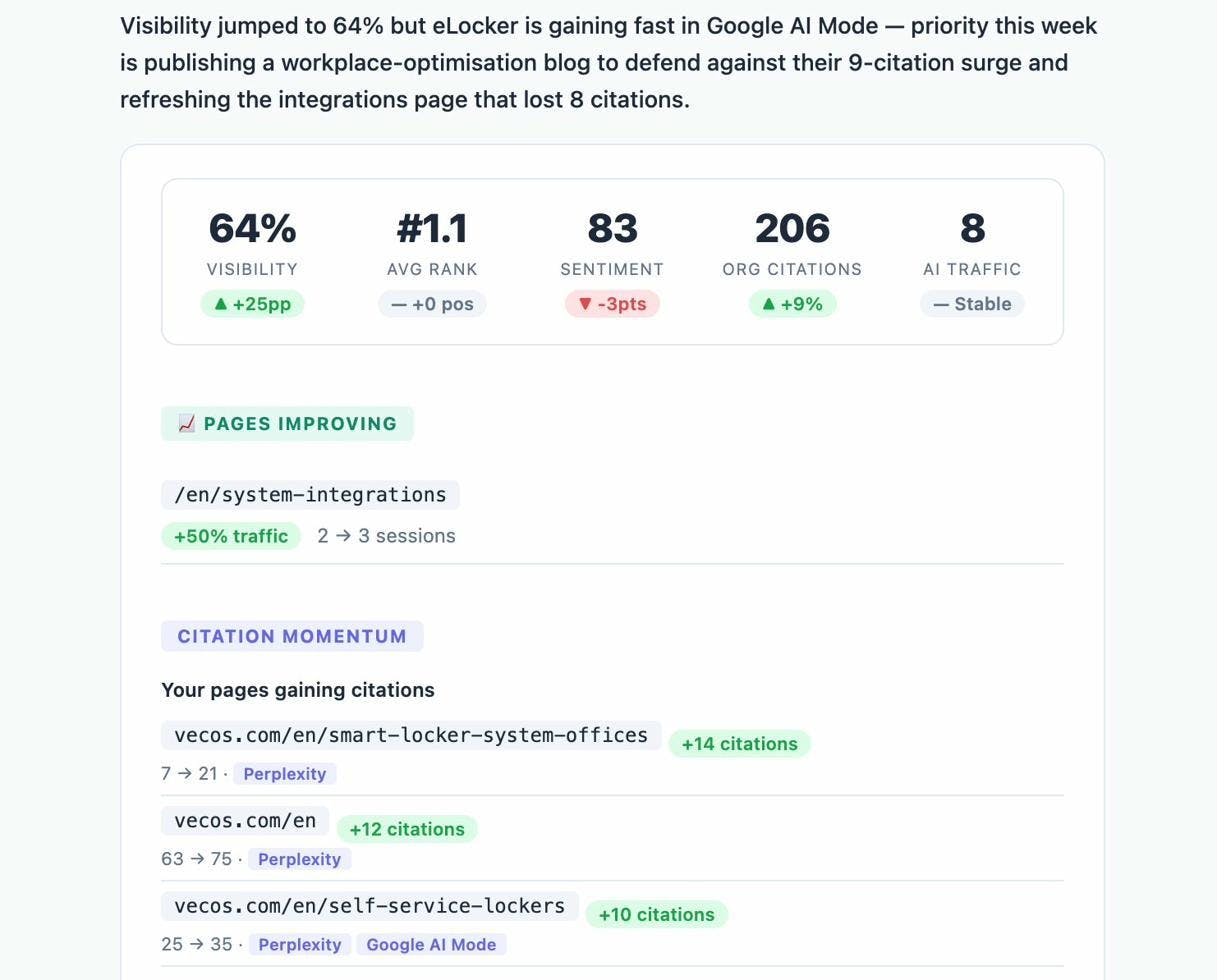
Every Monday you get a prioritized action list in your inbox. Competitor moves, new citation opportunities, sentiment shifts, AI traffic deltas. The kind of report you’d assemble manually on Sunday night, sent to you instead. The Weekly Email Digests page covers the full setup.
Side-by-side feature matrix
|
Capability |
Peec AI |
Profound |
Analyze AI |
|---|---|---|---|
|
Default engines included |
3 (Starter+) |
1 (Starter), 3 (Growth) |
All major engines, no tier gating |
|
Prompt suggestion |
Light |
Moderate |
Native, ranked by relevance and conversion potential |
|
Ad-hoc prompt search |
Limited |
Limited |
Yes, no setup required |
|
Citation graph |
Per-prompt view |
Full provider depth |
Full graph by engine, domain, frequency, plus hallucination detection |
|
AI traffic attribution |
Not native |
Limited, gated by tier |
Native GA4 tied to sessions, conversions, and revenue |
|
Content writer |
No |
No native pipeline |
Research → Outline → Draft → Brand Voice pipeline |
|
Content optimizer |
No |
No native page rewriter |
Audit, gap analysis, section rewrites with editor comments |
|
Agent builder |
No |
No |
180+ nodes, 34 data recipes, manual/scheduled/webhook triggers |
|
Headline price |
€85 to €425+ per month |
$99 to $2,000+ per month |
$99 per month |
Which one belongs in your stack?
If you’re an SMB or mid-market marketing team and you want to start tracking AI visibility this week, Peec AI is a clean entry point. The interface reads on day one and you can be live in an afternoon. Plan for the model add-ons if you grow into multi-engine tracking.
If you’re a Fortune 500 brand with a dedicated GEO program, a SOC 2 mandate, and a multi-region footprint, Profound earns the spend. The reporting fits the audience, the data density rewards an analyst, and the procurement cycle is one you’re built for.
If you’re a marketing team, an agency, or a content operation that needs the visibility layer plus the execution layer, Analyze AI is the upgrade. You stop paying for a tracker that just tells you what already happened, and you start running the full loop in one platform. The Analyze AI vs Peec AI and Analyze AI vs Profound pages walk through every line item.
One last thing worth saying. AI search is not replacing your SEO program. It’s another organic channel that runs on the same content quality and operational discipline you’ve been building for years. The brands that win in AI answers are the brands that win in Google. The tool you pick should keep both channels compounding.
Ready to see what your AI visibility actually looks like? Start a project at tryanalyze.ai and connect Google Analytics 4 to see attribution populate in real time.

Ernest

Ibrahim


