



Summarize this blog post with:


ZipTie does one thing well. It tracks whether your domain shows up in Google AI Overviews, ChatGPT, and Perplexity. For teams whose only question is “are we appearing?”, that is a fine starting point.
But in 2026, three engines is not enough. Google AI Mode is growing fast. Gemini is embedded across Google Workspace and Android. Claude is gaining traction with professional and technical buyers. Copilot sits inside every Microsoft product. If your visibility tool only watches three of those surfaces, you have a blind spot the size of half your market.
Then there is pricing. ZipTie uses a credit-based model starting at $69/month for 500 checks, with strict single-seat limits on every plan. That works for a solo practitioner tracking a handful of queries. It gets expensive fast when you add teammates, clients, or more prompts.
In this article, you’ll learn which AI visibility tools actually solve the problems ZipTie leaves open, what each one costs, which engines they track, and how to choose the right one based on whether you need monitoring, optimization, or both.
Table of Contents
Quick comparison: all 7 ZipTie alternatives at a glance
|
Tool |
Engines tracked |
Best for |
Pricing starts at |
Optimization built in? |
|---|---|---|---|---|
|
ChatGPT, Gemini, Perplexity, Claude, Copilot, DeepSeek, Meta AI, Google AIO |
Full-funnel visibility tied to traffic and conversions |
Transparent tiers, no credit math |
Yes (Writer, Optimizer, Agent Builder) |
|
|
ChatGPT, Perplexity, Gemini, Google AIO |
Multi-engine monitoring and competitor benchmarks |
~$50/mo |
No |
|
|
ChatGPT, Perplexity, Gemini, Google AIO |
Technical GEO monitoring and trend analysis |
Contact for pricing |
No |
|
|
ChatGPT, Perplexity, Google AIO |
Actionable audits with prioritized fix lists |
$29/mo |
Audit-level guidance |
|
|
ChatGPT, Perplexity, Gemini, Google AIO |
Content teams that want monitoring + writing in one place |
Contact for pricing |
Content creation only |
|
|
Google AIO (expanding) |
SEO teams adding AI tracking to an existing suite |
Part of SE Ranking plans |
No |
|
|
ChatGPT, Gemini, Perplexity, Google AIO |
Early adopters and innovation-driven teams |
Contact for pricing |
Diagnostic only (AXP in beta) |
|
|
ChatGPT, Gemini, Perplexity, Google AIO |
Agencies layering AI visibility onto existing SEO reporting |
Part of Nightwatch plans |
No |
1. Analyze AI: the agentic platform for SEO, AEO, content, and GTM ops
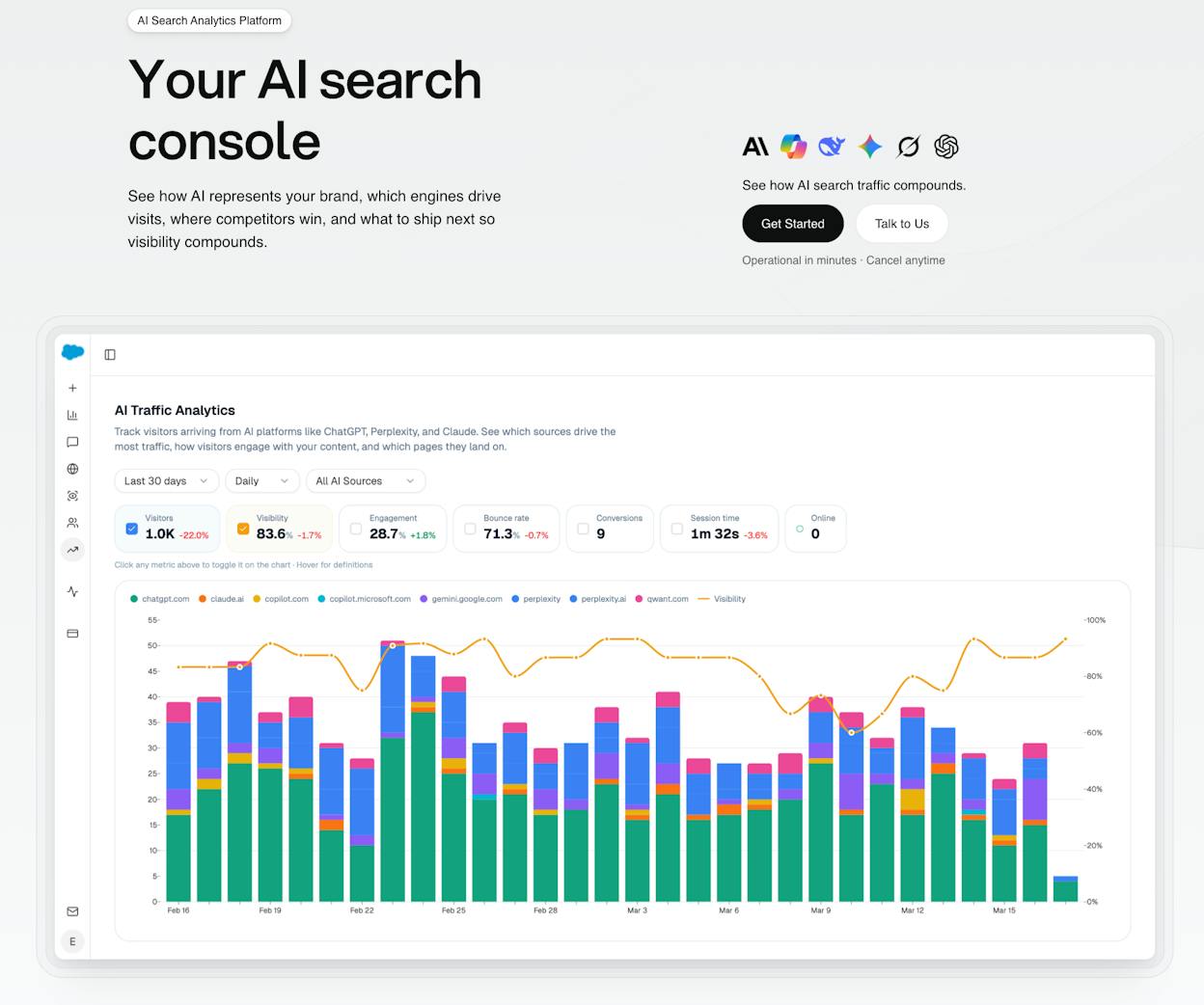
Most GEO tools answer one question: “Did we show up?” Analyze AI answers the five questions that come after it: Where did you rank? How were you described? Which competitor appeared instead? Did that visibility drive traffic? And what should you ship next?
That difference matters the moment your CMO asks you to defend AI search as a channel, not a curiosity.
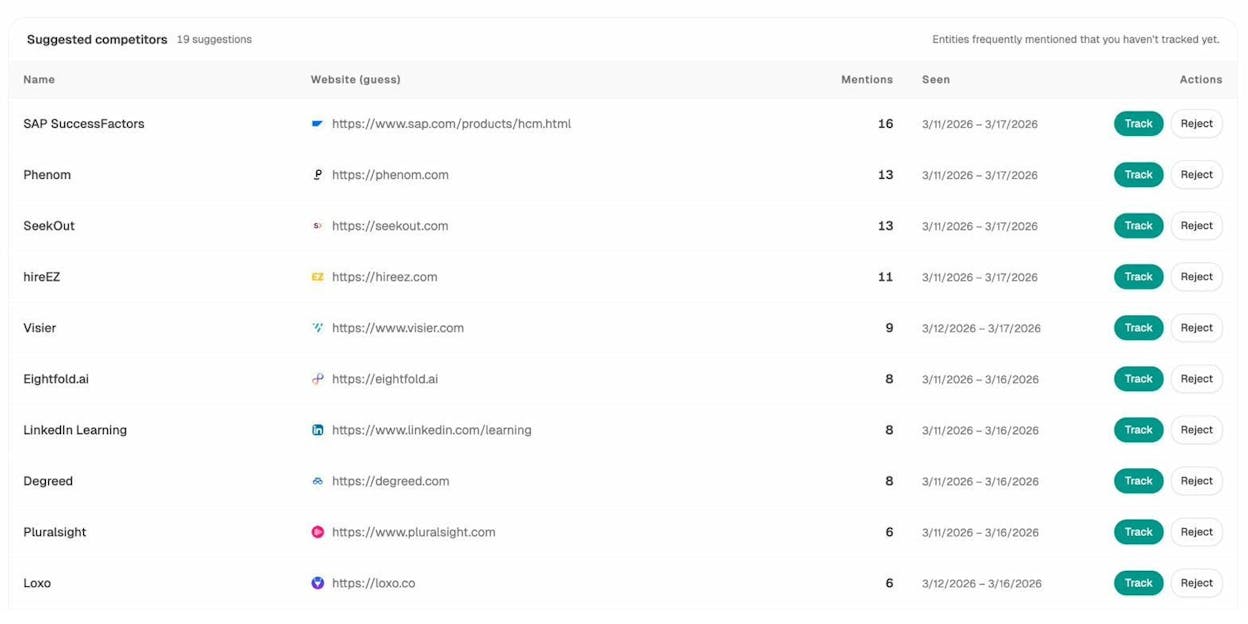
Track visibility across every engine your buyers actually use
ZipTie watches three engines. Analyze AI tracks ChatGPT, Gemini, Perplexity, Claude, Copilot, DeepSeek, Meta AI, and Google AI Overviews. You set the prompts that matter to your category, and Analyze AI monitors how those prompts are answered, who gets recommended, which sources get cited, and how sentiment shifts over time.
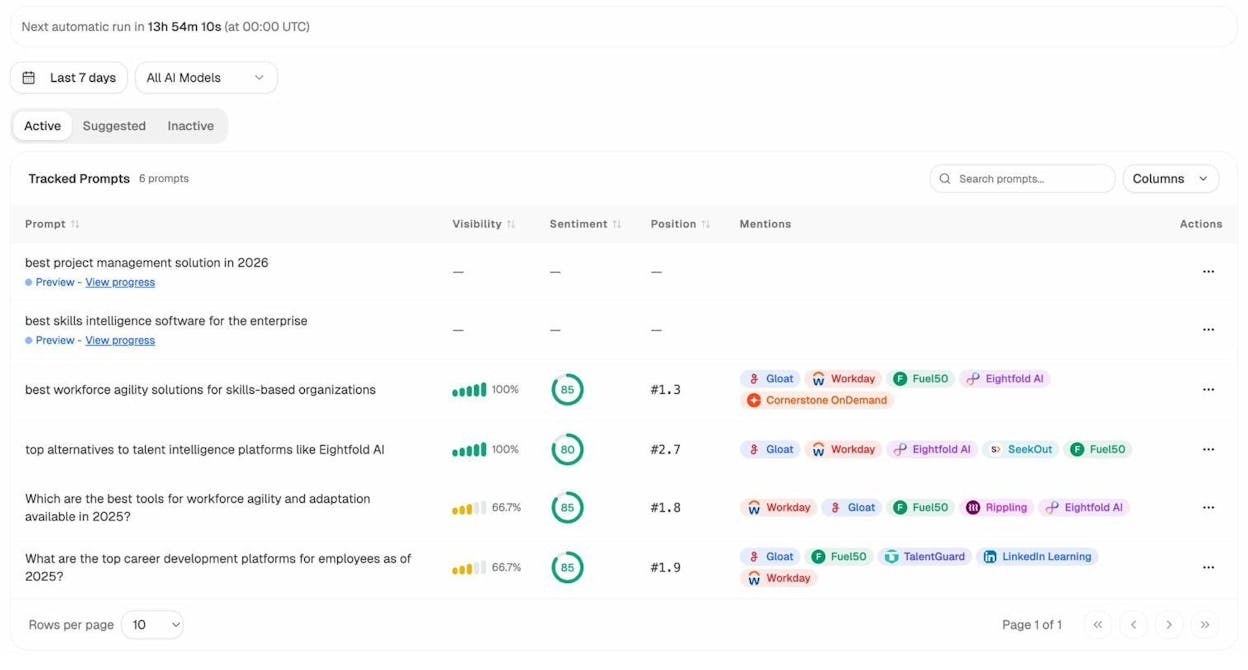
You can also test any prompt on the fly without adding it to a full tracking campaign. That is useful when you need to validate an idea before committing resources.
Tie visibility to traffic, conversions, and revenue
This is where Analyze AI pulls furthest ahead of every tool on this list. The AI Traffic Analytics module connects your GA4 data to show exactly which engines are sending visitors, which landing pages receive that traffic, and how those visitors convert.
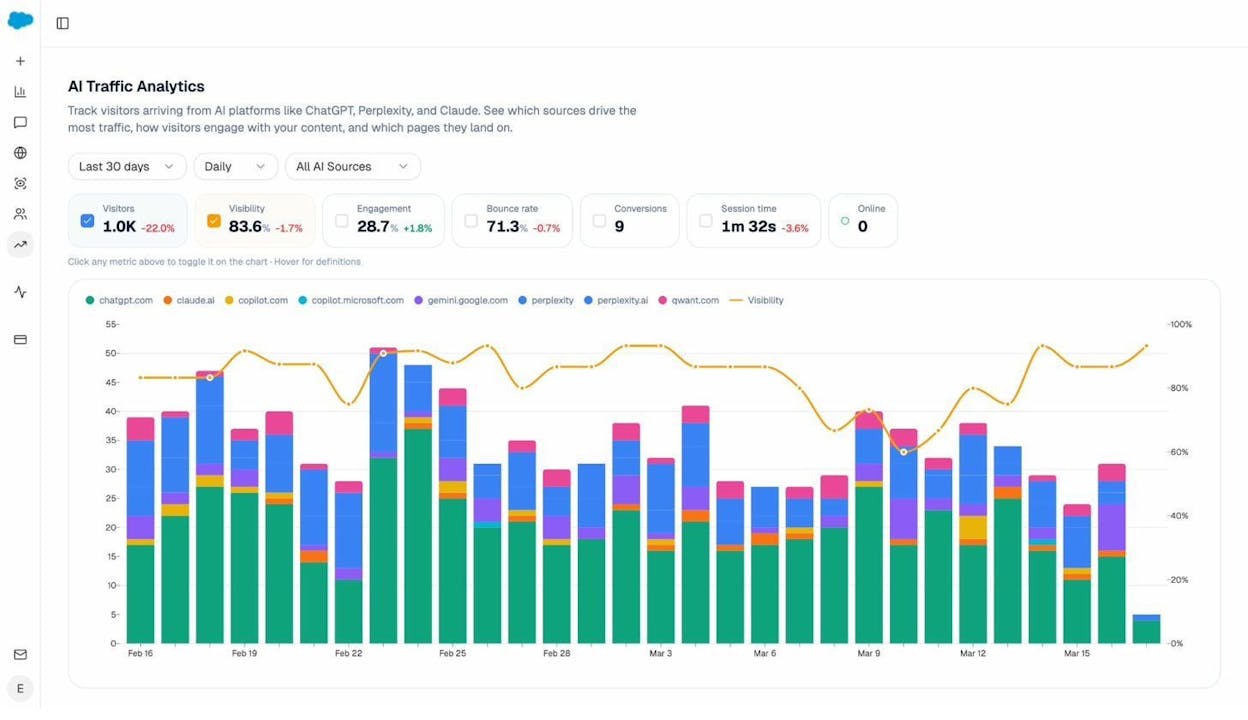
If Perplexity is quietly driving qualified traffic to a feature page that already converts at 5%, you see that and you can double down. If Claude is sending visitors to an outdated blog post that leaks conversions, you see that too, and you know where to fix the funnel first. No other tool on this list connects AI visibility to revenue outcomes this directly.
Spot where competitors win instead of you
For every tracked prompt, Competitor Intelligence shows which rival gets recommended, which claims the model repeats about them, and which source content earned those claims. You also see which prompts consistently produce a competitor but never produce you.
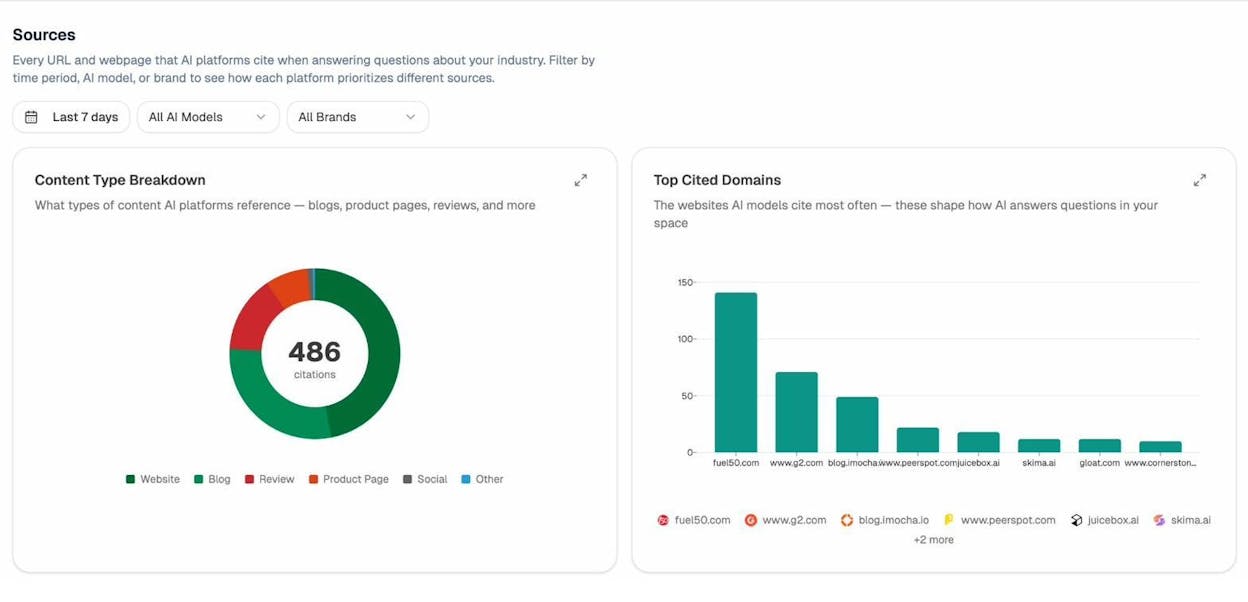
That is not just monitoring. That is a competitive playbook. You know which angles are winning, which content backs those angles, and exactly where your own coverage falls short.
Write and optimize content that earns citations
Most visibility tools stop at the dashboard. They tell you there is a gap, then leave you to figure out the fix in a different tool. Analyze AI closes that loop with two features that no competitor on this list matches.
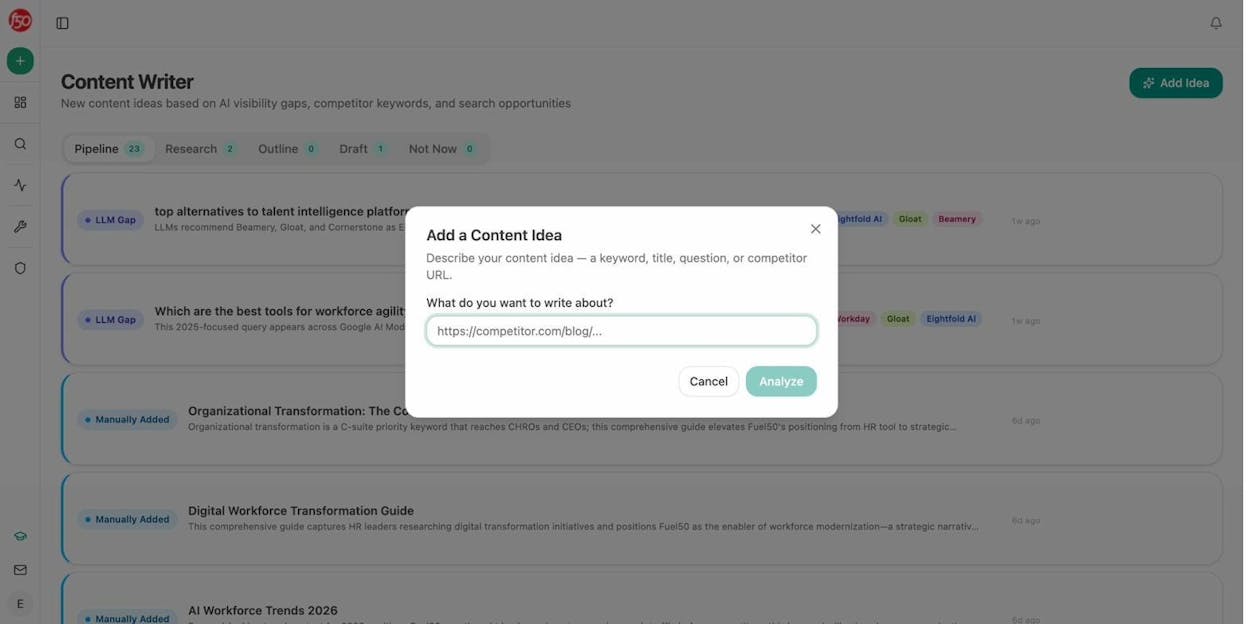
The AI Content Writer takes you from idea to research to outline to draft, with LLM visibility gaps, competitor analysis, and editorial comments baked into every step. It does not just generate text. It researches your topic against what AI engines are already citing, identifies argument gaps, and builds the draft around them.
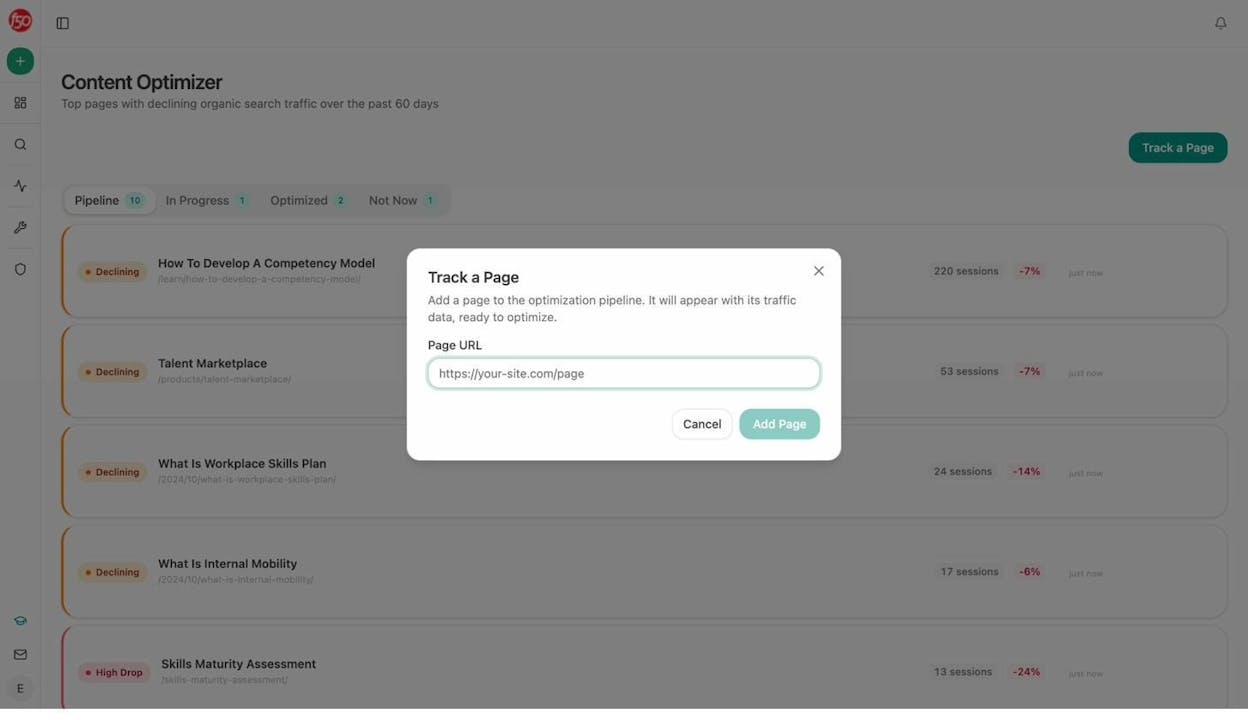
The AI Content Optimizer works the other direction. Paste a URL, and it scores the page for argument flow, clarity, entity coverage, and citation readiness. Then it rewrites the weak sections with specific improvements, not generic suggestions.
Automate the entire workflow with the Agent Builder
This is the feature that separates Analyze AI from every other tool in this category, and the one most people underestimate until they see what it actually does.
The Agent Builder is a programmable substrate with 180+ nodes, 34 pre-built data recipes, 13 input primitives, and three trigger modes (manual, scheduled, webhook). It connects directly to GA4, Google Search Console, DataForSEO, Semrush, HubSpot, Notion, WordPress, Slack, Mailchimp, and every major LLM.
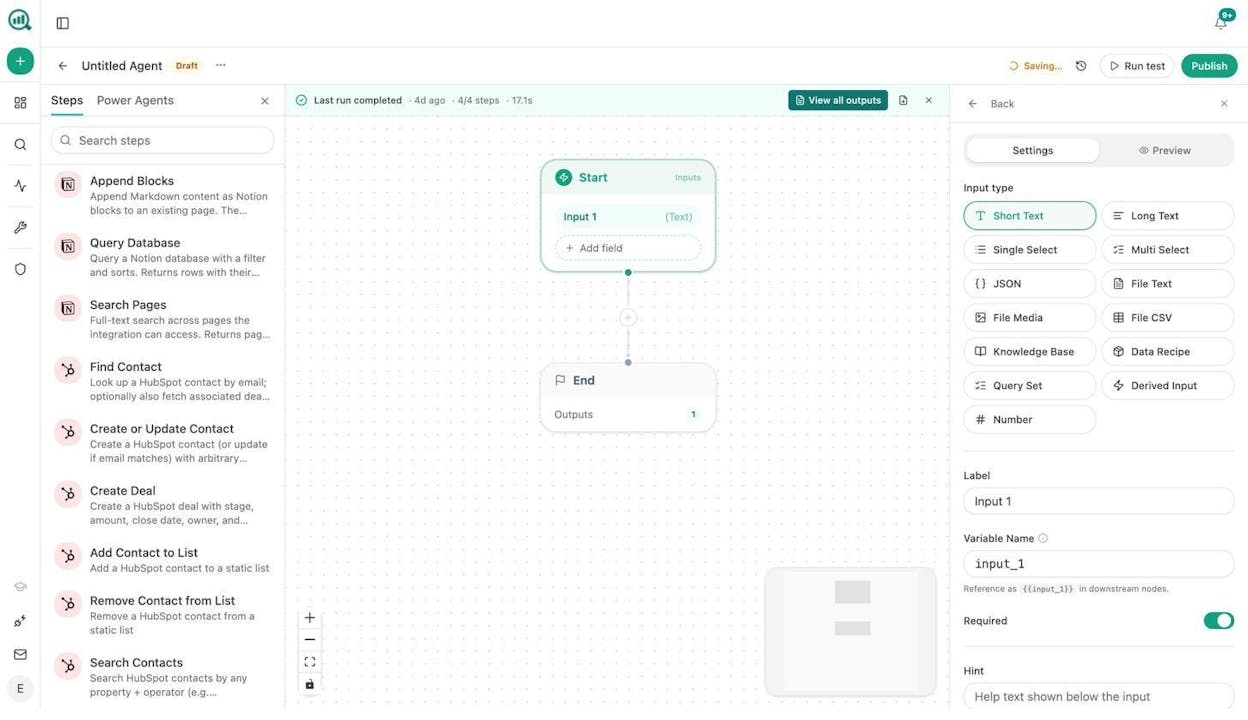
That means you can build workflows like:
-
Monday board prep for leadership: A scheduled agent pulls your AI visibility delta, GA4 traffic, new HubSpot deals, and competitor shifts, then assembles an executive summary and emails it to your leadership team every Monday at 7am. No analyst chase. No forgetting to check.
-
Content refresh fleet: A weekly agent identifies pages losing AI citations and organic traffic, rewrites them for freshness and brand voice, runs a quality gate, and publishes the update to WordPress. The “quietly losing rankings” problem solves itself.
-
Crisis early-warning: An agent checks brand mentions and news every 15 minutes. If sentiment drops below your threshold and reach exceeds a minimum, it Slack-messages your team with the source URLs and a draft response. You hear about negative coverage before your CEO does.
-
Brief-to-publish pipeline: When a content brief moves to “approved” in Notion, the agent generates research, builds an outline, writes a full draft with brand voice injected, scores it for AI citation readiness, and either publishes to WordPress or Slack-messages the writer with the gaps.
These are not templates. You compose from primitives. The practical surface area runs into millions of useful configurations. If you can describe the workflow, you can build it.
Govern your brand narrative
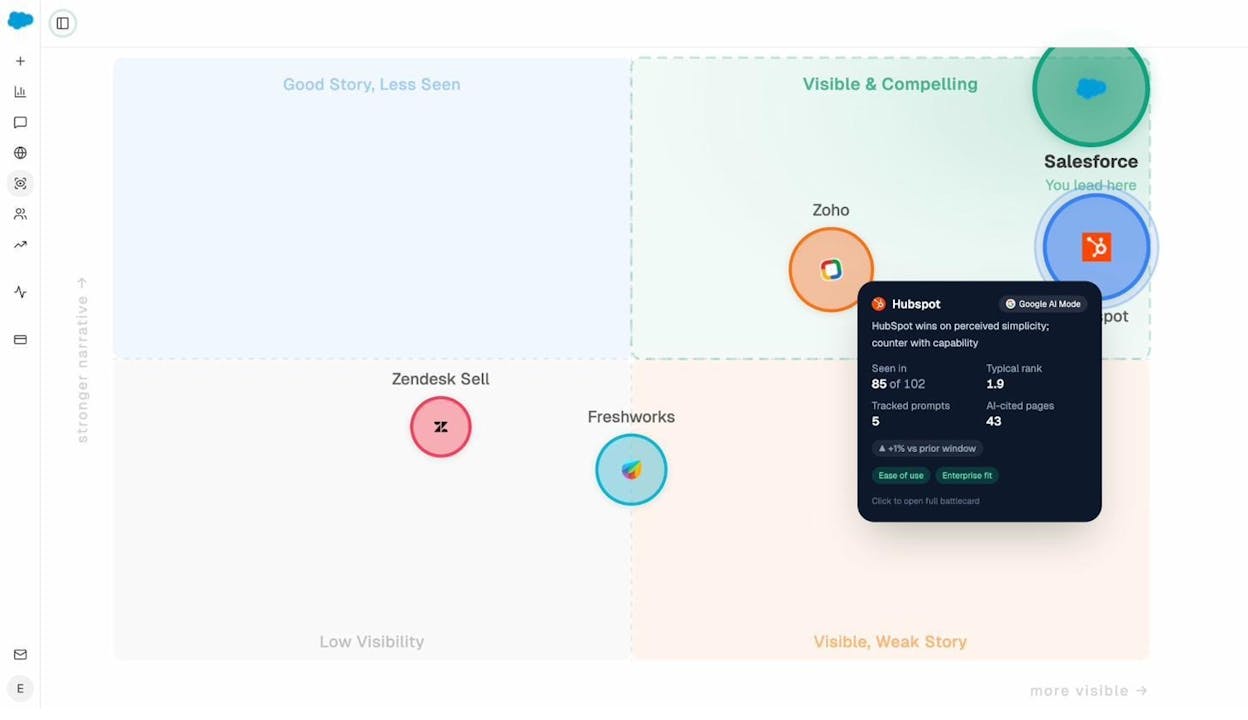
The Perception Map plots every tracked brand on a quadrant (presence vs. narrative strength). The AI Battlecards give your sales team ready-made counter-arguments based on how AI engines describe your competitors. And Sentiment Monitoring catches negative narratives before they spread.
You also get Weekly Email Digests with prioritized actions, citation changes, and competitor shifts delivered every Monday. No login required.
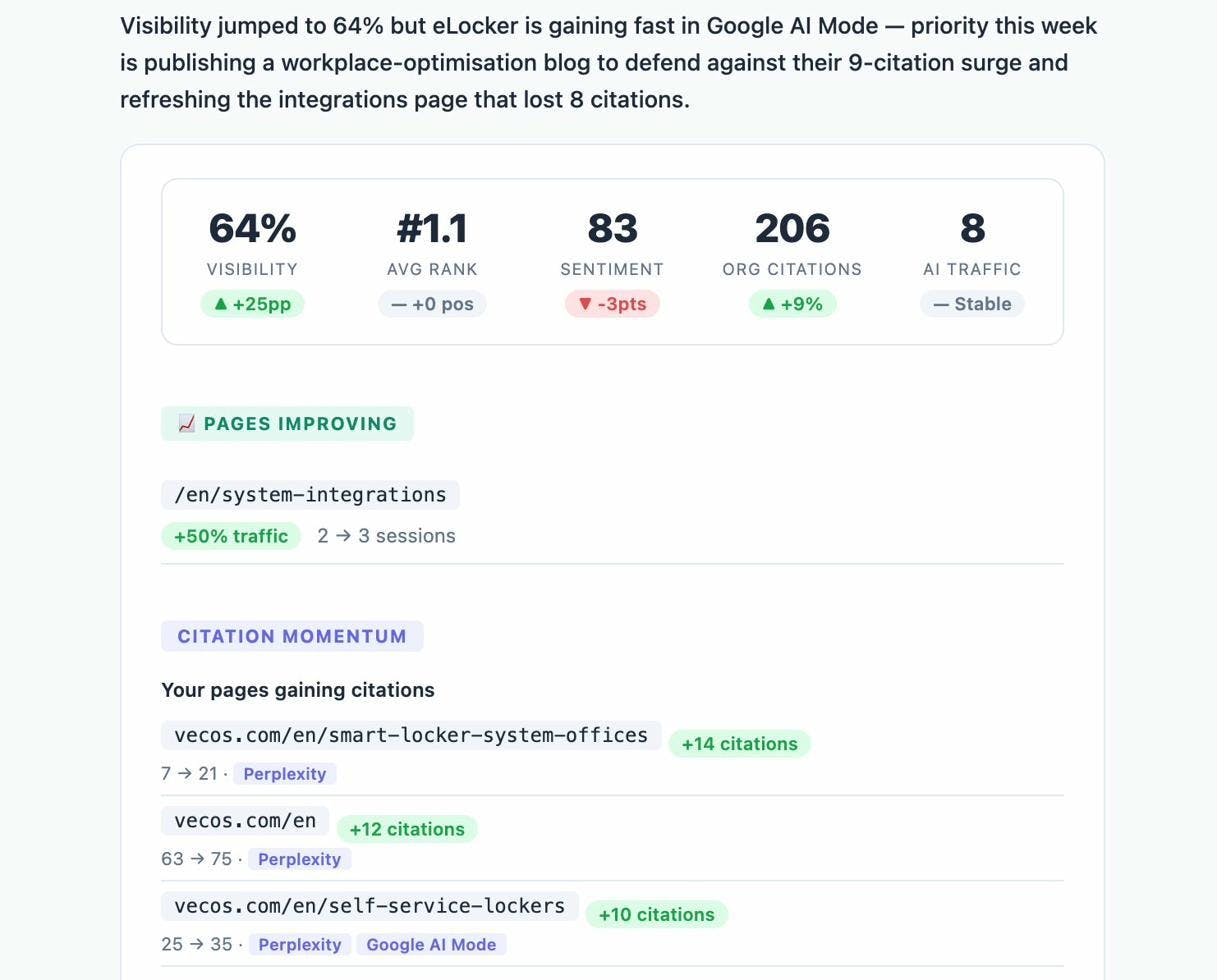
Bottom line: Analyze AI is not an AI search layer you bolt onto your stack. It is the agentic platform for SEO, AEO, content, and GTM ops that can pull data from anywhere, act on it automatically, and tie the results to revenue. If ZipTie’s 3-engine limit, credit-based pricing, or monitoring-only approach is holding you back, this is the upgrade that closes every gap at once.
2. Peec AI: best for multi-engine monitoring and competitive proof
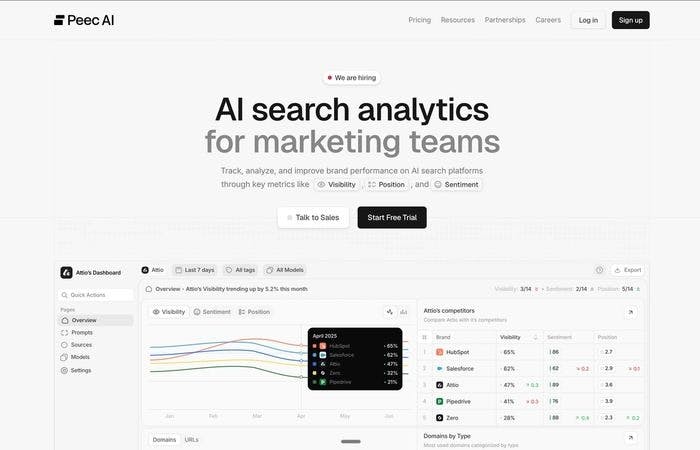
Peec AI tracks visibility across ChatGPT, Perplexity, Gemini, and Google AI Overviews through prompt-level monitoring. For every prompt you track, it records the exact answer, your position, and the pages that earned the citation. That is more engine coverage and more answer context than ZipTie provides.
Where Peec stands out is competitive benchmarking. You can compare share of voice, rank position, and citation frequency across the same prompt set, then export results to Looker Studio for stakeholder reporting. Agencies that need cross-engine proof for client pitches will find real value here.
The tradeoff is that Peec is a measurement tool, not an action tool. It tells you what is happening but does not help you fix it. You will still need a separate content platform to plan changes, write updates, and publish. And the API layer can feel narrow for teams building custom pipelines.
Best for: Content and SEO leads who need prompt-level proof and clear competitor deltas.
Watch out for: No built-in optimization or content workflows.
3. Rankscale.ai: best for technical GEO monitoring and trend analysis
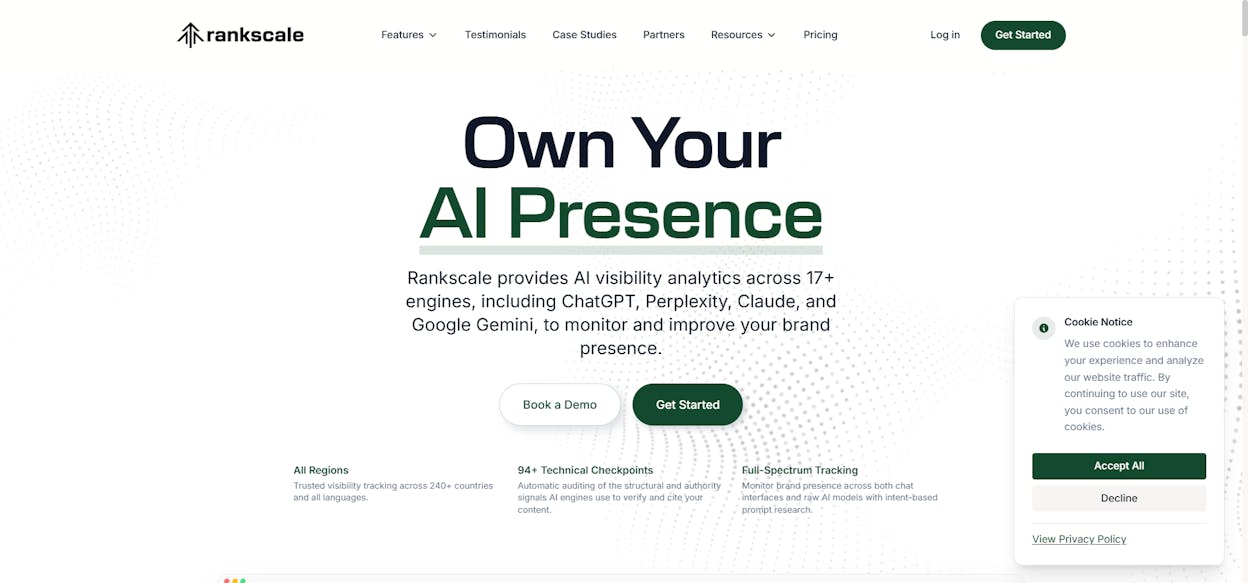
Rankscale.ai approaches AI visibility the way traditional SEO treats keyword rankings. It assigns an AI Visibility Score per engine, stores answer snapshots, and plots trend curves so you can see how your position changes over time. It also runs an AI readiness audit that checks schema, metadata, and content structure for citation eligibility.
For analysts and technical SEOs who want quantitative depth, Rankscale delivers data that is hard to get anywhere else. You can compare visibility movement across engines, measure citation frequency, and diagnose structural issues that block AI citations.
The downsides are real, though. The interface is still maturing, documentation lags behind new features, and there are few public case studies to validate results. You need analytical skill to translate Rankscale’s numbers into content decisions. It gives you more data than ZipTie, but it also asks more of you.
Best for: Technical marketers and analysts who want rank-like metrics for AI search.
Watch out for: Steep learning curve and limited documentation.
4. Otterly.ai: best for actionable GEO audits on a budget
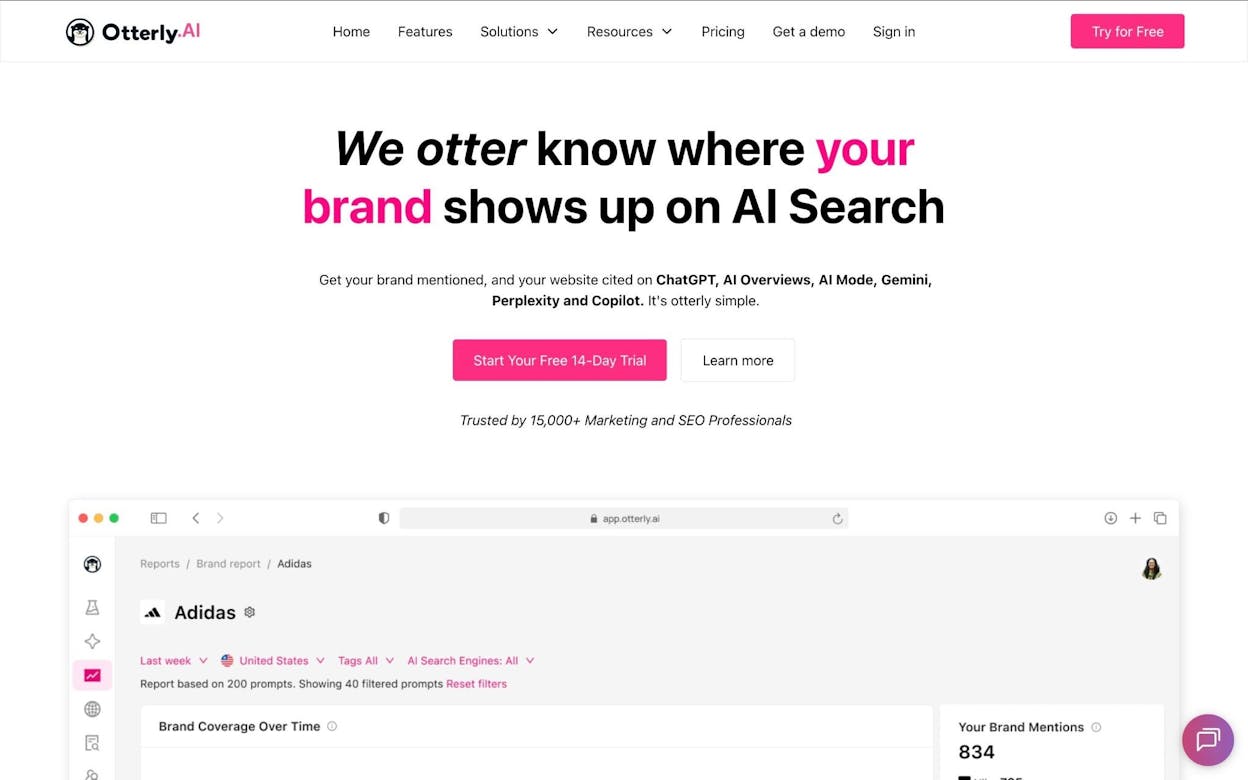
Otterly.ai combines visibility monitoring with a GEO Audit module that evaluates 25+ on-page and technical factors. After each audit, it ranks the most impactful fixes so you know which technical or content updates will most likely lift AI visibility. That “monitoring + what to fix” combination is the reason Otterly stands out at its $29/month entry price.
It also supports multi-country monitoring and integrates with Semrush, which means AI visibility metrics slot into dashboards your team already uses.
The limitations are coverage and depth. Otterly tracks ChatGPT, Perplexity, and Google AI Overviews, but does not cover Gemini, Claude, or Copilot. Its audit recommendations are useful for on-page fixes, but they do not extend to full content creation or automated workflows. And as a younger platform, it has fewer case studies and enterprise integrations than mature tools.
Best for: SEO managers who want prioritized fix lists tied to visibility data.
Watch out for: Limited engine coverage and no content creation features.
5. Writesonic GEO: best for combining monitoring and content creation
Writesonic GEO merges AI visibility tracking with a content creation platform. When visibility dips or a gap appears, you can rewrite the page right inside the same dashboard. That closed loop from insight to action is genuinely useful for teams that value speed over analytical depth.
The Prompt Explorer helps you find queries where your content underperforms, and the built-in editor lets you address those gaps without switching tools.
The tradeoff is analytics depth. Writesonic’s monitoring layer is lighter than what you get from dedicated visibility platforms. Prompt segmentation, long-term trend modeling, and advanced exports are limited. If you need intricate visibility visualizations or automated data pipelines, the analytics layer will feel thin.
Best for: Fast-moving content teams that want insight and editing in one place.
Watch out for: Less analytics depth than specialist tools.
6. SE Ranking: best for SEO teams adding AI tracking to an existing suite
SE Ranking’s AI visibility module adds AI Overviews tracking alongside traditional keyword rankings and backlink data. If your team already uses SE Ranking, this is the lowest-friction way to add AI monitoring without learning a new platform.
You can compare how each keyword performs in both organic results and AI-generated summaries, which helps you understand whether your SEO improvements also influence AI citations.
The limitation is scope. SE Ranking currently focuses on Google AI Overviews and is expanding slowly. Multi-engine coverage for ChatGPT, Perplexity, Claude, or Gemini is limited or absent. Teams that need dedicated prompt-level tracking across multiple engines will outgrow this module quickly.
Best for: SEO teams already on SE Ranking who want AI tracking without a new tool.
Watch out for: Narrow engine coverage, limited prompt-level analytics.
7. Scrunch AI: best for early adopters testing the edges of GEO
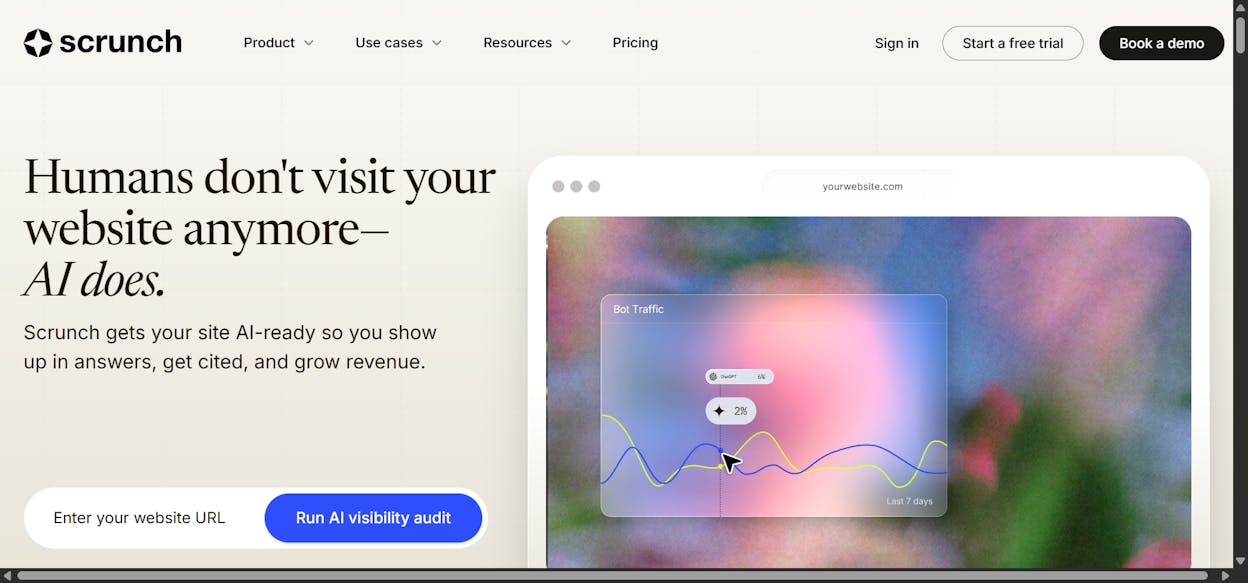
Scrunch AI takes a diagnostic approach to AI visibility. Beyond tracking mentions and citations, its Insights module identifies why gaps occur, whether that is outdated content, missing schema, or third-party sources distorting your brand perception. The journey mapping feature shows how AI agents navigate your content, which reveals blind spots and content silos.
The team iterates fast, and early users play an active role in shaping features. Scrunch’s Agent Experience Platform (AXP), still in beta, aims to create AI-optimized content layers without changing the human-facing site.
The catch is maturity. Documentation is sparse, onboarding support is limited, and flagship features like AXP are not fully available yet. You will need separate tools to act on what Scrunch identifies, because it has no built-in content editor, audit workflows, or publishing integrations.
Best for: Experiment-driven marketers who want to test GEO methods early.
Watch out for: Sparse docs, limited support, no in-tool execution.
8. Nightwatch: best for agencies adding AI visibility to SEO reporting
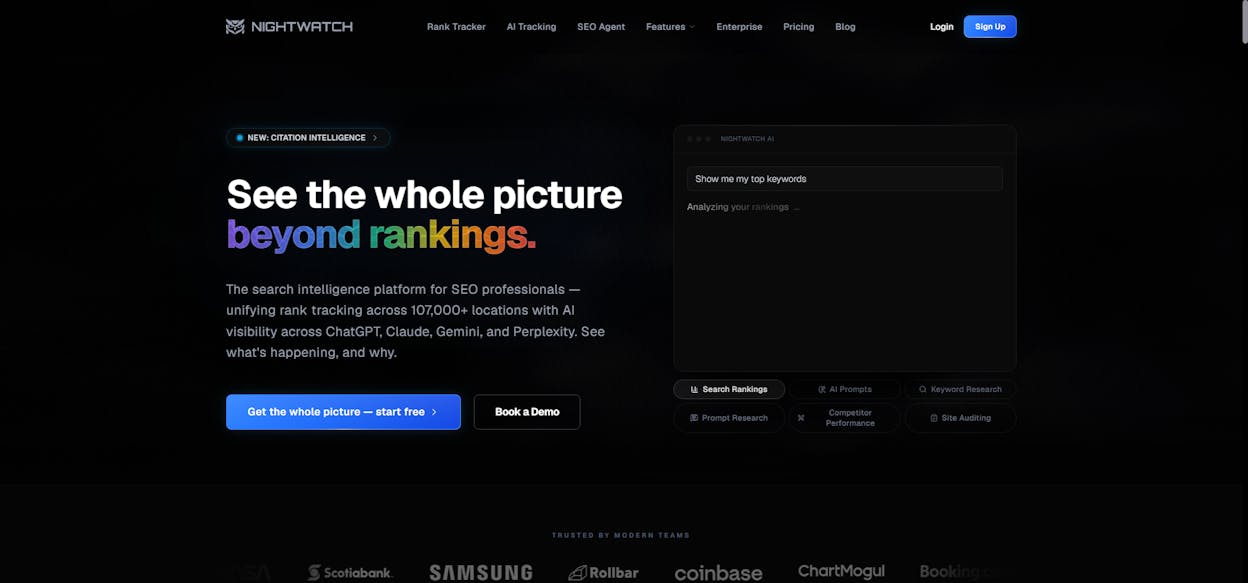
Nightwatch extends its established rank-tracking platform with AI visibility monitoring. The value proposition is continuity. Agencies that already use Nightwatch for organic tracking can add AI metrics to client reports without onboarding a new tool or retraining teams. White-label reporting, flexible exports, and scheduling make it agency-friendly out of the box.
The AI tracking module is still early. It detects whether your site appears in LLM responses for target prompts, but it lacks prompt-level context, sentiment analysis, and the kind of answer-by-answer diagnostics that dedicated GEO tools provide. Engine coverage and update frequency trail behind specialist platforms.
Best for: Agencies wanting AI visibility in existing Nightwatch reporting workflows.
Watch out for: Early-stage depth, limited prompt context, narrow engine coverage.
How to choose the right ZipTie alternative
Your decision comes down to three questions.
How many AI engines do your buyers use? If the answer is more than three, ZipTie’s coverage is not enough. Analyze AI, Peec, and Rankscale offer the broadest multi-engine tracking.
Do you need monitoring, or monitoring plus action? Most tools on this list are dashboards. They show you what is happening but leave the “what to do about it” to you and your other tools. Analyze AI is the only platform with a full content writer, content optimizer, and a programmable Agent Builder that automates the loop from insight to published improvement.
Can you prove ROI to leadership? If you need to tie AI visibility to traffic and pipeline, Analyze AI’s GA4 integration is the only option on this list that connects appearances to sessions, landing pages, and conversions. Every other tool stops at the dashboard.
If you are exploring this space for the first time, start with the AI Visibility Guide or run a free check with the AI Visibility Checker to see where your brand stands right now.

Ernest

Ibrahim


![6 AthenaHQ Alternatives That Skip the Credit Math [2026]](/_next/image?url=https%3A%2F%2Fwww.datocms-assets.com%2F164164%2F1778742681-blobid0.png&w=3840&q=75)


