



Summarize this blog post with:


Google launched AI Overviews in the U.S. on May 14, 2024. Since then, the feature has expanded to over 100 countries, doubled in frequency after the March 2025 core update, and reduced clicks to top-ranking content by up to 58%.
That is the bad news.
The good news is that AI Overviews are not a death sentence for organic traffic. They are a new layer of search—one that rewards the same content fundamentals that have always worked in SEO, but also opens a parallel channel in AI search engines like ChatGPT, Perplexity, Claude, and Gemini.
The brands that understand both layers will compound their visibility. The ones that ignore either will lose ground.
In this article, you’ll learn what Google’s AI Overviews are, how they work under the hood, the full timeline of their rollout, how they impact your organic traffic, and—most importantly—how to track, measure, and optimize for them so your content stays visible as search evolves.
Table of Contents
What Are Google’s AI Overviews?
Google’s AI Overviews are AI-generated summaries that appear above traditional search results. They pull information from multiple web sources, synthesize it into a direct answer, and include links to those sources for further reading.
![[Screenshot: Example of an AI Overview appearing above organic results for an informational query]](https://www.datocms-assets.com/164164/1777046354-blobid1.png?auto=format,compress&w=1248&fit=max)
Think of them as Google’s attempt to answer your question without making you click through ten blue links. Before AI Overviews, Google achieved something similar with featured snippets—but those pulled from a single source. AI Overviews pull from several, which changes the game for content creators.
Here is a quick comparison:
|
Feature |
Featured Snippets |
AI Overviews |
|---|---|---|
|
Sources |
Single page |
Multiple pages |
|
Format |
Paragraph, list, or table |
Conversational summary |
|
User interaction |
Static |
Can ask follow-ups (via AI Mode) |
|
Impact on CTR |
Moderate decline |
Up to 58% decline for position 1 |
|
Powered by |
Algorithmic extraction |
Gemini LLM (retrieval-augmented generation) |
The distinction matters. With featured snippets, you could win the box by formatting your content well. With AI Overviews, you need to be one of several sources the model trusts enough to synthesize from—and that requires a different approach to optimization.
Timeline of AI Overviews’ Rollout
AI Overviews have changed rapidly since their first appearance. Here is the full timeline:
![[Screenshot: Visual timeline infographic showing the evolution from SGE to AI Overviews]](https://www.datocms-assets.com/164164/1777046365-blobid2.png?auto=format,compress&w=1248&fit=max)
2023
-
May 10, 2023 — Google announces the Search Generative Experience (SGE) at Google I/O as a Labs experiment.
-
May 25, 2023 — Google opens SGE access to users who joined the waitlist.
2024
-
March 22, 2024 — Google begins testing AI Overviews in the main search results, even for users who never opted into SGE.
-
May 14, 2024 — Google officially launches AI Overviews in the U.S. A new “Web” filter is added for users who want text-only results.
-
May 24, 2024 — AI Overviews come under fire for dangerous and wrong answers. Among them: recommending non-toxic glue for pizza sauce, eating small rocks daily, and drinking urine to pass kidney stones.
-
May 30, 2024 — Google responds by explaining improvements to AI Overview accuracy and quality.
-
August 15, 2024 — AI Overviews expand to the UK, India, Japan, Indonesia, Mexico, and Brazil. Google also begins showing AI Overviews in Incognito mode and for signed-out users.
-
August 23, 2024 — Google’s John Mueller confirms that AI Overviews are affected by core algorithm updates.
-
October 28, 2024 — AI Overviews expand to more than 100 countries and territories. New languages added: Hindi, Indonesian, Japanese, Portuguese, and Spanish. A redesigned desktop layout introduces a right-hand panel of source links.
2025
-
March 5, 2025 — Google announces an upgrade: AI Overviews in the U.S. are now powered by Gemini 2.0, which improves quality and allows AI Overviews for more complex queries (coding, advanced math, multimodal queries). Google also announces AI Mode as a Labs experiment—a conversational search experience with follow-up questions.
-
March 25, 2025 — AI Overviews expand to more European countries: Austria, Belgium, Germany, Ireland, Italy, Poland, Portugal, Spain, and Switzerland. New supported languages include German, Italian, Polish, and French.
-
April 11, 2025 — Google confirms that AI Overviews link to their own internal search results, not just external websites.
-
April 23, 2025 — Google begins testing AI Overviews on YouTube search.
-
May 20, 2025 — Google rolls out AI Mode to everyone in the U.S.
2026
-
March 2026 — Google launches Web Guide, a magazine-style SERP that curates AI summaries and organic results—notably, it encourages clicks rather than replacing them.
Google’s iterative approach means AI Overviews will keep changing. The feature has gone from an embarrassing launch (glue on pizza) to a core part of search in less than two years. Expect the pace to accelerate.
Why Should You Care About AI Overviews?
Three reasons.
First, Google still dominates search. As of 2026, Google holds the largest search engine market share globally by a wide margin. Research from SparkToro confirms that AI tools have not yet displaced Google in any meaningful way—most search activity still happens on Google’s platform.
![[Screenshot: Chart showing Google’s dominance in search market share compared to other platforms]](https://www.datocms-assets.com/164164/1777046367-blobid3.jpg?auto=format,compress&w=1248&fit=max)
Second, AI Overviews are showing up more, not less. After the March 2025 core update, AI Overviews grew by 116%. They now appear for roughly 9.46% of all desktop keywords globally and 16% in the U.S. But the volume story is even bigger: AI Overviews show for 54.61% or more of all Google searches by search volume, meaning they disproportionately appear on high-traffic queries.
Third, the click impact is real and worsening. Early research showed a 34.5% reduction in clicks to top-ranking content when an AI Overview appeared. Updated data from February 2026 puts that number at 58%. For every 100 clicks you used to earn at position 1, Google now keeps 58 of them.
If you rely on organic traffic from Google—and most businesses do—you need a plan for AI Overviews.
But here is what most coverage of AI Overviews misses: Google is just one of several AI search engines now sending traffic. ChatGPT, Perplexity, Claude, Gemini, and Copilot all generate answers that cite web sources. Each of these platforms represents a new organic channel. The brands that track and optimize for all of them—not just Google—will have the biggest advantage.
This is the core idea behind treating AI search as a complementary organic channel alongside traditional SEO. Not a replacement. An expansion.
How Do AI Overviews Work?
At a high level, Google’s AI Overviews use retrieval-augmented generation (RAG). The AI does not rely solely on pre-trained knowledge. Instead, it retrieves fresh information from the web and uses that to build its answer.
AI Overviews are powered by Gemini, Google’s own large language model. Based on Google’s patent, analyzed by SEO researcher Rich Sanger, here is how the process works step by step:
Step 1: Query understanding. You enter a search query. Google’s LLMs analyze the context, intent, and complexity of your question.
Step 2: Content retrieval. Google’s systems fetch relevant content from its index. It also considers related searches and what other users tend to click for similar queries. This is where the “retrieval” in RAG happens.
Step 3: Synthesis. Gemini takes the collected information and generates a summary answer. This summary combines points from multiple sources and aims to directly address your question.
Step 4: Grounding and citations. Google attaches links to the source web pages within the AI Overview. Google calls this “grounding”—it helps ensure accuracy and lets users click through to verify information.
Step 5: Feedback loop. Over time, the system learns from user interactions. If users consistently click a cited source, or ignore the Overview and scroll to organic results, Google adjusts future outputs.
![[Screenshot: Diagram showing how Google Gemini generates AI Overviews from query to summary]](https://www.datocms-assets.com/164164/1777046375-blobid4.png?auto=format,compress&w=1248&fit=max)
Google has also noted that AI Overviews can be context-aware and user-aware. If you are signed in, it might use your recent searches or location to refine the answer. This is important for local businesses and geo-specific content.
How AI Overviews Differ From Other AI Search Engines
Understanding how Google’s AI Overviews work also helps you understand how other AI search engines operate—because the core mechanism is similar, even if the execution differs.
|
AI Search Engine |
Model |
Sources |
Citation Style |
Key Difference |
|---|---|---|---|---|
|
Google AI Overviews |
Gemini 2.0 |
Google’s index |
Inline links + side panel |
Integrated into existing SERPs |
|
ChatGPT Search |
GPT-4o |
Bing index + web |
Footnote citations |
Conversational, multi-turn |
|
Perplexity |
Multiple models |
Own crawl + Bing |
Numbered inline citations |
Research-focused, heavy citations |
|
Claude |
Claude models |
Web search (when used) |
Inline references |
Reasoning-focused |
|
Gemini (standalone) |
Gemini |
Google’s index |
Inline links |
Google ecosystem integration |
|
Copilot |
GPT-4 |
Bing index |
Footnote citations |
Microsoft ecosystem integration |
All of these platforms use some form of RAG. All of them cite sources. And all of them represent an opportunity—or a risk—depending on whether your content is among the sources they pull from.
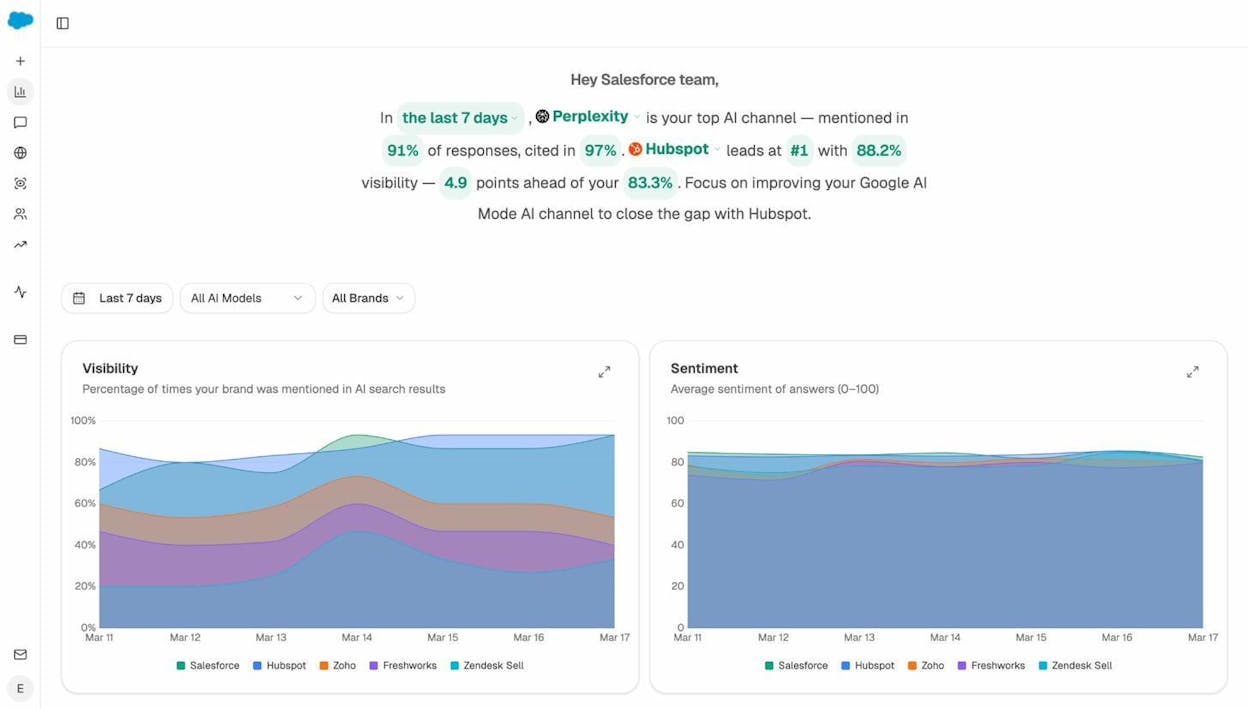
This is why tracking your visibility across every major AI search engine matters, not just Google. A tool like Analyze AI lets you monitor how your brand appears across ChatGPT, Perplexity, Claude, Copilot, Gemini, and Google AI Mode from a single dashboard—showing visibility, sentiment, and citations by engine.
How AI Overviews Impact the SERPs
AI Overviews are one of the biggest changes to the SERPs in recent years. Multiple studies have measured their impact, and the data paints a clear picture.
The Click Impact
The headline number: AI Overviews reduce clicks to top-ranking content by 58% as of the latest measurement.
Here is how the data has evolved:
|
Study Date |
Click Reduction (Position 1) |
Source |
|---|---|---|
|
April 2025 |
34.5% |
Ahrefs |
|
February 2026 |
58% |
Ahrefs (updated) |
This means that a page ranking #1 for a keyword with an AI Overview now gets roughly 42% of the clicks it would have received without the Overview. The remaining clicks go nowhere—users get their answer from the AI summary and never scroll down.
Where AI Overviews Show Up
Not all queries trigger AI Overviews. Here is what the data says about which queries are most affected:
AI Overviews appear more often for:
-
Informational queries (99.2% of AI Overview keywords are informational in intent)
-
Longer, more specific search queries
-
Queries with higher search volumes
-
Complex questions that benefit from synthesized answers
AI Overviews appear less often for:
-
Branded queries (searching for a specific company or product)
-
Local queries (looking for nearby businesses)
-
Short, navigational queries (e.g., “facebook login”)
-
Transactional queries (ready-to-buy searches)
Market Concentration
The data also reveals significant market concentration. The top 50 domains account for 28.90% of all mentions across 55.8 million AI Overviews analyzed. This means that a relatively small number of authoritative domains dominate the AI Overview results.
For smaller sites, this sounds discouraging. But it also means that information gain—providing unique data, original research, or first-hand experience that the top 50 domains lack—can be your way in.
User Behavior With AI Overviews
A UX study by Growth Memo found that 7 in 10 searchers never read past the first third of an AI Overview. Younger mobile users tend to engage with AI answers more readily, while older desktop users still scroll past to the blue links.
This tells us two things. One, if your content is cited in the first few lines of an AI Overview, you get disproportionate visibility. Two, traditional organic results still matter, especially for audiences that skip AI Overviews entirely.
Reddit threads, YouTube videos, and forum posts absorb roughly a third of the traffic that AI Overviews redirect away from traditional results. This makes Reddit and YouTube increasingly important for content distribution.
How to Track and Measure the Impact of AI Overviews
Here is the uncomfortable truth: Google Search Console does not distinguish between AI Overview impressions and regular organic impressions. They are lumped together. This means you cannot use GSC alone to measure the impact of AI Overviews on your traffic.
You have three options.
Option 1: Use Google Search Console With Filters (Limited but Free)
While GSC does not flag AI Overview keywords specifically, you can approximate the impact by filtering for query types most likely to trigger AI Overviews.
Here is how:
-
Go to Google Search Console > Performance > Search Results.
-
Add a “Query” filter using Regex to isolate informational queries. Use a pattern like: ^what |^how |^why |^when |^where |^who |^which | guide|tutorial|definition|examples|vs |versus| best way|difference between
-
Exclude your branded queries with a second filter.
-
Compare clicks and CTR for these queries before and after known AI Overview rollout dates (May 2024, October 2024, March 2025).
![[Screenshot: Google Search Console performance report with regex filter applied to isolate informational queries likely affected by AI Overviews]](https://www.datocms-assets.com/164164/1777046382-blobid6.jpg?auto=format,compress&w=1248&fit=max)
This gives you a rough sense of click loss. But it cannot tell you which keywords specifically have AI Overviews, or whether you are cited in them.
Option 2: Use an SEO Tool to Track AI Overview Keywords
SEO tools with SERP feature tracking can show you which of your ranking keywords trigger AI Overviews. Enter your domain, go to the organic keywords report, and filter for keywords where an AI Overview appears.
![[Screenshot: SEO tool showing organic keywords filtered by AI Overview SERP feature presence]](https://www.datocms-assets.com/164164/1777046391-blobid7.png?auto=format,compress&w=1248&fit=max)
This is better than GSC because you can see the specific keywords affected. But it only shows you Google’s AI Overviews—not what is happening on ChatGPT, Perplexity, Claude, or Gemini.
Option 3: Track AI Search Visibility Across All Engines
The most complete approach is to track your visibility across every AI search engine—not just Google. This is where the AI search channel becomes actionable.
With Analyze AI, you can set up tracked prompts that run daily across ChatGPT, Perplexity, Claude, Copilot, Gemini, and Google AI Mode. Each prompt shows your visibility score, sentiment, position, and which competitors appear alongside you.
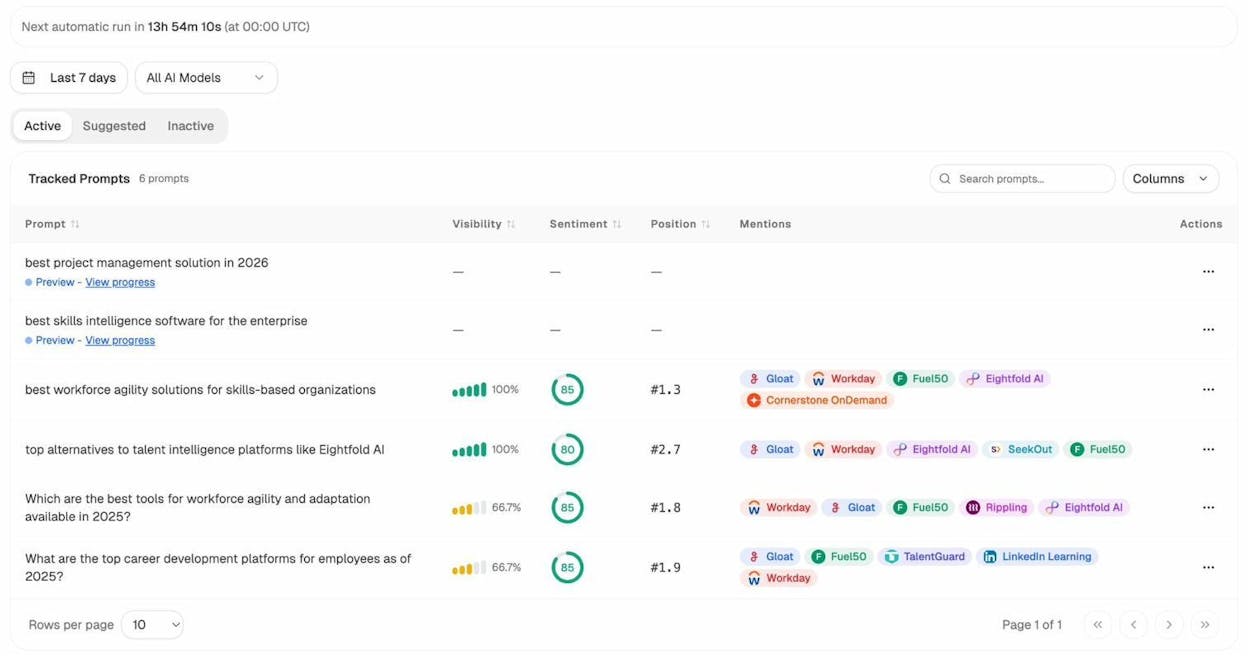
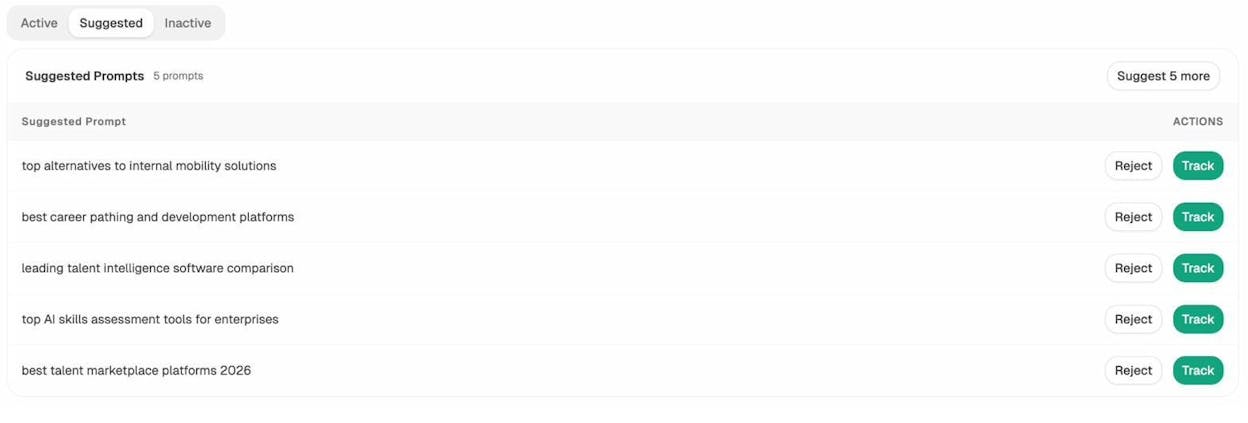
The platform also suggests prompts based on your industry and tracked clusters, so you can expand your coverage without guesswork.
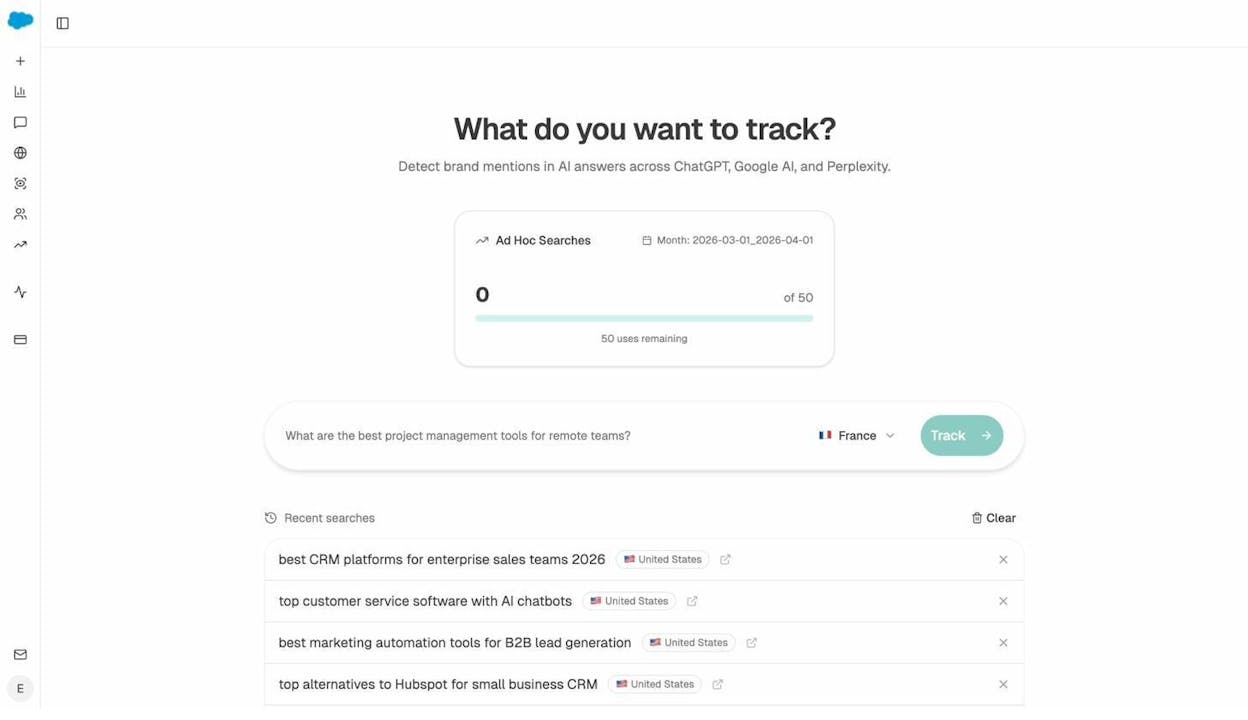
For quick research, Ad Hoc Searches let you test any prompt across AI engines instantly to see if your brand appears.
Measuring Actual AI Traffic
Beyond visibility, you also want to measure how much traffic AI search engines actually send to your site. This is the metric that connects AI visibility to business outcomes.
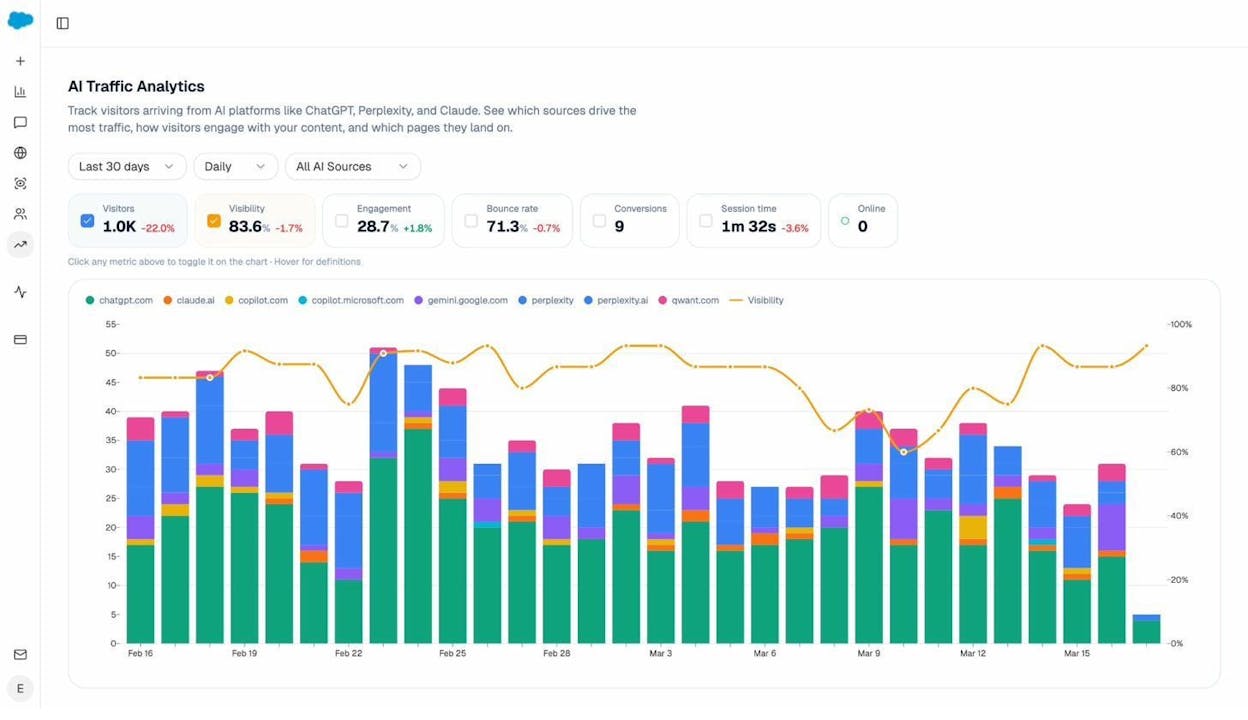
Analyze AI’s AI Traffic Analytics connects to your GA4 and breaks down sessions from AI platforms by source (ChatGPT, Claude, Perplexity, Copilot, Gemini), showing visitors, engagement, bounce rate, conversions, and session time.
The Landing Pages report goes one level deeper. It shows you which specific pages on your site receive AI-referred traffic, which engine sent the visitors, and how those visitors behave (engagement, duration, conversions).
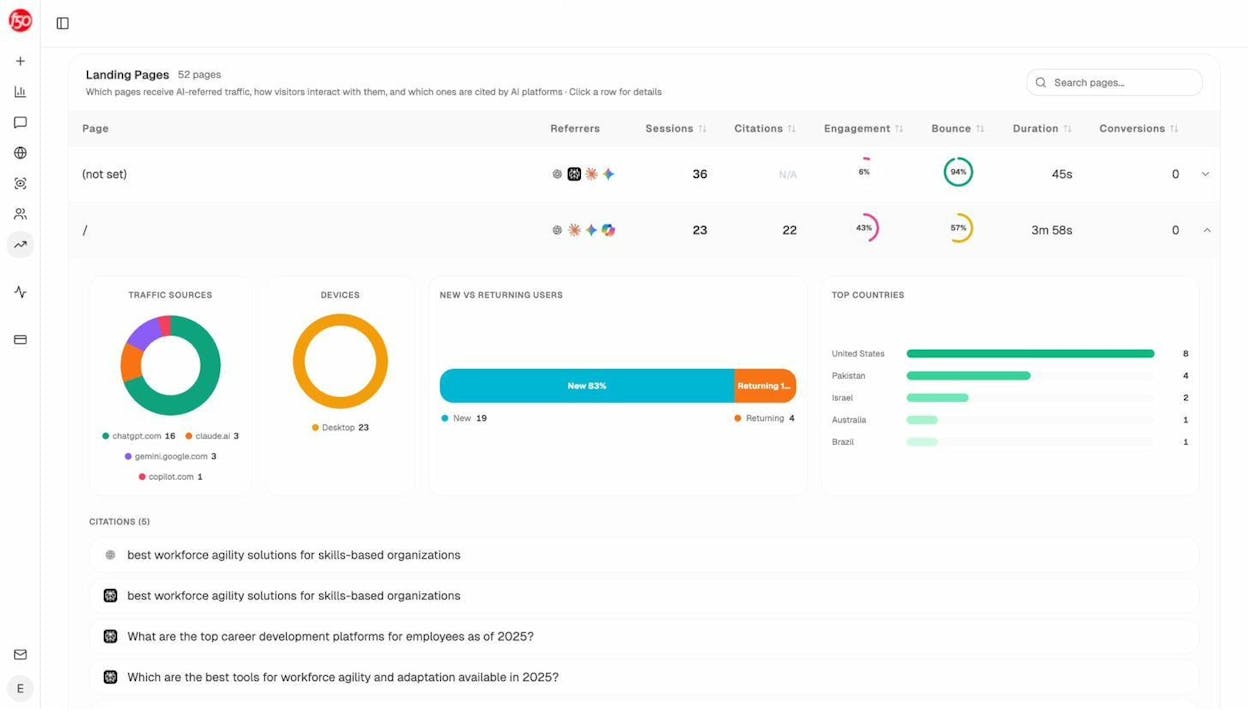
This is the data that lets you identify patterns. If your “how-to” guides consistently get AI referral traffic but your product pages do not, you know where to double down. If Perplexity sends more engaged visitors than ChatGPT, you know which engine’s citation patterns to study.
Tracking Citations: Where AI Models Pull Your Content
Citations are the link between your content and AI visibility. When an AI engine cites your page as a source, that citation drives clicks and brand awareness.
Analyze AI’s Sources report shows every URL and domain that AI platforms cite when answering questions in your industry. You can see which content types get cited most (blogs, product pages, reviews), which domains dominate, and where you have gaps.
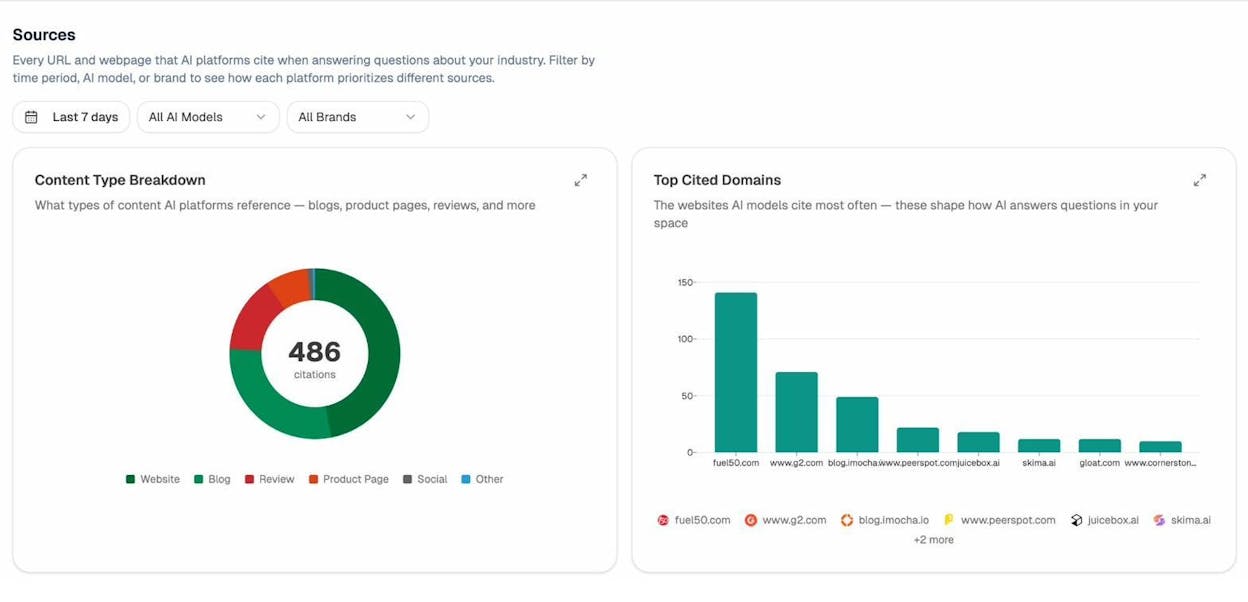
This is actionable intelligence. If you see a competitor’s blog post getting cited 50 times for a topic you also cover, you know exactly what to improve.
How to Optimize for AI Overviews
Let’s be direct: optimizing for AI Overviews is not a separate discipline from SEO. It builds on the same fundamentals. But it does require a few additions to your process.
Start With Traditional SEO Fundamentals
Google’s AI Overviews pull heavily from pages that already rank well organically. In fact, 76% of citations in AI Overviews come from top-10 ranking pages. This makes traditional SEO the foundation.
Rich Sanger, who analyzed Google’s patent on AI Overviews, concluded that the optimization recommendations are essentially SEO basics. The summary:
-
Do keyword research. Find the queries your audience searches. Use tools like Analyze AI’s Keyword Generator or Keyword Difficulty Checker to evaluate opportunity.
-
Match search intent. Look at what currently ranks for your target keyword. If every result is a how-to guide, do not write a product page. Match the format and depth that Google expects.
-
Make content comprehensive and fulfill E-E-A-T. Experience, Expertise, Authoritativeness, and Trustworthiness are what Google evaluates when deciding which content to feature. First-hand experience and original data carry extra weight.
-
Build links. Backlinks remain one of the strongest ranking signals. Check your link profile with a Website Authority Checker and identify link building opportunities.
Add Information Gain
Here is where most AI Overview optimization advice stops. “Just do good SEO” is true but incomplete.
Google’s patent suggests that AI Overviews actively seek out source diversity. If the top-ranked content for a query is all saying the same thing, the model moves on to related queries to find different perspectives.
This is a direct incentive for information gain—providing new information that existing content lacks.
There are three ways to add information gain:
Experimentation. Run tests, collect data, and publish original findings. For example, analyzing 55.8 million AI Overviews produces insights that no competitor can copy because they did not do the work.
Experience. Write from first-hand experience with the topic. If you are writing about CRM software, actually use the tools and describe specific workflows. AI models and readers both value lived experience over recycled advice.
Effort. Go beyond what competitors offer. Add original diagrams, run surveys, interview practitioners, or create tools that readers can use. Content that requires more effort to reproduce earns more citations.
Structure Content for AI Extraction
AI models parse content differently from human readers. A few structural choices make your content easier for models to cite:
Use clear headings that match question patterns. If people search “how do AI Overviews work,” use that exact phrasing (or close to it) as an H2. AI models map headings to user queries.
Lead each section with the answer. Put the key takeaway in the first sentence of each section, then provide supporting detail. This is the BLUF (Bottom Line Up Front) approach. It helps both AI extraction and reader comprehension.
Use structured data where appropriate. FAQ schema, HowTo schema, and article schema help search engines understand your content. While structured data alone will not get you into AI Overviews, it removes friction from the extraction process.
Include tables and lists for comparative information. AI models handle structured data well. If you are comparing features, pricing, or options, a table is more extractable than a paragraph.
Optimize for AI Search Beyond Google
Google AI Overviews are one piece of a larger AI search landscape. ChatGPT, Perplexity, Claude, Copilot, and Gemini all generate answers that reference web sources—and each engine has slightly different citation patterns.
Research based on 65,000 AI prompt citations shows that:
-
ChatGPT tends to cite authoritative, well-known domains and strongly favors content that ranks well in Bing
-
Perplexity cites more diverse sources, including niche blogs and forums, and relies heavily on fresh, recently updated content
-
Google AI Mode and AI Overviews have only 13.7% citation overlap despite 86% semantic similarity in their answers—meaning you may need different content performing well in different contexts
This is why tracking visibility across all AI engines matters. What works on Google AI Overviews might not appear on ChatGPT, and vice versa.
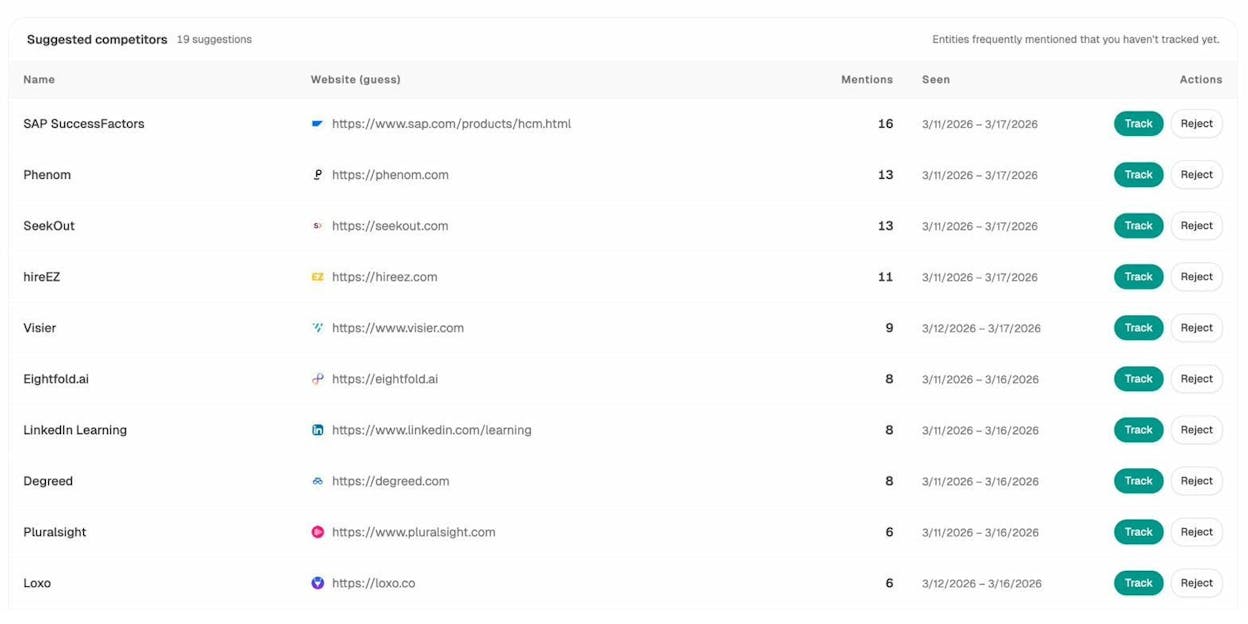
With Analyze AI’s Competitors view, you can see exactly which brands appear alongside yours in AI answers—and which ones show up where you do not. The platform automatically identifies competitors from your tracked prompts and shows mention counts, frequency, and trends.
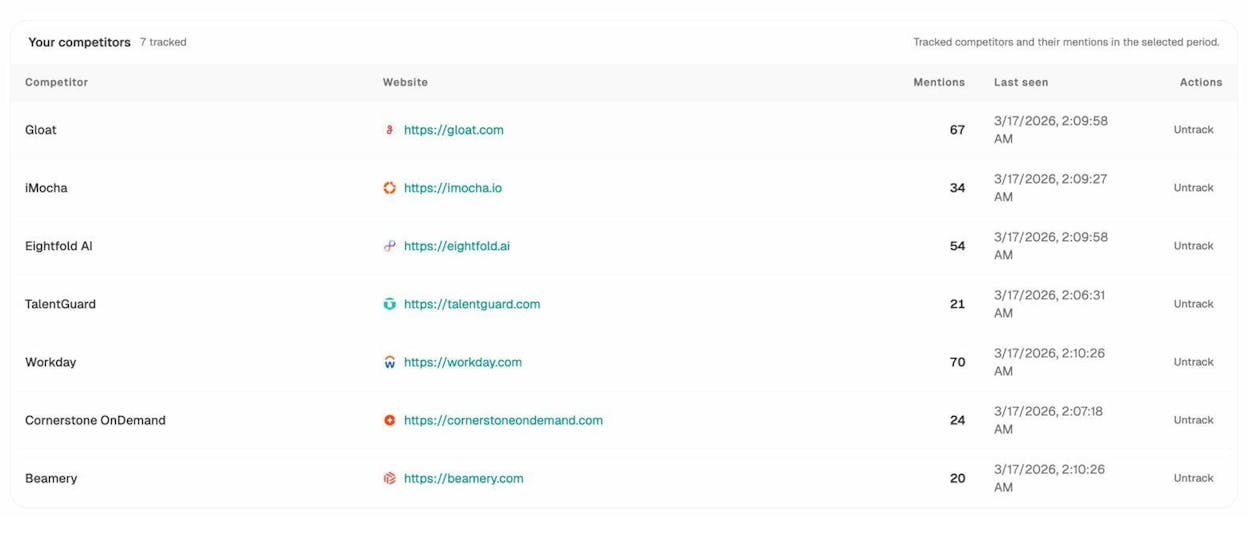
Better yet, the Suggested Competitors feature surfaces brands that appear frequently in your space but that you have not tracked yet. These are the blind spots most teams miss.
Track Competitive Gaps in AI Search
The biggest wins in AI search come from finding the prompts where competitors appear and you do not. This is the AI search equivalent of finding keyword gaps in traditional SEO.
Use Analyze AI’s Perception Map to see where your brand sits relative to competitors on two axes: visibility (how often you appear) and narrative strength (how positively AI models frame you).
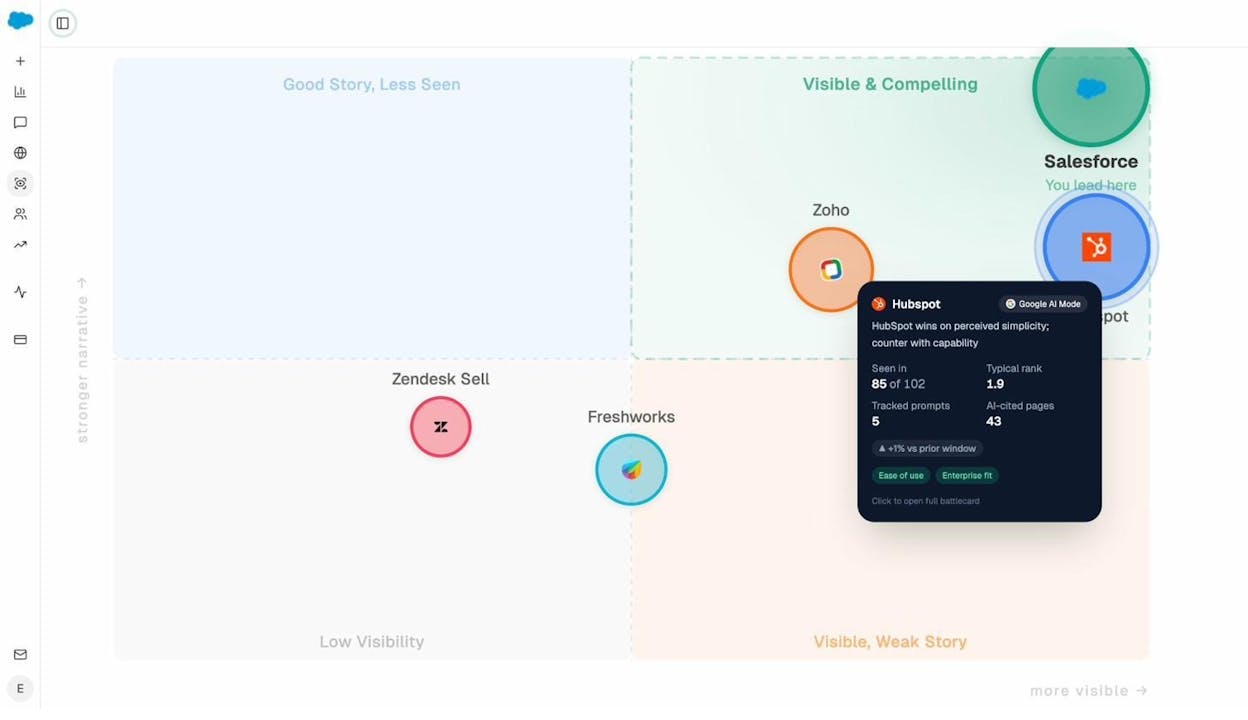
Brands in the upper-right quadrant (visible and compelling) are winning. Brands in the lower-left (low visibility, weak story) need the most work. The Perception Map gives you a strategic view of where to focus your content and PR efforts.
Stay Informed With Automated Reporting
AI search changes weekly. New citations emerge, competitors gain ground, and traffic patterns shift. Manual tracking is not sustainable.
Analyze AI’s Weekly Emails deliver an automated summary of your AI visibility, including: your top-level metrics (visibility, rank, sentiment, citations, AI traffic), pages gaining or losing citations, competitor movements, and specific actions to take.
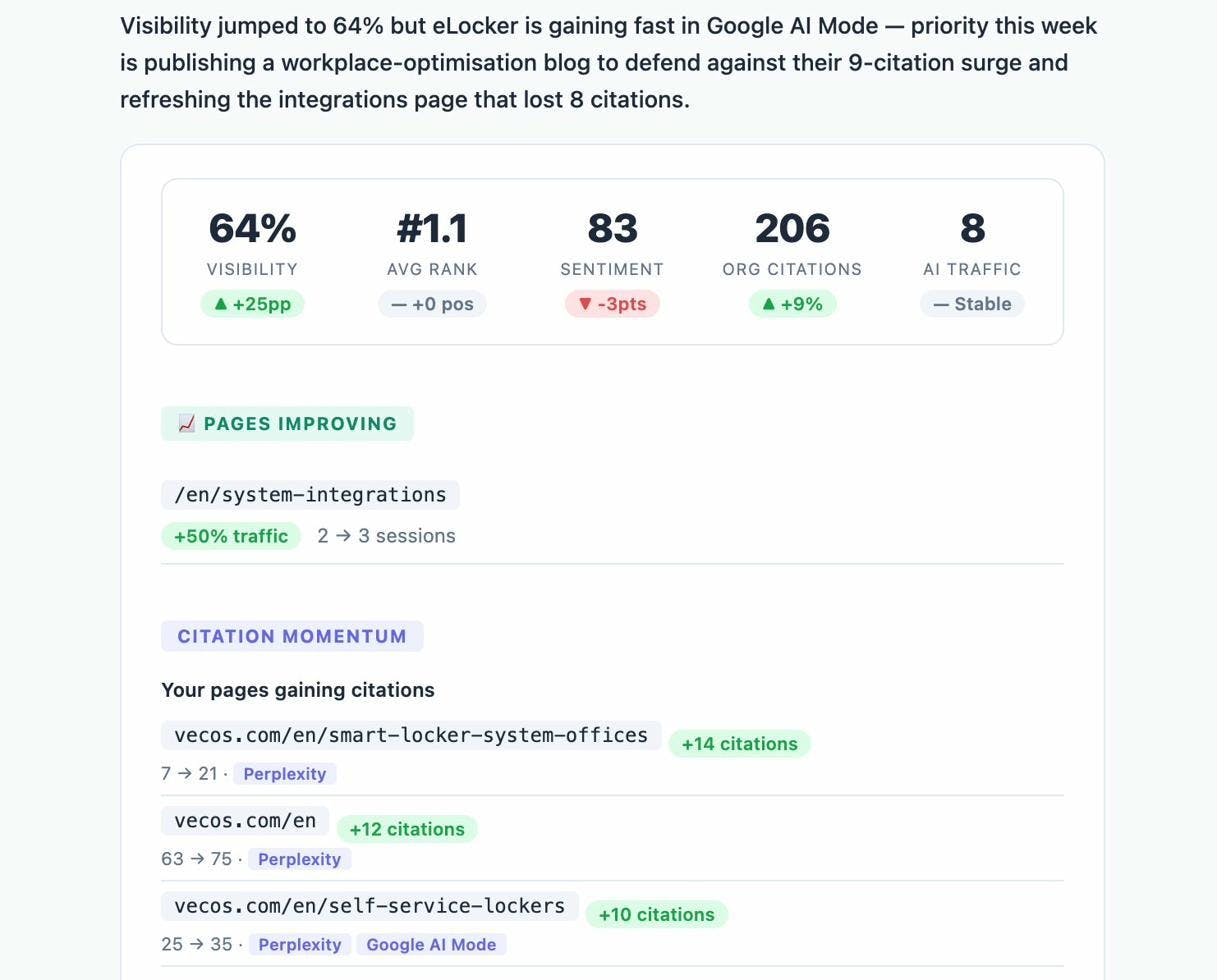
The email highlights which competitor pages are gaining citations and why, so you can respond before the gap widens. It is the kind of briefing that turns AI search from a monitoring task into an actionable workflow.
Can You Opt Out of AI Overviews?
Short answer: sort of, but with consequences.
You cannot selectively opt out of AI Overviews. Google considers AI Overviews a search feature, not a separate product. There is no toggle to say “show my content in organic results but not in AI Overviews.”
You can block Google entirely using noindex meta tags or robots.txt. But this removes your content from both AI Overviews and organic results—a drastic measure for most sites.
Google offers a middle option: preview controls. Using the max-snippet meta robots directive or nosnippet, you can limit how much content Google can display in snippets and AI Overviews.
SEO consultant Glenn Gabe tested this approach and found that it works—eventually. It took time and even a direct ping to Google’s John Mueller before the change took effect. But once active, Google stopped pulling his content into AI Overviews.
The trade-off: your organic listing loses its snippet entirely. Instead of showing a description below your title, Google shows only the URL and title. This can significantly reduce click-through rates from regular organic results.
For most sites, the better strategy is not to opt out, but to optimize. Getting cited in AI Overviews with a link to your site is better than being invisible in both the AI summary and the organic results.
The Bigger Picture: AI Search as a Complementary Channel
Most coverage of AI Overviews frames the situation as a crisis. Clicks are down. Google is stealing content. SEO is dead.
We see it differently.
AI Overviews are one feature within a much larger shift. Google, ChatGPT, Perplexity, Claude, Copilot, and Gemini are all building AI search experiences that cite web sources. Each of these represents a new organic channel—a new way for people to discover your content and your brand.
GEO is not a replacement for SEO. It is the next transformation of it. Search is expanding from ten blue links to multi-modal, prompt-shaped answers. Quality still governs visibility. Authority still comes from depth, originality, structure, and usefulness.
What changes is where that quality must be legible—to crawlers, to AI models, and to the people asking better questions.
The practical implication: you need to track both channels. Use Google Search Console and an SEO tool for traditional search. Use a platform like Analyze AI for AI search visibility across all engines. The brands that measure both will make better decisions about where to invest their content efforts.
How to Start: A Practical Checklist
If you have read this far, you understand the landscape. Here is how to start acting on it today:
Audit your current exposure. Use Analyze AI’s free AI Visibility Checker to see how your brand currently appears across AI engines. Use the SERP Checker to see which of your target keywords trigger AI Overviews on Google.
Set up AI search tracking. Pick 10–20 prompts that represent your most important topics and track them daily across AI engines. Start with prompts that mirror your highest-value SEO keywords.
Benchmark against competitors. Identify 3–5 competitors and track their mentions alongside yours. Look for prompts where they appear and you do not—these are your content gaps.
Measure actual AI traffic. Connect your analytics to see how many sessions come from AI search engines. Break them down by source and landing page.
Optimize content for both channels. Apply SEO fundamentals (keyword research, intent matching, E-E-A-T, link building) and add information gain (original data, first-hand experience, deeper effort). Structure content so AI models can extract and cite it easily.
Review weekly. Set up automated reports so you catch changes in visibility, citations, and competitor movements before they compound against you.
Final Thoughts
Google’s AI Overviews have changed search. Clicks are declining for informational queries. The SERP is more competitive. And the landscape will keep shifting as Google iterates on AI Mode, Web Guide, and whatever comes next.
But the fundamentals have not changed. Great content, built on real expertise and structured for both humans and machines, will continue to earn visibility—in organic results and in AI answers.
The new variable is AI search. The brands that treat it as a complementary organic channel alongside SEO will compound their visibility across both. The ones that ignore it will watch their traffic erode without understanding why.
Start measuring. Start optimizing. And start treating AI search as what it is: not the end of SEO, but its next evolution.
Want to see where your brand appears across AI search engines? Try Analyze AI to track visibility, measure AI traffic, and find the content gaps that matter.

Ernest

Ibrahim


