



Summarize this blog post with:


In this article, you’ll learn how to find and choose the right keywords for SEO, step by step. You’ll see how to generate seed keywords, expand them with research tools, filter for traffic potential and business value, assess difficulty, spy on competitors, and validate your final list. You’ll also learn how keyword choices now affect your visibility in AI search engines like ChatGPT, Perplexity, and Google AI Mode, and how to factor that into your strategy.
Table of Contents
1. Start With Seed Keywords
Seed keywords are the broad topics your business revolves around. They are starting points, not targets. You won’t rank for “project management software” or “dog food” directly. But those seeds will generate hundreds of specific, rankable keyword ideas when you plug them into a research tool.
To come up with good seeds, answer three questions:
What does your business sell or do? Write down the core products, services, or categories. If you sell running shoes, your seeds might be “running shoes,” “trail running,” “marathon training,” and “athletic footwear.”
What problems does your audience have? Think about the pain points your product solves. A CRM company might jot down “sales pipeline,” “lead management,” “customer retention,” and “deal tracking.”
What topics does your audience care about? Go beyond your product. A meal kit company might add “quick dinner recipes,” “meal planning,” and “healthy eating on a budget.”
Don’t overthink this step. Write down 5 to 15 seeds. You’ll refine everything later with data.
Where to look for seed inspiration
If you’re stuck, look at these sources:
Your website’s navigation and category pages already reflect your core topics. Your competitors’ blogs show what topics matter in your space. Industry forums, subreddits, and communities reveal the language your audience actually uses. And your sales team hears the same questions repeatedly, which are often seeds hiding in plain sight.
One source most people overlook: AI search engines. Type a broad question like “what’s the best way to manage a remote team?” into ChatGPT or Perplexity. The answer will reference specific subtopics, tools, and frameworks, each one a potential seed keyword.
2. Use Keyword Research Tools to Expand Your List
Once you have seeds, you need a tool to find what people actually search for. A seed like “email marketing” might unlock thousands of specific queries you’d never brainstorm on your own. Here are the tools worth using.
Google Keyword Planner
Google’s free Keyword Planner is the obvious starting point. Enter a seed keyword, and it returns related ideas with search volume estimates.
The catch: unless you’re running ads, Google only shows broad volume ranges like “10K–100K.” That range is too wide to make prioritization decisions. A keyword could get 11,000 searches or 95,000. You can’t tell.
![[Screenshot: Google Keyword Planner showing broad search volume ranges for a seed keyword like “email marketing”]](https://www.datocms-assets.com/164164/1774985091-blobid1.png?auto=format,compress&w=1248&fit=max)
Still, it’s useful for generating initial ideas and getting a rough sense of demand. Just don’t rely on it as your only data source.
Analyze AI Keyword Generator
Analyze AI’s free Keyword Generator is a quick way to surface keyword ideas without signing up for anything. Enter a seed, and it returns related keywords you can filter and sort.
![[Screenshot: Analyze AI Keyword Generator tool interface showing keyword suggestions for a seed keyword]](https://www.datocms-assets.com/164164/1774985063-blobid2.png?auto=format,compress&w=1248&fit=max)
For deeper analysis, pair it with the Keyword Difficulty Checker to gauge how hard each keyword will be to rank for, or the SERP Checker to preview the current top results without leaving the tool.
Google Search Console
If you already have a website with some traffic, Google Search Console is a goldmine. It shows you the keywords people are already using to find your site, including ones you didn’t intentionally target.
Go to the Performance > Search results report. Filter by Queries to see every keyword driving impressions or clicks. Pay special attention to keywords where your page ranks in positions 8 through 20. These are keywords where you’re close to the first page but haven’t broken through yet. A dedicated piece of content, or an update to an existing page, could push you over the edge.
![[Screenshot: Google Search Console Performance report showing queries, clicks, impressions, CTR, and average position]](https://www.datocms-assets.com/164164/1774985085-blobid3.png?auto=format,compress&w=1248&fit=max)
Sort by impressions (high to low) to find keywords with demand where your current content isn’t fully meeting the intent. These are low-hanging fruit.
AlsoAsked and People Also Ask
AlsoAsked visualizes the “People Also Ask” questions that appear in Google’s search results. Enter a keyword, and it maps out the full tree of related questions.
This is useful for two reasons. First, these questions reveal subtopics you should cover in your content. Second, they’re often long-tail keywords in their own right, with lower competition and clear intent.
![[Screenshot: AlsoAsked interface showing a tree of People Also Ask questions branching from a seed query]](https://www.datocms-assets.com/164164/1774985090-blobid4.png?auto=format,compress&w=1248&fit=max)
Your Company’s Internal Knowledge
Some of the best keyword ideas never show up in any tool. They live in your sales calls, support tickets, and customer onboarding chats.
Talk to your sales team and ask: “What questions do prospects ask before they buy?” Search your help center tickets for recurring themes. Browse community forums where your audience hangs out. Look at the exact phrases people use, not just the topics.
These unfiltered phrases often translate into high-converting long-tail keywords that tools miss because the volume is small but the intent is strong.
Keyword Research Tools Worth Exploring
There is no single best tool. The right one depends on your budget and workflow. For a detailed comparison of free and paid options, see our guide to the 9 best keyword research tools. For free-only options, check out these 6 tools to find new keywords.
3. Find Keywords With Real Traffic Potential
Search volume is the most-cited metric in keyword research. It’s also the most misleading.
A keyword with 10,000 monthly searches sounds great. But if Google answers the query directly in the search results with a featured snippet or AI Overview, very few of those 10,000 searchers will actually click through to any website. The keyword has high volume but low traffic potential.
The reverse happens too. A keyword with 2,000 monthly searches can drive 8,000 or more visits to the top-ranking page because that page also ranks for hundreds of related keywords.
How to evaluate traffic potential properly
Instead of fixating on search volume, look at two things:
How much traffic the current #1 page actually gets. Most SEO tools show you estimated organic traffic for any URL. If the top-ranking page for your target keyword gets 500 visits a month despite the keyword showing 5,000 monthly searches, the real traffic potential is closer to 500, not 5,000.
Clicks per search. Some keywords generate multiple clicks per search (e.g., product comparison queries where people open several tabs). Others generate zero clicks because Google answers the question inline. Prioritize keywords where people actually click.
![[Screenshot: An SEO tool showing the gap between a keyword’s search volume and the actual traffic the top-ranking page receives]](https://www.datocms-assets.com/164164/1774985097-blobid5.png?auto=format,compress&w=1248&fit=max)
A new dimension: AI search traffic
Here is something most keyword guides completely ignore. Traffic no longer comes exclusively from Google’s ten blue links.
AI search engines like ChatGPT, Perplexity, Google AI Mode, Claude, and Copilot now drive measurable referral traffic to websites. When someone asks Perplexity “what’s the best CRM for small businesses?” and it cites your comparison article, that’s real traffic. It shows up in your analytics. People click through, read your content, and convert.
This means a keyword’s traffic potential is now larger than what search volume alone suggests. A keyword might send you 2,000 visits from Google and another 300 from AI search engines. If you only looked at Google, you’d underestimate the total opportunity.
Tools like Analyze AI let you track exactly how much traffic AI platforms send to your site, broken down by engine (ChatGPT, Perplexity, Claude, Gemini, Copilot) and by landing page. This gives you a complete picture of a keyword’s true traffic potential across both traditional and AI-driven search.
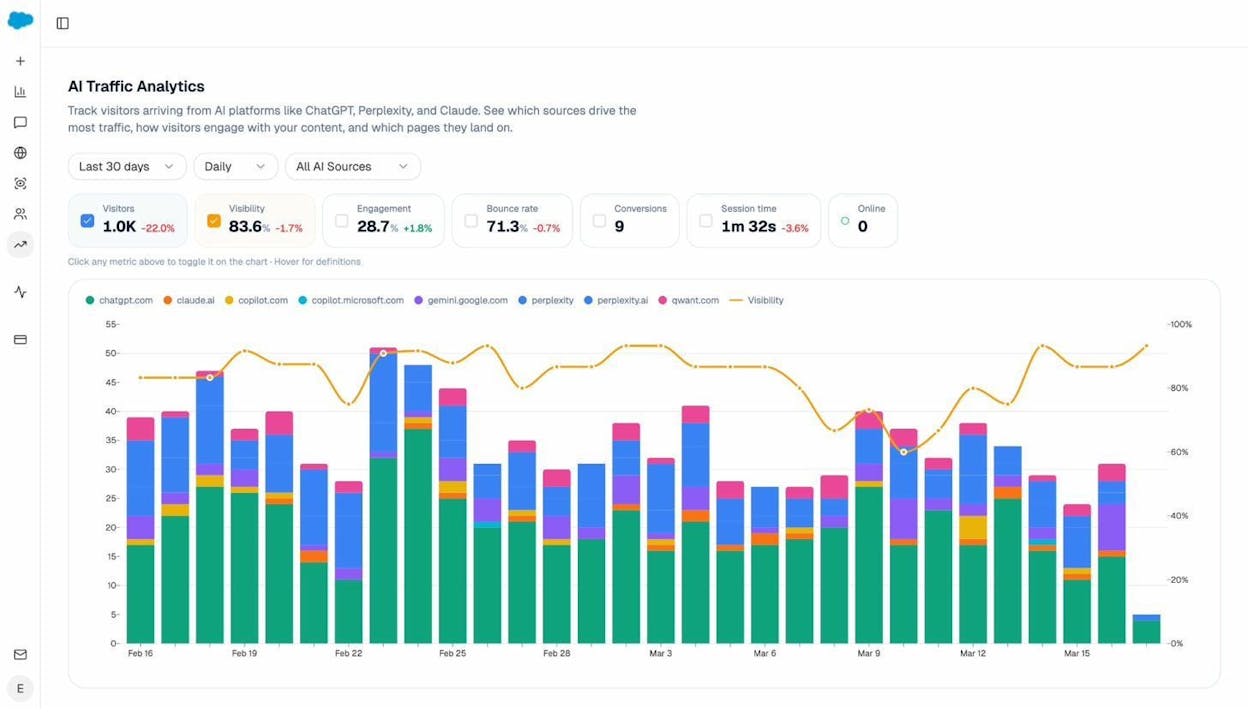
You can even drill into which specific pages receive AI referral traffic, along with engagement metrics like session duration and bounce rate.
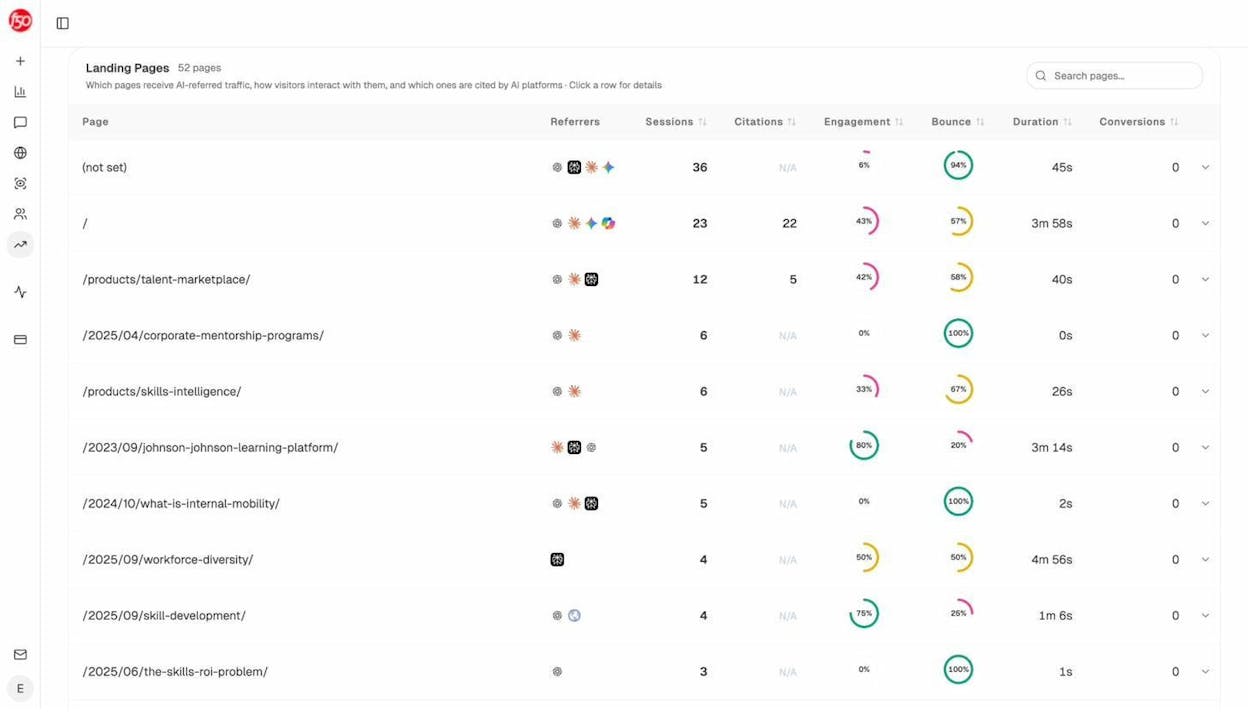
When you see a page that already attracts AI traffic and has strong engagement, that signals the keyword behind it is worth doubling down on. It’s performing in both channels.
4. Check Your Keyword’s Search Intent
Search intent is the reason behind the query. It’s what the searcher expects to find. And it’s the single most important factor when deciding whether to target a keyword.
Google won’t rank your content if it doesn’t match what searchers want. You can have the best article in the world about “running shoes,” but if the entire first page of results is product category pages from Nike, Adidas, and Amazon, your blog post isn’t going to rank. Google has learned that people searching “running shoes” want to buy, not read.
There are four main types of search intent:
|
Intent Type |
What the Searcher Wants |
Typical Content Format |
Example Keywords |
|---|---|---|---|
|
Informational |
Learn something |
Blog post, guide, tutorial |
“how to train a puppy,” “what is SEO” |
|
Commercial investigation |
Compare options before buying |
Comparison post, review, listicle |
“best CRM software,” “HubSpot vs Salesforce” |
|
Transactional |
Buy or sign up |
Product page, pricing page, landing page |
“buy running shoes online,” “Slack pricing” |
|
Navigational |
Find a specific website or page |
Brand homepage, login page |
“Gmail login,” “Spotify” |
How to determine intent
The fastest way: Google the keyword and look at the results.
If the first page is all blog posts, the intent is informational. Write a blog post. If it’s product pages, the intent is transactional. You need a product or category page. If it’s a mix of reviews and comparison articles, the intent is commercial investigation.
![[Screenshot: Google search results page showing the type of content ranking for a keyword, with a mix of blog posts indicating informational intent]](https://www.datocms-assets.com/164164/1774985105-blobid8.png?auto=format,compress&w=1248&fit=max)
Don’t fight the SERP. If Google has decided a keyword is informational, creating a product page won’t work. Match the format that’s already winning.
Intent in AI search works differently
In traditional Google search, intent determines the type of page you need. In AI search, intent still matters, but the dynamics are different.
AI engines don’t return ten blue links. They synthesize an answer and cite sources. So even transactional keywords, where Google would only show product pages, sometimes get answered by AI with informational context plus citations. This means your informational content can surface for commercial queries in AI answers, even when it wouldn’t rank on page one of Google for those same queries.
This is an important nuance. A keyword you might skip because Google’s intent doesn’t match your content format could still be valuable for AI search visibility.
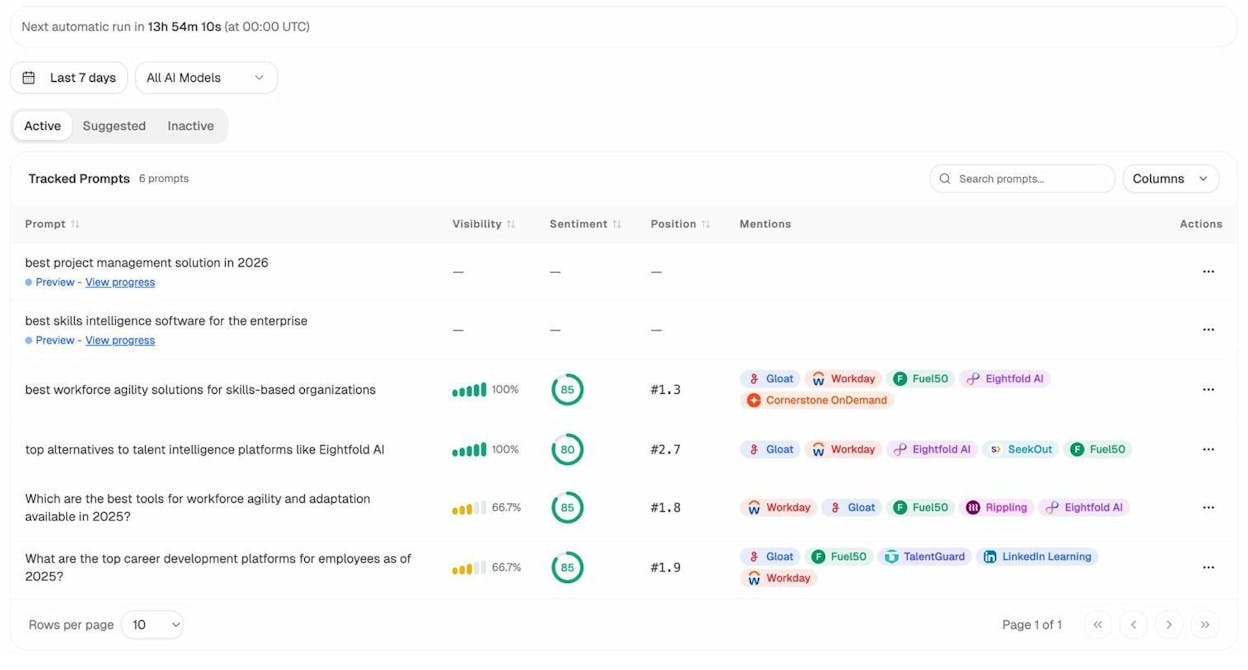
You can use Analyze AI’s Prompts feature to see how AI engines respond to specific queries in your space. Track the prompts that matter to your business, and you’ll see exactly which brands get mentioned, which sources get cited, and where you’re missing.
5. Score Every Keyword for Business Potential
Not all keywords are created equal, even if they have similar search volumes. A keyword is only valuable if it connects to your product or service in a meaningful way.
Here’s a simple scoring framework:
|
Score |
Definition |
Example (for an SEO tool) |
|---|---|---|
|
3 |
Your product is essential to the solution. You can’t explain the topic without mentioning it. |
“how to do keyword research” |
|
2 |
Your product helps, but isn’t the only way to solve the problem. You can mention it naturally. |
“how to improve organic traffic” |
|
1 |
Your product is tangentially related. You can mention it briefly but it’s a stretch. |
“how to create a content calendar” |
|
0 |
No way to naturally mention your product. Audience overlap exists, but the topic doesn’t connect. |
“how to install Google Analytics” |
Prioritize keywords that score 2 or 3. These bring visitors who have a real problem your product solves, which makes your content both helpful and commercially valuable without being pushy.
At Analyze AI, for example, a keyword like “how to track AI search visibility” scores a 3. The article is about what our platform does. A keyword like “how to choose keywords for SEO” scores a 2, because keyword research connects to search visibility, and we can naturally show how AI search adds a new dimension to keyword selection.
Scoring business potential also applies to AI search. If your brand frequently appears in AI-generated answers for a topic cluster, those keywords have proven business potential in the AI channel too, even if the search volume in Google is modest.
Don’t confuse business potential with being salesy
Choosing high-business-potential keywords doesn’t mean turning every article into a pitch. It means choosing topics where your product genuinely helps. The product mention should feel like a natural extension of the advice, not an interruption.
6. Assess Keyword Difficulty Honestly
Some keywords are realistic targets. Others would take years of sustained effort, even if they’re perfect from a business perspective.
Keyword difficulty (KD) scores, available in most SEO tools, give you a quick estimate of how hard a keyword will be to rank for. They’re usually based on the number and quality of backlinks pointing to the current top-ranking pages. A high KD means the top results have earned a lot of links, and you’d need to do the same.
Use Analyze AI’s free Keyword Difficulty Checker to get a quick read on any keyword. If you’re a newer site with a lower domain authority (you can check yours with the Website Authority Checker), focus on keywords with KD scores below 30 to start. As your site gains authority, you can target harder terms.
![[Screenshot: A keyword difficulty tool showing KD scores for a list of keyword ideas, with filters applied to show only low-difficulty opportunities]](https://www.datocms-assets.com/164164/1774985112-blobid10.png?auto=format,compress&w=1248&fit=max)
What KD scores don’t tell you
KD scores are useful shortcuts, but they don’t capture everything. Here are factors they often miss:
Brand dominance. If the first page is dominated by brands like Amazon, Wikipedia, and Forbes, even a “low KD” keyword might be practically impossible for a small site. Those brands rank partly because of their domain authority, not just their backlinks on that specific page.
Content quality. If the top results are thin, outdated, or clearly generated by AI with no original insight, that’s a genuine opportunity, regardless of what the KD score says. You can outrank strong domains with genuinely better content if the current results are weak.
Topical authority. If you’ve published extensively on related subtopics and built a cluster of interlinked content, you’ll have an easier time ranking for a new keyword in that cluster than a KD score would suggest. Google rewards depth and specialization.
For more on finding realistic opportunities, see our guide on how to find new keywords with lower competition.
7. Study What Competitors Already Rank For
Your competitors have already done keyword research for you. They’ve tested which topics drive traffic, which content formats work, and which keywords convert. You can learn from their work.
Find keyword gaps with content gap analysis
The most useful competitor technique is a content gap analysis. This shows you keywords that one or more competitors rank for, but you don’t.
Here’s how to do it:
Step 1: Identify 3 to 5 competitors. These can be direct business competitors or sites that rank for the same types of keywords you want to target.
Step 2: Use a content gap tool (available in most SEO platforms) and enter your domain against your competitors. The tool will output a list of keywords where competitors have rankings and you don’t.
![[Screenshot: A content gap analysis tool showing keywords that competitors rank for but the target site does not, with search volumes and difficulty scores]](https://www.datocms-assets.com/164164/1774985115-blobid11.png?auto=format,compress&w=1248&fit=max)
Step 3: Filter the results. Look for keywords with decent search volume (100+), manageable difficulty, and a business potential score of 2 or 3. These are your highest-priority opportunities.
Step 4: Review the actual ranking pages. Don’t just grab the keyword, study the content that ranks. What format is it? How deep does it go? What angles does it take? Understanding this gives you a blueprint for creating something better.
Competitor analysis in AI search
Traditional competitor analysis only shows you who ranks on Google. But your competitors in AI search might be completely different.
In Analyze AI’s Competitors dashboard, you can see which brands AI engines mention alongside yours when answering questions in your space. These “AI competitors” might include companies you’ve never considered as SEO competitors.
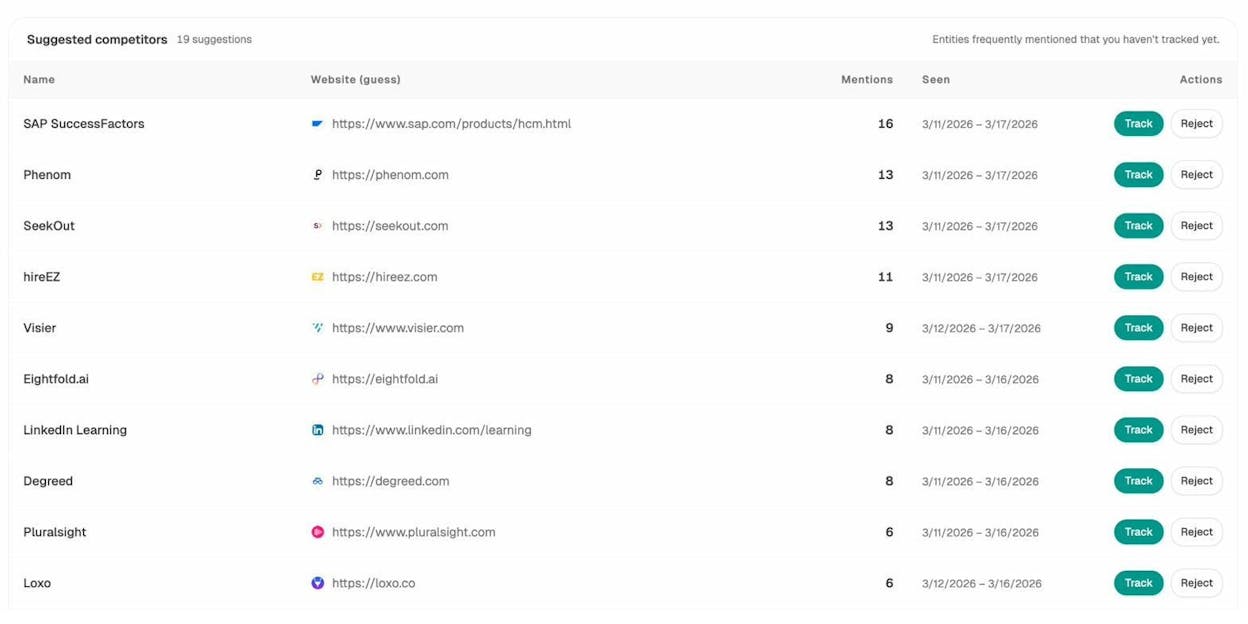
Analyze AI’s Competitors feature showing suggested competitors with their mention counts and the dates they were detected across AI platforms
This matters for keyword strategy. If a competitor consistently appears in AI answers for a topic cluster but you don’t, that’s a content gap worth closing, even if your Google rankings for those keywords are fine. AI search is a separate channel with its own competitive landscape.
Analyze AI also shows you the specific sources that AI models cite when answering questions in your industry. The Sources dashboard reveals which domains and content types get cited most, giving you a roadmap for the kind of content that earns AI visibility.
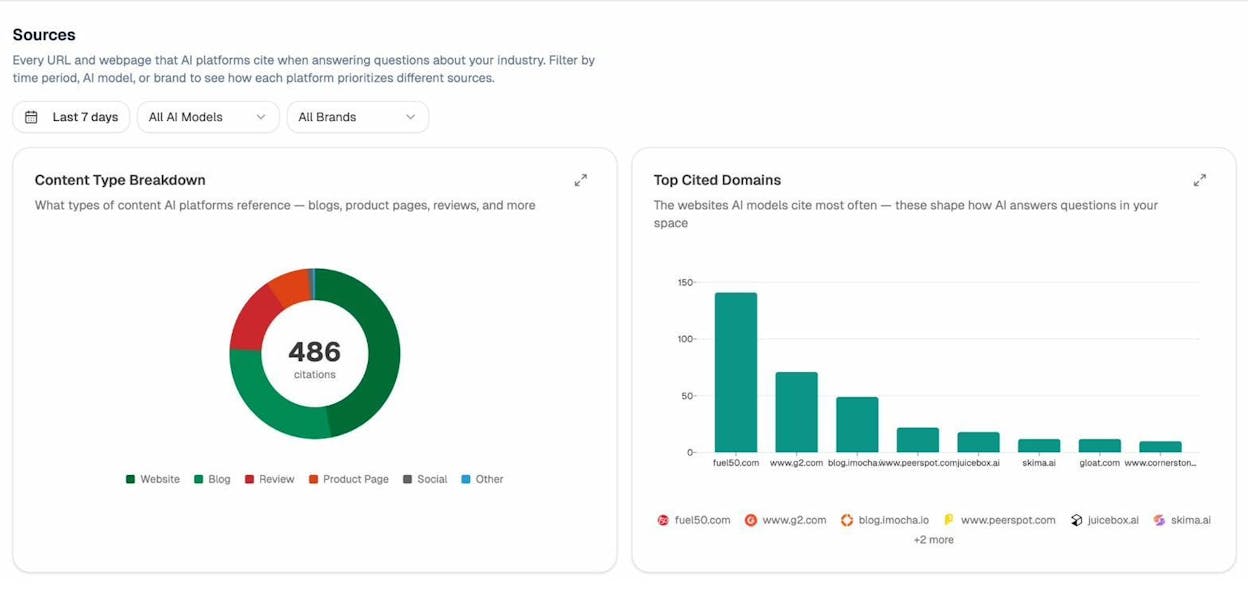
Analyze AI Sources dashboard showing content type breakdown and top cited domains that AI platforms reference when answering industry questions
If you notice that AI engines cite blog posts and comparison pages far more than product pages, that tells you where to invest your keyword-targeting efforts for the AI channel.
8. Think About Keywords for AI Search, Not Just Google
This is the section most keyword research guides leave out entirely. And it’s a mistake, because AI search is now a measurable source of traffic and conversions.
SEO is not dead. But it is evolving. As Analyze AI’s manifesto puts it: GEO isn’t a replacement for SEO, it’s the next transformation of it. Search is expanding from ten blue links to multi-modal, prompt-shaped answers. AI search should be treated as an additional organic channel to optimize alongside traditional SEO, not as a replacement.
So what does this mean for keyword selection?
How AI search changes keyword evaluation
In traditional SEO, you choose a keyword, create content optimized for it, and try to rank on page one of Google. In AI search, the dynamics are different:
There are no “positions” in the traditional sense. AI engines don’t rank ten results. They generate an answer and may cite sources. Your goal is to be cited, not to rank #1.
The “keywords” are actually prompts. People don’t type two-word queries into ChatGPT. They ask full questions like “What’s the best project management tool for remote teams with under 50 employees?” Your content needs to answer these specific, nuanced queries to get cited.
Topical authority matters more. AI models tend to cite sources that demonstrate depth and expertise on a topic. One thin article won’t cut it. A cluster of authoritative, interlinked content on a topic signals to AI models that your site is a credible source.
How to choose keywords that work in both channels
The good news: the keywords that perform well in traditional SEO also tend to perform well in AI search. Depth, clarity, originality, and usefulness are rewarded in both channels. But here are specific considerations for AI search:
Target “best X for Y” and comparison queries. These are the prompts people type into AI engines constantly. “Best CRM for small businesses,” “HubSpot vs Salesforce,” “top email marketing tools for ecommerce.” If you create thorough, well-structured comparison content, AI engines are likely to cite it.
Answer specific, long-form questions. AI users ask detailed questions. Content that answers “What’s the best keyword research process for a B2B SaaS startup with no existing traffic?” will outperform generic “keyword research 101” content in AI citations.
Provide original data and unique insights. AI models prioritize sources that offer information they can’t find everywhere else. Original research, case studies, proprietary data, and expert interviews all increase your chances of being cited.
Structure content for extraction. Use clear headings, concise paragraphs with the main point up front, and structured formats like tables and step-by-step lists. AI engines pull from well-structured content more easily.
How to use Analyze AI for AI keyword research
Analyze AI was built specifically to help you understand how your brand appears in AI search. Here’s how to use it for keyword-level decisions:
Track prompts like you track keywords. In the Prompts dashboard, you can add the key questions your audience asks AI engines and monitor whether your brand appears in the responses, what position you hold, and how sentiment trends over time.
Use suggested prompts to find new opportunities. Analyze AI suggests prompts based on your industry and tracked competitors. These are queries where AI engines are already generating answers in your space, and you may be missing.
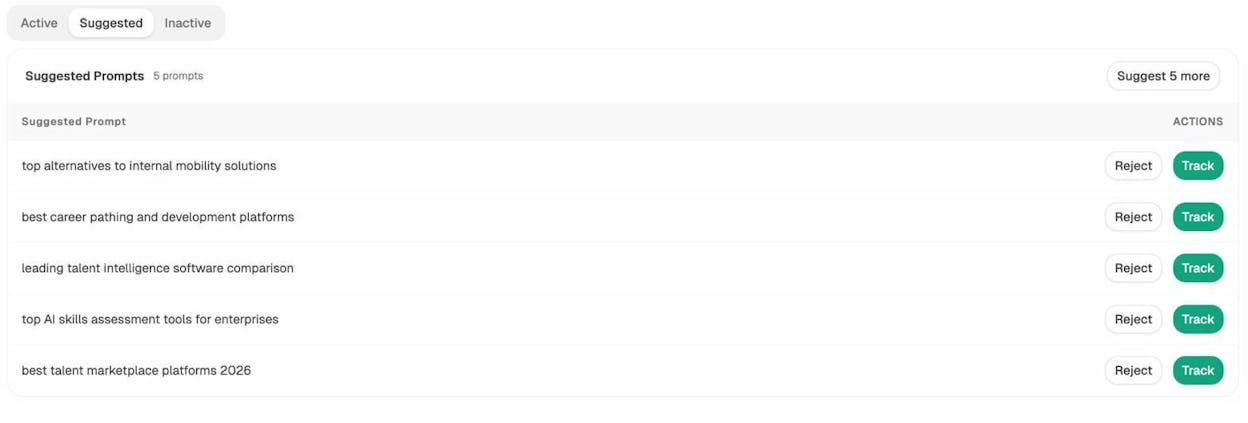
Analyze AI Suggested Prompts tab showing AI-generated prompt suggestions relevant to your industry with Track and Reject buttons
Run ad hoc searches to test visibility. Before committing to a keyword, use Analyze AI’s Ad Hoc Prompt Search to see how AI engines currently answer that query. If your brand doesn’t appear but competitors do, that keyword is worth targeting.
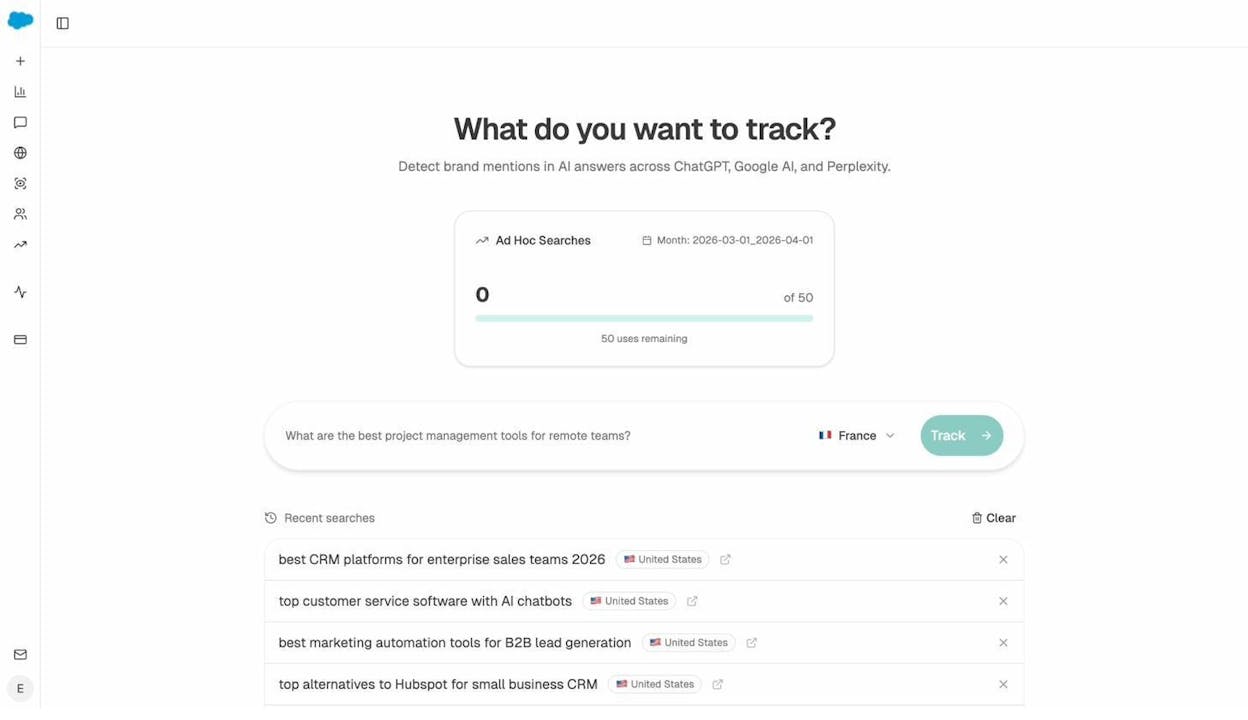
Analyze AI Ad Hoc Prompt Search interface where you can type any query and instantly see brand mentions across ChatGPT, Google AI, and Perplexity
Check the Perception Map. The Perception Map plots your brand against competitors on two axes: visibility and narrative strength. This tells you whether you’re visible and well-represented, or visible but poorly positioned. It can reveal that certain keyword clusters require content investment to shift the narrative.
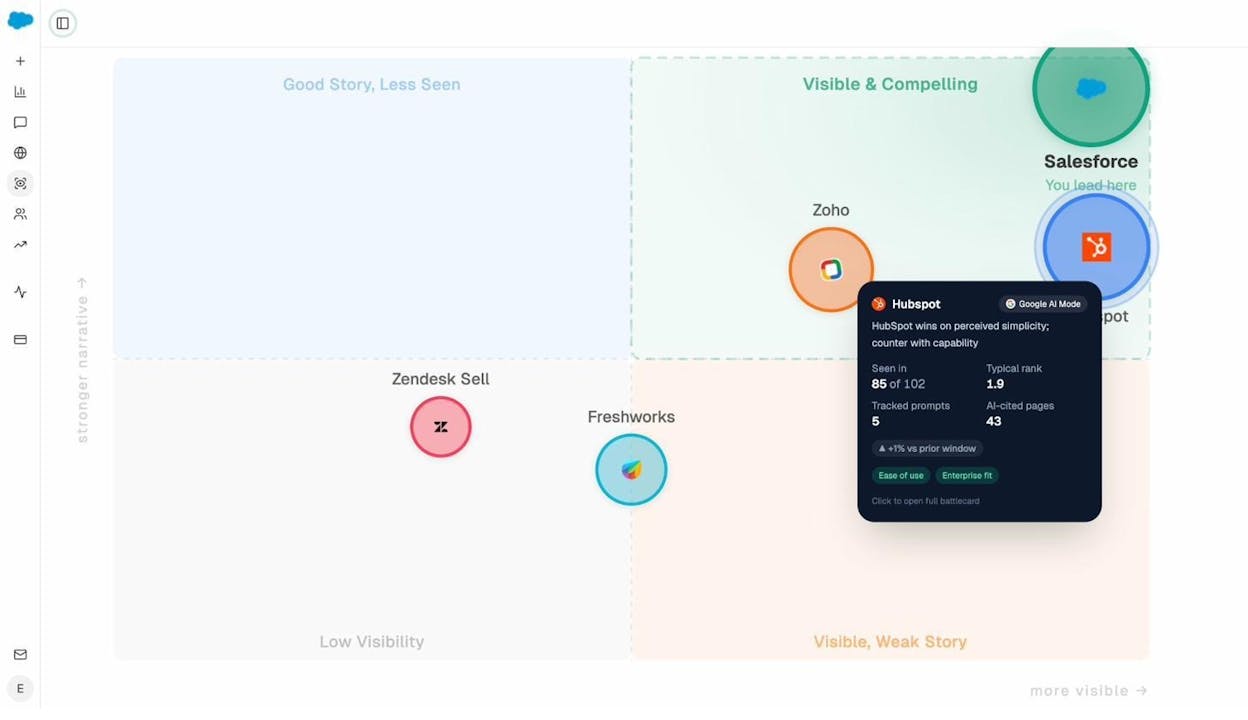
Analyze AI Perception Map showing brands plotted on axes of visibility and narrative strength, with battlecard popup showing competitor details
9. Find Long-Tail and Granular Keywords
Most keyword research guides tell you to start broad and go narrow. That’s correct, but most don’t explain how to go narrow systematically.
Long-tail keywords are longer, more specific queries. They typically have lower search volumes but also lower competition and clearer intent. More importantly, they convert better because the searcher knows exactly what they want.
How to find long-tail keywords
Use question modifiers. Take any seed keyword and add “how to,” “what is,” “why does,” “when should,” or “best way to.” The results are almost always long-tail keywords with clear informational intent.
Apply audience modifiers. Add your target audience to the keyword: “keyword research for beginners,” “keyword research for ecommerce,” “keyword research for local businesses.” Each modifier creates a distinct angle and often a distinct keyword.
Add comparison and alternative modifiers. Keywords like “[tool] alternatives,” “[tool A] vs [tool B],” and “best [category] tools” are high-converting long-tail keywords because the searcher is actively evaluating solutions.
Use geographic modifiers. For local or regional businesses: “SEO agency in Austin,” “best restaurants in Brooklyn,” “plumber near me.”
Explore “year” modifiers. Adding the current year (“best SEO tools 2026”) signals freshness intent. These keywords are competitive but can drive significant traffic because searchers want up-to-date information.
You can find long-tail keywords using any keyword research tool’s question or “related terms” report. The Analyze AI Keyword Generator and the Bing Keyword Tool also surface long-tail ideas you might miss in Google-focused tools, since Bing powers Copilot’s AI search responses.
Use keyword clustering to organize your list
Once you’ve collected dozens or hundreds of keywords, you need to group them into clusters. A keyword cluster is a group of related keywords that can be targeted by a single piece of content.
For example, “how to choose keywords for SEO,” “how to pick SEO keywords,” “choosing the right keywords,” and “how to select keywords for your website” all mean roughly the same thing. Google ranks the same pages for all of them. So you only need one piece of content to target the entire cluster.
Clustering prevents you from creating multiple pages that compete with each other for the same intent. It also helps you see the full scope of a topic, making your content more comprehensive.
For more on this, read our full guide on keyword clustering.
10. Validate Your Final Keyword List
Before you start creating content, run your keyword list through a final checklist. Every keyword you commit to should pass these five tests:
|
Test |
Question to Ask |
What to Do If It Fails |
|---|---|---|
|
Traffic potential |
Does the #1 page get meaningful organic traffic (not just search volume)? |
Drop it or keep it only if AI search potential is strong |
|
Search intent match |
Can you create the type of content that already ranks? |
Drop it or rethink your content format |
|
Business potential |
Can you naturally mention your product or service (score 2 or 3)? |
Deprioritize to a “nice to have” list |
|
Difficulty |
Is the KD realistic for your site’s authority? |
Target easier variations or build topical authority first |
|
AI search opportunity |
Does your brand appear when this topic is asked in AI engines? If not, do competitors? |
Use Analyze AI to check AI visibility and spot gaps |
If a keyword passes all five, it belongs on your priority list. If it fails one or two, it might still be worth targeting as a secondary keyword or a future play once your site has more authority.
Prioritize ruthlessly
You can’t target everything at once. Rank your validated keywords by a combination of business potential and feasibility. The best keywords to tackle first are those that score high on business potential, have realistic difficulty for your current authority, and have clear search intent you can match.
As you publish content and build topical authority, you’ll be able to move up to harder keywords. Keyword research isn’t a one-time project. It’s an ongoing process that should be revisited every quarter as your site grows and the search landscape shifts.
Final Thoughts
Choosing the right keywords for SEO comes down to five things: real traffic potential (not just search volume), business value, intent alignment, honest difficulty assessment, and now, AI search opportunity.
The biggest mistake people make is choosing keywords based on vanity metrics alone: high search volume, impressive-sounding topics, or whatever a tool recommends without context. The best keywords are the ones where traffic potential is real, your product genuinely helps, you can match the search intent, you have a realistic shot at ranking, and your content can surface in AI answers too.
The second biggest mistake is treating keyword research as a Google-only exercise. AI search engines are a growing channel that sends real, measurable traffic. The keywords that work well in traditional SEO tend to work well in AI search too, but understanding how AI engines select and cite sources gives you an edge most competitors are ignoring.
For a deeper look at how to use keywords once you’ve chosen them, check out our complete guide. And if you want to see how your brand currently performs in AI search for the keywords you care about, try Analyze AI to track your visibility, monitor competitors, and tie AI search to real traffic and conversions.

Ernest

Ibrahim


