Summarize this blog post with:


In this article, you’ll learn about the 11 most impactful types of marketing campaigns, see real examples of each, and get step-by-step guidance on how to launch them—including how to extend your campaigns into AI search, the fastest-growing organic channel most marketers still ignore.
Table of Contents
What Is a Marketing Campaign?
A marketing campaign is a set of coordinated activities designed to promote a product, service, or brand to a specific audience over a defined period. It ties together channels (email, social, search, ads, PR) around a single goal and a single message.
Without a campaign framework, marketing activity turns into a stream of disconnected posts, emails, and ads. Campaigns give that activity structure, measurement, and a deadline.
Every successful campaign shares six components:
|
Component |
What It Means |
Example |
|---|---|---|
|
Goal |
The measurable outcome the campaign targets |
Generate 500 qualified leads in Q3 |
|
Audience |
The specific people who should receive the message |
Product managers at mid-market SaaS companies |
|
Channels |
How and where the message gets delivered |
LinkedIn ads, email nurture, webinars |
|
Offer |
The action you want the audience to take |
Register for a live demo |
|
Message |
The angle that makes the audience care |
“Cut your onboarding time by 40% without adding headcount” |
|
Budget |
The time, money, and resources available |
$15K ad spend + 80 hours of team time |
With those foundations in place, the next question becomes: which type of campaign do you actually need? That depends on your goal. Here are the 11 types that matter most.
1. Product Marketing Campaign
A product marketing campaign introduces a new product, service, or feature to the market. It sits at the intersection of product, sales, and marketing—and it’s typically the most complex campaign a team will run.
The complexity comes from coordination. Product marketing campaigns require alignment across teams: engineering needs to ship on time, sales needs enablement materials, support needs documentation, and marketing needs positioning, messaging, and a launch plan—all synchronized around a single date.
When to use it: You’re launching a new product, entering a new market, or releasing a major feature that changes how customers use your product.
How to run a product marketing campaign
Step 1: Nail your positioning before anything else. Positioning answers three questions: who is this for, what problem does it solve, and why is your solution different? If you can’t answer those clearly, your launch messaging will be vague—and vague messaging doesn’t convert.
![[Screenshot: Your positioning document or framework template]](https://www.datocms-assets.com/164164/1774969640-blobid1.jpg?auto=format,compress&w=1248&fit=max)
Step 2: Build a go-to-market timeline. Map every deliverable backwards from launch day. This typically includes a landing page, product demo video, email announcement sequence, blog post, social assets, sales one-pager, and press outreach. Assign owners and deadlines for each.
Step 3: Create a landing page optimized for both search and conversions. Your landing page is the campaign’s hub. Make sure it targets a keyword with search demand (use a tool like Analyze AI’s Keyword Generator to find related terms), includes a clear CTA, and explains the product’s value in the first scroll.
Step 4: Sequence your launch across channels. Don’t blast everything on day one. A common cadence: teaser content one week before, a launch-day announcement across email and social, a follow-up blog post diving deeper into use cases, and a webinar or live demo within two weeks of launch.
Example
Buffer’s MVP launch is one of the most studied product marketing campaigns in startup history. Before writing a single line of code, Buffer created a landing page that explained the product concept and collected emails for a waiting list. That page alone validated demand. Then Buffer used the waiting list to gather feedback on which features to build first.
The takeaway: you don’t need a massive budget to run a product marketing campaign. You need clarity on what you’re building, who it’s for, and a way to test demand before you invest heavily.
![[Screenshot: Example of a simple MVP landing page with email capture]](https://www.datocms-assets.com/164164/1774969646-blobid2.png?auto=format,compress&w=1248&fit=max)
Extend it to AI search
When you launch a product, people don’t just Google it—they ask ChatGPT, Perplexity, and Claude about it too. A common prompt might be “best [category] tools in 2026” or “alternatives to [competitor].”
If your product doesn’t appear in those AI-generated answers, you’re invisible to a growing segment of your audience.
Use Analyze AI to track whether your new product appears in AI responses for relevant prompts. Start by adding prompts like “best [your category] tools” and “alternatives to [competitor name]” to your tracked prompt set. Then monitor your visibility, sentiment, and position over time.
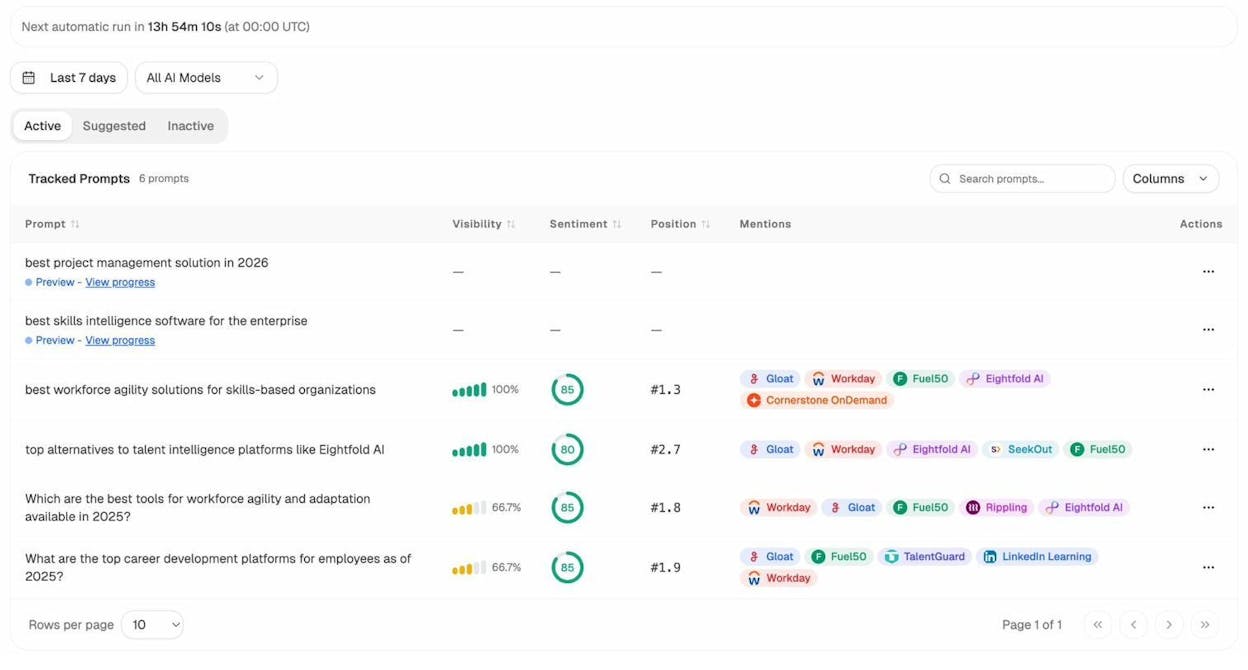
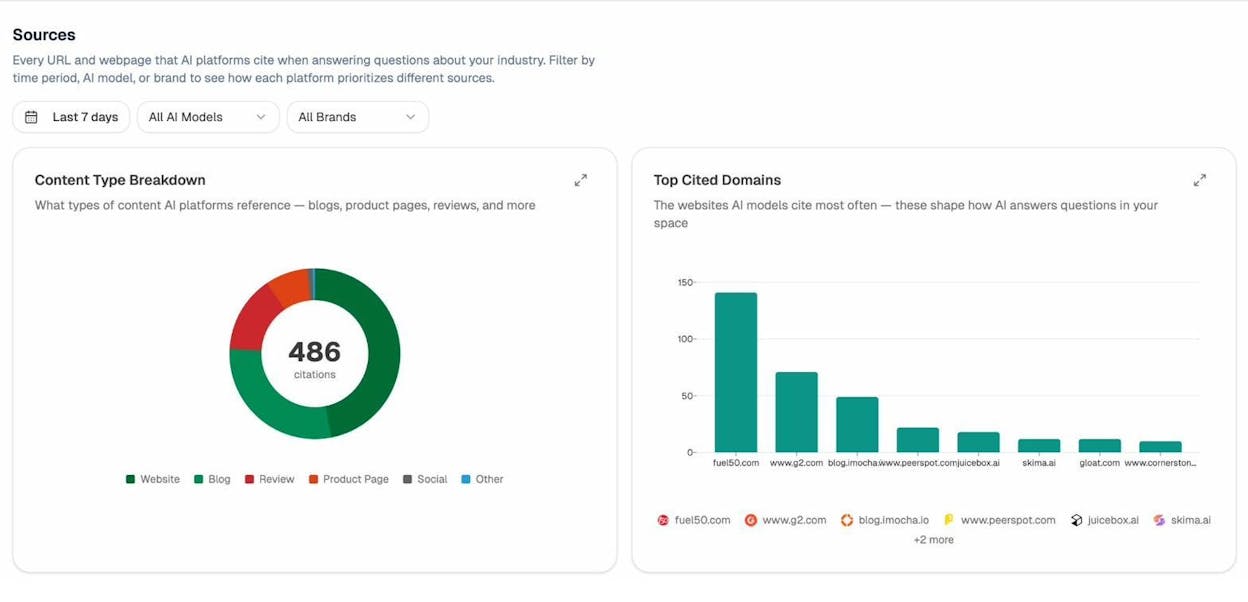
If your product isn’t showing up, check the Sources tab to see which competitor pages AI models are citing instead. That tells you exactly what content you need to create or improve to earn citations.
2. Sales Promotion Campaign
A sales promotion campaign is a short-term initiative designed to spike demand by reducing friction—usually through discounts, bundles, free shipping, or limited-time offers.
These campaigns work fast. Flash sales create urgency. Coupons lower the barrier to a first purchase. Bundles increase average order value. But there’s a downside to using them too often: frequent discounting trains customers to wait for deals and erodes your brand’s perceived value.
When to use it: You need to clear inventory, boost revenue in a slow quarter, acquire first-time customers quickly, or compete during a seasonal peak.
How to run a sales promotion campaign
Step 1: Choose your promotion type. Match the mechanic to your goal:
|
Promotion Type |
Best For |
Risk Level |
|---|---|---|
|
Percentage discount (20% off) |
Quick volume boost |
High—can devalue brand |
|
Dollar-off discount ($50 off) |
Higher-priced products |
Medium |
|
Bundle deal (buy 2, get 1) |
Increasing average order value |
Low |
|
Free shipping |
Reducing cart abandonment |
Low |
|
Limited-time access |
Creating urgency for digital products |
Low |
|
Loyalty reward (double points) |
Retaining existing customers |
Low |
Step 2: Set a hard deadline. Open-ended promotions kill urgency. Define a clear start date, end date, and communicate both prominently.
Step 3: Cap your exposure. Decide upfront how much margin you’re willing to sacrifice. Set a maximum number of redemptions or a total budget ceiling so a viral promotion doesn’t bankrupt you.
Step 4: Promote across owned channels first. Email your list, post on social, add a banner to your site. Only layer on paid ads if your owned channels don’t generate enough reach.
![[Screenshot: Example of a well-designed promotional banner with clear deadline and CTA]](https://www.datocms-assets.com/164164/1774969657-blobid5.png?auto=format,compress&w=1248&fit=max)
Example
Toyota’s annual Toyotathon—running since 1969—is one of the most successful recurring sales promotions in the U.S. It takes place every December, when dealerships need to clear the current year’s inventory before new models arrive.
What makes Toyotathon smart isn’t just the discounts. Toyota essentially created a sub-brand for its promotion. Customers aren’t just buying a discounted Toyota—they’re participating in an event. In December 2020, “toyotathon” generated roughly 35K monthly searches on Google, and Toyota sold over 211,000 vehicles that month alone.
The lesson: if you run recurring promotions, give them an identity. A named event feels more intentional than a generic “year-end sale.”
A word of caution
Running promotions too frequently creates a dependency cycle. Customers learn to wait for deals instead of buying at full price. Black Friday is a textbook example: many retailers see sales slump in the weeks leading up to the event because shoppers know discounts are coming. Use promotions strategically, not reflexively.
3. Brand Awareness Campaign
A brand awareness campaign increases how many people in your target audience recognize and remember your brand. Unlike sales promotions, these campaigns don’t push for immediate conversions. They build the mental associations that make people choose you later.
The goal is recall. When someone eventually needs what you sell, your brand should be the first one that comes to mind. That recall is built through consistent exposure to your brand’s visual identity, messaging, and values.
When to use it: You’re entering a new market, launching a new brand, or competing in a category where buyers consider multiple options before purchasing.
How to run a brand awareness campaign
Step 1: Define your brand codes. Brand codes are the distinctive assets people associate with your brand: your logo, colors, sounds, taglines, mascots, or visual style. Coca-Cola has its red color, contour bottle, and polar bears. Apple has its minimalist design and “Think Different” ethos. Before running an awareness campaign, know what your codes are.
Step 2: Choose channels where your audience already spends time. Brand awareness requires reach. Pick channels that let you get in front of large numbers of your target audience—display ads, social media, sponsorships, podcasts, YouTube pre-rolls, or content marketing.
Step 3: Prioritize consistency over novelty. The biggest mistake in brand awareness campaigns is changing your creative too often. Repetition builds memory. Keep your core visual identity and message consistent across all touchpoints, even when you’re tempted to “freshen things up.”
Step 4: Measure what matters. Brand awareness is harder to measure than direct response campaigns. Track aided and unaided brand recall through surveys, monitor branded search volume over time (use Analyze AI’s Keyword Rank Checker to see how your branded terms perform), and watch for increases in direct traffic to your site.
Example
Coca-Cola’s Christmas campaigns are the gold standard of brand awareness. The Santa Claus imagery, the red truck driving through snowy towns, the polar bears—these aren’t selling you a can of soda. They’re building a mental association between Coca-Cola and the warmth, joy, and togetherness of the holiday season.
These campaigns have been running for decades, and that consistency is the point. Coca-Cola doesn’t change its Christmas creative radically from year to year. It reinforces the same brand codes over and over, so the association becomes automatic.
The brand has even built a dedicated page on its website answering “Did Coca-Cola create Santa Claus?”—a page that alone generates around 900 monthly organic visits in the U.S.
Extend it to AI search
Here’s what most marketers miss about brand awareness: it now extends to AI search engines. When someone asks ChatGPT “What are the best CRM tools?” or Perplexity “Which project management apps do enterprise teams use?”—your brand either shows up in those answers or it doesn’t.
AI models form their responses based on the content they’ve ingested. If your brand isn’t well-represented across authoritative sources, you won’t appear in AI answers—even if you have strong traditional brand awareness.
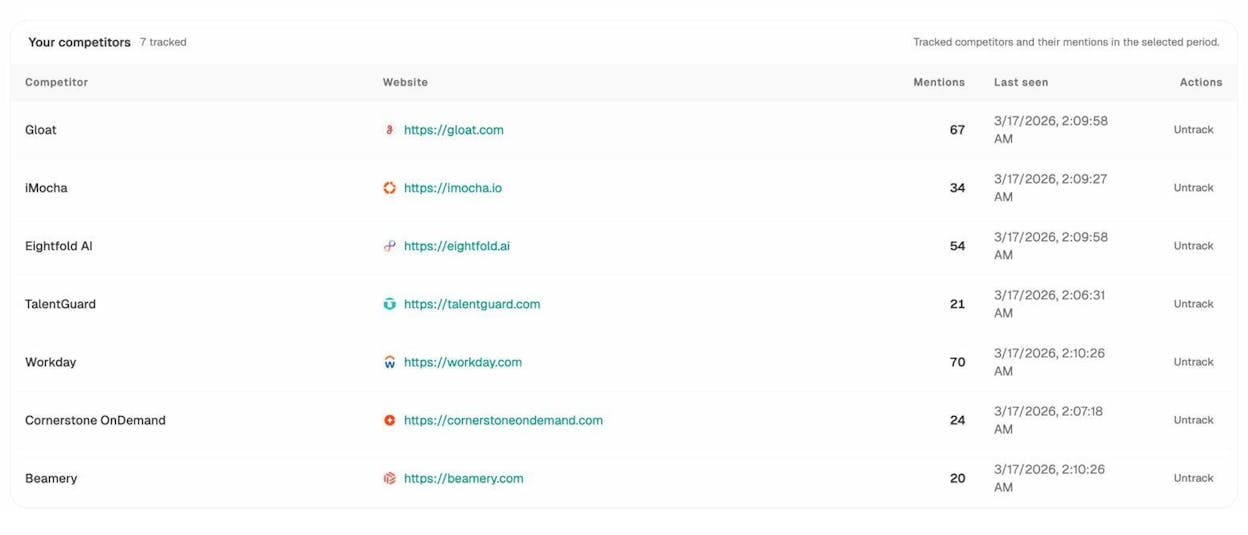
Analyze AI’s Competitor Overview dashboard shows exactly how your brand’s AI visibility stacks up against competitors. You can see your visibility share, sentiment scores, and which AI models mention you most frequently.
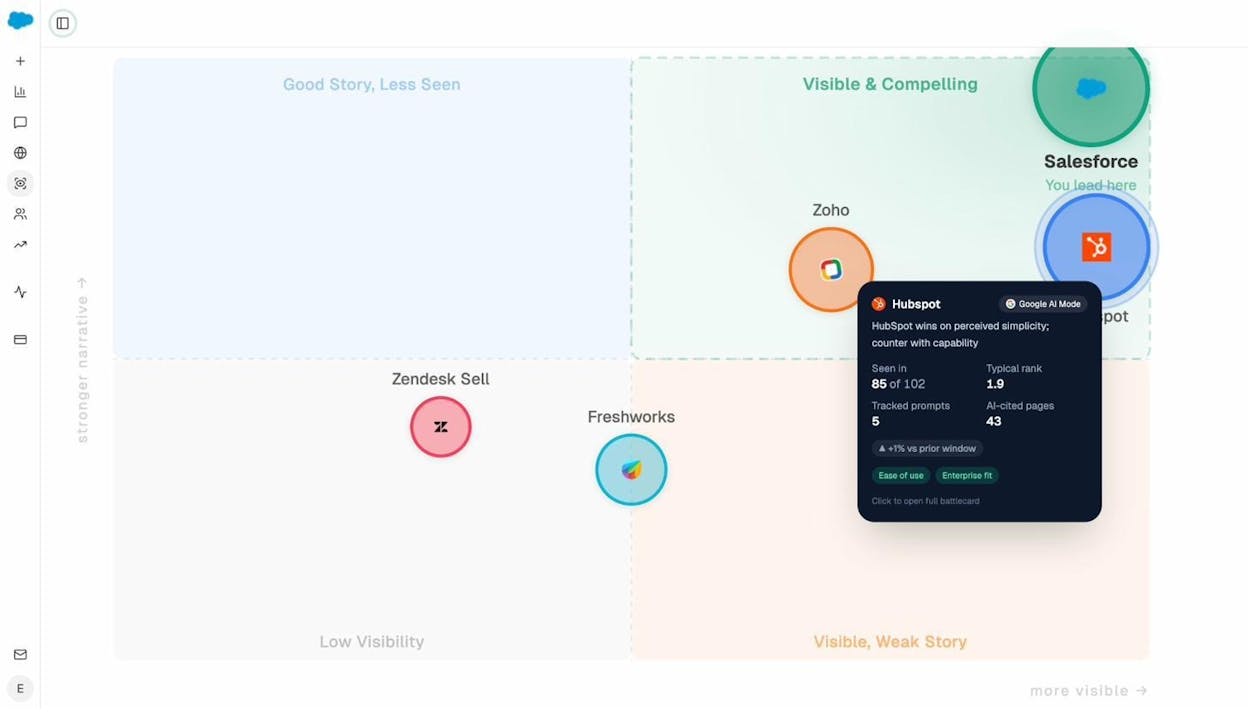
The Perception Map takes this further. It plots your brand against competitors on two axes—visibility and narrative strength—so you can see whether you’re “Visible & Compelling,” “Good Story, Less Seen,” or “Visible, Weak Story.” That tells you whether your awareness problem is about reach (you need more citations) or positioning (you need better messaging in the sources AI models rely on).
4. Rebranding Campaign
A rebranding campaign changes how your brand looks, sounds, and feels to the public. It can be as small as a logo refresh or as large as a complete overhaul of your brand name, visual identity, messaging, and positioning.
Rebranding is risky. You’re asking your existing audience to accept a new identity while simultaneously trying to attract a new one. Done well, it modernizes your brand and opens new markets. Done poorly, it confuses loyal customers and generates negative press.
When to use it: Your brand feels outdated relative to competitors, you’ve outgrown your original positioning, you need to distance yourself from negative associations, or you’re pivoting your product or business model.
How to run a rebranding campaign
Step 1: Be clear on why you’re rebranding. “We need a new look” isn’t a strategy. Define the business reason: are you entering a new market? Has your product evolved beyond your current brand? Are customers confused about what you do?
Step 2: Audit your current brand equity. Before you change anything, understand what people already associate with your brand. Survey customers, analyze branded search terms, review social mentions, and identify which brand elements have positive equity worth preserving.
Step 3: Design for recognition, not just aesthetics. A rebrand that looks beautiful but confuses existing customers has failed. Your new identity should feel like a natural evolution, not a complete break. Keep at least some continuity—whether it’s a color, a wordmark style, or a tagline.
Step 4: Plan a phased rollout. Don’t flip everything overnight. Announce the rebrand to employees first, then customers, then the public. Update your highest-traffic touchpoints (website, social profiles, email templates) first, then work through the long tail of materials.
![[Screenshot: Example of a brand style guide showing old vs. new identity elements]](https://www.datocms-assets.com/164164/1774969663-blobid8.png?auto=format,compress&w=1248&fit=max)
Example
In 2021, Kia underwent a major rebrand to signal its shift toward electric vehicles and sustainable mobility. The new logo replaced Kia’s familiar oval badge with a stylized wordmark designed to look sleek and futuristic.
The rebrand included a world-record-breaking drone light show and a new tagline built around “Movement that Inspires.” But the execution had a notable flaw: many people read the new logo as “KN” rather than “KIA.” Google searches for “kn car brand” and “kn car price” spiked immediately after the reveal.
The criticism was loud, but Kia didn’t backtrack. Over time, the confusion faded. The EV6 model, launched under the new branding, won the 2022 European Car of the Year. Kia’s sales and share price remained stable.
The lesson: initial backlash isn’t necessarily a sign of failure. Rebranding is a long-term bet, and reverting because of early criticism undermines the entire strategy. The question isn’t “do people like the new logo?”—it’s “does the new brand support where the business is going?”
5. Content Marketing Campaign
A content marketing campaign uses educational, entertaining, or informative content—blog posts, videos, guides, podcasts, webinars—to attract and engage a target audience over time.
Unlike advertising, content marketing doesn’t interrupt. It earns attention by being useful. And unlike one-off ads, content compounds: a well-written blog post or video can generate traffic, leads, and brand awareness for years after publication.
When to use it: You want to build organic traffic, establish thought leadership, generate leads through educational content, or support your sales team with resources that address buyer questions.
How to run a content marketing campaign
Step 1: Start with topics your audience actually searches for. Don’t guess. Use keyword research to find topics with real search demand. Analyze AI’s Keyword Generator helps you discover keyword ideas across Google, Bing, YouTube, and Amazon. Start with a seed keyword related to your product category and look for terms with decent search volume and manageable competition.
![[Screenshot: Analyze AI Keyword Generator tool showing keyword suggestions]](https://www.datocms-assets.com/164164/1774969669-blobid9.png?auto=format,compress&w=1248&fit=max)
Step 2: Prioritize topics that connect to your product. Not all traffic is equal. A blog post that attracts thousands of visitors who will never buy your product is less valuable than one that attracts hundreds of potential customers. Prioritize topics where your product naturally solves the reader’s problem. This approach is sometimes called pain-point SEO—targeting keywords where the searcher’s intent aligns with what your product does.
Step 3: Create content that’s genuinely better than what ranks today. Pull up the current top-ranking pages for your target keyword. Read them critically. Note what they cover, what they miss, and where they’re generic. Your content needs to offer something those pages don’t—whether that’s original data, deeper tactical detail, unique examples, or a clearer structure.
Step 4: Build in distribution from the start. Publishing and hoping isn’t a strategy. Before you hit publish, have a plan: email it to your list, share it on social, pitch it for inclusion in relevant newsletters, and identify opportunities for link building to boost its search ranking.
Step 5: Track performance and iterate. Monitor organic traffic, engagement metrics, and conversions using SEO reporting tools. Identify content that’s close to ranking on page one and update it to push it higher. This ongoing optimization is what separates content marketing from content publishing.
Example
HubSpot’s blog is arguably the most successful content marketing campaign in SaaS history. By consistently publishing comprehensive, SEO-optimized content about marketing, sales, and customer service topics, HubSpot built a content engine that generates millions of monthly organic visits. Many of those visitors enter HubSpot’s funnel by downloading free tools and templates mentioned in the blog posts.
The key insight from HubSpot’s approach: content marketing isn’t a project with an end date. It’s an ongoing operation. The companies that win at content marketing treat it like a product—with regular publishing cadences, systematic optimization of existing content, and clear metrics tied to business outcomes.
Extend it to AI search
Content marketing campaigns now have a second audience: AI models. When ChatGPT, Perplexity, or Google AI Mode generate answers, they draw from web content. If your blog posts are well-structured, authoritative, and deeply useful, they’re more likely to be cited in AI-generated responses.
Track which of your pages AI engines actually send traffic to using Analyze AI’s Landing Pages report. This shows you which URLs receive AI-referred sessions, broken down by referring AI engine, engagement metrics, and conversions.
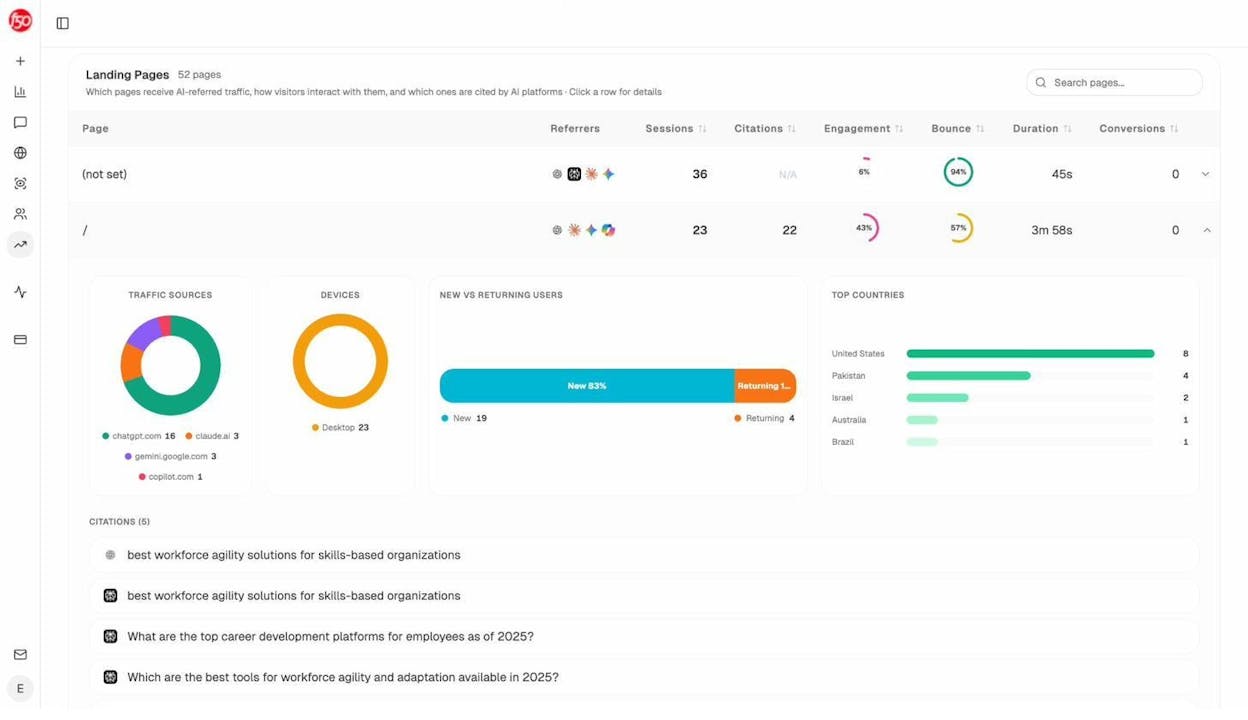
If certain page formats or topics consistently earn AI citations and traffic, double down on those patterns. For example, you might find that comparison pages or data-driven guides earn significantly more AI referral traffic than opinion pieces. That’s a signal to adjust your content mix accordingly.
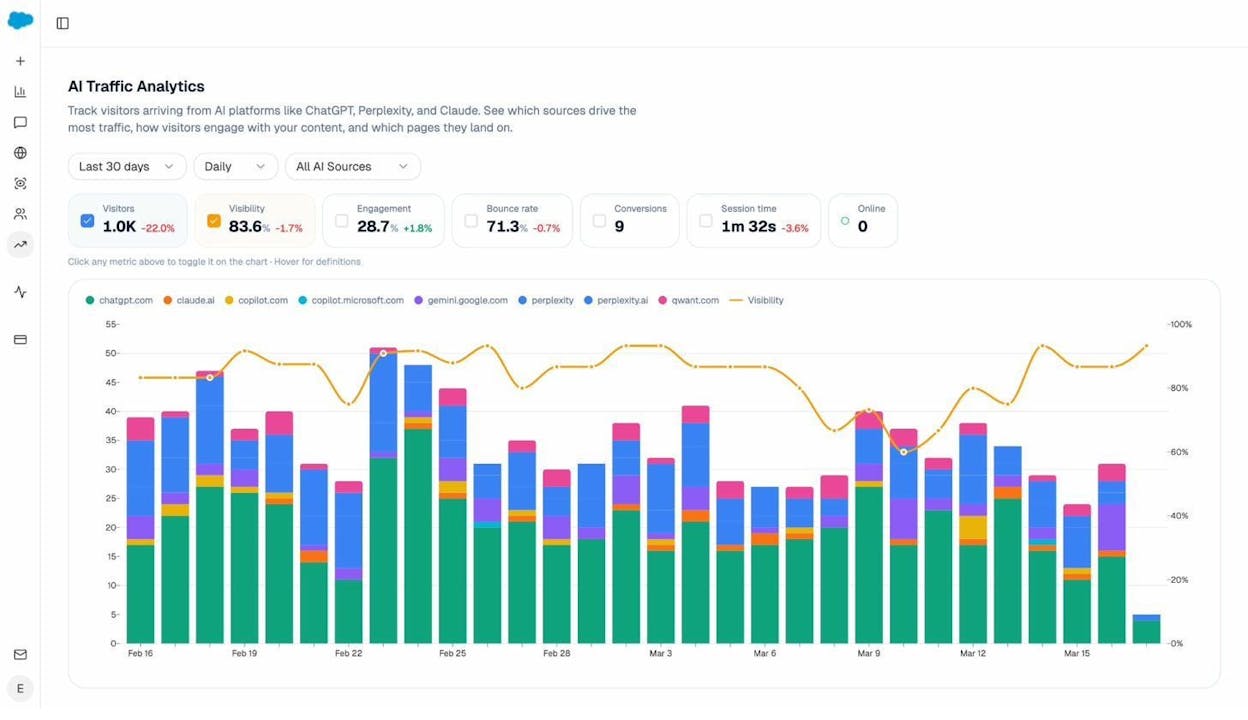
You can also check how AI referral traffic is trending over time using the AI Traffic Analytics dashboard. This gives you a clear picture of whether AI search is becoming a meaningful channel for your brand—and which specific AI engines drive the most visitors.
6. SEO Campaign
An SEO (Search Engine Optimization) campaign is a focused effort to improve your website’s visibility in search engine results for specific keywords. The goal is to rank higher on Google (and other search engines) so more people find your site through organic search.
SEO campaigns differ from content marketing campaigns in scope. A content marketing campaign is an ongoing program. An SEO campaign is typically a focused initiative targeting specific rankings—like building backlinks to a key page, improving your site’s technical health, or optimizing a set of pages for better keyword targeting.
When to use it: You want to increase organic traffic to specific pages, improve rankings for high-value keywords, fix technical issues holding back your search performance, or build domain authority through link acquisition.
How to run an SEO campaign
Step 1: Identify your target keywords. Use keyword research to find terms with meaningful search volume and reasonable competition. Analyze AI’s Keyword Difficulty Checker helps you estimate how hard it will be to rank for specific terms. Look for keywords where the top-ranking pages aren’t overwhelmingly authoritative—those are your best opportunities.
Step 2: Audit your current performance. Before you optimize, understand where you stand. Check which keywords your site already ranks for using Analyze AI’s Keyword Rank Checker. Look for “low-hanging fruit”—keywords where you rank on page two or at the bottom of page one. Those pages often need small improvements to jump significantly in rankings.
Step 3: Optimize your on-page SEO. Make sure each target page has a clear title tag, a compelling meta description, proper heading structure, internal links to and from related pages, and content that genuinely satisfies the searcher’s intent. Don’t stuff keywords—write for humans first, search engines second.
Step 4: Build relevant backlinks. Backlinks remain one of the strongest ranking signals. Focus on earning links from authoritative, topically relevant sites. Tactics include creating linkable assets (original research, free tools, comprehensive guides), guest posting on reputable industry blogs, and broken link building. Use Analyze AI’s Broken Link Checker to find broken links on relevant sites that you could offer to replace with your content.
Step 5: Fix technical issues. Run a site audit to identify crawl errors, slow-loading pages, duplicate content, broken links, and other technical problems that could hold back your rankings. Check your site’s overall authority with Analyze AI’s Website Authority Checker to benchmark against competitors.
![[Screenshot: Example of a site audit showing technical SEO issues to fix]](https://www.datocms-assets.com/164164/1774969679-blobid12.png?auto=format,compress&w=1248&fit=max)
Example
In 2020, the Ahrefs team ran a focused link-building campaign to rank for the keyword “SEO statistics.” They created a comprehensive list of statistics sourced from their own data and external studies, then reached out to other site owners to request backlinks.
The results: 515 outreach emails sent, 36 backlinks acquired from 32 unique websites, and a #1 ranking for “SEO statistics” in the U.S. The page continues to rank in the top five for related terms, generating consistent organic traffic.
The takeaway: SEO campaigns with a narrow, measurable goal (rank for this specific keyword) tend to outperform vague “improve our SEO” initiatives. Pick a target, build a focused plan, and execute.
Extend it to AI search: the AI visibility campaign
Here’s the shift most marketers haven’t made yet: the same content that ranks on Google also appears in AI-generated answers—but not automatically. AI models like ChatGPT, Perplexity, and Claude decide independently which sources to cite, and their selection criteria don’t perfectly overlap with Google’s ranking factors.
That means you can rank #1 on Google for a keyword but still be absent from AI answers for the same topic. And increasingly, your potential customers are using AI search alongside (or instead of) traditional search to research purchases, compare products, and find solutions.
This is where an AI visibility campaign comes in. Think of it as a parallel track to your SEO campaign—focused on earning visibility in AI-generated responses.
How to run an AI visibility campaign:
Step 1: Track your current AI visibility. Set up prompt tracking in Analyze AI for the keywords and queries that matter to your business. Add prompts like “best [category] tools,” “how to [solve problem your product addresses],” and “[your brand] vs [competitor].”
Analyze AI runs these prompts across ChatGPT, Perplexity, Claude, Gemini, Copilot, and Google AI Mode daily, then shows you whether your brand appears, what position you hold, what sentiment the response conveys, and which competitors show up alongside you.
Step 2: Identify opportunities where competitors appear but you don’t. The Competitor Overview in Analyze AI shows where rivals win mentions and citations that you’re missing. Each gap is a content or authority opportunity.
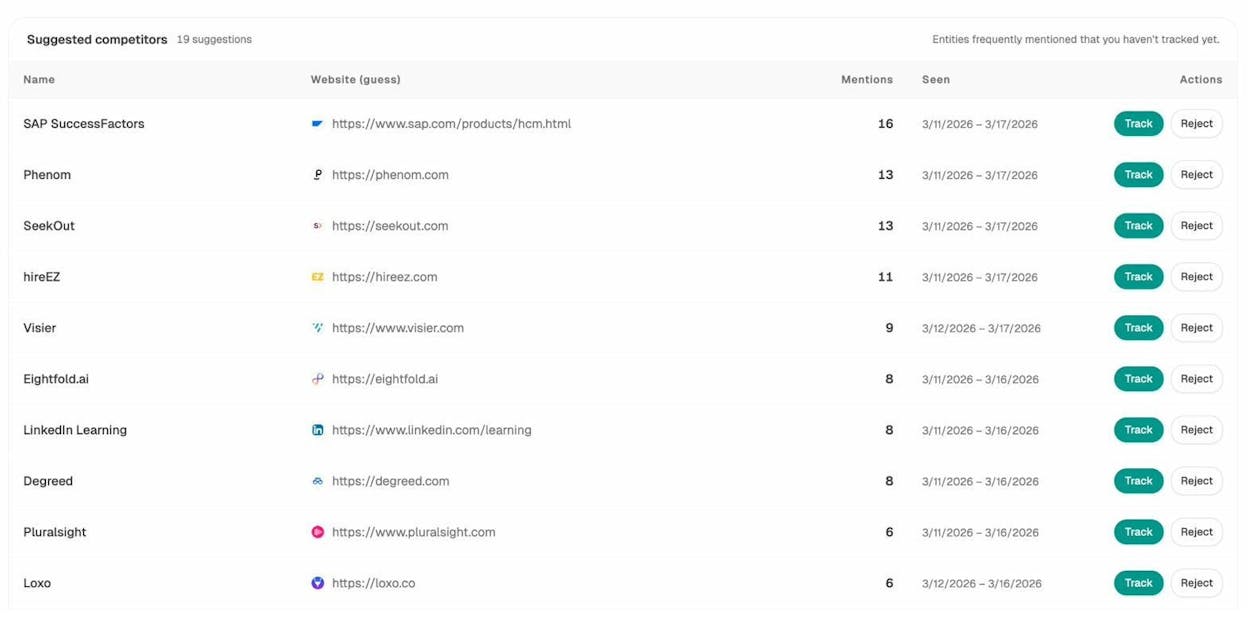
Step 3: Audit the sources AI models cite. In the Sources dashboard, you can see exactly which URLs and domains AI models reference when answering questions in your category. If your competitor’s blog post is cited but yours isn’t, you know which content needs upgrading—or creating.
Step 4: Optimize content for AI citations. AI models tend to cite content that’s well-structured, authoritative, up-to-date, and directly answers specific questions. Make sure your most important pages have clear headings, concise answers in the opening paragraphs, original data or expert quotes, and proper schema markup. For more on this, see our guide on answer engine optimization.
Step 5: Measure AI referral traffic. Connect your Google Analytics (GA4) to Analyze AI to see actual sessions coming from AI engines. This goes beyond visibility—it tells you whether AI mentions are translating into real website traffic and conversions.
This kind of AI visibility campaign isn’t a replacement for SEO. SEO isn’t dead—it’s evolving. AI search is a complementary organic channel that sits alongside traditional search. The brands that build visibility in both channels now will compound their advantage over competitors who wait.
7. Email Marketing Campaign
An email marketing campaign is a series of emails sent to a targeted list to promote a product, nurture leads, onboard users, or drive a specific action.
Email remains one of the highest-ROI marketing channels because it uses an owned audience—people who’ve already opted in to hear from you. Unlike social media, where algorithms control your reach, email delivers directly to inboxes.
When to use it: You want to nurture leads through a sales funnel, onboard new users, recover abandoned carts, promote content, announce product updates, or run a seasonal promotion to existing customers.
How to run an email marketing campaign
Step 1: Segment your audience. Don’t send the same email to everyone. Segment by behavior (pages visited, purchases made, emails opened), lifecycle stage (prospect, trial user, paying customer), or demographic data. Segmented campaigns consistently outperform one-size-fits-all blasts.
Step 2: Map your email sequence to the buyer’s journey. For a lead nurture campaign, a typical sequence might be: welcome email → educational content addressing their pain point → case study or social proof → product-focused email with a clear CTA → follow-up with a deadline or offer. Each email should build logically on the previous one.
Step 3: Write subject lines that earn opens. Your subject line competes with dozens of other emails in the recipient’s inbox. Keep it short (under 50 characters), specific, and benefit-oriented. Avoid spam triggers like ALL CAPS or excessive exclamation points.
Step 4: Automate based on triggers. Set up workflows triggered by user actions: cart abandonment triggers a recovery sequence, a free trial signup triggers an onboarding sequence, a content download triggers a nurture sequence. Automation makes email campaigns scalable without making them feel impersonal.
Step 5: Test and optimize relentlessly. A/B test subject lines, send times, CTA placement, and email length. Track open rates, click-through rates, and—most importantly—conversion rates. An email that gets opened but doesn’t drive action isn’t working.
![[Screenshot: Example of an email automation workflow diagram]](https://www.datocms-assets.com/164164/1774969685-blobid14.jpg?auto=format,compress&w=1248&fit=max)
Example
Tuft & Needle, a direct-to-consumer mattress brand, runs a three-part cart abandonment campaign that’s a masterclass in empathy-driven email marketing.
Instead of bombarding the shopper with discounts (a common mistake), the first email acknowledges that buying a mattress is a big decision. It links to a helpful resource about common fears of buying a mattress online. The second email highlights the product’s materials and value proposition, then links to a competitor comparison page. The third email addresses the biggest remaining objection—risk—by reminding the shopper about their 100-night trial with free returns.
Notice what’s absent: no discount code. No “15% off if you buy now!” Tuft & Needle understood that offering discounts in cart abandonment emails trains customers to abandon carts on purpose to trigger the discount. Instead, they focused on removing objections—which is a more sustainable conversion strategy.
8. Social Media Campaign
A social media campaign is a coordinated effort to achieve a specific marketing goal using one or more social media platforms. It’s more focused than general social media marketing—it has a defined objective, timeline, creative theme, and metrics for success.
Social media’s unique advantage is virality potential. A great social campaign can spread far beyond your existing followers, reaching audiences you couldn’t access through paid channels at any budget. The flip side: organic reach on most platforms has declined significantly in recent years, so many social campaigns now combine organic content with paid amplification.
When to use it: You want to build brand awareness among a broad audience, drive engagement around a product or event, encourage user-generated content, launch a hashtag or movement, or amplify a campaign running on other channels.
How to run a social media campaign
Step 1: Pick one primary platform. Trying to run a campaign across five platforms simultaneously dilutes your effort. Choose the platform where your target audience is most active and most engaged. LinkedIn for B2B, Instagram or TikTok for visual consumer brands, X (Twitter) for real-time conversation and tech audiences.
Step 2: Create a campaign hashtag or theme. Give your campaign a unifying thread. A hashtag works well on Instagram and X. A visual theme (consistent colors, layout, or style) works better on LinkedIn and Facebook. The goal is immediate recognition—when someone sees your content, they should instantly connect it to the campaign.
Step 3: Build content that invites participation. The best social campaigns aren’t monologues—they’re conversations. Create content that’s easy for your audience to respond to, remix, or share. User-generated content campaigns (where you invite your audience to create and share their own content using your hashtag) tend to generate far more reach than brand-created content alone.
Step 4: Amplify with paid support. Even a small paid budget can dramatically extend a social campaign’s reach. Use platform-native targeting to put your best-performing organic content in front of a broader audience that matches your ideal customer profile.
Step 5: Engage in real time. Social media is interactive. When people respond to your campaign, respond back. Like, comment, reshare. The algorithm rewards engagement, and your audience rewards authenticity.
Use Analyze AI’s free Social Media Caption Generator and Social Media Hashtag Generator to quickly draft captions and identify relevant hashtags for your campaign posts.
Example
Apple’s #ShotOniPhone campaign, launched in 2017, is one of the most successful social media campaigns ever run. The concept is simple: Apple showcases photos and videos taken by iPhone users on its Instagram account and invites its broader audience to share their own work under the same hashtag.
To date, the hashtag has accumulated over 28 million posts on Instagram. Apple turned its customers into content creators and its product’s camera quality into a social proof engine—all without offering a discount or running a traditional ad.
The brilliance of #ShotOniPhone is that every post is simultaneously a piece of user-generated content, a product demonstration, and a brand awareness asset. One campaign mechanic, three marketing objectives.
9. PR Campaign
A PR (Public Relations) campaign shapes public perception of your brand through earned media—press coverage, interviews, event appearances, and thought leadership—rather than paid advertising.
PR and marketing are sometimes treated as separate disciplines, but their goals overlap significantly. Both aim to influence how people perceive and interact with your brand. The key difference is the mechanism: marketing typically uses owned and paid channels, while PR focuses on earning coverage through third parties—journalists, bloggers, industry analysts, and influencers.
When to use it: You’re launching something newsworthy, repositioning your brand, managing a reputation issue, building credibility through third-party validation, or trying to reach audiences who distrust advertising.
How to run a PR campaign
Step 1: Identify what’s actually newsworthy. Journalists receive hundreds of pitches daily. Yours needs a hook. Newsworthy hooks include original data or research, a provocative industry take, a major partnership or funding round, a compelling customer story, or a timely tie-in to current events.
Step 2: Build your media list strategically. Don’t blast every journalist in your industry. Identify 10-20 reporters who specifically cover your topic area and have written about similar stories recently. Read their recent work. Personalize your pitch to show you understand what they care about.
Step 3: Write a pitch, not a press release (first). Lead with the story, not the company. A good pitch answers: “Why would this journalist’s audience care about this?” Open with the most interesting fact or angle, keep it under 200 words, and include one clear call to action (usually an offer for an interview or exclusive data).
Step 4: Create supporting assets. Have your press release, high-res images, executive bios, and key statistics ready to send immediately if a journalist responds. Slow follow-up kills media opportunities.
Step 5: Amplify earned coverage. When you get press, maximize its value. Share it on social, feature it on your website, include it in sales materials, and cite it in future pitches to other journalists. A press hit’s impact multiplies with amplification.
Example
Metro Trains Melbourne’s “Dumb Ways to Die” campaign is one of the most awarded PR campaigns of all time. Tasked with promoting railway safety to an audience that actively ignores safety messages, the creative team produced an animated music video that humorously depicted absurd ways to die—with the final scenarios involving unsafe behavior around trains.
The result: the campaign went viral, won more Cannes Lions than any campaign in history, and reduced near-miss railway accidents by 30% in Australia. It worked because it met the audience on their terms—with humor instead of lecturing—and created content people actually wanted to share.
Extend it to AI search
PR campaigns have a new second-order effect in the AI search era: the media coverage you earn feeds AI models.
When a major publication writes about your brand, that article becomes part of the training data and citation pool for AI models. If TechCrunch, Forbes, or an industry publication writes about your product launch, AI models are more likely to mention your brand in future responses.
This means PR isn’t just about reaching human readers anymore—it’s about seeding the information layer that AI models draw from. Every authoritative mention of your brand increases the probability that AI answers will include you.
Use Analyze AI’s Sources dashboard to track which external domains AI models cite when answering questions in your industry. If your PR efforts are landing coverage on high-authority sites, you should see those domains appearing as cited sources—and your brand should start appearing in more AI responses over time.
10. Influencer Marketing Campaign
An influencer marketing campaign partners with individuals who have established audiences and credibility in your target market. These individuals—whether they have 5,000 or 5 million followers—promote your product or service to their audience through sponsored content, reviews, or collaborations.
Influencer marketing works because it borrows trust. When someone your audience already follows and respects recommends your product, that recommendation carries more weight than a brand-created ad.
When to use it: You want to reach a specific niche audience quickly, build social proof and credibility, generate authentic product content you can repurpose, or drive awareness among people who are difficult to reach through traditional advertising.
How to run an influencer marketing campaign
Step 1: Define your goal before selecting influencers. Brand awareness campaigns need influencers with reach. Conversion campaigns need influencers with high engagement and niche relevance. The influencer you need depends entirely on what you’re trying to achieve.
Step 2: Prioritize relevance over follower count. A micro-influencer (10K-50K followers) in your exact niche will almost always outperform a generic mega-influencer for driving qualified traffic and conversions. Look for creators whose audience matches your ideal customer profile and whose content style aligns with your brand.
Step 3: Give creative freedom. The number one mistake brands make with influencer campaigns is over-scripting the content. The influencer’s audience follows them for their authentic voice. When content feels like an ad reading from a script, engagement drops and trust erodes. Provide key messages and requirements, but let the influencer deliver them in their own style.
Step 4: Structure for measurability. Use unique discount codes, UTM-tagged links, or dedicated landing pages for each influencer so you can attribute results. Without clear attribution, you can’t distinguish which partnerships drive results and which are vanity metrics.
Step 5: Build long-term partnerships. One-off sponsored posts have limited impact. The most effective influencer campaigns involve ongoing relationships where the influencer becomes a genuine advocate for your brand. Repeated, authentic endorsements build much more trust than a single paid post.
Example
Daniel Wellington, the watch brand, built a $200M+ business almost entirely through influencer marketing. Instead of running traditional ads, they sent free watches to thousands of Instagram influencers—from micro-influencers with a few thousand followers to celebrities—and asked them to post photos with a specific discount code.
The approach was scalable (free watches are cheap compared to ad spend), measurable (each influencer had a unique code), and authentic (influencers genuinely wore and photographed the watches in their daily lives). At its peak, #danielwellington had over 2 million Instagram posts.
11. 360-Degree Marketing Campaign
A 360-degree marketing campaign uses multiple channels to deliver a single, unified message. While other campaign types typically focus on one channel or tactic, a 360 campaign orchestrates email, social, search, paid ads, PR, content, events, and any other relevant touchpoint around the same core message.
The advantage of 360 campaigns comes from two principles: reach (more channels = more people exposed to your message) and repetition (the same message encountered across multiple touchpoints is more memorable and persuasive).
When to use it: You’re making a major brand announcement (rebrand, flagship product launch), running a high-stakes seasonal campaign, or trying to maximize the impact of a message that’s critical to your business.
How to run a 360-degree marketing campaign
Step 1: Start with one message. The power of a 360 campaign is a unified message delivered everywhere. If you can’t articulate your campaign message in one sentence, you’re not ready to go 360. Everything—your ads, emails, social posts, landing pages, and PR pitches—should reinforce this single core message.
Step 2: Map every touchpoint in the customer journey. List every place your audience might encounter your brand: Google search results, AI search answers, social media feeds, email inboxes, podcast ads, industry events, display ads, partner websites. Your 360 campaign should have a presence at each relevant touchpoint.
Step 3: Adapt the message for each channel, but keep the core consistent. A LinkedIn post looks different from an Instagram story, which looks different from an email. Adapt format, length, and tone for each platform—but the underlying message and visual identity should be unmistakably consistent.
Step 4: Coordinate timing across channels. The channels should reinforce each other, not compete. A common pattern: paid ads and PR generate initial awareness, email nurtures interested leads, social builds community and engagement, content provides depth, and retargeting brings back people who didn’t convert on their first visit.
Step 5: Track performance across every channel in one place. Use analytics and reporting tools that give you a unified view of campaign performance across channels. Without centralized tracking, you’ll struggle to understand which channels contributed to results and how they worked together.
Example
Analyze AI runs an always-on 360 campaign for its platform across multiple channels. The campaign’s core message—AI search is a complementary organic channel that should be measured and optimized alongside traditional SEO—shows up consistently across:
-
Organic search: Blog posts targeting SEO and AI search keywords drive ongoing organic traffic. Topics range from types of SEO to generative engine optimization to how to rank on ChatGPT.
-
Free tools: Tools like the Website Traffic Checker, SERP Checker, and Keyword Generator attract qualified users who eventually explore the paid platform.
-
Content marketing: Original research like the analysis of 83,670 AI citations establishes thought leadership and earns backlinks.
-
Email: Weekly insights emails keep existing users engaged and informed about new features.
-
AI search: The brand’s own AI visibility is tracked and optimized using its own platform—practicing what it preaches.
The unified message across all channels: AI search is growing, it’s measurable, and it compounds alongside your existing SEO efforts. That consistency makes the message stick.
How to Choose the Right Campaign Type
With 11 campaign types to choose from, the decision can feel overwhelming. But it simplifies quickly when you start with your goal:
|
Your Goal |
Best Campaign Type(s) |
|---|---|
|
Launch a new product or feature |
Product marketing campaign |
|
Boost short-term revenue |
Sales promotion campaign |
|
Make more people aware of your brand |
Brand awareness campaign + AI visibility campaign |
|
Update your brand’s identity |
Rebranding campaign |
|
Build long-term organic traffic |
Content marketing campaign + SEO campaign |
|
Improve search rankings for specific keywords |
SEO campaign |
|
Earn visibility in AI-generated answers |
AI visibility campaign (within SEO campaign) |
|
Nurture leads or recover abandoned carts |
Email marketing campaign |
|
Build community and engagement |
Social media campaign |
|
Earn media coverage and credibility |
PR campaign |
|
Reach niche audiences through trusted voices |
Influencer marketing campaign |
|
Maximize impact of a major announcement |
360-degree marketing campaign |
A few practical notes:
Most successful brands run multiple campaign types simultaneously. You might run an always-on content marketing campaign while periodically launching product marketing campaigns for new features and sales promotion campaigns for seasonal events.
Every campaign benefits from an AI search layer. Regardless of which campaign type you choose, consider how it affects your AI search visibility. A PR campaign generates earned media that feeds AI training data. A content marketing campaign creates pages that AI models can cite. Even a social media campaign, if it drives enough branded search volume, can influence how AI models perceive your brand.
Start where the data supports you. If you don’t know where to start, audit your current performance. Check your organic rankings with the SERP Checker. Check your AI visibility with Analyze AI. Identify the biggest gaps between where you are and where you want to be—then pick the campaign type that closes that gap.
Wrapping Up
Every campaign type on this list serves a different goal, but they all share one thing in common: they work better when they’re planned, measured, and optimized rather than thrown together on the fly.
The biggest shift happening in marketing campaigns right now is the expansion of search from ten blue links to AI-generated answers. Marketers who treat AI search as a complementary channel—not a replacement for SEO, not something to panic about, but a new surface to appear on and measure—will build a durable advantage.
If you want to see how your brand appears across AI search engines and tie that visibility to real traffic and conversions, try Analyze AI for free.

Ernest

Ibrahim