
Summarize this blog post with:


69% of marketers actively invest in SEO (HubSpot State of Marketing Report). The other 31% are either missing out or made a smart call based on their situation. The question is: which group should you be in?
SEO is typically worth the investment because of five core benefits:
-
Targeted, compounding traffic. SEO attracts visitors who are actively looking for what you offer. Unlike paid ads that stop the moment you stop paying, SEO content continues to pull in traffic for months or years after you publish it.
-
Connects with buyers at every stage. Whether someone is just researching a problem, comparing solutions, or ready to buy, SEO helps you show up at each point in that journey.
-
Displaces competitors. Every position you gain in search results is one your competitor loses. SEO is a zero-sum game on page one—your success directly reduces their visibility.
-
Lowers customer acquisition costs over time. With paid ads, you pay per click. With SEO, the traffic is “free” once you’ve done the work. That means your cost per acquisition drops as traffic grows—the opposite of what happens with most ad channels.
-
Builds brand trust. People trust organic search results more than ads. Ranking high signals credibility, and that credibility compounds as you consistently appear for related queries.
And there’s now a sixth reason that didn’t exist a few years ago: SEO fuels your visibility in AI-generated answers. Tools like ChatGPT, Perplexity, Google AI Mode, and Claude pull from the same high-quality, well-structured content that ranks on Google. Strong SEO doesn’t just get you Google traffic—it gets you cited in AI search too. One effort, two channels.
But those are general benefits. The real question is whether SEO makes sense for your business, in your market, right now.
Here’s a flowchart to help you decide:
![[Screenshot: Flowchart graphic — a decision tree with three questions: (1) Are people searching for what you sell or do? → Yes → SEO is worth it. No → (2) Are people searching for problems you help solve? → Yes → SEO is worth it. No → (3) Are people asking AI assistants about your category? → Yes → SEO + AI search optimization is worth it. No → Consider other marketing channels first.]](https://www.datocms-assets.com/164164/1781602295-blobid0.png?auto=format,compress&w=1248&fit=max)
In this article, you’ll learn exactly how to determine whether SEO is a worthwhile investment for your specific business. You’ll get a simple flowchart to make the decision, see real data on SEO costs and returns, understand when SEO is not the right move, and discover how AI search is creating a second layer of ROI from the same SEO work you’re already doing.
Table of Contents
Question 1: Are Potential Customers Searching for What You Sell or Do?
This is the most direct test. If people are typing your product, service, or business category into Google, SEO is almost certainly a good investment.
If You Run a Local Business, the Answer Is Almost Certainly Yes
The data here is overwhelming:
-
4 in 5 consumers use search engines to find local information (Google).
-
76% of people who search on their smartphones for something nearby visit a business within a day (Google).
-
28% of searches for something nearby result in a purchase (Google).
If you’re a plumber in Denver, a dentist in Atlanta, or a bakery in Portland—and you’re not showing up for relevant local queries—you are leaving money on the table. Local SEO helps with this, and the cost of entry is relatively low.
If You’re an E-Commerce, SaaS, or Online Business, You Need to Check
Not every product has search demand yet. If you’ve invented something genuinely new—a category that doesn’t exist in people’s minds—nobody will be searching for it.
Here’s how to check in under five minutes:
Step 1: Go to Analyze AI’s free keyword generator and type in what you sell or do.
![[Screenshot: Analyze AI’s Keyword Generator tool showing search results for a product category with search volume, keyword difficulty, and related keyword suggestions.]](https://www.datocms-assets.com/164164/1781602295-blobid1.png?auto=format,compress&w=1248&fit=max)
If you see meaningful search volume (even a few hundred monthly searches), people are looking for what you offer. SEO is worth pursuing.
Step 2: If your core product name shows little or no volume, try broader category terms. For example, “commissary kitchen” has 5,900 monthly searches in the U.S. alone. Even if your specific brand name gets zero searches, the category might have plenty of demand.
Step 3: Check variations and related terms. Use the Analyze AI keyword difficulty checker to see not just volume but how hard it would be to rank for those terms. A high-volume keyword you can’t realistically compete for isn’t as valuable as a moderate-volume keyword where you can crack the top five.
![[Screenshot: Analyze AI’s Keyword Difficulty Checker showing difficulty score, search volume, and SERP analysis for a target keyword.]](https://www.datocms-assets.com/164164/1781602310-blobid2.png?auto=format,compress&w=1248&fit=max)
Even if you find zero search demand for what you sell directly, don’t stop here. SEO may still be worthwhile—and that brings us to question two.
Question 2: Are Potential Customers Searching for Problems Your Business Helps to Solve?
This is where most businesses find their SEO opportunity, even when nobody is searching for their product by name.
The logic is simple: people search for problems before they search for solutions. If your product or service helps solve a problem people are Googling, you can create content that ranks for those problems—and introduce your solution within that content.
The data supports this approach:
-
68% of online experiences begin with a search engine (BrightEdge).
-
71% of B2B researchers start with a generic search rather than searching for a specific brand or product (Google).
-
53% of shoppers say they always research before a purchase to make sure they’re choosing the best option (Google).
A Real Example of Problem-Based SEO
Let’s say you’ve built a brand new relaxation app with a completely original name. Nobody is searching for that name. But thousands of people every month are searching for things like “how to relax after work,” “best relaxation techniques,” and “how to stop feeling stressed.”
You can create content that ranks for those problem-based queries, genuinely helps the reader, and naturally introduces your app as part of the solution.
This is exactly how companies like Analyze AI approach content. Very few people search for “AI search analytics platform” directly. But thousands search for problems Analyze AI helps solve—like “how to rank on ChatGPT,” “what is generative engine optimization,” or “how to do SEO competitor analysis.”
How to Find Problem-Based Keywords
Step 1: List the top five to ten problems your product or service solves. Be specific. Not “improves productivity” but “stops teams from losing track of project deadlines.”
Step 2: Plug each problem into the Analyze AI keyword generator. Look at the “Questions” results specifically—these are gold for content ideas because they match exactly how people phrase their searches.
![[Screenshot: Analyze AI Keyword Generator showing “Questions” results for a problem-related seed keyword, with search volumes displayed.]](https://www.datocms-assets.com/164164/1781602314-blobid3.png?auto=format,compress&w=1248&fit=max)
Step 3: Prioritize keywords where you can realistically compete. Use the Analyze AI SERP checker to look at who currently ranks for those terms. If the first page is dominated by massive brands with domain ratings above 80, you might need to target more specific, long-tail variations first. Our guide on SEO keywords walks through this in detail.
![[Screenshot: Analyze AI SERP Checker showing the top-ranking pages for a target keyword, including domain authority and estimated traffic for each result.]](https://www.datocms-assets.com/164164/1781602319-blobid4.png?auto=format,compress&w=1248&fit=max)
Step 4: Cross-reference with Analyze AI’s website authority checker to understand your own domain’s current authority. This gives you a realistic picture of which keywords you can compete for now versus which ones you need to build toward.
![[Screenshot: Analyze AI Website Authority Checker showing domain metrics for a sample website.]](https://www.datocms-assets.com/164164/1781602323-blobid5.png?auto=format,compress&w=1248&fit=max)
If you found even a handful of problem-based keywords with decent search volume and manageable competition, SEO is worth pursuing. You have a clear path to traffic that connects with potential customers.
Question 3: Are People Asking AI Assistants About Your Category?
This is the question the original SEO playbook missed—and it’s becoming critical.
Even if traditional search volume is thin for your niche, there’s now a second discovery channel: AI search. People are asking ChatGPT, Perplexity, Claude, Gemini, and Google AI Mode questions like “what’s the best tool for X,” “how do I solve Y,” and “compare A vs B for my use case.”
If your category shows up in those AI-generated answers—even if search volume is low on Google—there’s an SEO-adjacent opportunity worth investing in. And here’s the key insight: the same content that ranks well in traditional search tends to get cited by AI models. This isn’t a separate channel that requires a separate strategy. It’s a complementary organic channel that amplifies the ROI of your existing SEO work.
How to Check If AI Is Talking About Your Category
Step 1: Open ChatGPT, Perplexity, or Claude and ask the same questions your customers would ask. Things like “What’s the best [your category]?” or “How do I [problem you solve]?” Note whether your brand appears, whether competitors appear, and what sources get cited.
Step 2: To do this at scale and track it over time, use Analyze AI’s prompt tracking. You set up the prompts that matter to your business, and Analyze AI runs them daily across ChatGPT, Perplexity, Claude, Gemini, Copilot, and more. You get a dashboard showing your visibility, your position, which competitors appear alongside you, and how sentiment about your brand shifts over time.
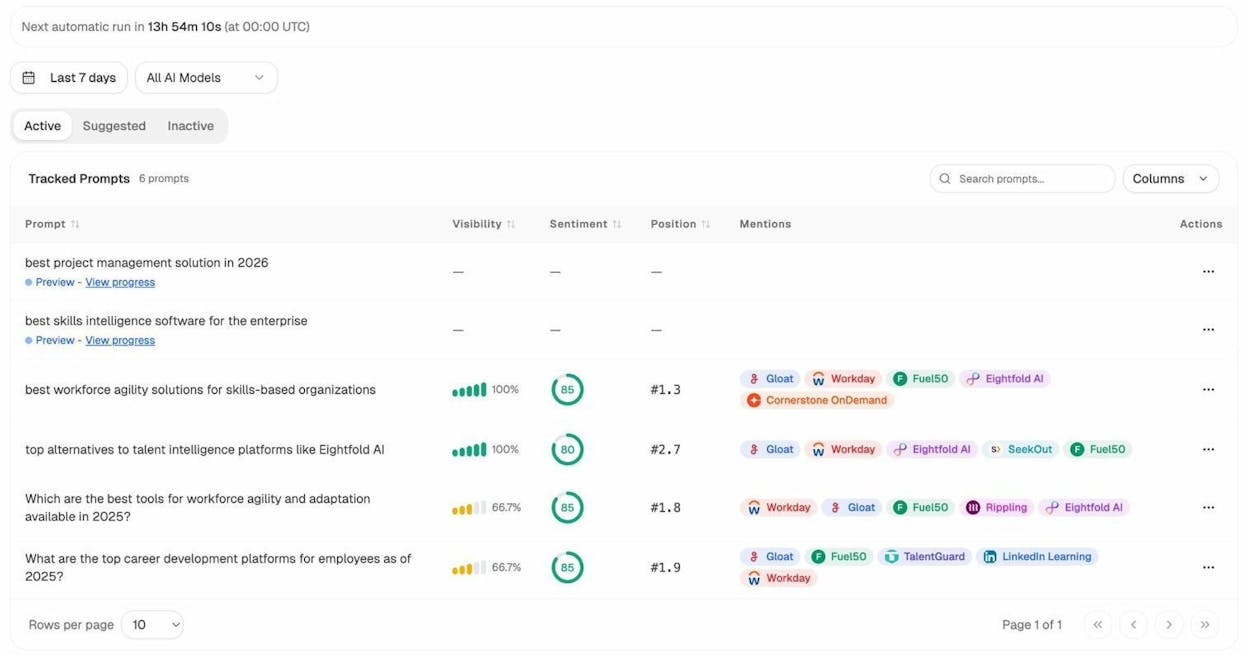
The Analyze AI Prompts dashboard. Each tracked prompt shows your visibility percentage, sentiment score, position, and which competitors are mentioned alongside you. Prompts run automatically on a daily schedule so you can track movement without manual checks.
Step 3: Check the “Suggested” tab in Analyze AI to discover prompts you haven’t thought of yet. The platform analyzes your category and recommends prompts people are likely asking AI assistants—prompts where you could be showing up but aren’t.
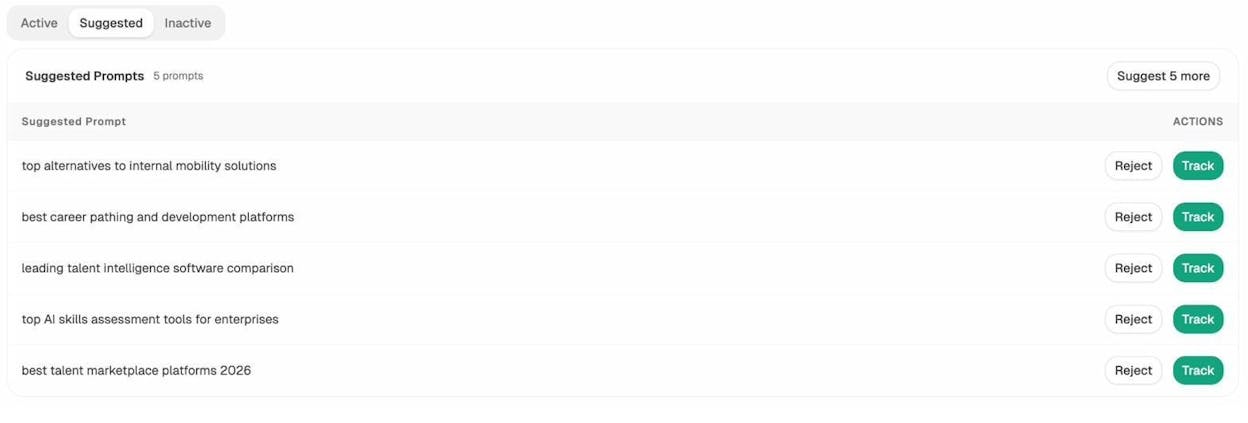
Each suggested prompt can be tracked with one click. This is how you expand your AI search coverage systematically rather than guessing which queries matter.
If your brand or category is showing up in AI answers—or if competitors are showing up and you’re not—that’s a strong signal that SEO-driven content will pay off across both traditional and AI search.
How SEO Fuels Your Visibility in AI Search (And Why It’s Not a Separate Strategy)
There’s a misconception floating around the marketing world that you need a completely separate “GEO” (Generative Engine Optimization) strategy to show up in AI-generated answers. That’s not how it works.
AI models like ChatGPT, Perplexity, and Google’s AI Mode pull their information from the web. When they need accurate, current data to answer a question, they rely on the same signals that drive traditional SEO: content quality, topical authority, structured data, and backlinks. If your content ranks well on Google and Bing, you have a high probability of being cited by AI models too.
That said, SEO alone isn’t quite enough. There are a few additional things worth doing to maximize your AI search visibility:
-
Structure your content for easy extraction. Use clear headings, concise definitions, and structured data. AI models are more likely to cite content that provides a clean, quotable answer to a specific question.
-
Build topical authority. Don’t just publish one article on a topic—build a content cluster. AI models tend to cite sources that demonstrate deep expertise across a topic area.
-
Monitor your AI search performance. You can’t improve what you don’t measure. Track which AI prompts your brand appears in, which competitors show up instead, and which of your pages get cited most.
How to Track and Improve Your AI Search Visibility
This is where most businesses are flying blind. They invest in SEO and assume AI search will follow—but they never check. Here’s a practical workflow:
Step 1: Set up visibility tracking. In Analyze AI, add your brand and your top three to five competitors. Set up the prompts that matter to your business—the questions potential customers ask AI assistants.
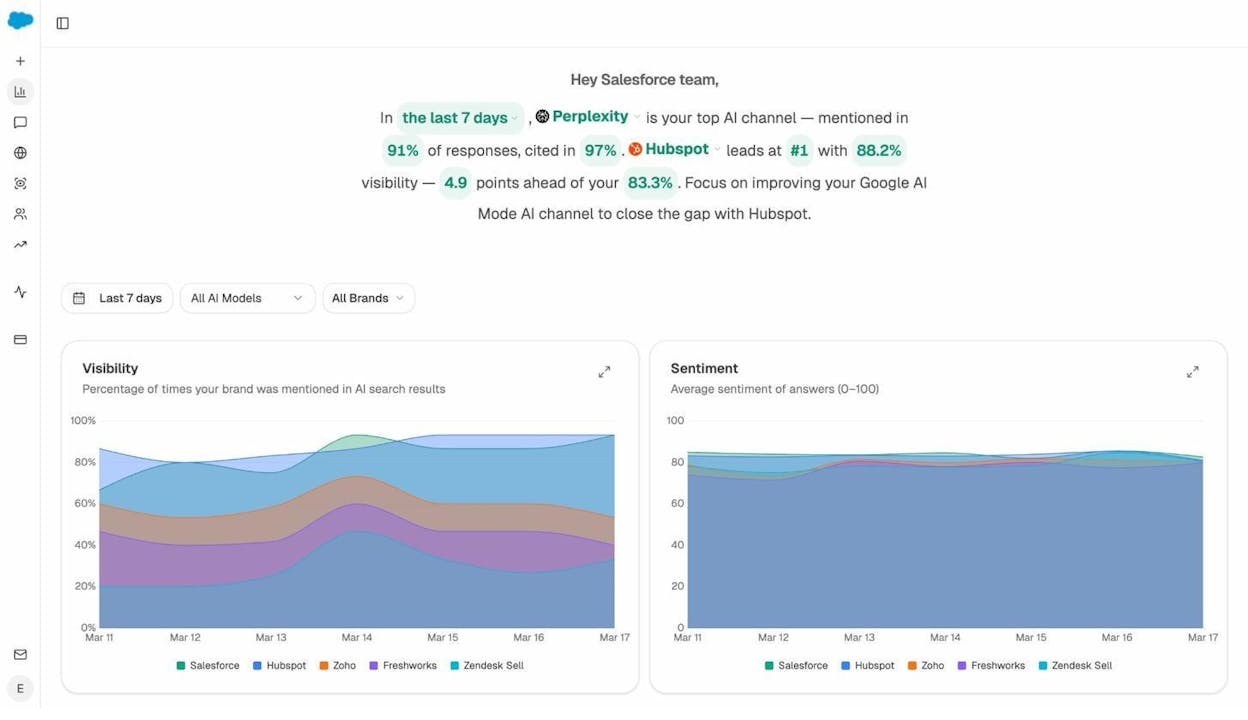
The Overview dashboard gives you an instant read on your AI search position. It tells you which AI engine is your top channel, your overall visibility percentage, who leads your category, and where to focus to close the gap.
Step 2: Identify competitor wins. Use the Competitors view to see which brands appear most often and in which prompts. Analyze AI surfaces “Suggested competitors”—entities that show up frequently in your category that you haven’t started tracking yet.
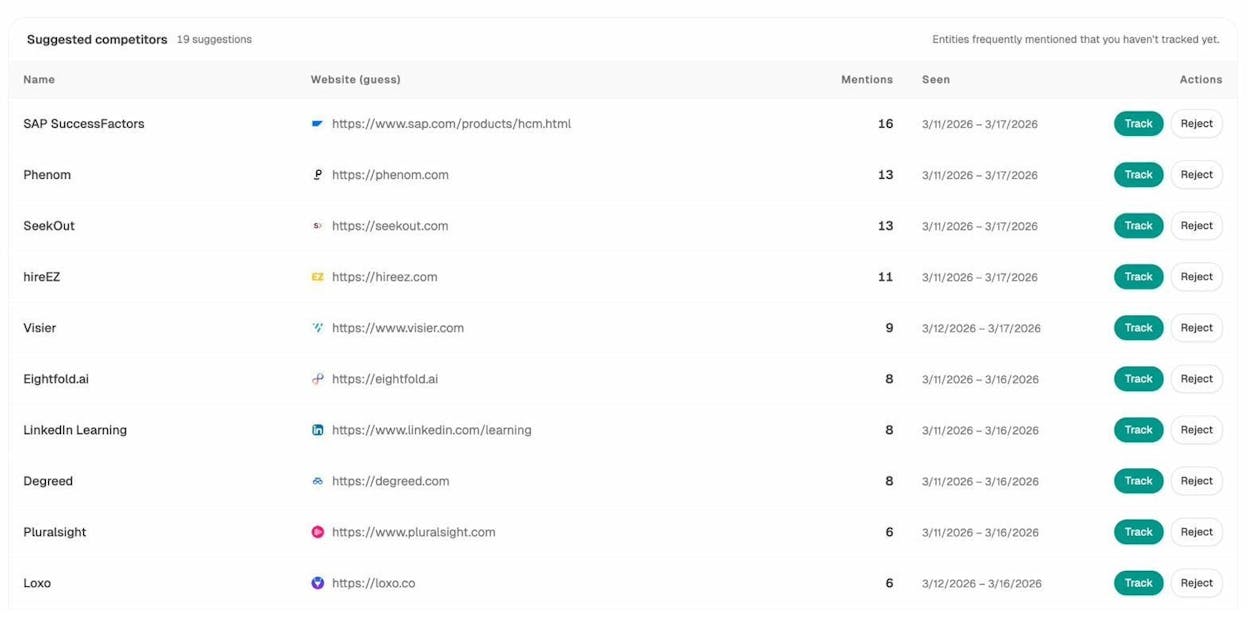
This is how you discover competitors you didn’t know you had in AI search. A brand might not rank for any of your traditional SEO keywords but could dominate the AI responses your customers see.
Step 3: Audit the sources AI cites. Go to the Sources section to see which domains and content types AI models rely on when answering questions in your space. This tells you where to focus your content and link-building efforts.
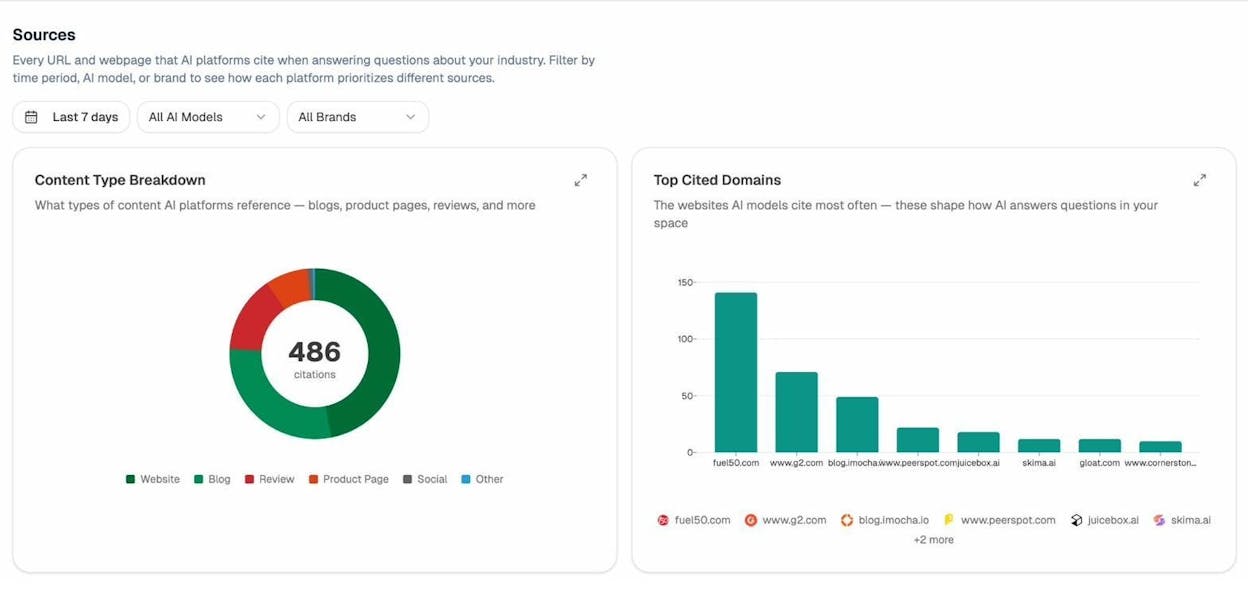
The Sources dashboard shows the types of content AI models prefer to cite (blogs, product pages, reviews, etc.) and the specific domains that get cited most. If a competitor’s blog is a top-cited domain and yours isn’t, you know exactly where the content gap is.
Step 4: Measure real AI-driven traffic. Connect your Google Analytics 4 to Analyze AI and see exactly how many sessions come from AI platforms, which engines drive the most traffic, and which landing pages receive that traffic.
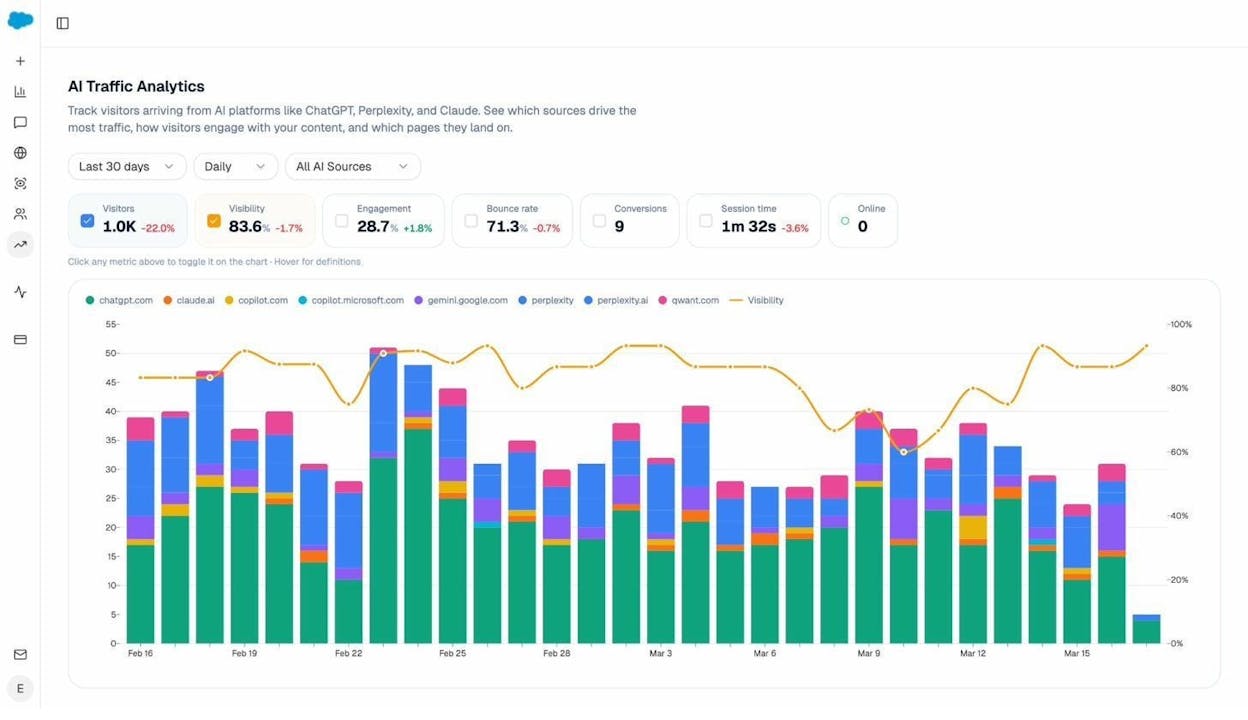
The AI Traffic Analytics dashboard. The stacked bar chart breaks down daily visitors by AI source—ChatGPT, Claude, Copilot, Gemini, Perplexity, and others. The orange line shows your overall visibility trend.
Step 5: Double down on what works. Check the Landing Pages report to see which specific pages receive AI-referred traffic. Look at sessions, citations, engagement, bounce rate, and conversions per page.
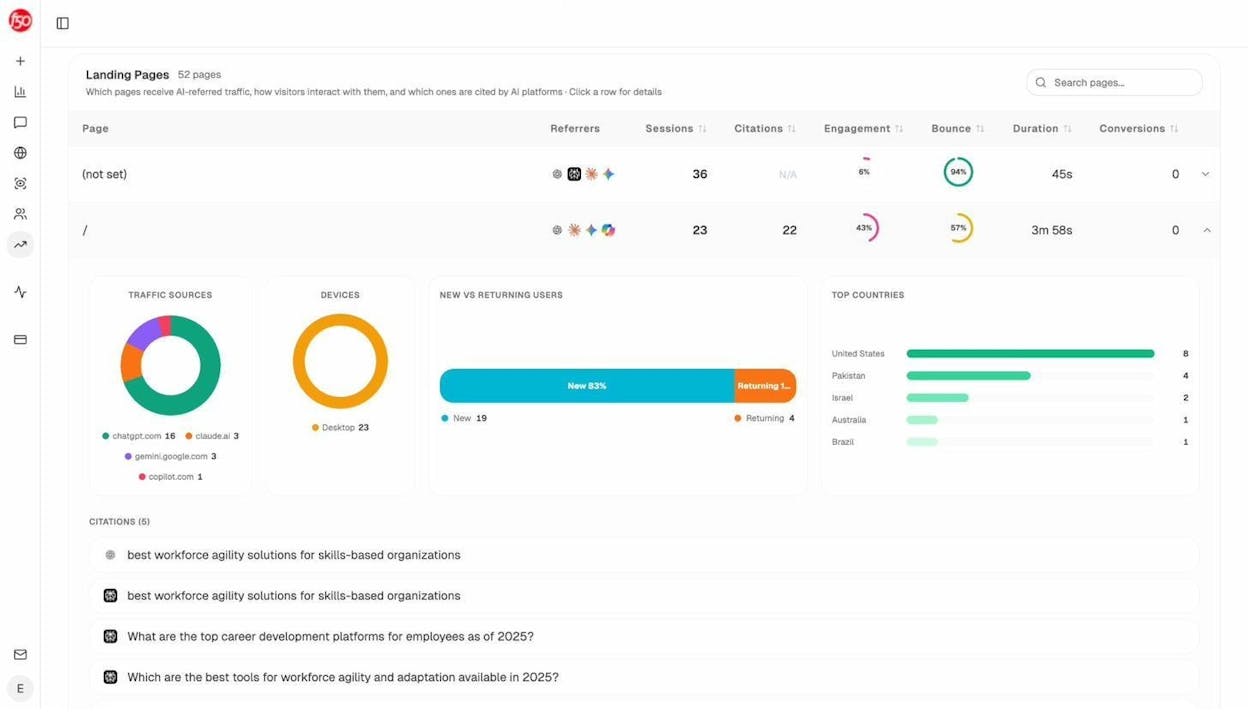
The Landing Pages report tells you exactly which pages AI engines send traffic to. Click into any page to see which AI platforms are the referral sources, how many sessions each drives, and which specific prompts led to the citation.
The point of all this isn’t to treat AI search as a replacement for traditional SEO. It’s not. SEO is not dead—it’s evolving. AI search is a complementary organic channel that multiplies the return on content you’re already creating. When you invest in SEO and track AI search performance together, you get visibility into two channels from one body of work.
When SEO Is NOT Worth It
SEO isn’t a universal solution. There are real situations where your time and money are better spent elsewhere. Being honest about these scenarios can save you months of wasted effort.
You Need Revenue in the Next 30–90 Days
SEO is a long game. Most businesses see meaningful results in three to six months, and real compounding growth takes twelve months or more. If you need revenue now—to make payroll, to fund a launch, to hit a quarterly target—SEO won’t move fast enough.
In these situations, consider paid search (Google Ads, Bing Ads), paid social (Meta, LinkedIn, TikTok ads), or direct outreach. These channels generate results immediately, though they stop the moment you stop paying.
You’re Promoting a Time-Sensitive Offer
If you’re running a flash sale, launching a seasonal campaign, or promoting a one-time event, SEO is the wrong tool. By the time your content ranks, the offer is over. Use paid channels, email marketing, or social media instead.
Your Audience Doesn’t Use Search Engines (Yet)
Some audiences—particularly younger demographics heavily active on TikTok, Instagram, or YouTube—discover products through platforms, not search engines. That said, SEO works on platforms beyond Google (you can optimize for YouTube, Amazon, and even Bing). And AI search is becoming a discovery channel for younger audiences who increasingly ask ChatGPT and Perplexity instead of searching Google.
Your Category Has No Search Demand—In Any Form
If you’ve worked through questions one, two, and three above and found no search volume, no problem-based queries, and no AI search activity in your category, SEO isn’t the right starting point. You need to build awareness first through channels like social-first content marketing, PR, community building, or influencer partnerships. Once people start searching for your category, SEO becomes worth it.
|
Situation |
Better Channel |
Why |
|
Need revenue in 30–90 days |
Paid ads, outreach |
SEO takes 3–6+ months |
|
Time-sensitive promotion |
Email, paid social |
SEO can’t rank fast enough |
|
Audience on TikTok/Instagram |
Social content, influencer marketing |
Audience discovery happens on-platform |
|
Zero search demand in any form |
PR, community, events |
Must build category awareness first |
|
Extreme competitor dominance |
Niche long-tail SEO + AI search |
Target underserved queries competitors miss |
How Long Does SEO Take to Show Results?
Based on industry surveys and data, here’s a realistic timeline:
Months 1–3: Foundation. This is setup time—auditing your site, fixing technical issues, doing keyword research, and publishing your first content. Expect minimal traffic during this phase. Use Analyze AI’s free broken link checker to find and fix broken links quickly during this stage.
Months 3–6: Early traction. Pages start indexing and ranking for lower-competition terms. You’ll see small but growing traffic from long-tail keywords. If you’ve set up AI search tracking with Analyze AI, you may also notice your content starting to appear in AI-generated answers.
Months 6–12: Real growth. Traffic accelerates. Your best content reaches page one for target keywords. You start seeing leads and sales from organic traffic. AI search citations increase as your topical authority builds.
12+ months: Compounding returns. Older content keeps generating traffic. New content ranks faster because your domain has built authority. Your cost per acquisition from organic channels drops steadily. AI search becomes a measurable second revenue stream.
What affects your timeline:
-
Domain age and authority. New sites take longer. Use the Analyze AI website authority checker to benchmark where you stand.
-
Competition level. Broad, high-volume keywords are slow. Niche, specific keywords are faster. Target the latter first.
-
Resource investment. More content, better content, and consistent publishing accelerate results.
-
Technical health. A site with crawl errors, slow load times, and broken links will rank slower regardless of content quality.
How Much Does SEO Actually Cost?
The cost of SEO depends on which path you take. Here’s a realistic breakdown:
Option 1: Hire an Agency or Consultant
This is the most expensive option. SEO agencies typically charge $99–$171 per hour, or $1,000–$10,000+ per month on retainer. Consultants range from $100–$300 per hour. The upside: you don’t have to learn SEO yourself, and you get experienced people who can execute quickly.
Option 2: Build a Team or Hire Freelancers
Moderate cost. SEO freelancers average $71.59 per hour. An in-house SEO specialist costs roughly $71,000 per year in the U.S. You need enough SEO knowledge to hire well and manage the work effectively.
Option 3: Do It Yourself
The cheapest option in money, the most expensive in time. You’ll need to learn SEO fundamentals, and the learning curve is real. But the advantage is complete control and no recurring costs beyond your tools.
A Hybrid Approach Often Works Best
Hire an agency or freelancer for the first three to six months to do the heavy lifting—site audit, keyword strategy, initial content. Once you see results and understand what’s working, transition to in-house management or DIY. This gives you the speed of expert execution with the cost efficiency of doing it yourself long-term.
For your SEO tools, many essential capabilities are available for free. Analyze AI offers a suite of free SEO and keyword tools including a keyword rank checker, keyword difficulty checker, SERP checker, website traffic checker, and website authority checker. You don’t need an expensive toolstack to get started.
|
Approach |
Monthly Cost |
Time to Value |
Best For |
|
Agency/Consultant |
$1,000–$10,000+ |
Fastest (1–3 months) |
Businesses with budget, no SEO expertise |
|
In-house team or freelancers |
$3,000–$8,000 |
Moderate (2–4 months) |
Growing companies with some SEO knowledge |
|
DIY |
$0–$200 (tools only) |
Slowest (3–6+ months) |
Bootstrapped startups, solo founders |
|
Hybrid (agency → in-house) |
Varies |
Fast start, efficient long-term |
Most mid-sized businesses |
How to Measure Whether Your SEO Investment Is Paying Off
You’ve decided SEO is worth it. You’ve invested time and money. How do you know it’s actually working?
Track These Core Metrics
Organic traffic growth. Use Google Search Console and Google Analytics to measure monthly organic sessions. Are they trending up? Use the Analyze AI keyword rank checker to see whether your target keywords are climbing in rankings.
![[Screenshot: Google Search Console performance report showing clicks, impressions, CTR, and position over time for organic search.]](https://www.datocms-assets.com/164164/1781602389-blobid13.png?auto=format,compress&w=1248&fit=max)
Keyword rankings. Track your target keywords weekly. Focus on position changes for your most important commercial and problem-based keywords. Our guide on how to find which keywords your site ranks for covers this in detail.
Conversions from organic traffic. Traffic without conversions is vanity. Set up goals in Google Analytics to track form submissions, signups, purchases, or whatever action matters to your business. Measure conversion rate from organic traffic specifically—not blended across all channels.
AI search traffic (the metric most teams miss). Connect your GA4 to Analyze AI to measure sessions from AI platforms. This is a growing channel that most businesses aren’t tracking at all, which means they’re underreporting the true ROI of their SEO work.
Customer acquisition cost (CAC) from organic. Calculate your total SEO spend (tools, team, content, agency fees) divided by the number of customers acquired from organic traffic. Compare this to your CAC from paid ads. In most cases, SEO’s CAC drops over time while paid CAC increases.
A Simple ROI Calculation
Here’s a back-of-the-napkin framework to estimate SEO ROI:
Monthly SEO investment: $3,000 (tools + content + partial team time)
Monthly organic traffic after 12 months: 10,000 sessions
Conversion rate from organic: 2%
Monthly conversions from organic: 200
Average customer value: $500
Monthly revenue attributable to SEO: $100,000
Monthly ROI: ($100,000 - $3,000) / $3,000 = 3,233%
These numbers are illustrative, but the math holds directionally for most businesses. SEO’s ROI improves over time because traffic compounds while your investment stays relatively flat.
Final Thoughts
SEO remains one of the highest-ROI marketing channels available. Even with AI Overviews, zero-click searches, and millions of people turning to AI assistants for answers, SEO continues to deliver precise, intent-driven traffic at a cost that decreases over time.
The key insight most marketers miss: SEO isn’t just about Google anymore. The same content quality, topical authority, and technical fundamentals that drive Google rankings also determine whether AI models cite your brand. When you invest in SEO, you’re investing in visibility across both traditional and AI search—two channels from one body of work.
But SEO isn’t right for every situation. Use the flowchart at the top of this article to make the call. If people are searching for what you sell, for problems you solve, or asking AI assistants about your category, the answer is clear: SEO is worth it.
If the answer to all three questions is no, invest in building category awareness through other channels first. Then come back to SEO once demand exists.
Ready to start? Here’s your next-step checklist:
-
Run your core keywords through the Analyze AI keyword generator to assess search demand.
-
Check your domain’s current authority with the website authority checker.
-
Audit your site for technical issues using the broken link checker and a site audit tool.
-
Build a keyword strategy focused on problems your business solves.
-
Set up AI search tracking in Analyze AI to measure the second layer of ROI most teams are missing.
The businesses that win in 2026 and beyond won’t choose between SEO and AI search. They’ll do both—because they’re the same work with double the payoff.

Ernest

Ibrahim