
Sources & citations
Source authority & risk
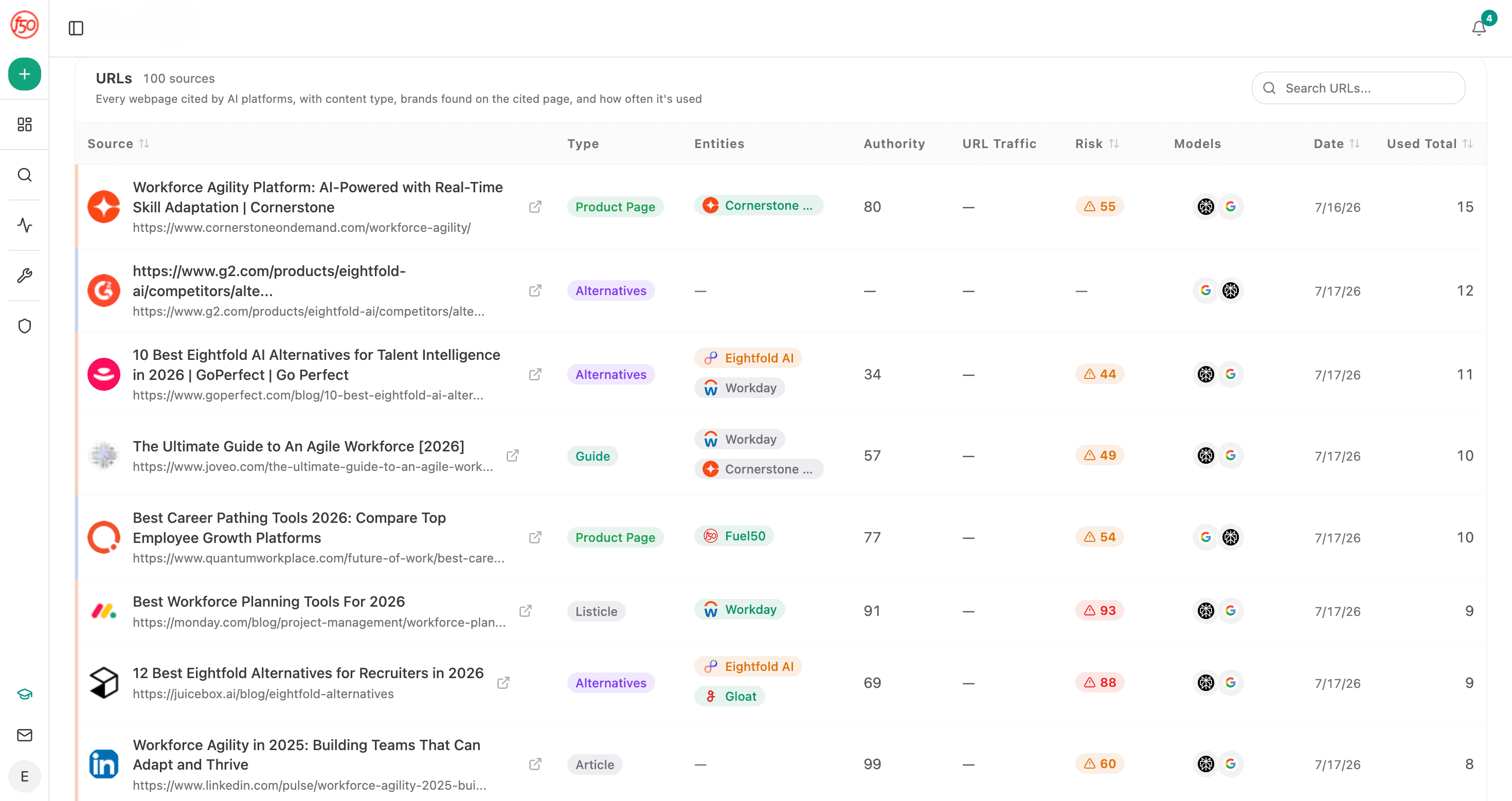
Every cited source gets two scores — authority, for how much weight it carries, and Analyze AI's own Risk Score, which measures how much competitive threat the page represents.
Two numbers per source
Every URL in your citation data carries two assessments, visible right in the sources table:
- Authority score (0–100) — how much weight the source carries: domain strength plus the page's organic traffic and keyword footprint. High-authority pages are the ones whose mentions actually move AI answers.
- Risk Score (0–100) — Analyze AI's own metric, and it means something specific: how much competitive threat this source represents to you. Not spam detection, not content quality — threat.
How the Risk Score works
The score blends five signals: the page's authority and traffic, its citation impact (how many engines cite it, how often), its competitive stance (how many of your competitors are framed positively on it), your coverage gap (whether you're absent or weakly framed while rivals shine), and recency (whether its citations are accelerating). Exact weights are in the metrics reference.
Bands: below 35 low · 35–64 medium · 65+ high.
A high-risk source is a powerful page that AI engines trust, that presents your competitors well, where you barely exist — and that's gaining momentum. In other words: the page most likely to cost you recommendations this quarter.
Reading the two scores together
| Pattern | What it means | The move |
|---|---|---|
| High authority, high risk | A trusted page actively powering competitors | Top priority: earn a mention, or publish the piece that answers it |
| High authority, low risk | A trusted page where you're already fine | Maintain; cite it in your own content where relevant |
| Low authority, high risk | A weak page punching above its weight on recency | Watch — momentum sometimes precedes authority |
| Low authority, low risk | Background noise | Ignore |
The workflow
Sort the sources table by Risk
The top of that list is your competitive to-do list, already prioritized — no spreadsheet required.
Open the entity detail before acting
The entity layer shows exactly who's on the page, the quoted snippets, and how each brand is framed — so you know whether you're pitching an addition, a correction, or writing a counter-piece.
Pick the lever
Listicles and comparisons: outreach for inclusion. Competitor-owned pages: counter with your own content targeting the same prompts. Rising-momentum pages: track the prompts they're winning and watch the trend.
You can run this conversationally too — the MCP server exposes source evaluation, so "is this URL worth chasing a mention on?" gets a verdict with reasons, straight from the same scores.