
Perception
What Perception is
Perception measures the story AI tells about every brand in your space — how strongly each one is framed, which themes each one owns, and what to do about yours.
Beyond counting mentions
Visibility tells you how often AI mentions your brand. Perception answers the harder question: what story does AI tell when it does? Two brands can both appear in 80% of answers while one is framed as the category leader and the other as the budget fallback — same visibility, completely different outcomes.
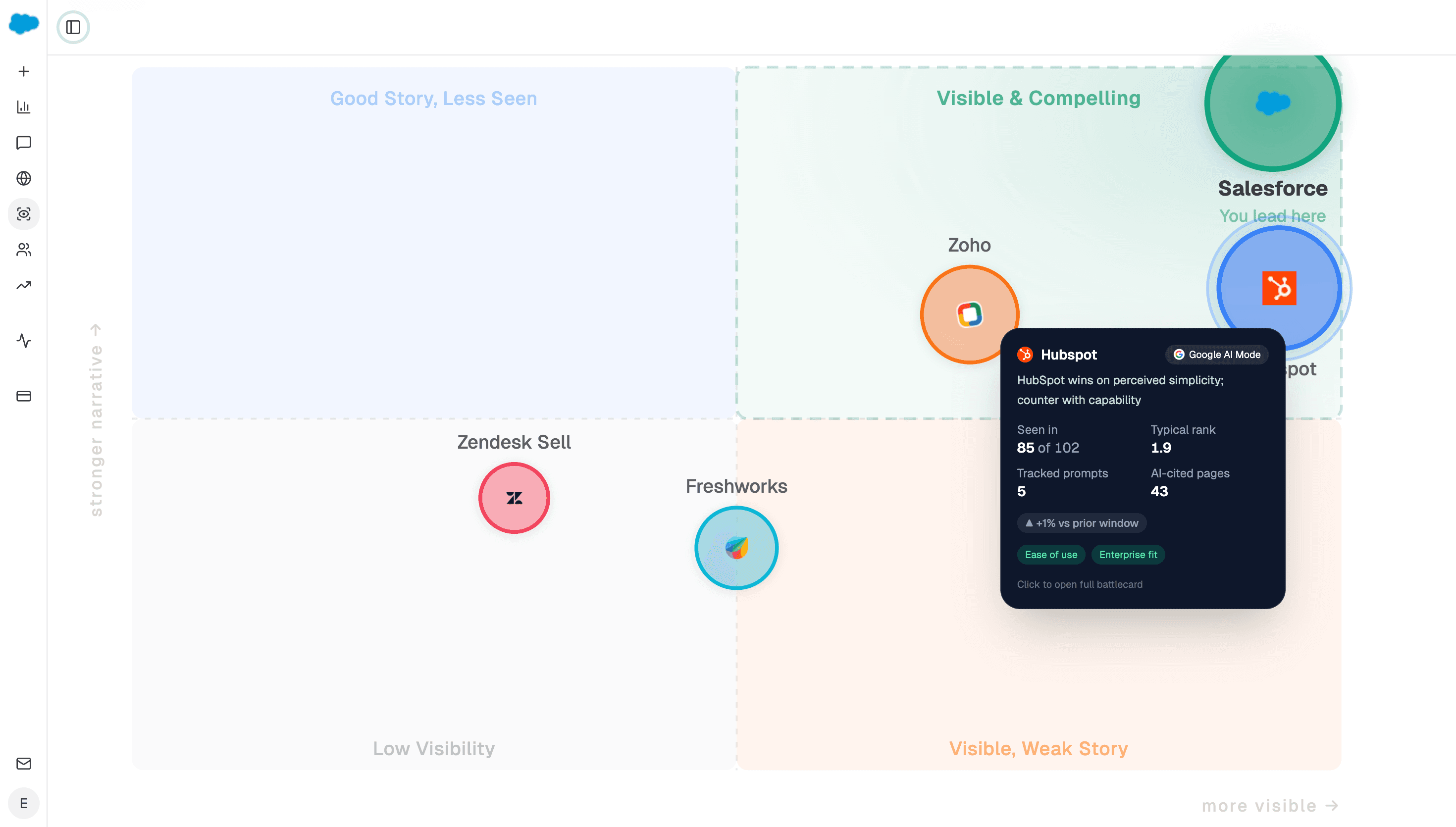
Analyze AI reads every answer across the engines and scores each brand on two axes: how visible it is, and how strong its narrative is — how positively, specifically, and consistently AI describes it.
What you get
- The quadrant map — every tracked brand positioned by visibility × narrative strength, across four zones: Visible & Compelling, Good Story, Less Seen, Visible, Weak Story, and Low Visibility. Hover any brand for its numbers; click through to the full battlecard. See reading the quadrant.
- Narrative themes — the storylines AI attaches to each brand ("ease of use", "enterprise fit"), with how often each appears, its trend, and which engine pushes it hardest.
- Competitor battlecards — a per-competitor deep dive: what AI says about them, how you compare head-to-head, and a concrete counter-play. See battlecards.
- The language itself — the exact phrases AI repeats about each brand, colored by sentiment, so "what's our narrative?" has a literal answer.
How it's computed
Perception is measured from your tracked prompt runs — the same answers that power your visibility metrics, read at a deeper level: which themes each answer touches, how favorably each brand is framed, and which claims recur. Strategy summaries refresh weekly on fixed windows (7, 14, 30, and 90 days), so the narrative reading stays stable enough to act on rather than jumping around with every run.
Make the quadrant part of quarterly positioning reviews, even in calm weeks. The pattern worth catching early is a competitor drifting up the narrative axis: a story gaining strength before it shows up in any visibility number.
Where to go next
- Reading the quadrant & themes
- Competitor battlecards
- Setting up your prompts — perception quality follows prompt quality