
Perception
Reading the quadrant & themes
How to read the Perception quadrant — the four zones, the per-brand hover stats, and the narrative themes with the exact language AI repeats.
The two axes
- More visible → how often the brand appears in AI answers to your tracked prompts.
- Stronger narrative ↑ how strong the brand's story is when it appears: favorable framing, specific claims, consistent themes.
Bubble position is the diagnosis; the four zones are the prescriptions:
| Zone | What it means | The move |
|---|---|---|
| Visible & Compelling | Seen often, framed well — the winning corner | Defend: keep the proof fresh, watch rising challengers |
| Good Story, Less Seen | AI likes you but rarely thinks of you | Distribution problem: win more citations on high-authority sources |
| Visible, Weak Story | Mentioned a lot, framed poorly or generically | Narrative problem: publish proof and sharpen positioning |
| Low Visibility | Barely on AI's radar | Foundation problem: prompt coverage, citations, presence |
Hover any brand for the numbers
The hover card gives you each brand's window in one glance: seen in X of Y answers, typical rank, tracked prompts, AI-cited pages, the trend vs the prior window, and its top themes — plus the engine where it's currently strongest. Click through for the full battlecard.
Themes: the storylines behind the position
Each brand's narrative decomposes into themes — the recurring storylines AI attaches to it. For every theme you get how many relevant answers it appeared in, whether it's rising or fading, how it's framed, which engine pushes it hardest, and how many cited pages support it.
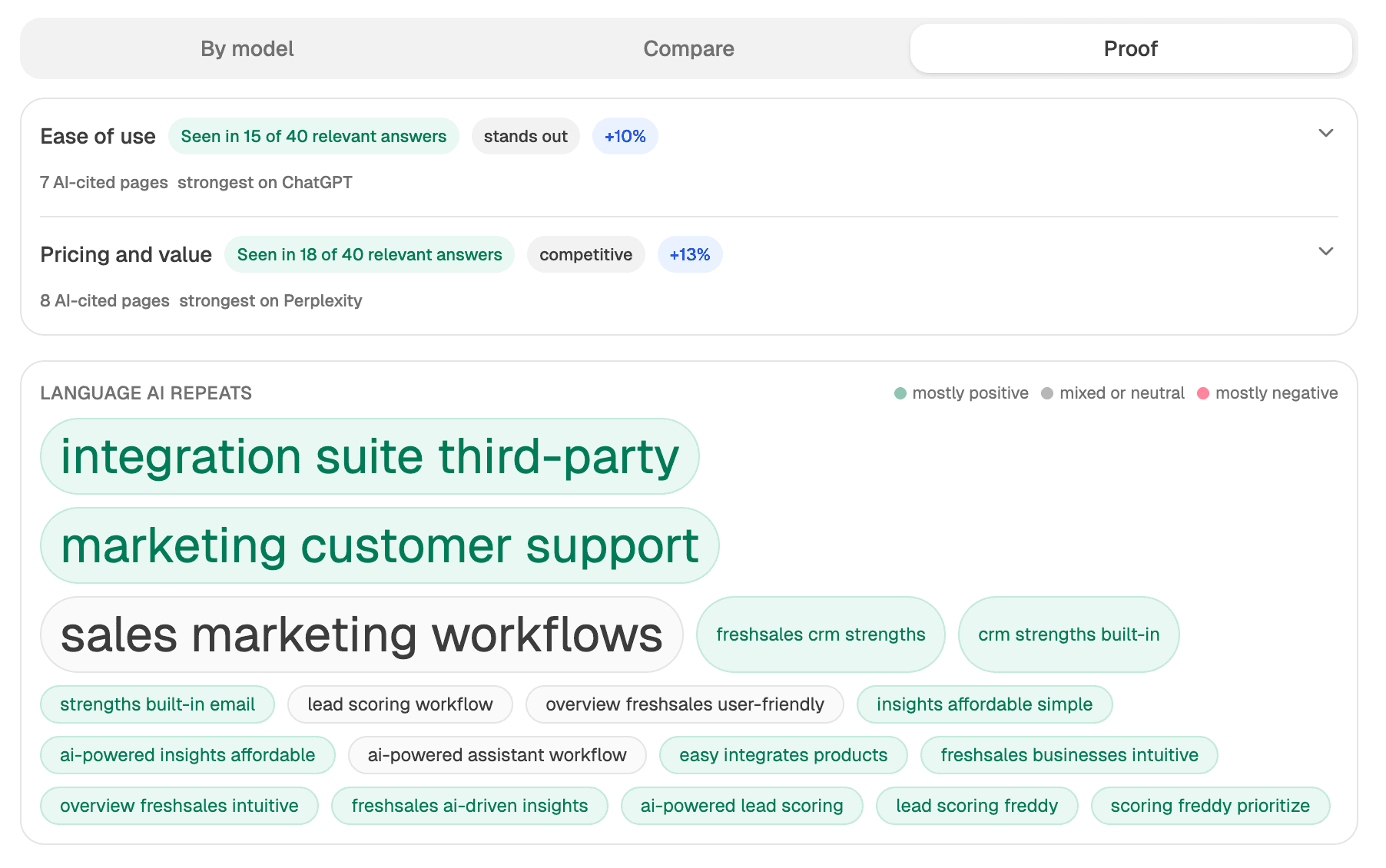
The Language AI Repeats cloud is the ground truth under everything: the actual phrases the engines keep using, sized by frequency and colored by sentiment. If your differentiator is missing from that cloud, AI hasn't absorbed it yet, and you know exactly what your next piece of content has to teach it.
How to work the quadrant
Start with your bubble's zone
The zone names the problem class: distribution, narrative, or foundation. That decides which lever to pull first.
Check movement as well as position
Hover for the trend vs the prior window. A stable position is a baseline; a moving one is a story — especially a competitor climbing the narrative axis.
Read your themes
Are the themes you want to own actually appearing? Is anything negative trending up? The theme trends are usually where a quadrant move announces itself first.
Confirm in the language cloud
Before writing any positioning content, check the exact phrases AI uses today. The gap between your messaging and that cloud is your work list.
Narrative strength moves slower than visibility — it's built from consistent framing across many answers. Expect visibility plays to show in days and narrative plays in weeks.